You can not live at all if you do not learn to adapt yourself to your life as it happens to be.
Eleanor Roosevelt (1884–1962) American politician, diplomat, activist; First Lady of the US (1933–45)
Memoir (1949), This I Remember, ch. 20 “The Last Term: 1944–1945”
(Source)
This passage was not included in her compiled Autobiography (1961).
Quotations about:
adaptation
Note not all quotations have been tagged, so Search may find additional quotes on this topic.

Not being able to control events, I control myself, and adapt myself to them if they do not adapt themselves to me.
[Ne pouvant regler les evenemens, je me regle moy-mesme : & m’applique à eux, s’ils ne s’appliquent à moy.]
Michel de Montaigne (1533–1592) French essayist
Essays, Book 2, ch. 17 (2.17), “Of Presumption [De la Presomption]” (1578) [tr. Cohen (1958)]
(Source)
This essay appeared in the 1st (1580) edition, and was expanded in succeeding editions. This passage was added in the 2nd (1588) edition.
(Source (French)). Other translations:Being unable to direct events, I governe my selfe; and if they apply not themselves to me, I apply my selfe to them.
[tr. Florio (1603)]Not being to govern events I govern myself, and apply myself to them, if they do not apply themselves to me.
[tr. Cotton (1686)]Not being able to govern events, I govern myself, and apply myself to them, if they will not apply themselves to me.
[tr. Cotton/Hazlitt (1877)]Being unable to regulate events, I regulate myself, and adapt myself to them if they do not adapt themselves to me.
[tr. Ives (1925)]Not being able to rule events, I rule myself, and adapt myself to them if they do not adapt themselves to me.
[tr. Frame (1943)]Not being able to control events I control myself: if they will not adapt to me then I adapt to them.
[tr. Screech (1987)]Since I cannot control events, I take control of myself and suit myself to them, if they do not suit me.
[tr. Atkinson/Sices (2012)]

THE DOCTOR: Well, what’s the use of a good quotation if you can’t change it?
Doctor Who (1963–1989) British science fiction television series, original run (BBC)
22×07 “The Two Doctors,” Part 1 (1985-02-16) [w. Robert Holmes]
(Source)
(Source (Video)). Given after Peri notes a quotation the Doctor just attributed to Rassilon was actually Samuel Johnson. This line is from the Sixth Doctor (the Second Doctor being the other Doctor in the episode).

The Utopia of a modern dreamer must needs differ in one fundamental aspect from the Nowheres and Utopias men planned before Darwin quickened the thought of the world. Those were all perfect and static States, a balance of happiness won for ever against the forces of unrest and disorder that inhere in things. […] But the Modern Utopia must be not static but kinetic, must shape not as a permanent state but as a hopeful stage, leading to a long ascent of stages. Nowadays we do not resist and overcome the great stream of things, but rather float upon it. We build now not citadels, but ships of state.
H. G. Wells (1866–1946) British writer [Herbert George Wells]
A Modern Utopia, ch. 1, § 1 (1905)
(Source)
The one thing that unifies men in a given age is not their individual philosophies but the dominant problem that these philosophies are designed to solve.
Jacques Barzun (1907–2012) French-American historian, educator, polymath
Romanticism and the Modern Ego, ch. 1 (1943)
(Source)
Let not these things thy least concern engage;
For though thou fret, they will not mind thy rage.
Him only good and happy we may call
Who rightly useth what doth him befall.
[τοῖς πράγμασιν γὰρ οὐχὶ θυμοῦσθαι χρεών:
μέλει γὰρ αὐτοῖς οὐδέν: ἀλλ᾽ οὑντυγχάνων
τὰ πράγματ᾽ ὀρθῶς ἂν τιθῇ, πράσσει καλῶς]Euripides (485?-406? BC) Greek tragic dramatist
Bellerophon [Βελλεροφῶν], frag. 287 (TGF) (c. 430 BC) [Morgan (1718)]
(Source)
Quoted in Plutarch, "De Tranquilitate Animi [On the Contentedness of the Mind]," sec. 4. (467a). Nauck frag. 287, Barnes frag. 132, Musgrave frag. 24.
(Source (Greek)). Other translations:Nor ought we to be angry at Events;
For they our anger heed not: but the man
Who best to each emergency adapts
His conduct, will assuredly act right.
[tr. Wodhull (1809)]Events will take their course, it is no good
Our being angry at them; he is happiest
Who wisely turns them to the best account.
[tr. Shilleto (1888), frag. 298]It does no good to rage at circumstance;
Events will take their course with no regard
For us. but he who makes the best of those
Events he lights upon will not fare ill.
[tr. Helmbold (1939)]There is no point in getting angry at circumstances. They are uncaring, utterly unconcerned.
But a man who responds to them in the right way, he fares well.
[tr. Stevens (2012)]One should not get angry with affairs, for they show no concern; but if a man handles affairs correctly as he encounters them, he fares well.
[tr. Collard, Hargreaves, Cropp (1995)]
When life hands you lemons, make whiskey sours.
W. C. Fields (1880–1946) American entertainer [b. William Claude Dukenfield]
(Attributed)
While attributed to Fields, possibly on a radio show, there is no documentation to indicate he ever actually said it.
More exploration of other references: The Big Apple: “When life gives you lemons, make a whiskey sour. For God’s sake, we’re adults now, people”.
Adapt or perish, now as ever, is Nature’s inexorable imperative.
H. G. Wells (1866–1946) British writer [Herbert George Wells]
Mind at the End of Its Tether, ch. 4 “Recent Realizations of the Nature of Life” (1945)
(Source)
The only way to make sense out of change is to plunge into it, move with it, and join the dance.
Alan Watts (1915–1973) Anglo-American philosopher, writer
The Wisdom of Insecurity: A Message for an Age of Anxiety, ch. 3 (1951)
(Source)
The values to which people cling most stubbornly under inappropriate conditions are those values that were previously the source of their greatest triumphs.
Jared Diamond (b. 1937) American geographer, historian, ornithologist, author
Collapse: How Societies Choose to Fail or Succeed, ch. 8 (2005)
(Source)

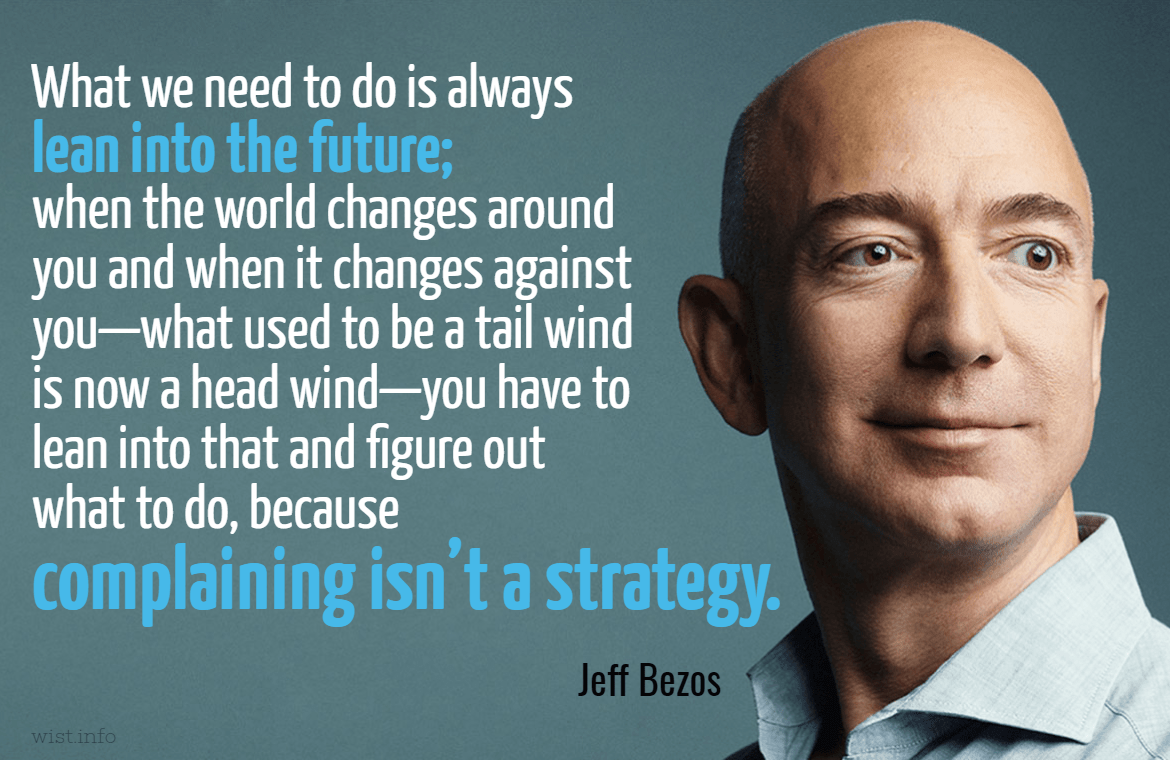
What we need to do is always lean into the future; when the world changes around you and when it changes against you — what used to be a tail wind is now a head wind — you have to lean into that and figure out what to do, because complaining isn’t a strategy.
Jeff Bezos (b. 1964) American business magnate, entrepreneur, investor
Interview, ABC News (25 Sep 2013)
(Source)

I often say that research is a way of finding out what you are going to do when you can’t keep on doing what you are doing now.
Charles F. Kettering (1876–1958) American inventor, engineer, researcher, businessman
“Industrial Prospecting,” Speech, Founder Societies of Engineers (20 May 1935)
The reasonable man adapts himself to the world: the unreasonable one persists in trying to adapt the world to himself. Therefore all progress depends on the unreasonable man.
George Bernard Shaw (1856–1950) Irish playwright and critic
Man and Superman, “Maxims for Revolutionists,” “Reason” (1903)
(Source)