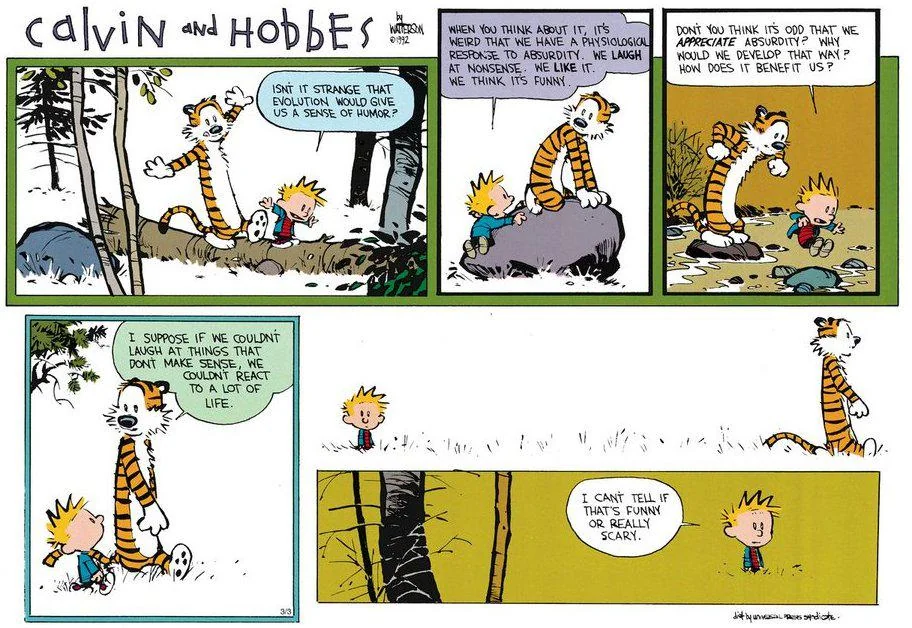
CALVIN: Isn’t it strange that evolution would give us a sense of humor? When you think about it, it’s weird that we have a physiological response to absurdity. We laugh at nonsense. We like it. We think it’s funny. Don’t you think it’s odd that we appreciate absurdity? Why would we develop that way? How does it benefit us?
HOBBES: I suppose if we couldn’t laugh at things that don’t make sense, we couldn’t react to a lot of life.
CALVIN: (after a pause) I can’t tell if that’s funny or really scary.
Quotations about:
incomprehensibility
Note not all quotations have been tagged, so Search may find additional quotes on this topic.

There are two things that I don’t care how smart you are, you will never understand. One is an alienist’s [psychiatrist’s] testimony, and the other is a railroad time table.
Will Rogers (1879–1935) American humorist
Column (1924-08-24), “Weekly Article: About Peggy, the Prince, Candidates, and Coolidge” [No. 89]
(Source)
CASSIUS: Did Cicero say anything?
CASCA: Ay, he spoke Greek.
CASSIUS: To what effect?
CASCA Nay, an I tell you that, I’ll ne’er look you i’ th’ face again. But those that understood him smiled at one another and shook their heads. But for mine own part, it was Greek to me.
William Shakespeare (1564–1616) English dramatist and poet
Julius Caesar, Act 1, sc. 2, l. 289ff (1.2.289-295) (1599)
(Source)
Not origin, but likely popularizer of the phrase, "It's Greek to me." Similar phrases had been around since Roman days, and through the Medieval period. Many languages/cultures have similar idioms.

We can see nothing face to face; our utmost seeing is but a fumbling of blind finger-ends in an overcrowded pocket.
Samuel Butler (1835–1902) English novelist, satirist, scholar
Ramblings In Cheapside (1890)
To know God better is only to realize how impossible it is that we should ever know him at all. I know not which is more childish, to deny him, or define him.
Samuel Butler (1835–1902) English novelist, satirist, scholar
The Note-Books of Samuel Butler (1912)
The most beautiful experience we can have is the mysterious. It is the fundamental emotion that stands at the cradle of true art and true science. Whoever does not know it and can no longer wonder, no longer marvel, is as good as dead, and his eyes are dimmed. It was the experience of mystery — even if mixed with fear — that engendered religion. A knowledge of the existence of something we cannot penetrate, our perceptions of the profoundest reason and the most radiant beauty, which only in their most primitive forms are accessible to our minds: it is this knowledge and this emotion that constitute true religiosity. In this sense, and only this sense, I am a deeply religious man.
Albert Einstein (1879–1955) German-American physicist
The World As I See It, Title Essay (1931) (1949)
(Source)
The essay is also known as "Mein Weltbild" or "My Worldview." Alternate translation: "The fairest thing we can experience is the mysterious. It is the fundamental emotion which stands at the cradle of true art and true science. He who knows it not and can no longer wonder, no longer feel amazement, is as good as dead, a snuffed-out candle. It was the experience of mystery -- even if mixed with fear -- that engendered religion. A knowledge of the existence of something we cannot penetrate, of the manifestations of the profoundest reason and the most radiant beauty, which are only accessible to our reason in their most elementary forms -- it is this knowledge and this emotion that constitute the truly religious attitude; in this sense, and in this alone, I am a deeply religious man."
What, has God put into our hands the keys and most secret springs of his power? Is he obliged not to exceed the limits of our knowledge?
[Quoy, Dieu nous a-il mis en main les clefs & les derniers ressorts de sa puissance? S’est-il obligé à n’outrepasser les bornes de nostre science?]
Michel de Montaigne (1533–1592) French essayist
Essays, Book 2, ch. 12 (2.12), “Apology for Raymond Sebond [Apologie de Raimond de Sebonde]” (1573) [tr. Cotton (1686)]
(Source)
This essay appeared in the 1st edition (1580) of the Essays, and was expanded in each subsequent edition. This text was in the original.
The same translation is given in Cotton/Hazlitt (1877).
(Source (French)). Other translations:What? Hath God delivered into our handes the keyes, and the strongest wardes of his infinite puissance? Hath hee obliged him-selfe not to exceede the boundes of our knowledge?
[tr. Florio (1603)]What! has God given us knowledge of the keys and the uttermost extent of his power? has he bound himself not to go beyond the limits of our understanding?
[tr. Ives (1925)]What! has God put into our hands the keys and most secret springs of His power? Has He bound Himself not to trespass beyond the limits of our knowledge?
[tr. Zeitlin (1934)]What! Has God placed in our hands the keys and ultimate springs of his power? Has he pledged himself not to overstep the bounds of our knowledge?
[tr. Frame (1943)]What! Has God placed in our hands the keys to the ultimate principles of his power? Did he bind himself not to venture beyond the limits of human knowledge?
[tr. Screech (1987)]

TRINITY, n. […] The Trinity is one of the most sublime mysteries of our holy religion. In rejecting it because it is incomprehensible, Unitarians betray their inadequate sense of theological fundamentals. In religion we believe only what we do not understand, except in the instance of an intelligible doctrine that contradicts an incomprehensible one. In that case we believe the former as a part of the latter.
Ambrose Bierce (1842–1914?) American writer and journalist
“Trinity,” The Devil’s Dictionary (1911)
(Source)
Originally published in The Devil's Dictionary [A-Z] as Vol. 7 of his Collected Works.