

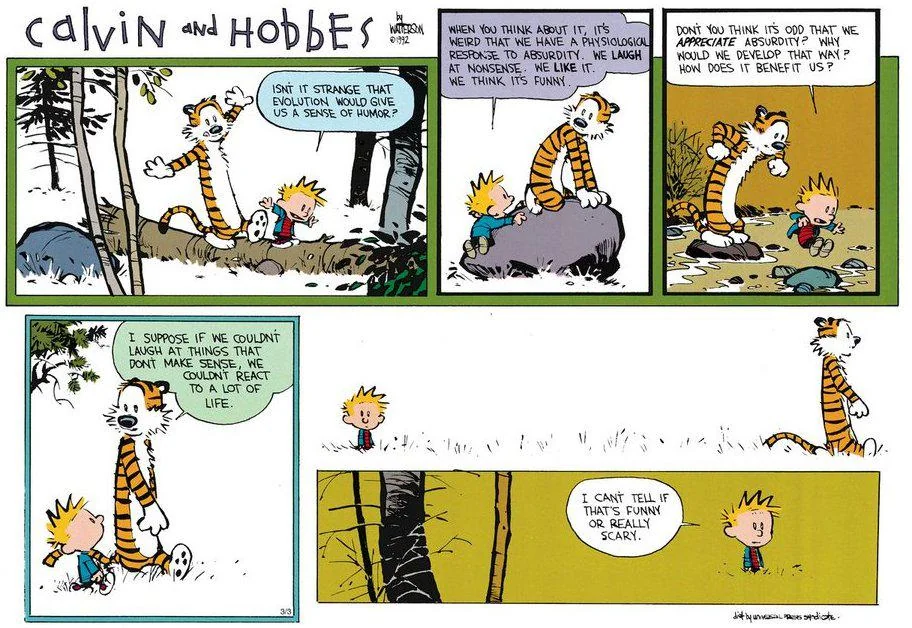
CALVIN: Isn’t it strange that evolution would give us a sense of humor? When you think about it, it’s weird that we have a physiological response to absurdity. We laugh at nonsense. We like it. We think it’s funny. Don’t you think it’s odd that we appreciate absurdity? Why would we develop that way? How does it benefit us?
HOBBES: I suppose if we couldn’t laugh at things that don’t make sense, we couldn’t react to a lot of life.
CALVIN: (after a pause) I can’t tell if that’s funny or really scary.
Quotations about:
nonsense
Note not all quotations have been tagged, so Search may find additional quotes on this topic.

“Second to the right, and straight on till morning.”
That, Peter had told Wendy, was the way to the Neverland; but even birds, carrying maps and consulting them at windy corners, could not have sighted it with these instructions. Peter, you see, just said anything that came into his head.

Lorem ipsum dolor sit amet, consectetur adipisicing elit, sed do eiusmod tempor incididunt ut labore et dolore magna aliqua. Ut enim ad minim veniam, quis nostrud exercitation ullamco laboris nisi ut aliquip ex ea commodo consequat. Duis aute irure dolor in reprehenderit in voluptate velit esse cillum dolore eu fugiat nulla pariatur. Excepteur sint occaecat cupidatat non proident, sunt in culpa qui officia deserunt mollit anim id est laborum.
(Other Authors and Sources)
“Lorem Ipsum” (c. 1960)
Pseudo-Latin text used for typography and layout demonstrations. It's modern origin is unknown.
The text itself is chopped up from Cicero's De Finibus Bonorum et Malorum, sec. 1.10.32-33. The first two words are a truncation of dolorem ipsum ("pain itself").
More information about this here: Lorem ipsum - Wikipedia.

Any bit of nonsense can be computerized — astrology, biorhythms, the I Ching — but that doesn’t make the nonsense any more valid.
John Allen Paulos (b. 1945) American mathematician, academic, writer
Innumeracy, ch. 3 “Pseudoscience” (1988)
(Source)

No one is exempt from talking nonsense. The great misfortune is to do it solemnly.
Anthony de Mello (1931–1987) Indian psychotherapist, writer, Jesuit priest
One Minute Nonsense, Introduction [The Master] (1992)
(Source)
The capacity of the human mind for swallowing nonsense and spewing it forth in violent and repressive action has never yet been plumbed.
Robert A. Heinlein (1907–1988) American writer
Essay (1952-10), “Concerning Stories Never Written,” Revolt in 2100, Postscript (1953)
(Source)
For your race, in its poverty, has unquestionably one really effective weapon — laughter. Power, money, persuasion, supplication, persecution — these can lift at a colossal humbug — push it a little — weaken it a little, century by century; but only laughter can blow it to rags and atoms at a blast. Against the assault of laughter nothing can stand. You are always fussing and fighting with your other weapons. Do you ever use that one? No; you leave it lying rusting. As a race, do you ever use it at all? No; you lack sense and the courage.
Mark Twain (1835–1910) American writer [pseud. of Samuel Clemens]
Story (1916), The Mysterious Stranger, ch. 10
(Source)
Satan speaking. Often paraphrased: "The human race has one really effective weapon, and that is laughter."
The novella was published posthumously (and with significant alterations by Twain's executor).
The above is taken from the Paine-Duneka text. An earlier version (of this story and passage) appear in The Chronicle of Young Satan, ch. 10 (c. 1898-12):For your race, in its poverty, has unquestionably one really effective weapon -- laughter. Power, Money, Persuasion, Supplication, Persecution -- these can lift at a colossal humbug, -- push it a little -- crowd it a little -- weaken it a little, century by century: but only Laughter can blow it to rags and atoms at a blast. Against the assault of Laughter nothing can stand. You are always fussing and fighting with your other weapons: do you ever use that one? No, you leave it lying rusting. As a race, do you ever use it at all? No -- you lack sense and the courage.

Nonsense wakes up the brain cells. And it helps develop a sense of humor, which is awfully important in this day and age. Humor has a tremendous place in this sordid world. It’s more than just a matter of laughing. If you can see things out of whack, then you can see how things can be in whack.
Dr. Seuss (1904–1991) American author, illustrator [pseud. of Theodor Geisel]
“Author Isn’t Just a Cat in the Hat,” interview by Miles Corwin, Los Angeles Times (1983-11-27)
(Source)

For there are two ways of dealing with nonsense in this world. One way is to put nonsense in the right place; as when people put nonsense into nursery rhymes. The other is to put nonsense in the wrong place; as when they put it into educational addresses, psychological criticisms, and complaints against nursery rhymes or other normal amusements of mankind.
Gilbert Keith Chesterton (1874–1936) English journalist and writer
Essay (1921-10-15), “Child Psychology and Nonsense,” closing words, Illustrated London News, “Our Notebook” column
(Source)

This isn’t right. This isn’t even wrong.
[Das ist nicht nur nicht richtig, es ist nicht einmal falsch!]
Wolfgang Pauli (1900–1958) American physicist
(Attributed)
Quoted by R. Peierls in “Wolfgang Ernst Pauli, 1900-1958,″ Biographical Memoirs of Fellows of the Royal Society (1960): “... a friend showed him the paper of a young physicist which he suspected was not of great value but on which he wanted Pauli’s views. Pauli remarked sadly ‘That’s not right. It’s not even wrong.’”More discussion here.