Keep, Galileo, to thy thought,
And nerve thy soul to bear;
They may gloat o’er the senseless words they wring
From the pangs of thy despair:
They may veil their eyes, but they cannot hide
The sun’s meridian glow;
The heel of a priest may tread thee down,
And a tyrant work thee woe;
But never a truth has been destroyed:
They may curse it, and call it crime;
Pervert and betray, or slander and slay
Its teachers for a time.
But the sunshine aye shall light the sky,
As round and round we run;
And the truth shall ever come uppermost,
And justice shall be done.Charles Mackay (1814–1889) Scottish poet, journalist, song writer
Poem (1847), “Eternal Justice,” st. 4
(Source)
Mackay's book Voices from the Mountain was published in 1847. The earliest rendition of the poem I can find in a publication is from The Harbinger, Vol. 5, No. 13 (1847-09-04).
Quotations about:
repression
Note not all quotations have been tagged, so Search may find additional quotes on this topic.

One thing is sure — none of the arts flourishes on censorship and repression. And by this time it should be evident that the American public is capable of doing its own censoring.
Eleanor Roosevelt (1884–1962) American politician, diplomat, activist; First Lady of the US (1933–45)
Column (1947-10-29), “My Day”
(Source)

I’ve always felt sorry for people afraid of feeling, of sentimentality, of emotion, who conceal what they feel and are unable to weep with their whole heart. Because those who do not know how to weep with their whole heart don’t know how to laugh either.
Golda Meir (1898–1978) Russian-American-Israeli politician, teacher; Prime Minister of Israel (1969–1974)
Interview (1972-11) by Oriana Fallaci, Ms. (1973-04)
(Source)
Answering to the charge that she is hard and inflexible, countering that she is very sensitive and feeling in most matters.
The full interview was reprinted in Fallaci, Interview with History, ch. 4 "Golda Meir" (1974) [tr. Shepley (1976)], but slightly rephrased:I’ve always felt sorry for people who are afraid of their feelings, of their emotions, and who hide what they feel and can’t cry wholeheartedly. Because anyone who can’t cry wholeheartedly can’t laugh wholeheartedly either.
Was this re-edited (and in which instance?), or is it a matter of different translation? It's unclear in what language the interview was conducted, but the original edition of the book (Intervista con la Storia) was in Italian, Fallaci's native language, which gave the passage as follow:A me ha sempre fatto pena la gente che ha paura dei sentimenti, delle emozioni, e nasconde quello che prova e non sa piangere con tutto il cuore. Perché chi non sa piangere con tutto il cuore non sa nemmeno ridere a gola spiegata.

Anger as soon as fed is dead —
‘Tis starving makes it fat.

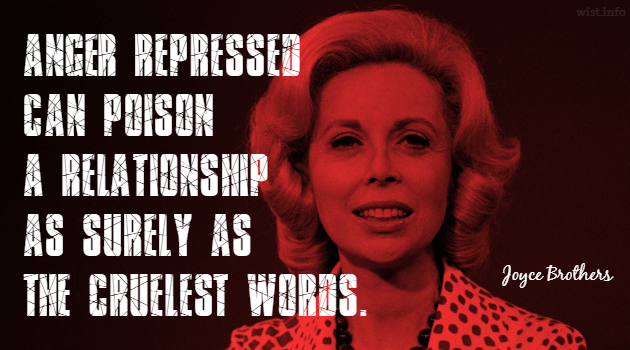
Anger repressed can poison a relationship as surely as the cruelest words.
Joyce Brothers (1927–2013) American psychologist, television personality, advice columnist
“When Your Husband’s Affection Cools,” Good Housekeeping (May 1972)

KING ARTHUR: Shut up!
DENNIS: Oh, now we see the violence inherent in the system. Come and see the violence inherent in the system! Help! Help! I’m being repressed!
KING ARTHUR: Bloody peasant!
DENNIS: Oh, what a giveaway! Did you hear that? Did you hear that, eh? That’s what I’m on about! Did you see him repressing me? You saw him, didn’t you?
Monty Python (b. 1969) British comedy troupe [Graham Chapman, John Cleese, Terry Gilliam, Eric Idle, Terry Jones, Michael Palin]
Monty Python and the Holy Grail (1975)
Every dictatorship has ultimately strangled in the web of repression it wove for its people, making mistakes that could not be corrected because criticism was prohibited.
Robert Francis Kennedy (1925–1968) American politician
“Value of Dissent,” speech, Nashville, Tennessee (21 Mar 1968)
The capacity of the human mind for swallowing nonsense and spewing it forth in violent and repressive action has never yet been plumbed.
Robert A. Heinlein (1907–1988) American writer
Essay (1952-10), “Concerning Stories Never Written,” Revolt in 2100, Postscript (1953)
(Source)
MALCOLM: Give sorrow words; the grief that does not speak
Whispers the o’er-fraught heart and bids it break.William Shakespeare (1564–1616) English dramatist and poet
Macbeth, Act 4, sc. 3, l. 246ff (4.3.246-247) (1606)
(Source)