And now here I was, in a country where a right to say how the country should be governed was restricted to six persons in each thousand of its population. For the nine hundred and ninety-four to express dissatisfaction with the regnant system and propose to change it, would have made the whole six shudder as one man, it would have been so disloyal, so dishonorable, such putrid black treason. So to speak, I was become a stockholder in a corporation where nine hundred and ninety-four of the members furnished all the money and did all the work, and the other six elected themselves a permanent board of direction and took all the dividends. It seemed to me that what the nine hundred and ninety-four dupes needed was a new deal.
Mark Twain (1835–1910) American writer [pseud. of Samuel Clemens]
Novel (1889), A Connecticut Yankee in King Arthur’s Court, Part 3 “The Tale of the Lost Land,” ch. 13 “Freemen!”
(Source)
Quotations about:
monarchy
Note not all quotations have been tagged, so Search may find additional quotes on this topic.
The Founding Fathers cannot have intended a President and his small group of appointed advisors to perform like a monarch surrounded by his court. As if the people’s representatives and the people themselves were a general nuisance, and the job is to keep the whole tiresome bunch quiet: manipulate them.
Martha Gellhorn (1908–1998) American novelist, journalist war correspontent
Letter (1971) to Daniel Ellsberg
(Source)
An open letter Gellhorn wrote to Daniel Ellsberg. In 1971, Ellsberg, a military analyst, leaked the "Pentagon Papers" to the media, a top-secret Defense Department study of US goverment decision-making in the Vietnam War. He was charged under the Espionage Act of 1917, but due to government misconduct and illegal evidence-gathering, all charges were dismissed in 1973.
More importantly, the US government, under Richard Nixon, tried to impose a preemptive injunction to stop the Papers' publication by US media. The Supreme Court ruled in New York Times Co. v. United States that such prior restraint of publication was unconstitutional.

Men are all equal in a republican government, and they are equal in a despotic government: in the first, because they are everything, in the second, because they are nothing.
[Les hommes sont tous égaux dans le gouvernement républicain; ils sont égaux dans le gouvernement despotique: dans le premier, c’est parce qu’ils sont tout; dans le second, c’est parce qu’ils ne sont rien.]
Charles-Lewis de Secondat, Baron de Montesquieu (1689–1755) French political philosopher
Spirit of Laws [The Spirit of the Laws; De l’esprit des lois], Book 6, ch. 2 (6.2) (1748) [tr. Stewart (2018)]
(Source)
(Source (French)). Other translations:In republican governments men are all equal; equal they are also in despotic governments: in the former because they are everything, in the latter because they are nothing.
[tr. Nugent (1750)]Men are all equal in republican government; they are equal in despotic government; in the former, it is because they are everything; in the latter, it is because they are nothing.
[tr. Cohler/Miller/Stone (1989)]
For it is clear that in a monarchy, where the person who executes the laws holds himself above them, less virtue is required than in a popular government, where the person who executes the laws is aware that he himself is subject to them and that he will feel their weight.
[Car il est clair que, dans une monarchie, où celui qui fait exécuter les loix se juge au-dessus des loix, on a besoin de moins de vertu que dans un gouvernement populaire, où celui qui fait exécuter les loix, sent qu’il y est soumis lui-même, & qu’il en portera le poids.]
Charles-Lewis de Secondat, Baron de Montesquieu (1689–1755) French political philosopher
Spirit of Laws [The Spirit of the Laws; De l’esprit des lois], Book 3, ch. 3 (3.3) (1748) [tr. Stewart (2018)]
(Source)
(Source (French)). Other translations:For it is clear that in a monarchy, where he who commands the execution of the laws generally thinks himself above them, there is less need of virtue than in a popular government, where the person entrusted with the execution of the laws is sensible of his being subject to their direction.
[tr. Nugent (1750)]For it is clear that less virtue is needed in a monarchy, where the one who sees to the execution of the laws judges himself above the laws, than in a popular government, where the one who sees the execution of the laws feels that he is subject to them himself and that he will bear their weight.
[tr. Cohler/Miller/Stone (1989)]
PERICLES: Kings are Earth’s gods; in vice their law’s their will;
And if Jove stray, who dares say Jove doth ill?William Shakespeare (1564–1616) English dramatist and poet
Pericles, Act 1, sc. 1, l. 108ff (1.1.108-109) (1607) [with George Wilkins]
(Source)
Liberty, under every conceivable Form of Government is always in Danger. It is so even under a simple, or perfect Democracy, more so under a mixed Government, like the Republic of Rome, and still more so under a limited Monarchy.
John Adams (1735–1826) American lawyer, Founder, statesman; US President (1797–1801)
Diary (1772, Spring), “Notes for a Oration at Braintree”
(Source)
Sometimes Kings have courted the People in Opposition to the Nobles. At other Times the Nobles have united with the People in Opposition to Kings. But Kings and Nobles have much oftener combined together, to crush, to humble and to Fleece the People.
John Adams (1735–1826) American lawyer, Founder, statesman; US President (1797–1801)
Diary (1772, Spring), “Notes for a Oration at Braintree”
(Source)
It is the eternal struggle between these two principles — right and wrong — throughout the world. They are the two principles that have stood face to face from the beginning of time, and will ever continue to struggle. The one is the common right of humanity, and the other the divine right of kings. It is the same principle in whatever shape it develops itself. It is the same spirit that says, “You work and toil and earn bread, and I’ll eat it.” No matter in what shape it comes, whether from the mouth of a king who seeks to bestride the people of his own nation and live by the fruit of their labor, or from one race of men as an apology for enslaving another race, it is the same tyrannical principle.
Abraham Lincoln (1809–1865) American lawyer, politician, US President (1861–65)
Speech (1858-10-15), Lincoln-Douglas Debate No. 7, Alton, Illinois
(Source)

The nobility, say nobles, serves as intermediary between king and people. True, just as the hound serves as intermediary between hunter and hares.
[«La noblesse, disent les nobles, est une intermédiaire entre le roi et le peuple…» Oui, comme le chien de chasse est un intermédiaire entre le chasseur et les lièvres.]Nicolas Chamfort (1741–1794) French writer, epigrammist (b. Nicolas-Sébastien Roch)
Products of Perfected Civilization [Produits de la Civilisation Perfectionée], Part 1 “Maxims and Thoughts [Maximes et Pensées],” ch. 8, ¶ 511 (1795) [tr. Dusinberre (1992)]
(Source)
(Source (French)). Other translations:The nobility, say the nobles, is an intermediary between the king and the people.... Precisely; just as the hound is the intermediary between the huntsman and the hares.
[tr. Hutchinson (1902)]The Nobility, its members say, is an intermediary between the King and the People. .... Exactly, just as hounds are intermediary between men and hares.
[tr. Mathers (1926), ¶ 512]“The nobility,” say the nobles, “is an intermediary between the king and the people . . .” No doubt: just as the hunting dog is an intermediary between the hunter and the hares.
[tr. Merwin (1969)]"The nobility," say the nobles, "is a go-between twixt the king and the people ..." Yes, just as the hunting dog is the go-between twixt the huntsman and the hares.
[tr. Pearson (1973)]"The nobility", say the nobles, "is an intermediary between the king and the people ..." Yes, like a hunting dog is an intermediary between a hunter and hares.
[tr. Siniscalchi (1994), ¶ 511]"We're the intermediary between the king and his subjects," claim the nobility. Yes indeed -- and the hound is the intermediary between the hunter and the hare.
[tr. Parmée (2003), ¶ 269]

Away with empire, and oppressive laws;
None but the fool can wish for regal power,
That he may proudly lord it o’er his equals.[οὔτ᾽ εἰκὸς ἄρχειν οὔτ᾽ ἐχρὴν ἄνευ νόμου
τύραννον εἶναι” μωρία δὲ καὶ ϑέλειν
ὃς τῶν ὁμοίων βούλεται χρατεῖν μόνος.]Euripides (485?-406? BC) Greek tragic dramatist
Antigone [Ἀντιγόνη], frag. 172 (TGF, Kannicht) (c. 420-406 BC) [tr. Wodhall (1809)]
(Source)
Barnes frag. 11, Musgrave frag. 5. (Source (Greek)). Other translation:It is neither reasonable to rule, nor ought there to be a king [law].
It is folly for a man even to want [...]
who wishes to hold sole power over his peers.
[Source]
What has ever been granted to the countless millions of workers of Earth without a fight? Czar Nicholas has discovered that he is not all Russia. Will he “let the voice of the people be heard”? Was it argument or force that changed Czar Nicholas’s mind? Well , the Russian people have gotten the thin edge of the wedge in; let them keep striking hard, they will split the throne after a while.
Lucy Parsons (1851–1942) American labor organizer, anarchist, orator [a.k.a. Lucy Gonzalez]
“On Revolution in Russia and Chinese Use of the Boycott,” The Liberator (3 Sep 1905)
(Source)

It is in vain to Say that Democracy is less vain, less proud, less selfish, less ambitious or less avaricious than Aristocracy or Monarchy. It is not true in Fact and no where appears in history. Those Passions are the same in all Men under all forms of Simple Government, and when unchecked, produce the same Effects of Fraud Violence and Cruelty. When clear Prospects are opened before Vanity, Pride, Avarice or Ambition, for their easy gratification, it is hard for the most considerate Phylosophers and the most conscientious Moralists to resist the temptation. Individuals have conquered themselves, Nations and large Bodies of Men, never.
John Adams (1735–1826) American lawyer, Founder, statesman; US President (1797–1801)
Letter (1814-12-17) to John Taylor
(Source)
I do not say that Democracy has been more pernicious, on the whole, and in the long run, than Monarchy or Aristocracy. Democracy has never been and never can be so durable as Aristocracy or Monarchy. But while it lasts it is more bloody than either. […] Remember Democracy never lasts long. It soon wastes exhausts and murders itself. There never was a Democracy Yet, that did not commit suicide.
John Adams (1735–1826) American lawyer, Founder, statesman; US President (1797–1801)
Letter (1814-12-17) to John Taylor
(Source)
KING ARTHUR: Shut up!
DENNIS: Oh, now we see the violence inherent in the system. Come and see the violence inherent in the system! Help! Help! I’m being repressed!
KING ARTHUR: Bloody peasant!
DENNIS: Oh, what a giveaway! Did you hear that? Did you hear that, eh? That’s what I’m on about! Did you see him repressing me? You saw him, didn’t you?
Monty Python (b. 1969) British comedy troupe [Graham Chapman, John Cleese, Terry Gilliam, Eric Idle, Terry Jones, Michael Palin]
Monty Python and the Holy Grail (1975)
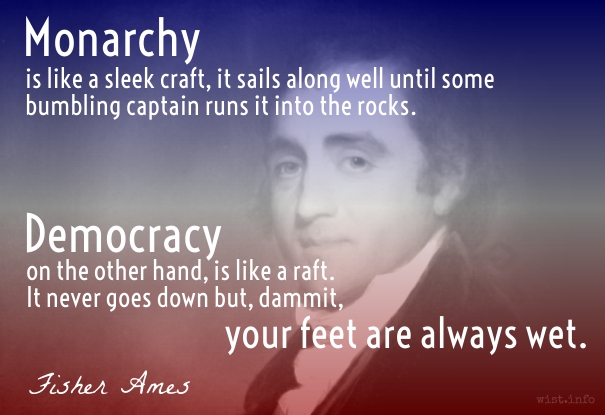
Monarchy is like a sleek craft, it sails along well until some bumbling captain runs it into the rocks. Democracy, on the other hand, is like a raft. It never goes down but, dammit, your feet are always wet.
Fisher Ames (1758–1808) American politician, orator
(Attributed)
This is the earliest reference I can find to this metaphor. Variants:
- "A monarchy is a merchantman which sails well, but will sometimes strike on a rock and go to the bottom; a republic is a raft which will never sink, but then your feet are always in the water." This variant is often attributed to a speech in the House of Representatives in 1795, but is not found in records of Ames' speeches.
- "A monarchy is like a man-of-war -- bad shots between wind and water hurt it exceedingly; there is danger of capsizing. But democracy is a raft. You cannot easily overturn it. It is a wet place, but it is a pretty safe one." -- Joseph Cook (1860-1947) Anglo-Australian politician
- "Dictatorship is like a big proud ship -- steaming away across the ocean with a great hulk and powerful engines driving it. It’s going fast and strong and looks like nothing could stop it. What happens? Your fine ship strikes something -- under the surface. Maybe it’s a mine or a reef, maybe it’s a torpedo or an iceberg. And your wonderful ship sinks. Now take democracy. It’s like riding on a raft, a rickety raft that was put together in a hurry. We get tossed about on the waves, it’s bad going and our feet are always wet. But that raft doesn’t sink … It’s the raft that will get to the shore at last." --- Roaldus Richmond (fl. 1940) American writer. In, ed., "A Yankee Businessman in New Hampshire," American Life Histories: Manuscripts from the Federal Writers Project, 1936-1940.
- "Democracy is like a raft: It won't sink, but you will always have your feet wet." -- Russell B. Long (1918-2003) American politician
- "But you have to understand, American democracy is not like the system you have. We're not an ocean liner that sails across the ocean from point A to point B at 30 knots. That's not American democracy. American democracy is kind of like a life raft that bobs around the ocean all the time. Your feet are always wet. Winds are always blowing. You're cold. You're wet. You're uncomfortable -- but you never sink." -- Colin Powell (b. 1937) American politician, diplomat, soldier
History gives no countenance to the theory that popular governments are either more moral or more pacific than strong monarchies.
William Ralph Inge (1860–1954) English prelate [Dean Inge]
“Our Present Discontents,” Outspoken Essays: First Series (1919)

The Russian government is an absolute monarchy tempered by assassination.
Astolphe-Louis-Léonor, Marquis de Custine (1790–1857) French aristocrat and writer
La Russie en 1839, Vol. 1 (1843)
We should stop going around babbling about how we’re the greatest democracy on earth, when we’re not even a democracy. We are a sort of militarised republic. The founding fathers hated two things, one was monarchy and the other was democracy, they gave us a constitution that saw to it we will have neither. I don’t know how wise they were.
Gore Vidal (1925–2012) American novelist, dramatist, critic
“Gore Vidal and the Mind of the Terrorist”, interview by Ramona Koval, Australian Broadcasting Corporation (Nov 2001)
(Source)

And his hands would plait the priest’s entrails,
For want of a rope, to strangle kings.[Et ses mains ourdiraient les entrailles du prêtre,
Au défaut d’un cordon pour étrangler les rois.]Denis Diderot (1713–1784) French editor, philosopher
Poem (1772), “Les Éleuthéromanes”
(Source)
The work is also sometimes referred to as "Dithrambe sur fête de rois."
(Source (French)). Other translations:And his hands would plait a priest's entrails;
In lieu of a rope for strangling kings.
[Source]His hands would plait the priest’s guts,
if he had no rope, to strangle kings.
[E.g.]
Jean-François de La Harpe, Lycée, ou Cours de Littérature Ancienne et Moderne (1822), attributes this variant to Diderot as the "crowning touch" of his philosophy:With the guts of the last priest,
Let us strangle the last king
[Et des boyaux du dernier prêtre
Serrons le cou du dernier roi.]
Alternately:And [with] the guts of the last priest
Let's shake the neck of the last king.
[E.g.]
This phrasing of Diderot's is most likely derived from a passage by Jean Meslier (c. 1664–1733), a French priest. In his Testament [Common Sense], Vol. 1, ch. 2 [ed. Charles (1864)], he told (and approved) of an "ignorant, uneducated man" who said (English, French):He said he wished [...] that all the great men in the world and all the nobility could be hanged, and strangled with the guts of priests.
[Il souhaitoit [...] que tous les grands de la terre et que tous les nobles fussent pendus et étranglés avec les boïaux des prêtres.]
Other translations of Meslier:His wish was that all the rulers of the earth and all the nobles be hanged and strangled with the guts of priests.
[tr. Shreve (2009)]
Bill Brown, the 2007 translator of Veneigem's The Resistance to Christianity (1993), noted that Voltaire, who edited an early edition of Meslier's Testament, rewrote the passage to provide another French variant (with Brown's English translation):I would like, and this would be the last and most ardent of my wishes, I would like it that the last king was strangled with the guts of the last priest.
[Je voudrais, et ce sera le dernier et le plus ardent de mes souhaits, je voudrais que le dernier des rois fût etranglé avec les boyaux du dernier prêtre.]
Other variants, in general:
- "Men will never be free until the last king is strangled with the entrails of the last priest."
- "Humanity will only be happy when the last priest has been hung with the guts of the last prince."
Democracy substitutes election by the incompetent many for appointment by the corrupt few.
George Bernard Shaw (1856–1950) Irish playwright and critic
Man and Superman, “Maxims for Revolutionists,” “Democracy” (1903)
(Source)

Give me a king whose chief interest in life is stamps, railways, or race-horses ….
J.R.R. Tolkien (1892–1973) English writer, fabulist, philologist, academic [John Ronald Reuel Tolkien]
Letter to Christopher Tolkien (1943-11-29)
(Source)
Letter 52 in Humphrey Carpenter, ed., The Letters of J.R.R. Tolkien (1981).

The fundamental Article of my political Creed is, that Despotism, or unlimited Sovereignty, or absolute Power is the Same in a Majority of a popular Assembly, an Aristocratical Counsel, an Oligarchical Junto and a Single Emperor. Equally arbitrary cruel bloody and in every respect, diabolical.
John Adams (1735–1826) American lawyer, Founder, statesman; US President (1797–1801)
Letter (1815-11-13) to Thomas Jefferson
(Source)
I shall be an autocrat: that’s my trade. And the good Lord will forgive me: that’s his.
[Moi, je serai autocrate: c’est mon metier. Et le bon Dieu me pardonnnera: c’est son metier.]
Catherine II (1762–1796) Russian empress [Catherine the Great; b. Sophie of Anhalt-Zerbst]
(Attributed)