When dictatorship is a fact, revolution becomes a right.
[Quand la dictature est un fait, la révolution devient un droit.]
Victor Hugo (1802–1885) French writer, journalist, human rights activist, politician
(Attributed)
While in keeping with his opposition to the regime of Napoleon III, I have been unable to find any primary source or citation in English or French for this quotation (that Time Magazine (1957-06-03) used the quote doesn't really count).
Quotations about:
authoritarianism
Note not all quotations have been tagged, so Search may find additional quotes on this topic.
Why is the goose-step not used in England? There are, heaven knows, plenty of army officers who would be only too glad to introduce some such thing. It is not used because the people in the street would laugh. Beyond a certain point, military display is only possible in countries where the common people dare not laugh at the army.
George Orwell (1903–1950) English journalist, essayist, writer [pseud. of Eric Arthur Blair]
Essay (1941-02-19), “The Lion and the Unicorn: Socialism and the English Genius,” Part 1 “England Your England,” sec. 2, The Searchlight Books [ed. Fyvel and Orwell]
(Source)
Part of Part 1, "England Your England" with the title "The Ruling Class" was previously published in Horizon (1940-12).
Nazi theory indeed specifically denies that such a thing as “the truth” exists. There is, for instance, no such thing as “science.” There is only “German science,” “Jewish science” etc. The implied objective of this line of thought is a nightmare world in which the Leader, or some ruling clique, controls not only the future but the past. If the Leader says of such and such an event, “It never happened” — well, it never happened. If he says that two and two are five — well, two and two are five. This prospect frightens me much more than bombs — and after our experiences of the last few years that is not a frivolous statement.
George Orwell (1903–1950) English journalist, essayist, writer [pseud. of Eric Arthur Blair]
Essay (1942-08), “Looking Back on the Spanish War,” ch. 4, Such, Such Were the Joys, essay 8 (1953)
(Source)
This is a central theme in his later novel, Nineteen Eighty-Four.
In our country, disagreements among us are expressed in the polling place. In the dictatorships, disagreements are suppressed in the concentration camp.
Franklin Delano Roosevelt (1882–1945) American lawyer, politician, statesman; US President (1933–45)
Speech (1941-03-29), Jackson Day Radio Broadcast, U.S.S. Potomac
(Source)
When the clock of civilization can be turned back by burning libraries, by exiling scientists, artists, musicians, writers and teachers, by dispersing universities, and by censoring news and literature and art, an added burden is placed upon those countries where the torch of free thought and free learning still burns bright.
Franklin Delano Roosevelt (1882–1945) American lawyer, politician, statesman; US President (1933–45)
Speech (1938-06-30), National Education Association, World’s Fair, New York City
(Source)
They don’t ask much of you. They only want you to hate the things you love and to love the things you despise.
Boris Pasternak (1890–1960) Russian poet, novelist, and literary translator
Quoted in “Farewell in a Poet’s Land,” Life Magazine (1960-06-13)
(Source)
On the Communist leadership of the Soviet Union.
This article was an obituary for Pasternak. I have been unable to find a primary source for the quote.

The great misfortune, the root of all the evil to come, was the loss of faith in the value of personal opinions. People imagined that it was out of date to follow their own moral sense, that they must all sing the same tune in chorus, and live by other people’s notions, the notions which were being crammed down everybody’s throat.
Boris Pasternak (1890–1960) Russian poet, novelist, and literary translator
Doctor Zhivago [До́ктор Жива́го], Part 2, ch. 13 “Opposite the House of Caryatids,” sec. 14 [Yury] (1955) [tr. Hayward & Harari (1958), UK ed.]
(Source)
Other translations:The main misfortune, the root of all evil to come, was loss of the confidence in the value of one's own opinion. People imagined that it was out of date of follow their own moral sense, that they must all sing in chorus, and live by other people's notions, notions that were crammed down everybody's throat.
[tr. Hayward & Harari (1958), US ed.]The main trouble, the root of the future evil, was loss of faith in the value of one’s own opinion. People imagined that the time when they followed the urgings of their moral sense was gone, that now they had to sing to the general tune and live by foreign notions imposed on everyone.
[tr. Pevear & Volokhonsky (2010)]
Fascism, Nazism and Stalinism have in common that they offered the atomized individual a new refuge and security. These systems are the culmination of alienation. The individual is made to feel powerless and insignificant, but taught to project all of his human powers into the figure of the leader, the state, the “fatherland,” to whom he has to submit and whom he has to worship. He escapes from freedom and into a new idolatry. All the achievements of individuality and reason, from the late Middle Ages to the nineteenth century are sacrificed on the altars of the new idols.
Erich Fromm (1900–1980) American psychoanalyst and social philosopher
The Sane Society, ch. 7 (1956)
(Source)

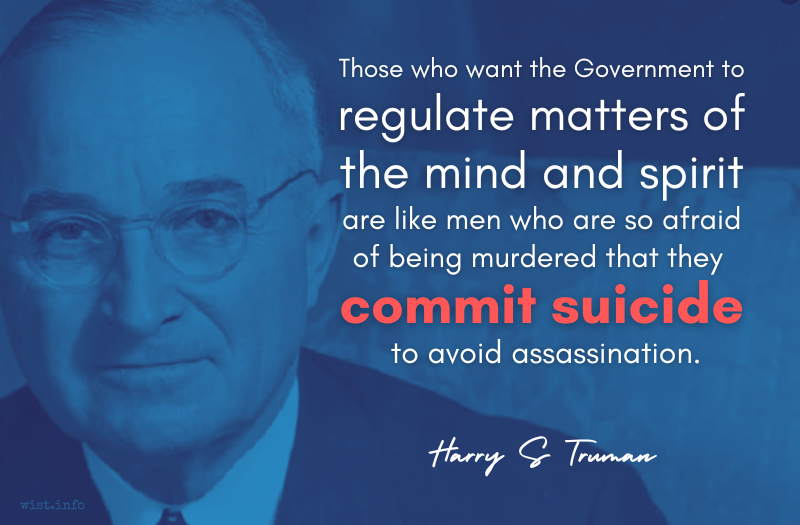
Those who want the Government to regulate matters of the mind and spirit are like men who are so afraid of being murdered that they commit suicide to avoid assassination.
All the Sixties were complicated, you know. On the one hand it was funny too, you know; on the other hand it was cruel, you know. The Communists are so cruel, because they impose one taste on everybody, on everything, and who doesn’t comply with their teachings and with their ideology, is very soon labeled pervert, you know, or whatever they want you call it, or counterrevolutionary or whatever. And then the censorship itself, that’s not the worst evil. The worst evil is — and that’s the product of censorship — is the self-censorship, because that twists spines, that destroys my character because I have to think something else and say something else, I have to always control myself. I am stopping to being honest, I am becoming hypocrite — and that’s what they wanted, they wanted everybody to feel guilty, they were, you know… And also they were absolutely brilliant in one way, you know: they knew how effective is not to punish somebody who is guilty; what Communist Party members could afford to do was mind-boggling: they could do practically anything they wanted — steal, you know, lie, whatever. What was important — that they punished if you’re innocent, because that puts everybody, you know, puts fear in everybody.
Jan Tomáš "Miloš" Forman (1932–2018) Czech-American film director, screenwriter, actor, academic
National Security Archive interview (18 Jan 1997)
(Source)

Fascism, after all, is not only a historical term; it describes a modern style of authoritarian rule that seeks to mobilize the masses by appealing to nationalism, xenophobia, and populist resentment. Its trademark is the use of democratic procedure even as it seeks to destroy the substantive values of democracy from within. It disdains the free press and seeks to undermine its credibility in the public sphere.
Peter E, Gordon (b. 1966) American intellectual historian
“Why Historical Analogy Matters,” New York Review of Books (7 Jan 2020)
(Source)

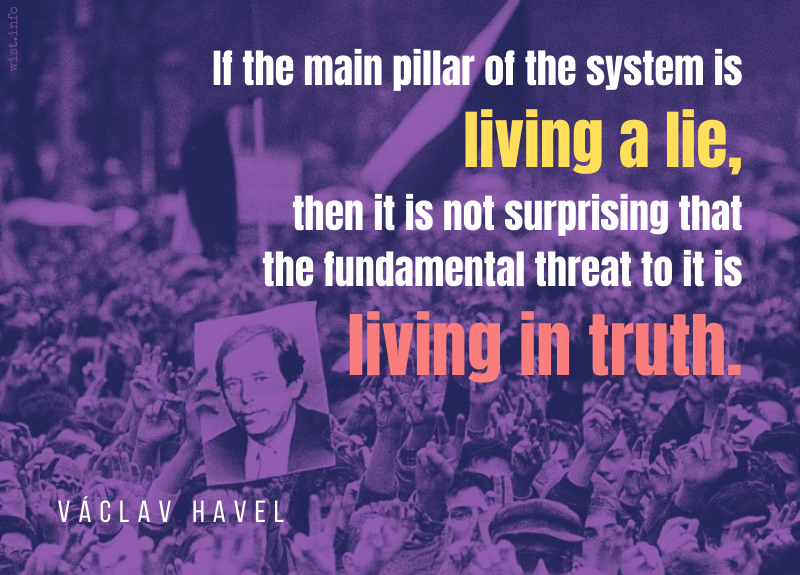
If the main pillar of the system is living a lie, then it is not surprising that the fundamental threat to it is living in truth. This is why it must be suppressed more severely than anything else.
Václav Havel (1936–2011) Czech playwright, essayist, dissident, politician
Essay (1978-10), “The Power of the Powerless,” ch. 7 [tr. Wilson], The Power of the Powerless [ed. John Keane] (1985)
(Source)
People say we ought not to allow ourselves to be drawn into a theoretical antagonism between Nazidom and democracy; but the antagonism is here now. It is this very conflict of spiritual and moral ideas which gives the free countries a great part of their strength. You see these dictators on their pedestals, surrounded by the bayonets of their soldiers and the truncheons of their police. On all sides they are guarded by masses of armed men, cannons, aeroplanes, fortifications, and the like — they boast and vaunt themselves before the world, yet in their hearts there is unspoken fear. They are afraid of words and thoughts; words spoken abroad, thoughts stirring at home — all the more powerful because forbidden — terrify them. A little mouse of thought appears in the room, and even the mightiest potentates are thrown into panic. They make frantic efforts to bar our thoughts and words; they are afraid of the workings of the human mind. Cannons, airplanes, they can manufacture in large quantities; but how are they to quell the natural promptings of human nature, which after all these centuries of trial and progress has inherited a whole armoury of potent and indestructible knowledge?
Winston Churchill (1874–1965) British statesman and author
“The Defence of Freedom and Peace (The Lights are Going Out),” radio broadcast (16 Oct 1938)
(Source)
Moreover, if we look at the techniques of totalitarian government, it is obvious that the argument of “the lesser evil” — far from being raised only from the outside by those who do not belong to the ruling elite — is one of the mechanisms built into the machinery of terror and criminality. Acceptance of lesser evils is consciously used in conditioning the government officials as well

Totalitarianism appeals to the very dangerous emotional needs of people who live in complete isolation and in fear of one another.
Hannah Arendt (1906–1975) German-American philosopher, political theorist
Interview (1973-10) with Roger Errera, Office de Radiodiffusion-Télévision Française (ORTF)
This portion of the interview was published in The New York Review of Books (1978-10-26).
Other parts of the interview were turned into an episode of the French TV series "Un certain regard," directed by Jean-Claude Lubtchansky, first broadcast 1974-07-06.
From the totalitarian point of view history is something to be created rather than learned. A totalitarian state is in effect a theocracy, and its ruling caste, in order to keep its position, has to be thought of as infallible. But since, in practice, no one is infallible, it is frequently necessary to rearrange past events in order to show that this or that mistake was not made, or that this or that imaginary triumph actually happened. Then again, every major change in policy demands a corresponding change of doctrine and a revelation of prominent historical figures.
This kind of thing happens everywhere, but is clearly likelier to lead to outright falsification in societies where only one opinion is permissible at any given moment. Totalitarianism demands, in fact, the continuous alteration of the past, and in the long run probably demands a disbelief in the very existence of objective truth.George Orwell (1903–1950) English journalist, essayist, writer [pseud. of Eric Arthur Blair]
Essay (1946-01), “The Prevention of Literature,” Polemic Magazine
(Source)
Comfort and habits let us be ready to forgo, but I am not ready for a creed which does not care how much it destroys the liberty and security of daily life, which uses deliberately the weapons of persecution, destruction and international strife. How can I admire a policy which finds a characteristic expression in spending millions to suborn spies in every family and group at home, and to stir up trouble abroad?
John Maynard Keynes (1883–1946) English economist
“A Short View of Russia” (1925)
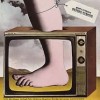
KING ARTHUR: Shut up!
DENNIS: Oh, now we see the violence inherent in the system. Come and see the violence inherent in the system! Help! Help! I’m being repressed!
KING ARTHUR: Bloody peasant!
DENNIS: Oh, what a giveaway! Did you hear that? Did you hear that, eh? That’s what I’m on about! Did you see him repressing me? You saw him, didn’t you?
Monty Python (b. 1969) British comedy troupe [Graham Chapman, John Cleese, Terry Gilliam, Eric Idle, Terry Jones, Michael Palin]
Monty Python and the Holy Grail (1975)
The Catholic and the Communist are alike in assuming that an opponent cannot be both honest and intelligent. Each of them tacitly claims that “the truth” has already been revealed, and that the heretic, if he is not simply a fool, is secretly aware of “the truth” and merely resists it out of selfish motives.
George Orwell (1903–1950) English journalist, essayist, writer [pseud. of Eric Arthur Blair]
Essay (1946-01), “The Prevention of Literature,” Polemic Magazine
(Source)
A majority held in restraint by constitutional checks and limitations, and always changing easily with deliberate changes of popular opinions and sentiments, is the only true sovereign of a free people. Whoever rejects it does of necessity fly to anarchy or to despotism.
Abraham Lincoln (1809–1865) American lawyer, politician, US President (1861–65)
Speech (1861-03-04), Inaugural Address, Washington, D. C.
(Source)
Censorship reflects a society’s lack of confidence in itself. It is a hallmark of an authoritarian regime. Long ago, those who wrote our First Amendment charted a different course. They believed a society can be truly strong only when it is truly free. In the realm of expression, they put their faith, for better or for worse, in the enlightened choice of the people, free from the interference of a policeman’s intrusive thumb or a judge’s heavy hand. So it is that the Constitution protects coarse expression as well as refined, and vulgarity no less than elegance. A book worthless to me may convey something of value to my neighbor. In the free society to which our Constitution has committed us, it is for each to choose for himself.
Potter Stewart (1915–1985) US Supreme Court Justice (1959–81)
Ginzburg v. United States, 383 U.S. 463, 498 (1966) [dissenting]
(Source)