

Had there been a literary censorship in Rome, we should have had to-day neither Horace, Juvenal, nor the philosophical works of Cicero. If Milton, Dryden, Pope, and Locke had not been free, England would have had neither poets nor philosophers; there is something positively Turkish in proscribing printing; and hampering it is proscription.
[S’il y avait eu une inquisition littéraire à Rome, nous n’aurions aujourd’hui ni Horace, ni Juvénal, ni les œuvres philosophiques de Cicéron. Si Milton, Dryden, Pope, et Locke, n’avaient pas été libres l’Angleterre n’aurait eu ni des poètes, ni des philosophes: il y a je ne sais quoi de turc à proscrire l’imprimerie, et c’est la proscrire que la trop gêner.]
Voltaire (1694–1778) French writer [pseud. of Francois-Marie Arouet]
Letter (1733-06-20) to a First Commissioner [Lettre á un premier commis] [tr. Tallentyre (1919)]
(Source)
Quotations about:
free press
Note not all quotations have been tagged, so Search may find additional quotes on this topic.
All the governments of the world adopt elaborate methods of concealing truths which they consider undesirable, and inflict various forms of penalty upon those who spread knowledge which is thought bad for the population This applies especially to knowledge of the kind which is considered seditious, and the kind which is considered obscene. I shall not give instances, since, if I did, I should myself fall under the ban of the law.
Bertrand Russell (1872–1970) English mathematician and philosopher
Education and the Social Order [Education and the Modern World], ch. 1 “The Individual versus the Citizen” (1932)
(Source)
As you have it in your power, sir, to do some service to letters, I implore you not to clip the wings of our writers so closely, nor to turn into barn-door fowls those who, allowed a start, might become eagles; reasonable liberty permits the mind to soar — slavery makes it creep.
[Puisque vous êtes, monsieur, à portée de rendre service aux belles-lettres, ne rognez pas de si près les ailes à nos écrivains, et ne faites pas des volailles de basse-cour de ceux qui, en prenant l’essor, pourraient devenir des aigles: une liberté honnête élève l’esprit, et l’esclavage le fait ramper.]
Voltaire (1694–1778) French writer [pseud. of Francois-Marie Arouet]
Letter (1733-06-20) to a First Commissioner [Lettre á un premier commis] [tr. Tallentyre (1919)]
(Source)
(Source (French); alternate).
On censorship. The last clause is most often quoted, and has spawned a variety of French and English variants, e.g.:
- [La servitude fait ramper l'esprit, et la liberté le fait voler.]
- Slavery makes the mind creep, and liberty makes it fly.
Despotism can no more exist in a nation until the liberty of the press be destroyed, than night can happen before the sun is set.
Charles Caleb "C. C." Colton (1780–1832) English cleric, writer, aphorist
Lacon: Or, Many Things in Few Words, Vol. 1, § 468 (1820)
(Source)
In the democracies of the world, the passion for freedom of speech and of thought is always accentuated when there is an effort anywhere to keep ideas away from people and to prevent them from making their own decisions. One of the best ways of enslaving a people is to keep them from education and thus make it impossible for them to understand what is going on in the world as a whole. […] The second way of enslaving a people is to suppress the sources of information, not only by burning books, but by controlling all the other ways in which ideas are transmitted.
Eleanor Roosevelt (1884–1962) First Lady of the US (1933–1945), politician, diplomat, activist
Column (1943-05-11), “My Day”
(Source)
In a self-governing country the people are called citizens. Under a despotism or autocracy the people are called subjects. This is because in a free country the people are themselves sovereign, while in a despotic country the people are under a sovereign. In the United States the people are all citizens, including its President. The rest of them are fellow citizens of the President. In Germany the people are all subjects of the Kaiser. They are not his fellow citizens, they are his subjects.
This is the essential difference between the United States and Germany, but the difference would vanish if we now submitted to the foolish or traitorous persons who endeavor to make it a crime to tell the truth about the Administration when the Administration is guilty of incompetence or other shortcomings. Such an endeavor is itself a crime against the nation. Those who take such an attitude are guilty of moral treason of a kind both abject and dangerous.Theodore Roosevelt (1858–1919) American politician, statesman, conservationist, writer, US President (1901–1909)
Essay (1918-04-06), “Citizens or Subjects?” Kansas City Star
(Source)
Regarding a bill which had just passed the Senate Judiciary Committee which would fine and imprison any one who used "contemptuous or slurring language about the President."
This passage was added to later editions of his essay, "Lincoln and Free Speech,", as printed in The Works of Theodore Roosevelt, vol. 21, The Great Adventure, ch. 7 (1925). It does not appear in the original version of the essay or book.
Government is competent when all who compose it work as trustees for the whole people. It can make constant progress when it keeps abreast of all the facts. It can obtain justified support and legitimate criticism when the people receive true information of all that government does.
Franklin Delano Roosevelt (1882–1945) American lawyer, politician, statesman, US President (1933–1945)
Speech (1937-01-20), Inaugural Address, Washington, D.C.
(Source)
One thing is sure — none of the arts flourishes on censorship and repression. And by this time it should be evident that the American public is capable of doing its own censoring.
Eleanor Roosevelt (1884–1962) First Lady of the US (1933–1945), politician, diplomat, activist
Column (1947-10-29), “My Day”
(Source)
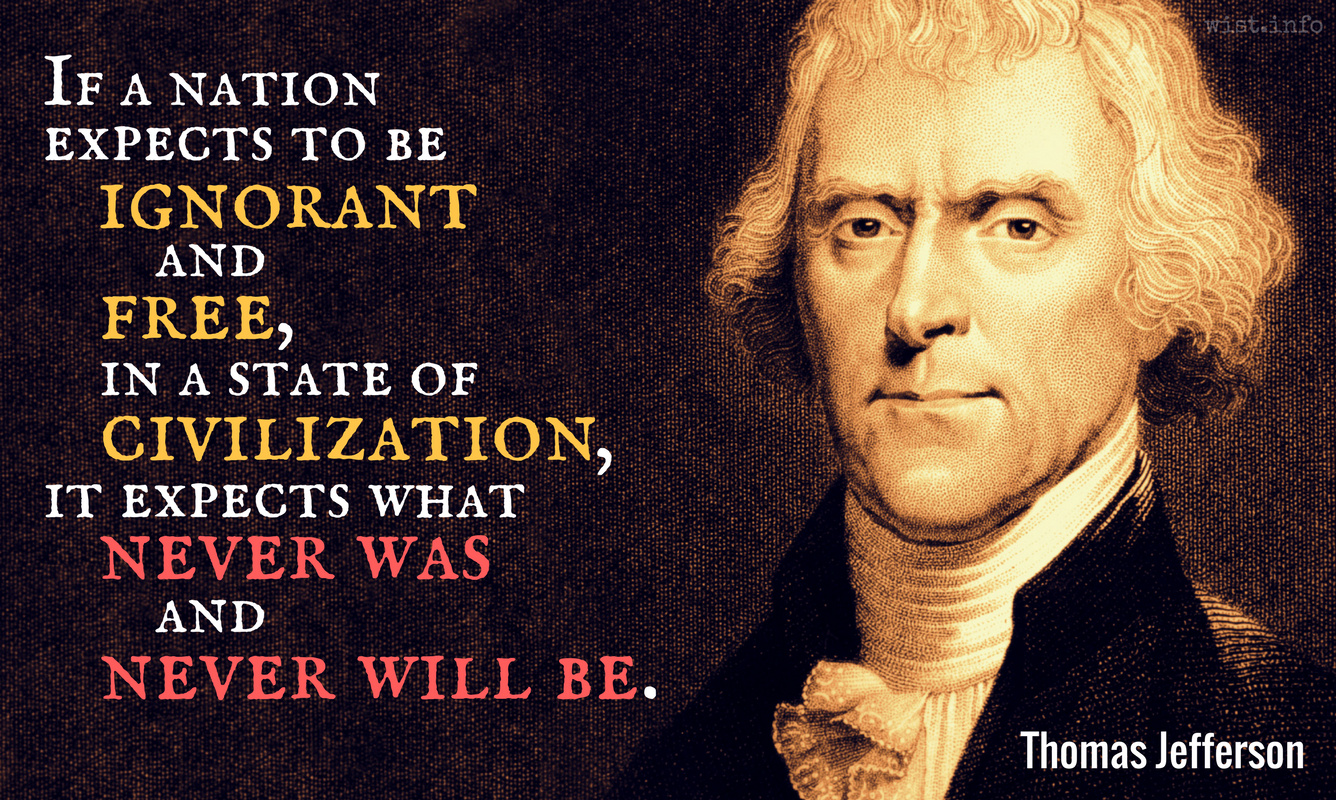
If a nation expects to be ignorant and free, in a state of civilization, it expects what never was and never will be. The functionaries of every government have propensities to command at will the liberty and property of their constituents. There is no safe deposit for these but with the people themselves; nor can they be safe with them without information. Where the press is free, and every man able to read, all is safe.
Thomas Jefferson (1743–1826) American political philosopher, polymath, statesman, US President (1801–09)
Letter (1816-01-06) to Charles Yancey
(Source)
The original, non-orthographic version of this reads:if a nation expects to be ignorant & free, in a state of civilisation, it expects what never was & never will be. the functionaries of every government have propensities to command at will the liberty & property of their constituents. there is no safe deposit for these but with the people themselves; nor can they be safe with them without information. where the press is free and every man able to read, all is safe.
There is a spurious variant on part of this quotation that reads:If a nation expects to be ignorant and free, in a state of civilization, it expects what never was and never will be. If we are to guard against ignorance and remain free, it is the responsibility of every American to be informed.
While the first sentence (as above) is legitimate, the second is not. It appears to be a paraphrase of Jefferson used by Ronald Reagan in 1981.
At some time in the future, if the human mind becomes something totally different from what it is now, we may learn to separate literary creation from intellectual honesty. At present we know only that the imagination, like certain wild animals, will not breed in captivity.
George Orwell (1903–1950) English journalist, essayist, writer [pseud. of Eric Arthur Blair]
Essay (1946-01), “The Prevention of Literature,” Polemic
(Source)
On the suppression of independent writers and writing in totalitarian statues, such as Germany and the Soviet Union, and the apathy of Western intelligentsia about it.
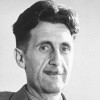
Printers are educated in the Belief, that when Men differ in Opinion, both Sides ought equally to have the Advantage of being heard by the Publick; and that when Truth and Error have fair Play, the former is always an overmatch for the latter: Hence they chearfully serve all contending Writers that pay them well, without regarding on which side they are of the Question in Dispute.
Benjamin Franklin (1706–1790) American statesman, scientist, philosopher, aphorist
“Apology for Printers,” Philadelphia Gazette (1731-06-10)
(Source)
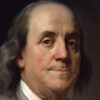
The civil rights of none shall be abridged on account of religious belief or worship, nor shall any national religion be established, nor shall the full and equal rights of conscience be in any manner, or on any pretext, infringed.
The people shall not be deprived or abridged of their right to speak, to write, or to publish their sentiments; and the freedom of the press, as one of the great bulwarks of liberty, shall be inviolable.
The people shall not be restrained from peaceably assembling and consulting for their common good; nor from applying to the Legislature by petitions, or remonstrances, for redress of their grievances.
James Madison (1751–1836) American statesman, political theorist, US President (1809–17)
Speech Introducing Proposed Constitutional Amendments (1789-06-08)
(Source)
Speech before the House of Representatives, proposing a Bill of Rights amending the US Constitution. This was the first draft of the text that would go on to become the First Amendment.
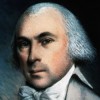
I find it difficult to see how talk about sex can be placed under the kind of censorship the Court here approves without subjecting our society to more dangers than we can anticipate at the moment. It was to avoid exactly such dangers that the First Amendment was written and adopted. For myself I would follow the course which I believe is required by the First Amendment, that is, recognize that sex at least as much as any other aspect of life is so much a part of our society that its discussion should not be made a crime.
Hugo Black (1886–1971) American politician and jurist, US Supreme Court Justice (1937–71)
Ginzburg v. United States, 383 U.S. 463, 482 (1966) [dissent]
(Source)
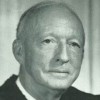
These rights may be abused by using speech or press or assembly in order to incite to violence and crime. The people, through their legislatures may protect themselves against that abuse. But the legislative intervention, can find constitutional justification only by dealing with the abuse. The rights themselves must not be curtailed.The greater the importance of safeguarding the community from incitements to the overthrow of our institutions by force and violence, the more imperative is the need to preserve inviolate the constitutional rights of free speech, free press and free assembly in order to maintain the opportunity for free political discussion, to the end that government may be responsive to the will of the people and that changes, if desired, may be obtained by peaceful means. Therein lies the security of the Republic, the very foundation of constitutional government.
Charles Evans Hughes, Sr. (1862–1948) American statesman, politician, Supreme Court Justice (1910–1916, 1930–1941)
De Jonge v. Oregon, 299 U.S. 353, 364-365 (1937) [majority]
(Source)
We’re stronger because we’re democracies. We’re not afraid of free and fair elections, because true legitimacy can only come from one source — and that is the people. We’re not afraid of an independent judiciary, because no one is above the law. We’re not afraid of a free press or vibrant debate or a strong civil society, because leaders must be held accountable. We’re not afraid to let our young people go online to learn and discover and organize , because we know that countries are more successful when citizens are free to think for themselves.
Barack Obama (b. 1961) American politician, US President (2009–2017)
Speech, Nordea Concert Hall, Tallinn, Estonia (3 Sep 2014)
(Source)
Who are those who are really disloyal? Those who inflame racial hatreds, who sow religious and class dissensions. Those who subvert the Constitution by violating the freedom of the ballot box. Those who make a mockery of majority rule by the use of the filibuster. Those who impair democracy by denying equal educational facilities. Those who frustrate justice by lynch law or by making a farce of jury trials. Those who deny freedom of speech and of the press and of assembly. Those who press for special favors against the interest of the commonwealth. Those who regard public office as a source of private gain. Those who would exalt the military over the civil. Those who for selfish and private purposes stir up national antagonisms and expose the world to the ruin of war.
The Bill of Rights was not written into the Constitution in order to protect governments from “trouble,” but so that the people might have a legitimate method of causing trouble to governments they no longer trusted.
Henry Steele Commager (1902–1998) American historian, writer, activist
Letter (1971-06-17) to the Editor, New York Times
(Source)
In reply to the criticism by Secretary of State William Rogers that publication of the Pentagon Papers by the New York Times "is going to cause a great deal of trouble."
Fascism, after all, is not only a historical term; it describes a modern style of authoritarian rule that seeks to mobilize the masses by appealing to nationalism, xenophobia, and populist resentment. Its trademark is the use of democratic procedure even as it seeks to destroy the substantive values of democracy from within. It disdains the free press and seeks to undermine its credibility in the public sphere.
Peter E, Gordon (b. 1966) American intellectual historian
“Why Historical Analogy Matters,” New York Review of Books (7 Jan 2020)
(Source)

The moment we no longer have a free press, anything can happen. What makes it possible for a totalitarian or any other dictatorship to rule is that people are not informed; how can you have an opinion if you are not informed?
Hannah Arendt (1906–1975) German-American philosopher, political theorist
Interview (1973-10) with Roger Errera, Office de Radiodiffusion-Télévision Française (ORTF)
(Source)
Other parts of this interview were turned into an episode of the French TV series "Un certain regard," directed by Jean-Claude Lubtchansky, first broadcast 1974-07-06.
This portion of the interview was published in The New York Review of Books (1978-10-26).
Our loyalty is due entirely to the United States. It is due to the President only and exactly to the degree in which he efficiently serves the United States. It is our duty to support him when he serves the United States well. It is our duty to oppose him when he serves it badly.
Theodore Roosevelt (1858–1919) American politician, statesman, conservationist, writer, US President (1901–1909)
Essay (1918-04-06), “Citizens or Subjects?” Kansas City Star
(Source)
Regarding a bill which had just passed the Senate Judiciary Committee which would fine and imprison any one who used "contemptuous or slurring language about the President."
This passage was added to later editions of his essay, "Lincoln and Free Speech,", as printed in The Works of Theodore Roosevelt, vol. 21, The Great Adventure, ch. 7 (1925). It does not appear in the original version of the essay or book. See Roosevelt and Roosevelt.

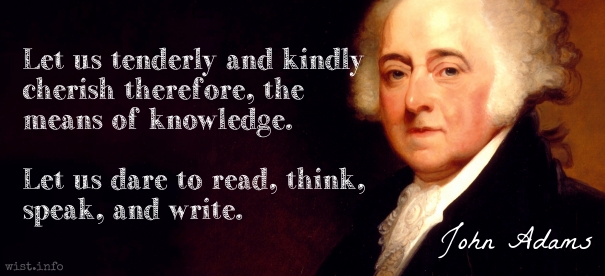
Let us tenderly and kindly cherish, therefore, the means of knowledge. Let us dare to read, think, speak and write.
John Adams (1735–1826) American lawyer, Founding Father, statesman, US President (1797–1801)
Essay (1765-10-21), “A Dissertation on the Canon and the Feudal Law,” No. 4, Boston Gazette
(Source)
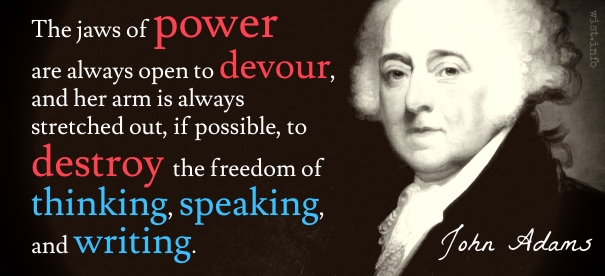
The jaws of power are always open to devour, and her arm is always stretched out, if possible, to destroy the freedom of thinking, speaking, and writing.
John Adams (1735–1826) American lawyer, Founding Father, statesman, US President (1797–1801)
Essay (1765-09-30), “A Dissertation on the Canon and the Feudal Law,” No. 3, Boston Gazette
(Source)
Originally written for the Sodalitas Club.
I disapprove of what you say, but I will defend to the death your right to say it.
Voltaire (1694–1778) French writer [pseud. of Francois-Marie Arouet]
(Spurious)
(Source)
The words are not found in any actual Voltaire source. They belong to historian Evelyn Beatrice Hall, writing as S. G. Tallentyre, in The Friends of Voltaire (1906), describing an 1759 incident where Voltaire learned that Claude-Adrien Helvétius' book On the Mind [De l’esprit] had been burned (along with Voltaire's own On Natural Law) after condemnation by the Paris Parliament and the Sorbonne. Voltaire himself wasn't impressed by Helvétius' book, but thought a book burning was unjustified. Hall wrote:"What a fuss about an omelette!" he had exclaimed when he heard of the burning. How abominably unjust to persecute a man for such an airy trifle as that! "I disapprove of what you say, but I will defend to the death your right to say it," was his attitude now.
Hall later wrote that the actual words were her own and ought not to have had quotation marks.
Variations:For more detailed information, see Quote Origin: I Disapprove of What You Say, But I Will Defend to the Death Your Right to Say It – Quote Investigator®.
- I wholly disapprove of what you say -- and will defend to the death your right to say it.
- Monsieur l’Abbé, je déteste ce que vous écrivez, mais je donnerais ma vie pour que vous puissiez continuer à écrire. [Monsieur l’abbé, I detest what you write, but I would give my life to make it possible for you to continue to write.]
[The people] have a right, an indisputable, unalienable, indefeasible, divine right to that most dreaded and envied kind of knowledge, I mean, of the characters and conduct of their rulers.
John Adams (1735–1826) American lawyer, Founding Father, statesman, US President (1797–1801)
Essay (1765-09-30), “A Dissertation on the Canon and the Feudal Law,” No. 3, Boston Gazette
(Source)
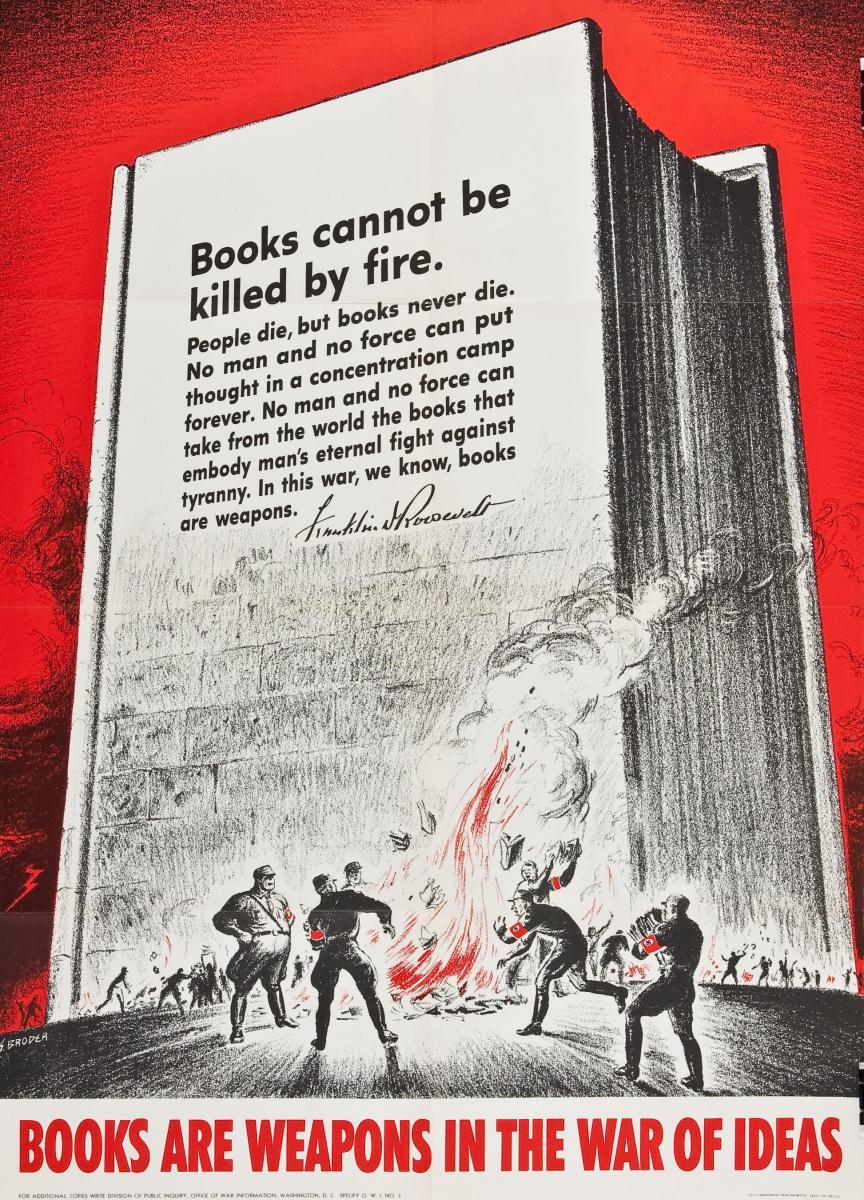
We all know that books burn — yet we have the greater knowledge that books cannot be killed by fire. People die, but books never die. No man and no force can abolish memory. No man and no force can put thought in a concentration camp forever. No man and no force can take from the world the ideas that embody man’s eternal fight against tyranny of every kind. In this war, we know, books are weapons.
Franklin Delano Roosevelt (1882–1945) American lawyer, politician, statesman, US President (1933–1945)
Letter (1942-04-23), “Message to American Booksellers Association,” Annual Banquet (1942-05-06), Astor Hotel, New York City
(Source)
The letter was delivered with a speech by Archibald MacLeish (appointed by Roosevelt as Librarian of Congress, 1939-1944) titled "A Free Man's Books." This was shortly after FDR named April 17 as "Victory Book Day".
This quotation was turned into a poster by S. Broder, published by the US Office of War Information in 1942.
MILNE: No matter how imperfect things are, if you’ve got a free press everything is correctable, and without it everything is concealable.
RUTH: I’m with you on the free press. It’s the newspapers I can’t stand.Tom Stoppard (1937–2025) Czech-English playwright and screenwriter
Night and Day, Act 1 (1978)
Certainly the First Amendment’s language leaves no room for inference that abridgments of speech and press can be made just because they are slight. That Amendment provides, in simple words, that “Congress shall make no law … abridging the freedom of speech, or of the press.” I read “no law … abridging” to mean no law abridging.
Hugo Black (1886–1971) American politician and jurist, US Supreme Court Justice (1937–71)
Smith v. California, 361 U.S. 147, 157 (1959) [concurring]
(Source)
If the fires of freedom and civil liberties burn low in other lands, they must be made brighter in our own.
If in other lands the press and books and literature of all kinds are censored, we must redouble our efforts here to keep them free.
If in other lands the eternal truths of the past are threatened by intolerance we must provide a safe place for their perpetuation.Franklin Delano Roosevelt (1882–1945) American lawyer, politician, statesman, US President (1933–1945)
Speech (1938-06-30), National Education Association, World’s Fair, New York City
(Source)
The rock-bottom foundation of a free press is the integrity of the people who run it. Our press may make a million mistakes of judgment without doing itself permanent harm so long as its proprietors are steadfast in their adherence to truth.
Adlai Stevenson II (1900–1965) American politician, diplomat, statesman
Speech (1952-09-08), “The One-Party Press,” Portland Journal Luncheon, Portland, Oregon
(Source)
If liberty means anything at all it means the right to tell people what they do not want to hear.
George Orwell (1903–1950) English journalist, essayist, writer [pseud. of Eric Arthur Blair]
Animal Farm, unpublished preface (1945)
(Source)
The original essay was written in 1945 as an introduction to the first edition of the book, but was left unpublished It was rediscovered in 1971, and finally published under Orwell's name as "The Freedom of the Press," Times Literary Supplement [of London] (1972-09-15).
More history of this quotation here: If Liberty Means Anything At All It Means the Right To Tell People What They Do Not Want To Hear – Quote Investigator®.
Censorship reflects a society’s lack of confidence in itself. It is a hallmark of an authoritarian regime. Long ago, those who wrote our First Amendment charted a different course. They believed a society can be truly strong only when it is truly free. In the realm of expression, they put their faith, for better or for worse, in the enlightened choice of the people, free from the interference of a policeman’s intrusive thumb or a judge’s heavy hand. So it is that the Constitution protects coarse expression as well as refined, and vulgarity no less than elegance. A book worthless to me may convey something of value to my neighbor. In the free society to which our Constitution has committed us, it is for each to choose for himself.
Potter Stewart (1915–1985) US Supreme Court Justice (1959–81)
Ginzburg v. United States, 383 U.S. 463, 498 (1966) [dissenting]
(Source)
We must not confuse dissent with disloyalty.
Edward R. Murrow (1908–1965) American journalist
Commentary (1954-03-09), “A Report on Senator Joseph R. McCarthy,” See It Now, CBS TV
(Source)
(Source (Video)). Episode dealing with Sen. Joe McCarthy's witch hunt of Communists in the US.

Patriotism means to stand by the country. It does not mean to stand by the President or any other public official save exactly to the degree in which he himself stands by the country. It is patriotic to support him in so far as he efficiently serves the country. It is unpatriotic not to oppose him to the exact extent that by inefficiency or otherwise he fails in his duty to stand by the country. In either event, it is unpatriotic not to tell the truth — whether about the President or about any one else.
Theodore Roosevelt (1858–1919) American politician, statesman, conservationist, writer, US President (1901–1909)
Essay (1918-05), “Lincoln and Free Speech,” Metropolitan Magazine, Vol. 47, No. 6
(Source)
On war-time censorship by the Wilson Administration taken against critics of its handling of war efforts.
Reprinted in Appendix C of his The Great Adventure (1918), and as ch. 7 of that book in Vol. 21 of The Works of Theodore Roosevelt (1925), The Great Adventure.
See also Roosevelt and Roosevelt.