
CASSIUS: What trash is Rome,
What rubbish, and what offal when it serves
For the base matter to illuminate
So vile a thing as Caesar!William Shakespeare (1564–1616) English dramatist and poet
Julius Caesar, Act 1, sc. 3, l. 112ff (1.3.112–115) (1599)
(Source)
Quotations about:
dictatorship
Note not all quotations have been tagged, so Search may find additional quotes on this topic.

Fascist dictators don’t announce that they’re fascist dictators.
They announce that it’s illegal to be anti-fascist.Oliver Markus Malloy (contemp.) German-American writer, cartoonist, musician
Post (2026-07-01), @malloyrocks, Substack.com
(Source)

Unlimited power is the ideal thing when it is in safe hands. The despotism of heaven is the one absolutely perfect government, and earthly despotism would be the absolute perfect earthly government if the conditions were the same; namely the despot the perfectest individual of the human race, and his lease of life perpetual; but as a perishable, perfect man must die and leave his despotism in the hands of an imperfect successor, an earthly despotism is not merely a bad form of government, it is the worst form that is possible.
Mark Twain (1835–1910) American writer [pseud. of Samuel Clemens]
Novel (1889), A Connecticut Yankee in King Arthur’s Court, Part 3 “The Tale of the Lost Land,” ch. 10 “Beginnings of Civilization”
(Source)

Of governments, that of the mob is the most sanguinary, that of soldiers the most expensive, and that of civilians the most vexatious.
Charles Caleb "C. C." Colton (1780–1832) English cleric, writer, aphorist
Lacon: Or, Many Things in Few Words, Vol. 1, § 411 (1820)
(Source)

When dictatorship is a fact, revolution becomes a right.
[Quand la dictature est un fait, la révolution devient un droit.]
Victor Hugo (1802–1885) French writer, journalist, human rights activist, politician
(Attributed)
While in keeping with his opposition to the regime of Napoleon III, I have been unable to find any primary source or citation in English or French for this quotation (that Time Magazine (1957-06-03) used the quote doesn't really count).

Despotism can no more exist in a nation until the liberty of the press be destroyed, than night can happen before the sun is set.
Charles Caleb "C. C." Colton (1780–1832) English cleric, writer, aphorist
Lacon: Or, Many Things in Few Words, Vol. 1, § 468 (1820)
(Source)
We think because we have words, not the other way around, and the greater our vocabulary, the greater our ability to think conceptually. The first people a dictator puts in jail are the writers, the teachers, the librarians — because these people are dangerous. They have enough vocabulary to recognize injustice and to speak out loudly about it. Let us have the courage to go on being dangerous people.
Madeleine L'Engle (1918–2007) American writer
Speech (1983-11-16), “Dare To Be Creative,” Lecture, Library of Congress, Washington, DC
(Source)

Why is the goose-step not used in England? There are, heaven knows, plenty of army officers who would be only too glad to introduce some such thing. It is not used because the people in the street would laugh. Beyond a certain point, military display is only possible in countries where the common people dare not laugh at the army.
George Orwell (1903–1950) English journalist, essayist, writer [pseud. of Eric Arthur Blair]
Essay (1941-02-19), “The Lion and the Unicorn: Socialism and the English Genius,” Part 1 “England Your England,” sec. 2, The Searchlight Books [ed. Fyvel and Orwell]
(Source)
Part of Part 1, "England Your England" with the title "The Ruling Class" was previously published in Horizon (1940-12).

No person is so foolish that they don’t understand that if we remain asleep at this moment we will have to live through a rule that is not only cruel and arrogant but ignoble and disgraceful too. You know this man’s arrogance, his friends, and his whole household. To serve shameful lusts, bullies, disgusting and irreverent thieves, those drunkards — well, that is the worst suffering married to the greatest dishonor.
[Nemo est tam stultus qui non intellegat, si indormierimus huic tempori, non modo crudelem superbamque dominationem nobis sed ignominiosam etiam et flagitiosam ferendam. Nostis insolentiam Antoni, nostis amicos, nostis totam domum. Libidinosis, petulantibus, impuris, impudicis, aleatoribus, ebriis servire, ea summa miseria est summo dedecore coniuncta.]
Marcus Tullius Cicero (106–43 BC) Roman orator, statesman, philosopher
Philippics [Philippicae; Antonian Orations], No. 3, ch. 14 / sec. 34-35 (3.14/3.34-35) (44-12-20 BC) [tr. @sentantiq (2021)]
(Source)
Warning of Mark Antony's intentions to succeed Julius Caesar. Once Antony was in power, under the Triumvirate, he had Cicero killed.
(Source (Latin)). Other translations:There is no one so foolish as not to perceive that if we go to sleep over this opportunity we shall have to endure a tyranny which will be not only cruel and haughty, but also ignominious and flagitious. You know the insolence of Antonius; you know his friends, you know his whole household. To be slaves to lustful, wanton, debauched, profligate, drunken gamblers, is the extremity of misery combined with the extremity of infamy.
[tr. Yonge (1903)]No man is so foolish as not to understand that, if we sleep on this crisis, we must bear a tyranny, not merely cruel and arrogant, but also ignominious and infamous. You know Antonius' insolence, you know his friends, you know his whole household. Slavery under men lustful, wanton, foul, unchaste, gamblers and drunkards, this is the utmost misery allied with the utmost disgrace.
[tr. Ker (Loeb) (1926)]No man is so dull as not to realize that if we doze over this crisis we shall have to endure a despotism not only cruel and arrogant but ignominious and disgraceful. You now Antonius' insolence, you know his friends, you know his whole retinue. To be slave to libertines, bullies, foul profligates, gamblers, drunkards, that is the ultimate in misery joined with the ultimate in dishonor.
[tr. Manuwald (2007)]
The early Bolsheviks may have been angels or demons, according as one chooses to regard them, but at any rate they were not sensible men. They were not introducing a Wellsian Utopia but a Rule of the Saints, which, like the English Rule of the Saints, was a military despotism enlivened by witchcraft trials.
George Orwell (1903–1950) English journalist, essayist, writer [pseud. of Eric Arthur Blair]
Essay (1941-08), “Wells, Hitler, and the World State,” Horizon
(Source)
In our country, disagreements among us are expressed in the polling place. In the dictatorships, disagreements are suppressed in the concentration camp.
Franklin Delano Roosevelt (1882–1945) American lawyer, politician, statesman; US President (1933–45)
Speech (1941-03-29), Jackson Day Radio Broadcast, U.S.S. Potomac
(Source)

In dictatorships there can be no party divisions. For all men must think as they are told, speak as they are told, write as they are told, live — and die — as they are told. In those countries the Nation is not above the party, as with us; the party is above the Nation; the party is the Nation. Every common man and woman is forced to walk the straight and narrow path of the party line, not strictly speaking a party line, but rather a line drawn by the dictator himself, who owns the party.
Franklin Delano Roosevelt (1882–1945) American lawyer, politician, statesman; US President (1933–45)
Speech (1941-03-29), Jackson Day Radio Broadcast, U.S.S. Potomac
(Source)
The dictators cannot seem to realize that here in America our people can maintain two parties, and at the same time maintain an inviolate and indivisible Nation. The totalitarian mentality is too narrow to comprehend the greatness of a people who can be divided in party allegiance at election time, but remain united in devotion to their country and to the ideals of democracy at all times.
Franklin Delano Roosevelt (1882–1945) American lawyer, politician, statesman; US President (1933–45)
Speech (1941-03-29), Jackson Day Radio Broadcast, U.S.S. Potomac
(Source)
The events from 1933 to 1945 should have been fought in 1928 at the latest. Later it was too late. We must not wait until the struggle for freedom is called treason. We must not wait until the snowball has turned into an avalanche, we must crush the rolling snowball. Nobody can stop the avalanche! It only comes to rest when it has buried everything underneath it.
That is the lesson, that is the conclusion of what happened to us in 1933, that is the conclusion we must draw from our experiences, and it is the conclusion of my speech. Impending dictatorships can only be fought before they have taken power. It is a matter of an appointment calendar, not heroism.[Die Ereignisse von 1933 bis 1945 hätten spätestens 1928 bekämpft werden müssen. Später war es zu spät. Man darf nicht warten, bis der Freiheitskampf Landesverrat genannt wird. Man darf nicht warten, bis aus dem Schneeball eine Lawine geworden ist. Man muß den rollenden Schneeball zertreten. Die Lawine hält keiner mehr auf. Sie ruht erst, wenn sie alles unter sich begraben hat.
Das ist die Lehre, das ist das Fazit dessen, was uns 1933 widerfuhr. Das ist der Schluß, den wir aus unseren Erfahrungen ziehen müssen, und es ist der Schluß meiner Rede. Drohende Diktaturen lassen sich nur bekämpfen, ehe sie die Macht übernommen haben. Es ist eine Angelegenheit des Terminkalenders, nicht des Heroismus.]Erich Kästner (1899–1974) German writer, poet, screenwriter, satirist
Speech (1958-05-10), “Über das verbrennen von büchern [On the Burning of Books],” Hamburg PEN Conference
(Source)
Collected in Kastner, Gesammelte Schriften für Erwachsene [Collective Writings for Adults], Book 8 "Miscellaneous Articles III" (1969).
The speech was given on the 25th anniversary of the 1933 book burnings in Berlin. 1928 was the first federal election in Germany when the Nazi Party had federal candidates. It only received 3% of the vote.
This quote is forwarded through social media frequently, in a variety of translations and edits, usually without citation.
(Source (German)). Other translations:The events 1933–1945 should have been combated by 1928. Later was too late. We must not wait until the fight for freedom is called treason. We must not wait until the snowball has turned into an avalanche. You have to crush the rolling snowball. No one can stop the avalanche. It only comes to rest when it has buried everything underneath it.
That is the lesson of what happened to us in 1933. Impending dictatorships can only be fought before they have taken power.
[Source]They should have been combated by 1928 at the latest. Later it was too late. We must not wait until the struggle for freedom is called treason. We must not wait until the snowball has turned into an avalanche. You have to crush the rolling snowball. No one can stop the avalanche. It only comes to rest when it has buried everything underneath it.
That is the lesson, that is the conclusion of what happened to us in 1933. That is the conclusion we must draw from our experiences.
[Source]The events from 1933 to 1945 should have been battled in 1928 at the latest. Later was already too late. One must not wait until liberty is called treason. One must not wait till the snowball has become an avalanche. One must squelch the rolling snowball. The avalanche can't be stopped anymore [...]
[Source]The events from 1933 to 1945 should have been stopped in 1928 at the latest. After that it was too late. You can't wait until the struggle for freedom is labeled as treason. You need to squash the rolling snowball. No one can stop the ensuing avalanche after that. It ends only after everything is ruined.
[...] Threatening dictatorships can only be stopped before they have taken power.
[Source]The events of 1933 to 1945 should have been fought against by 1928 at the latest. Later it was too late. We must not wait until the fight for freedom is called treason. We must not wait until the snowball has become an avalanche. We must crush the rolling snowball. No one can stop the avalanche. It will not rest until it has buried everything beneath it.
That is the lesson, that is the conclusion of what happened to us in 1933. That is the conclusion we must draw from our experiences, and it is the end of my speech. Threatening dictatorships can only be fought against before they have taken power.
[Source]The events from 1933 until 1945 should've been eradicated as late as 1928. Later is too late. We cannot wait until the fight for freedom is called treason. We cannot wait until the snowball has turned into an avalanche. We must trample the rolling snowball. Nobody can stop the avalanche. It won't rest until it has buried everything.
[...] Threatening dictatorships can only be fought before they have gained power.
[Source]
But if war continues to absorb and dominate it, or if the itch to rule the world requires large military establishment and appropriation, the freedom of democracy may one by one succumb to the discipline of arms and strife. If race or class war divides us into hostile camps, changing political argument into blind hate, one side or the other may overturn the hustings with the rule of the sword. If our economy of freedom fails to distribute wealth as ably as it has created it, the road to dictatorship will be open to any man who can persuasively promise security to all; and a martial government, under whatever charming phrases, will engulf the democratic world.
William James (Will) Durant (1885–1981) American historian, teacher, philosopher
The Lessons of History, ch. 10 (1968) [with Ariel Durant]
(Source)
Despotic authority attaches great importance to being considered strong, and much less to being admired for its wisdom. Besides, what does wisdom mean to a despot? It means skill in the use of power. The wise despot knows when and how to strike. This continual display of power is necessary because, at root, any dictatorship appeals to the lowest instincts of the governed: fear, aggressiveness toward one’s neighbors, bootlicking. Terror most effectively excites such instincts, and fear of strength is the wellspring of terror.
Ryszard Kapuściński (1932–2007) Polish journalist, photographer, poet, author
Shah of Shahs (1982)
(Source)
People say we ought not to allow ourselves to be drawn into a theoretical antagonism between Nazidom and democracy; but the antagonism is here now. It is this very conflict of spiritual and moral ideas which gives the free countries a great part of their strength. You see these dictators on their pedestals, surrounded by the bayonets of their soldiers and the truncheons of their police. On all sides they are guarded by masses of armed men, cannons, aeroplanes, fortifications, and the like — they boast and vaunt themselves before the world, yet in their hearts there is unspoken fear. They are afraid of words and thoughts; words spoken abroad, thoughts stirring at home — all the more powerful because forbidden — terrify them. A little mouse of thought appears in the room, and even the mightiest potentates are thrown into panic. They make frantic efforts to bar our thoughts and words; they are afraid of the workings of the human mind. Cannons, airplanes, they can manufacture in large quantities; but how are they to quell the natural promptings of human nature, which after all these centuries of trial and progress has inherited a whole armoury of potent and indestructible knowledge?
Winston Churchill (1874–1965) British statesman and author
“The Defence of Freedom and Peace (The Lights are Going Out),” radio broadcast (16 Oct 1938)
(Source)

If we could learn to look, instead of gawking,
We’d see the horror in the heart of farce.
If only we could act, instead of talking,
We wouldn’t always end up on our arse.
This is the thing that nearly had us mastered;
Don’t yet rejoice in his defeat, you men!
Although the world has stood up and stopped the bastard,
The bitch that bore him is in heat again.[Ihr aber lernet, wie man sieht statt stiert
Und handelt, statt zu reden noch und noch.
So was hätt einmal fast die Welt regiert!
Die Völker wurden seiner Herr, jedoch
Dass keiner uns zu früh da triumphiert —
Der Schoß ist fruchtbar noch, aus dem das kroch.]Bertolt Brecht (1898–1956) German poet, playwright, director, dramaturgist
The Resistible Rise of Arturo Ui [Der Aufhaltsame Aufstieg des Arturo Ui], Epilogue (1941) [tr. Tabori (1963)]
(Source)
Original German. The end of the play, after the violent death of the gangster Ui, modeled after the rise of Hitler. It was not performed until 1958 (German), 1960 (English). The above is the translation first used on Broadway (1963).
The last three lines are in the credits of the Sam Peckinpah (dir.) film Cross of Iron (1977).
Other translations:Therefore we learn how to see and not to gape.
To act instead of talking all day long.
The world was almost won by such an ape!
The nations put him where his kind belong.
But don't rejoice too soon at your escape --
The womb he crawled from is still going strong.
[tr. Manheim (1981)]
The last four lines of Manheim's version were quoted by a vampire in the final episode of the first series (UK) of Being Human (2008).Learn how to face the facts you tried to shun.
And how to act, where once you idly slept.
That's how the world was going to be run!
The nations duly mastered it, except
(In case you think the battle has been won) --
The womb is fertile still from which that crept.
[tr. Willett]
That was similar to the quatrain Willett translated (1998) from the portion of that that Brecht used in his War Primer [Kriegsfibel] (1947):That’s how the world was going to be run!
The other nations mastered him, except
(In case you think the battle has been won) --
The womb is fertile still from which that crept.Something like that almost governed the world.
Yet the people mastered him. But
I wish you'd hold your triumph:
The womb is fertile still from which that crawled.
[Another Kriegsfibel trans.]Let none of us exult too soon: the womb is fertile still from which this monster crawled.
[Notes from Brecht in the notes for José Limón's unfinished memoir]Do not applaud quite so soon, for the womb is fertile still from where this one crawled.
[Source]
It would seem … that man has been shocked by the war into forgetting how to be a political animal. This suspicion is confirmed by the spread of Fascism, which is a headlong flight into fantasy from the necessity for political thought. There is nothing more obvious about the post-war situation than that it is novel, springs from causes which have not yet been analysed, and cannot be relieved until this analysis is complete and has been made the basis of a new social formula. Yet persons supporting Fascism behave as if man were already in possession of principles which would enable him to deal with all our problems, and as if it were only a question of appointing a dictator to apply them.
Rebecca West (1892–1983) British author, journalist, literary critic, travel writer [pseud. for Cicily Isabel Fairfield]
“The Necessity and Grandeur of the International Ideal” (1934)
(Source)

The moment we no longer have a free press, anything can happen. What makes it possible for a totalitarian or any other dictatorship to rule is that people are not informed; how can you have an opinion if you are not informed?
Hannah Arendt (1906–1975) German-American philosopher, political theorist
Interview (1973-10) with Roger Errera, Office de Radiodiffusion-Télévision Française (ORTF)
(Source)
Other parts of this interview were turned into an episode of the French TV series "Un certain regard," directed by Jean-Claude Lubtchansky, first broadcast 1974-07-06.
This portion of the interview was published in The New York Review of Books (1978-10-26).

The total moral collapse of respectable society during the Hitler regime may teach us that under such circumstances those who cherish values and hold fast to moral norms and standards are not reliable: we now know that moral norms and standards can be changed overnight, and that all that then will be left is the mere habit of holding fast to something.
Much more reliable will be the doubters and skeptics, not because skepticism is good or doubting wholesome, but because they are used to examine things and to make up their own minds.
Best of all will be those who know only one thing for certain: that whatever else happens, as long as we live we shall have to live together with ourselves.
There is some hope of elections, but doubtful; some suspicion of a Dictatorship, but that too not definite; peace reigns in the Forum, but it’s the peace of a senile community rather than a contented one.
[Erat non nulla spes comitiorum sed incerta, erat aliqua suspicio dictaturae, ne ea quidem certa, summum otium forense sed senescentis magis civitatis quam acquiescentis]
Marcus Tullius Cicero (106–43 BC) Roman orator, statesman, philosopher
Epistulae ad Quintum fratrem [Letters to brother Quintus], Book 2, Letter 15, sec. 5 (2.15.5) (54 BC) [tr. Shackleton Bailey (1978), # 18, 2.14]
(Source)
Describing the situation in Rome. This letter is identified by various editors and translators (besides their own ordinal numbers) as 2.13, 2.14, 2.15, and 2.15A.
(Source (Latin)). Other translations:There was some expectation of the comitia, but a doubtful one: there was some suspicion of a dictatorship, but not even that was certain. There is a perfect cessation of all business in the courts of law, but more as if the state was growing indolent from age than from real tranquility.
[tr. Watson (1855), 2.15A.4]There is some hope of the elections taking place, but it is an uncertain one. There is some latent idea of a dictatorship, but neither is that confirmed. There is profound calm in the forum, but it is rather the calm of decrepitude than content.
[tr. Shuckburgh (1900), # 140, 2.13]Tis some hope of the elections being held, but it is a vague one; there is also some suspicion of a dictatorship, but even that has no certain foundation; the forum is profoundly tranquil, but that indicates senile decay, rather than acquiescence, on the part of the State.
[tr. Williams (Loeb) (1928), 2.15A]We have no small hope in our elections, but it is still uncertain. There is some suspicion of a dictatorship. We have peace in public but it is the calm of an old and tired state, not one giving consent.
[tr. @sentantiq (2020), # 19]
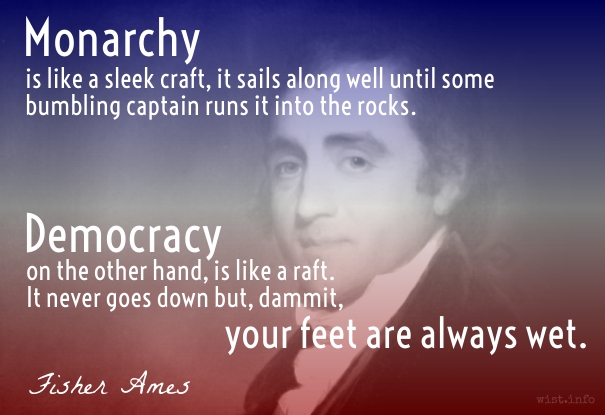
Monarchy is like a sleek craft, it sails along well until some bumbling captain runs it into the rocks. Democracy, on the other hand, is like a raft. It never goes down but, dammit, your feet are always wet.
Fisher Ames (1758–1808) American politician, orator
(Attributed)
This is the earliest reference I can find to this metaphor. Variants:
- "A monarchy is a merchantman which sails well, but will sometimes strike on a rock and go to the bottom; a republic is a raft which will never sink, but then your feet are always in the water." This variant is often attributed to a speech in the House of Representatives in 1795, but is not found in records of Ames' speeches.
- "A monarchy is like a man-of-war -- bad shots between wind and water hurt it exceedingly; there is danger of capsizing. But democracy is a raft. You cannot easily overturn it. It is a wet place, but it is a pretty safe one." -- Joseph Cook (1860-1947) Anglo-Australian politician
- "Dictatorship is like a big proud ship -- steaming away across the ocean with a great hulk and powerful engines driving it. It’s going fast and strong and looks like nothing could stop it. What happens? Your fine ship strikes something -- under the surface. Maybe it’s a mine or a reef, maybe it’s a torpedo or an iceberg. And your wonderful ship sinks. Now take democracy. It’s like riding on a raft, a rickety raft that was put together in a hurry. We get tossed about on the waves, it’s bad going and our feet are always wet. But that raft doesn’t sink … It’s the raft that will get to the shore at last." --- Roaldus Richmond (fl. 1940) American writer. In, ed., "A Yankee Businessman in New Hampshire," American Life Histories: Manuscripts from the Federal Writers Project, 1936-1940.
- "Democracy is like a raft: It won't sink, but you will always have your feet wet." -- Russell B. Long (1918-2003) American politician
- "But you have to understand, American democracy is not like the system you have. We're not an ocean liner that sails across the ocean from point A to point B at 30 knots. That's not American democracy. American democracy is kind of like a life raft that bobs around the ocean all the time. Your feet are always wet. Winds are always blowing. You're cold. You're wet. You're uncomfortable -- but you never sink." -- Colin Powell (b. 1937) American politician, diplomat, soldier

The welfare of the people in particular has always been the alibi of tyrants, and it provides the further advantage of giving the servants of tyranny a good conscience. It would be easy, however, to destroy that good conscience by shouting to them: if you want the happiness of the people, let them speak out and tell what kind of happiness they want and what kind they don’t want! But, in truth, the very ones who make use of such alibis know they are lies; they leave to their intellectuals on duty the chore of believing in them and of proving that religion, patriotism, and justice need for their survival the sacrifice of freedom.
Albert Camus (1913–1960) Algerian-French novelist, essayist, playwright
“Homage to an Exile” (1955)
Published as an essay in Actuelles III, originally a speech (7 Dec 1955) at a banquet in honor of President Eduardo Santos, editor of El Tiempo, driven out of Columbia by a dictatorship". Reprinted in Resistance, Rebellion, and Death (1960).
If I had to choose, I should detest the tyranny of one man less than that of many. A despot always has his good moments; an assembly of despots never.
Voltaire (1694–1778) French writer [pseud. of Francois-Marie Arouet]
Philosophical Dictionary, “Tyranny” (1764) [tr. Gay (1962)]
(Source)

Every dictatorship has ultimately strangled in the web of repression it wove for its people, making mistakes that could not be corrected because criticism was prohibited.
Robert Francis Kennedy (1925–1968) American politician
“Value of Dissent,” speech, Nashville, Tennessee (21 Mar 1968)

Dictatorships foster oppression, dictatorships foster servitude, dictatorships foster cruelty; more abominable is the fact that they foster idiocy.
[Las dictaduras fomentan la opresión, las dictaduras fomentan el servilismo, las dictaduras fomentan la cureldad; más abominable es el hecho de que fomentan la idiotez.]
Jorge Luis Borges (1899–1986) Argentine writer
Speech (1946), “Hurry, Hurry [De’le, De’le],” Argentine Society of Letters [JLB 57]
(Source)
(Source (Spanish)). Given at a dinner in his honor after he had been fired from his library position by the new Juan Peron government for having signed a pro-democracy statement, and then appointed as a regional poultry and rabbit inspector.

I have heard, in such a way as to believe it, of your recently saying that both the Army and the Government needed a Dictator. Of course it was not for this, but spite of it, that I have given you the command. Only those generals who gain successes, can set up dictators. What I now ask of you is military success, and I will risk the dictatorship.
Abraham Lincoln (1809–1865) American lawyer, politician, US President (1861–65)
Letter (1863-01-26) to Gen. Joseph Hooker
(Source)

It is important, likewise, that the habits of thinking in a free country should inspire caution in those intrusted with its administration to confine themselves within their respective constitutional spheres, avoiding in the exercise of the powers of one department to encroach upon another. The spirit of encroachment tends to consolidate the powers of all the departments in one, and thus to create, whatever the form of government, a real despotism. A just estimate of that love of power and proneness to abuse it which predominates in the human heart is sufficient to satisfy us of the truth of this position.
George Washington (1732–1799) American military leader, Founding Father, US President (1789–1797)
Essay (1796-09-18), “Farewell Address,” Claypoole’s American Daily Advertiser, Philadelphia
(Source)
The original draft of "The Address of Gen. Washington to the People of America on His Declining the Presidency of the United States" was by James Madison in June 1792. At the end of his second term, Washington, with the help of Alexander Hamilton, revised it for release and publication.

The difference between a Democracy and a Dictatorship is that in a Democracy you vote first and take orders later; in a Dictatorship you don’t have to waste your time voting.
Charles Bukowski (1920–1994) German-American author, poet
Erections, Ejaculations, Exhibitions and Tales of Ordinary Madness (1972)
(Source)
