

And now here I was, in a country where a right to say how the country should be governed was restricted to six persons in each thousand of its population. For the nine hundred and ninety-four to express dissatisfaction with the regnant system and propose to change it, would have made the whole six shudder as one man, it would have been so disloyal, so dishonorable, such putrid black treason. So to speak, I was become a stockholder in a corporation where nine hundred and ninety-four of the members furnished all the money and did all the work, and the other six elected themselves a permanent board of direction and took all the dividends. It seemed to me that what the nine hundred and ninety-four dupes needed was a new deal.
Mark Twain (1835–1910) American writer [pseud. of Samuel Clemens]
Novel (1889), A Connecticut Yankee in King Arthur’s Court, Part 3 “The Tale of the Lost Land,” ch. 13 “Freemen!”
(Source)
Quotations about:
aristocracy
Note not all quotations have been tagged, so Search may find additional quotes on this topic.
My lords, you are highly placed. It is well. We must believe that God has his reasons that it should be so. You have power, opulence, pleasure, the sun ever shining in your zenith, authority unbounded, enjoyment without a sting, and a total forgetfulness of others. So be it. But there is something below you — above you, it may be. My lords, I bring you news — news of the existence of mankind.
[Mylords, vous êtes en haut. C’est bien. Il faut croire que Dieu a ses raisons pour cela. Vous avez le pouvoir, l’opulence, la joie, le soleil immobile à votre zénith, l’autorité sans borne, la jouissance sans partage, l’immense oubli des autres. Soit. Mais il y a au-dessous de vous quelque chose. Au-dessus peut-être. Mylords, je viens vous apprendre une nouvelle. Le genre humain existe.]
Victor Hugo (1802–1885) French writer, journalist, human rights activist, politician
The Man Who Laughs [L’Homme qui rit; The Laughing Man; By Order of the King], Part 2, Book 8, ch. 7 (2.8.7) (1869) [tr. Steele (Auth.) (1871)]
(Source)
Gwynpaine addressing the House of Lords.
(Source (French)). Other translations:My lords, you are highly placed. It is well. We must believe that God has his reasons that it should be so. You have power, opulence, pleasure, the sun ever shining in your zenith, authority unbounded, enjoyment without a sting, and a total forgetfulness of others. So be it. But there is something below you -- above you, may be. My lords, I bring you news, -- news of the existence of mankind.
[tr. Steele (1869)]My lords, you are on high. 'Tis well. We must believe that God hath his reasons for this. You have power, opulence, joy, the sun motionless in your zenith, authority without limit, enjoyment undivided, immense forgetfulness of others. But there is something below you; above, perhaps. My lords, I am come to tell you some news. The human race exists.
[tr. Hapgood (1888)]My Lords, you are loftily placed. It is well. We must believe that God has his reasons for this. You have power, opulence, joy, the sun always motionless at your zenith, unbounded authority, undivided enjoyment, an immense oblivion of all others. So be it. But there is something beneath you. Above you, too, perhaps. My Lords, I come to tell you news. The human race exists.
[tr. Phillips (1894)]Mylords, you are upstairs. That is good. You must believe that God has his reasons for this. You have power, opulence, joy, the sun standing still at your zenith, unbounded authority, undivided enjoyment, immense forgetfulness of others. So be it. But there is somthing below you. Above perhaps. Mylords, I have come to tell you some news. The human race exists.
[tr. Lavelle (2003)]

I am one who has come up out of the depths. My lords, you are rich and powerful. Therein lies your danger. You profit by the night; but beware! The Dawn is all-powerful. You cannot prevail over that. It is coming. Nay! it is already come. Within it is the day-spring of irresistible light. And who shall hinder that sling from hurling the sun into the sky? The sun I speak of is Right. You are Privilege. Tremble!
[Je suis celui qui vient des profondeurs. Mylords, vous êtes les grands et les riches. C’est périlleux. Vous profitez de la nuit. Mais prenez garde, il y a une grande puissance, l’aurore. L’aube ne peut être vaincue. Elle arrivera. Elle arrive. Elle a en elle le jet du jour irrésistible. Et qui empêchera cette fronde de jeter le soleil dans le ciel? Le soleil, c’est le droit. Vous, vous êtes le privilège. Ayez peur.]
Victor Hugo (1802–1885) French writer, journalist, human rights activist, politician
The Man Who Laughs [L’Homme qui rit; The Laughing Man; By Order of the King], Part 2, Book 8, ch. 7 (2.8.7) (1869) [tr. Unknown (1869)]
(Source)
Gwynplaine addressing the House of Lords.
(Source (French)). Other translations:I am he who cometh out of the depths. My lords, you are great and rich. There lies your danger. You profit by the night; but beware! The Dawn is all-powerful. You cannot prevail over it. It is coming. Nay! it is come. Within it is the day-spring of irresistible light. And who shall hinder that sling from hurling the sun into the sky? The sun I speak of is Right. You are Privilege. Tremble!
[tr. Unknown, Authorized (1871)]I am he who comes from the depths. My Lords, you are the great and the rich. This is perilous. You profit by the night. But have a care, there is a great power, -- the dawn. The dawn cannot be vanquished. It will come. It is coming. It has within it the irresistable light of day. And who shall prevent this sling from hurling the sun into the sky? The sun means the Right. You are Privilege. Be afraid.
[tr. Hapgood (1888)]I am he who comes from the depths. My Lords, you are the great and the rich. That is perilous. You take advantage of darkness. But take care, there is a great power, dawn. Daybreak cannot be conquered. It will come. It is coming. The irresistable ray of daylight is within it. And who will hinder that sling from hurling the sun into the sky? The sun, is Man's Right. You -- you are Privilege. You may well be afraid.
[tr. Phillips (1894)]I am he who comes from the depths. My lords, you are the great and the rich. It is perilous. You take advantage of the night. But beware, there is a great power, the dawn. The dawn cannot be defeated. It will come. It is coming. It has in it the irresistible throw of the day. And who will stop this slingshot from throwing the sun into the sky? The sun is the right. You, you are the privilege. Be afraid.
[tr. Lavelle (2003)]
Robbers must exalted be,
Small ones on the Gallow-Tree,
While greater ones ascend to Thrones,
But what is that to thee or me?Benjamin Franklin (1706–1790) American statesman, scientist, philosopher, aphorist
Poor Richard Improved (1748 ed.)
(Source)
Well, I liked the king, and as king I respected him — respected the office; at least respected it as much as I was capable of respecting any unearned supremacy; but as MEN I looked down upon him and his nobles — privately. And he and they liked me, and respected my office; but as an animal, without birth or sham title, they looked down upon me — and were not particularly private about it, either. I didn’t charge for my opinion about them, and they didn’t charge for their opinion about me: the account was square, the books balanced, everybody was satisfied.
Mark Twain (1835–1910) American writer [pseud. of Samuel Clemens]
Novel (1889), A Connecticut Yankee in King Arthur’s Court, Part 3 “The Tale of the Lost Land,” ch. 8 “The Boss”
(Source)
Your “ἄρiςτοi” [aristocrats] are the most difficult Animals to manage, of any thing in the whole Theory and practice of Government. They will not Suffer themselves to be governed. They not only exert all their own Subtilty Industry and courage, but they employ the Commonalty, to knock to pieces every Plan and Model that the most honest Architects in Legislation can invent to keep them within bounds.
John Adams (1735–1826) American lawyer, Founder, statesman; US President (1797–1801)
Letter (1813-07-09) to Thomas Jefferson
(Source)
The question as to whether there is such a thing as divine right of kings is not settled in this book. It was found too difficult. That the executive head of a nation should be a person of lofty character and extraordinary ability, was manifest and indisputable; that none but the Deity could select that head unerringly, was also manifest and indisputable; that the Deity ought to make that selection, then, was likewise manifest and indisputable; consequently, that He does make it, as claimed, was an unavoidable deduction. I mean, until the author of this book encountered the Pompadour, and Lady Castlemaine, and some other executive heads of that kind; these were found so difficult to work into the scheme, that it was judged better to take the other tack in this book (which must be issued this fall), and then go into training and settle the question in another book. It is, of course, a thing which ought to be settled, and I am not going to have anything particular to do next winter anyway.
Mark Twain (1835–1910) American writer [pseud. of Samuel Clemens]
Novel (1889), A Connecticut Yankee in King Arthur’s Court, Preface
(Source)
“Their vanity is full of phantoms which move as in a sublime night, armed with helm and cuirass, spurs on their heels and the sceptres in their hands, saying in a grave voice, ‘We are the ancestors!’ The canker-worms eat the roots, and panoplies eat the people. Why not? Are we to change the laws? The peerage is part of the order of society. Do you know that there is a duke in Scotland who can ride ninety miles without leaving his own estate? Do you know that the Archbishop of Canterbury has a revenue of £40,000 a year? Do you know that her Majesty has £700,000 sterling from the civil list, besides castles, forests, domains, fiefs, tenancies, freeholds, prebendaries, tithes, rent, confiscations, and fines, which bring in over a million sterling? Those who are not satisfied are hard to please.”
“Yes,” murmured Gwynplaine sadly, “the paradise of the rich is made out of the hell of the poor.”— Leur vanité est pleine de fantômes qui s’y promènent comme dans une nuit sublime, armés, casqués, cuirassés, éperonnés, le bâton d’empire à la main, et disant d’une voix grave: Nous sommes les aïeux ! Les scarabées mangent les racines, et les panoplies mangent le peuple. Pourquoi pas? Allons-nous changer les lois? La seigneurie fait partie de l’ordre. Sais-tu qu’il y a un duc en Écosse qui galope trente lieues sans sortir de chez lui? Sais-tu que le lord archevêque de Canterbury a un million de Francs de revenu? Sais-tu que sa majesté a par an sept cent mille livres sterling de liste civile, sans compter les châteaux, forêts, domaines, fiefs, tenances, alleux, prébendes, dîmes et redevances, confiscations et amendes, qui dépassent un million sterling ? Ceux qui ne sont pas contents sont difficiles.
— Oui, murmura Gwynplaine pensif, c’est de l’enfer des pauvres qu’est fait le paradis des riches.
Victor Hugo (1802–1885) French writer, journalist, human rights activist, politician
The Man Who Laughs [L’Homme qui rit; The Laughing Man; By Order of the King], Part 2, Book 2, ch. 11 (2.2.11) (1869) [Authorized trans. (1871)]
(Source)
Ursus and Gwynplaine, at the end of the former's 11-page rant about the rich and powerful.
(Source (French)). Other translations:"Their vanity is full of phantoms which move as in a sublime night, armed with helm and cuirass, spurs on their heels and sceptres in their hands, saying in a grave voice, 'We are the ancestors!' Canker-worms eat the roots, and panoplies eat the people. Why not? Can we expect to change the laws? The peerage is part of the order of society. Do you know that there is a duke in Scotland who can ride ninety miles without leaving his own estate? Do you know that the Archbishop of Canterbury has a revenue of £40,000 a year? Do you know that her Majesty has £700,000 sterling from the civil list, besides castles, forests, domains, fiefs, tenancies, freeholds, prebendaries, tithes, rent, confiscations, and fines, which bring in over a million sterling? Those who are not satisfied are hard to please."
"Yes," murmured Gwynplaine, sadly; "the paradise of the rich is made out of the hell of the poor."
[tr. Unknown (1869)]"Their vanity is full of phantoms, which stalk therein as in a sublime night, armed, helmed, cuirassed, spurred, the wand of empire in their hands, and saying in a grave voice: 'We are ancestors!' Beetles devour roots, and panoplies of armor devour peoples. Why not? Shall we change the laws? The lords form part of order. Do you know that there is a duke in Scotland who can gallop thirty leagues without leaving his own domains? Do you know that the Lord Archbishop of Canterbury has an income of a million francs of France? Do you know that her majesty has seven hundred thousand pounds sterling a year from the civil list, not reckoning castles, forests, domains, fiefs, tenancies, allodial tenures, prebendary ships, tithes, and quitrents, confiscations and fines, which exceed a million sterling. Those who are not content are hard to suit."
"Yes," muttered Gwynplaine, thoughtfully, "it is of the hell of the poor that the paradise of the rich is made."
[tr. Hapgood (1888)]"Their vanity is full of phantoms which walk about in it, as in a sublime night, armed, helmeted, cuirassed, spurred, the staff of empire in their hands, and saying in a grave voice: 'We are the ancestors!' Beetles devour roots, and panoplies devour the people. Why not? Are we going to change the laws? The lords form a part of the order of things. Do you know that there is a duke in Scotland who can gallop thirty leagues without leaving his own land? Do you know that the Lord Archbishop of Canterbury has a revenue of a million French francs? Do you know that Her Majesty has seven hundred thousand pounds sterling of civil list a year, without counting castles, forests, domains, fiefs, tenancies, freeholds, prebendaries, tithes and dues, confiscations and fines which exceed a million sterling? Those who are not satisfied, are hard to please."
"Yes," murmured Gwymplaine, thoughtfully. "The paradise of the rich is made out of the hell of the poor."
[tr. Phillips (1894)]"Their vanity is full of ghosts who walk there as in a sublime night, armed, helmeted, cuirassed, spurred, with the staff of empire in their hands, and sayin with a grave voice: 'We are the forefathers!' The beetles eat the roots, and the panoplies eat the people. Why not? Shall we change the laws? The lordship is part of the order. Do you know that there is a duke in Scotland who gallops thirty leagues without leaving his house? Do you know that the Lord Archbishop of Canterbury has an income of a million French? Do you know that his majesty has a yearly civil list of seven hundred thousand pounds sterling, not counting castles, forests, estates, fiefs, tenements, alleys, prebends, tithes and dues, confiscations and fines, which exceed one million sterling? Those who are not happy are difficult."
"Yes," murmured Gwynplaine thoughtfully, "from the hell of the poor is made the paradise of the rich.
[tr. Lavelle (2003)]

Liberty, under every conceivable Form of Government is always in Danger. It is so even under a simple, or perfect Democracy, more so under a mixed Government, like the Republic of Rome, and still more so under a limited Monarchy.
John Adams (1735–1826) American lawyer, Founder, statesman; US President (1797–1801)
Diary (1772, Spring), “Notes for a Oration at Braintree”
(Source)
Sometimes Kings have courted the People in Opposition to the Nobles. At other Times the Nobles have united with the People in Opposition to Kings. But Kings and Nobles have much oftener combined together, to crush, to humble and to Fleece the People.
John Adams (1735–1826) American lawyer, Founder, statesman; US President (1797–1801)
Diary (1772, Spring), “Notes for a Oration at Braintree”
(Source)
Rank without merit earns deference without respect.
[L’importance sans mérite obtient des égards sans estime.]
Nicolas Chamfort (1741–1794) French writer, epigrammist (b. Nicolas-Sébastien Roch)
Products of Perfected Civilization [Produits de la Civilisation Perfectionée], Part 1 “Maxims and Thoughts [Maximes et Pensées],” ch. 1, ¶ 60 (1795) [tr. Merwin (1969)]
(Source)
(Source (French)). Other translations:Eminence without merit earns deference without esteem.
[tr. Mathers (1926)]Being important without merit attracts consideration without esteem.
[tr. Siniscalchi (1994)]

In short, the contradiction in the old defense of class stratification is that it defends leisure for the leisure class, but not for the underclass. With reference to the underclass, leisure is said to destroy the incentive to work, leads to slothfulness and self-indulgence, and retards cognitive and moral development. When applied to the leisure class, the concept evokes an image of Plato and Aristotle, whose leisure was based on slave labor, creating the intellectual foundations of Western civilization; or patrician slave-owners like Washington and Jefferson laying the foundations of American civilization; or creative aristocrats like Count Leo Tolstoy or Bertrand, Earl Russell; or, even closer to home, of our own sons and daughters (or of ourselves, when we were young adults) being freed from the stultifying tasks of earning a living until well into our adult years so that we could study in expensive universities to gain specialized knowledge and skills.
James Gilligan (b. c. 1936) American psychiatrist and author
Preventing Violence, ch. 5 (2001)
(Source)

It is in vain to Say that Democracy is less vain, less proud, less selfish, less ambitious or less avaricious than Aristocracy or Monarchy. It is not true in Fact and no where appears in history. Those Passions are the same in all Men under all forms of Simple Government, and when unchecked, produce the same Effects of Fraud Violence and Cruelty. When clear Prospects are opened before Vanity, Pride, Avarice or Ambition, for their easy gratification, it is hard for the most considerate Phylosophers and the most conscientious Moralists to resist the temptation. Individuals have conquered themselves, Nations and large Bodies of Men, never.
John Adams (1735–1826) American lawyer, Founder, statesman; US President (1797–1801)
Letter (1814-12-17) to John Taylor
(Source)
These women were fatuous with a fatuity which had threatened her all her life, as it threatened all people of means, and which was of mournful significance for humanity in general, since it proved the emptiness of one of man’s most reasonable expectations. No more sensible form of government could be imagined than aristocracy. If certain able stocks in the community were able to amass enough wealth to give their descendants beautiful houses to grow up in, the widest opportunities of education, complete economic security, so that they need never be influenced by mercenary considerations, and easy access to any public form of work they chose to undertake — why, then, the community had a race of perfect governors ready made.
Only, as the Lauristons showed, the process worked out wholly different in practice. There came to these selected stocks a deadly, ungrateful complacence, which made them count these opportunities as their achievements, and belittle everybody else’s achievements unless they were similarly confused with opportunities; and which did worse than this, by abolishing all standards from their minds except what they themselves were and did.
Rebecca West (1892–1983) British author, journalist, literary critic, travel writer [pseud. for Cicily Isabel Fairfield]
The Thinking Reed, ch. 7 (1936)

I believe in aristocracy, though — if that is the right word, and if a democrat may use it. Not an aristocracy of power, based upon rank and influence, but an aristocracy of the sensitive, the considerate and the plucky. Its members are to be found in all nations and classes, and all through the ages, and there is a secret understanding between them when they meet. They represent the true human tradition, the one permanent victory of our queer race over cruelty and chaos. Thousands of them perish in obscurity, a few are great names. They are sensitive for others as well as for themselves, they are considerate without being fussy, their pluck is not swankiness but the power to endure, and they can take a joke.
Because a body of men holding themselves accountable to nobody, ought not to be trusted by anybody.
Thomas Paine (1737–1809) American political philosopher and writer
Rights of Man (1791)
(Source)
Reason Four why an aristocratic body of hereditary legislators (such as the United Kingdom's House of Lords) is a bad idea.


In reality, the likelihood of reaching the pinnacle of capitalist society today is only marginally better than were the chances of being accepted into the French nobility four centuries ago, though at least an aristocratic age was franker, and therefore kinder, about the odds. It did not relentlessly play up the possibilities open to all, … and so, in turn, did not cruelly equate an ordinary life with a failed one.
Alain de Botton (b. 1969) Swiss-British author
The Pleasures and Sorrows of Work, ch. 9 “Entrepreneurship” (2009)
(Source)

The surface of American society is, if I may use the expression, covered with a layer of democracy, from beneath which the old aristocratic colors sometimes peep.
Alexis de Tocqueville (1805–1859) French writer, diplomat, politician
Democracy in America, ch. 2 (1835) [tr. Reeve (1899)]
(Source)Other translations:
- As above, but given as "... sometimes seep."
- "American society, if I may put it this way, is like a painting that is democratic on the surface but from time to time allows the old acistocratic colors to peep through." [tr. Goldhammer (2004)]
- "The surface of American society is covered with a layer of democratic paint, but from time to time one can see the old aristocratic colors breaking through."
I do not say that Democracy has been more pernicious, on the whole, and in the long run, than Monarchy or Aristocracy. Democracy has never been and never can be so durable as Aristocracy or Monarchy. But while it lasts it is more bloody than either. […] Remember Democracy never lasts long. It soon wastes exhausts and murders itself. There never was a Democracy Yet, that did not commit suicide.
John Adams (1735–1826) American lawyer, Founder, statesman; US President (1797–1801)
Letter (1814-12-17) to John Taylor
(Source)
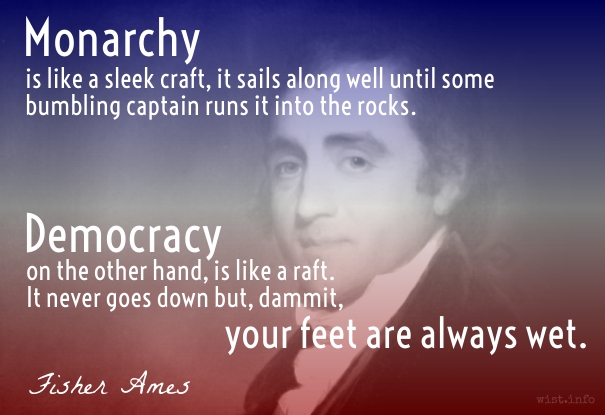
Monarchy is like a sleek craft, it sails along well until some bumbling captain runs it into the rocks. Democracy, on the other hand, is like a raft. It never goes down but, dammit, your feet are always wet.
Fisher Ames (1758–1808) American politician, orator
(Attributed)
This is the earliest reference I can find to this metaphor. Variants:
- "A monarchy is a merchantman which sails well, but will sometimes strike on a rock and go to the bottom; a republic is a raft which will never sink, but then your feet are always in the water." This variant is often attributed to a speech in the House of Representatives in 1795, but is not found in records of Ames' speeches.
- "A monarchy is like a man-of-war -- bad shots between wind and water hurt it exceedingly; there is danger of capsizing. But democracy is a raft. You cannot easily overturn it. It is a wet place, but it is a pretty safe one." -- Joseph Cook (1860-1947) Anglo-Australian politician
- "Dictatorship is like a big proud ship -- steaming away across the ocean with a great hulk and powerful engines driving it. It’s going fast and strong and looks like nothing could stop it. What happens? Your fine ship strikes something -- under the surface. Maybe it’s a mine or a reef, maybe it’s a torpedo or an iceberg. And your wonderful ship sinks. Now take democracy. It’s like riding on a raft, a rickety raft that was put together in a hurry. We get tossed about on the waves, it’s bad going and our feet are always wet. But that raft doesn’t sink … It’s the raft that will get to the shore at last." --- Roaldus Richmond (fl. 1940) American writer. In, ed., "A Yankee Businessman in New Hampshire," American Life Histories: Manuscripts from the Federal Writers Project, 1936-1940.
- "Democracy is like a raft: It won't sink, but you will always have your feet wet." -- Russell B. Long (1918-2003) American politician
- "But you have to understand, American democracy is not like the system you have. We're not an ocean liner that sails across the ocean from point A to point B at 30 knots. That's not American democracy. American democracy is kind of like a life raft that bobs around the ocean all the time. Your feet are always wet. Winds are always blowing. You're cold. You're wet. You're uncomfortable -- but you never sink." -- Colin Powell (b. 1937) American politician, diplomat, soldier
The fundamental Article of my political Creed is, that Despotism, or unlimited Sovereignty, or absolute Power is the Same in a Majority of a popular Assembly, an Aristocratical Counsel, an Oligarchical Junto and a Single Emperor. Equally arbitrary cruel bloody and in every respect, diabolical.
John Adams (1735–1826) American lawyer, Founder, statesman; US President (1797–1801)
Letter (1815-11-13) to Thomas Jefferson
(Source)