

The laws of conscience, which we pretend to be derived from nature, proceed from custom; every one, having an inward veneration for the opinions and manners approved and received among his own people, cannot, without very great reluctance, depart from them, nor apply himself to them without applause.
[Les loix de la conscience, que nous disons naistre de nature, naissent de la coustume : chacun ayant en veneration interne les opinions & mœurs approuvees & receues autour de luy, ne s’en peut desprendre sans remors, ny s’y appliquer sans applaudissement.]
Michel de Montaigne (1533–1592) French essayist
Essays, Book 1, ch. 22 (1.22), “Of Custom and Not Easily Changing an Accepted Law [De la Coustume et de Ne Changer Aisément une Loy Receüe]” (1572) [tr. Cotton/Hazlitt (1877)]
(Source)
The essay was in the 1st (1580) edition, but this passage was written in or after 1588, showing up in the final (1588) edition.
Some translators use the 1588 sequence of chapters, not the 1595, and so identify this as ch. 23.
(Source (French)). Alternate translations:The lawes of conscience, which we say to proceede from nature, rise and proceede of custome: every man holding in speciall regard, and inward veneration the opinions approved, and customes received about him, can not without remorse leave them, nor without applause applie himselfe unto them.
[tr. Florio (1603)]The Laws of Conscience, which we pretend to be deriv’d from Nature, proceed from Custom; every one having an inward Veneration for the Opinions and Manners, approv’d and receiv’d amongst his own People, cannot without very great Reluctancy depart from them, nor apply himself to them without applause.
[tr. Cotton (1686)]The laws of conscience, which we say are engendered by nature, are born of custom; every man, holding in inward veneration the opinions and fashions approved and received around him, can not depart from them without [self] upbraiding, or conform to them without [self] commendation.
[tr. Ives (1925), 1.23]The laws of conscience, which we say are born of nature, are born of custom. Each man, holding in inward veneration the opinions and the behavior approved and accepted around him, cannot break loose from them without remorse, or apply himself to them without self-satisfaction.
[tr. Frame (1943), 1.23]The laws of conscience which we say are born of Nature are born of custom; since man inwardly venerates the opinions and the manners approved and received about him, he cannot without remorse free himself from them nor apply himself to them without self-approbation.
[tr. Screech (1987), 1.23]
Quotations about:
mores
Note not all quotations have been tagged, so Search may find additional quotes on this topic.

The first sign of corrupt morals is the banishing of truth.
[Le premier traict de la corruption des mœurs, c’est le bannissement de la verité]
Michel de Montaigne (1533–1592) French essayist
Essays, Book 2, ch. 18 (2.18), “Of Giving the Lie [Du Démentir]” (1578–79) [tr. Screech (1987)]
(Source)
This essay (and this passage) appeared in the 1st (1580) edition, and was expanded in each succeeding edition.
(Source (French)). Alternate translations:The first part of customs-corruption, is the banishment of truth.
[tr. Florio (1603)]The first step to the corruption of manners is banishing of truth.
[tr. Cotton (1686)]The first thing done in the corruption of manners is banishing truth.
[tr. Cotton/Hazlitt (1877)]The first feature of corruption of morals is the banishment of truth.
[tr. Ives (1925)]The first feature in the corruption of morals is the banishment of truth.
[tr. Zeitlin (1934)]The first stage in the corruption of morals is the banishment of truth.
[tr. Frame (1943)]
We have said that the laws were the particular and precise institutions of a legislator, and manners and customs the institutions of a nation in general. Hence it follows that when these manners and customs are to be changed, it ought not to be done by laws; this would have too much the air of tyranny: it would be better to change them by introducing other manners and other customs.
[Nous avons dit que les loix étoient des institutions particulieres & précises du législateur, & les mœurs & les manieres des institutions de la nation en général. De-là il suit que, lorsque l’on veut changer les mœurs & les manieres, il ne faut pas les changer par les loix ; cela paroîtroit trop tyrannique: il vaut mieux les changer par d’autres mœurs & d’autres manieres.]
Charles-Lewis de Secondat, Baron de Montesquieu (1689–1755) French political philosopher
Spirit of Laws [The Spirit of the Laws; De l’esprit des lois], Book 19, ch. 14 (1748) [tr. Nugent (1750)]
(Source)
(Source (French)). Other translations:We have said that the laws were the particular and precise institutions of the legislator and the mores and manners, the instructions of the nation in general. From this it follows that when one wants to change the mores and manners, one must not change them by the law, as this would appear to be too tyrannical; it would be better to change them by other mores and other manners.
[tr. Cohler/Miller/Stone (1989)]We have said that laws were particular and precise institutions of the legislator, and the morals and the manners institutions of the nation as a whole. Whence it follows that when you want to change morals and manners, you should not do it by laws, which would appear too tyrannical; it is better to change them with other morals and manners.
[tr. Stewart (2018)]

When a society abandons its ideals just because most people can’t live up to them, behavior gets very ugly indeed.

The total moral collapse of respectable society during the Hitler regime may teach us that under such circumstances those who cherish values and hold fast to moral norms and standards are not reliable: we now know that moral norms and standards can be changed overnight, and that all that then will be left is the mere habit of holding fast to something.
Much more reliable will be the doubters and skeptics, not because skepticism is good or doubting wholesome, but because they are used to examine things and to make up their own minds.
Best of all will be those who know only one thing for certain: that whatever else happens, as long as we live we shall have to live together with ourselves.

Culture eats strategy for breakfast.
Peter F. Drucker (1909–2005) Austrian-American business consultant
(Attributed)
Frequently attributed to Drucker, but not found in his writings. See here for more discussion.


When once the forms of civility are violated, there remains little hope of return to kindness or decency.
Samuel Johnson (1709–1784) English writer, lexicographer, critic
Essay (1750-09-25), The Rambler, No. 50
(Source)
Couched as a letter to the paper from a woman.

What once were vices, are now the manners of the day.
Seneca the Younger (c. 4 BC-AD 65) Roman statesman, philosopher, playwright [Lucius Annaeus Seneca]
Moral Letters to Lucilius [Epistulae morales ad Lucilium], Letter 109

I never expected to see the day when girls would get sunburned in the places they do today.
Will Rogers (1879–1935) American humorist
(Misattributed)
Widely attributed to Rogers, but I was unable to find it in any published primary source. That's because it appears to have been said by a different Will Rogers.
In The Pathfinder, "Art of Wisecracking Takes on New Significance," Issue 1866 (1929-10-05), the results of "Wisecrack Contest" among the weekly periodical's readers provides the following second place winner (earning it $10).Grandpa Wayback rises to remark: “I never expected to live to see the day when the girls would get sunburned on the places they do now.” Won by Will B. Rogers, Atlanta, Ga
That is not the famous Oklahoman humorist (William Penn Adair Rogers), though the latter is mentioned (along with Ring Lardner) in the text of the story as a famous wisecracker.
This appears to be the origin of the quotation, and an explanation as to why it was quickly associated with the more famous figure by that name, an association that occurred very quickly when the Rogers from Georgia was forgotten.
Variants (mostly attributed to Rogers):I never expected to see the day when the girls would get sunburned in the places they do now.
[Albert Shaw, ed., Review of Reviews (1935-02)]I never expected to see the day when girls would get sunburned in the places they do.
[P.G. Wodehouse & Guy Bolton, Bring on the Girls: The Improbable Story of Our Life in Musical Comedy (1953)]Few men expected to see the day when women would get sunburned in the places they do now.
[Louis T. Stanley, The London Season, "Feminine Wiles" (1956), used without attribution to Rogers]I never expected to see the day when the girls would get sunburned in the places they do now.
[John Birch Society, American Opinion, Vol. 4 (1961)]

In olden days, a glimpse of stocking
Was looked on as something shocking,
But now, God knows,
Anything goes.
Cole Porter (1891–1964) American composer and songwriter
“Anything Goes” (1934)

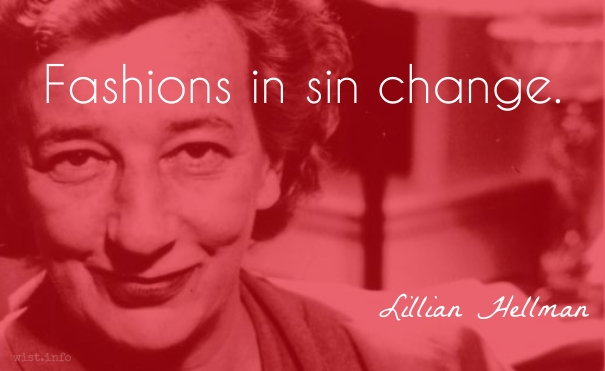
Fashions in sin change.
Lillian Hellman (1905–1984) American playwright, screenwriter
Watch on the Rhine (1941)

Times change. The vices of your age are stylish today.
Aristophanes (c. 450-c. 388 BC) Athenian comedic playwright
The Clouds, l. 914 (c. 423 BC) [tr. Arrowsmith (1962)]
This phrase comes from a single translation, by William Arrowsmith (1962), of Aristophanes, The Clouds, l. 914. It is the only translation that includes anything like that:[909] Philosophy: Why, you Precocious Pederast! You Palpable Pervert!
[910] Sophistry: Pelt me with roses!
[910] Philosophy: You Toadstool! O Cesspool!
[911] Sophistry: Wreath my hairs with lilies!
[911] Philosophy: Why, you Parricide!
[912] Sophistry: Shower me with gold! Look, don't you see I welcome your abuse?
[913] Philosophy: Welcome it, monster? In my day we would have cringed with shame.
[914] Sophistry: Whereas now we're flattered. Times change. The vices of your age are stylish today.
Compare to Hickey (1853):[909] Just Cause: You are debauched and shameless.
[910] Unjust Cause: You have spoken roses of me.
[910] Just Cause: And a dirty lickspittle.
[911] Unjust Cause: You crown me with lilies.
[911] Just Cause: And a parricide.
[912] Unjust Cause: You don't know that you are sprinkling me with gold.
[913] Just Cause: Certainly not so formerly, but with lead.
[914] Unjust Cause: But now this is an ornament to me.

There is no virtue which is final; all are initial. The virtues of society are the vices of the saint. The terror of reform is the discovery that we must cast away our virtues, or what we have always esteemed such, into the same pit that has consumed our grosser vices.
Ralph Waldo Emerson (1803–1882) American essayist, lecturer, poet
Essay (1841), “Circles,” Essays: First Series, No. 10
(Source)

Ben, the ethics of sex is a thorny problem. Each of us is forced to grope for a solution he can live with — in the face of a preposterous, unworkable, and evil code of so-called ‘morals.’ Most of us know the code is wrong; almost everybody breaks it. But we pay Danegeld by feeling guilty and giving lip service. Willy-nilly, the code rides us, dead and stinking, an albatross around the neck.
Robert A. Heinlein (1907–1988) American writer
Stranger in a Strange Land [Jubal] (1961)
(Source)
In the 1960 "uncut" edition, the passage reads as: "Ben, the ethics of sex is a thorny problem because each of us has to find a solution pragmatically compatible with a preposterous, utterly unworkable, and evil public code of so-called "morals." Most of us know, or suspect, that the public code is wrong, and we break it. Nevertheless we pay Danegeld by giving it lip service in public and feeling guilty about breaking it in private. Willy-nilly, that code rides us, dead and stinking, an albatross around the neck."

Once again prosperous and successful crime goes by the name of virtue; good men obey the bad, might is right and fear oppresses law.
Seneca the Younger (c. 4 BC-AD 65) Roman statesman, philosopher, playwright [Lucius Annaeus Seneca]
Hercules Furens, Part 1, l.255 [Amphitryon] [tr. Miller (1917)]
(Source)
Other translations: "Successful and fortunate crime is called virtue."