For this reason, mixing with men is wonderfully useful, and visiting foreign countries […] to bring back knowledge of the characters and ways of those nations, and to rub and polish our brains by contact with those of others.
[A cette cause le commerce des hommes y est merveilleusement propre, & la visite des pays estrangers […] pour en rapporter principalement les humeurs de ces nations & leurs façons : & pour frotter & limer nostre cervelle contre celle d’autruy.]
Michel de Montaigne (1533–1592) French essayist
Essays, Book 1, ch. 25 (1.25), “Of the Education of Children [De l’institution des enfans]” (1579) [tr. Frame (1943), ch. 26]
(Source)
Talking of education through practical experience, not simply book learning.
This essay and passage were in the 1st (1580) edition. Some translators use the 1588 sequence of chapters, not the 1595, and so identify this as ch. 26.
(Source (French)). Alternate translations:For furtherence thereof, commerce or common societie among men, visiting of forraine countries, and observing of strange fashions, are very necessary [...] But they should principally observe, and be able to make certaine relation of the humours and fashions of those countries they have seene, that they may the better know, how to correct and prepare their wittes by those of others.
[tr. Florio (1603), ch. 25]And for this reason, conversation with men is of very great use and travel into foreign countries; [...] to be able chiefly to give an account of the humours, manners, customs, and laws of those nations where he has been, and that we may whet and sharpen our wits by rubbing them against those of others.
[tr. Cotton (1686); Cotton/Hazlitt (1877), ch. 25]And for this very reason the society of men, the visiting of foreign countries, observing people and strange customs, are very necessary; [...] They should be able to give an account of the ideas, manners, customs, and laws of the nations they have visited. That he may whet and sharpen his wits by rubbing them upon those of others.
[tr. Rector (1899), ch. 25]For this reason, intercourse with men is wonderfully proper for [education], and travel in foreign countries, [...] chiefly to bring back the characteristics of those nations and their manner of living, and to rub and file our wits against those of others.
[tr. Ives (1925), ch. 26]Human society is wonderfully adapted to this end, and so is travel in foreign countries [...] for the practical purpose of discovering the characteristics and customs of the different nations, and of rubbing and polishing our wits on those of others.
[tr. Cohen (1958), ch. 26]For this purpose mixing with people is wonderfully appropriate. So are visits to foreign lands [...] mainly learning of the humours of those peoples and of their manners, and knocking off our corners by rubbing our brains against other people’s.
[tr. Screech (1987)]For this reason social intercourse is wonderfully suitable for it, and visiting foreign countries [...] mainly to bring back the character of these lands and their ways and to polish and refine our brains by rubbing against the others'.
[tr. Atkinson/Sices (2012)]
Quotations about:
customs
Note not all quotations have been tagged, so Search may find additional quotes on this topic.

We have said that the laws were the particular and precise institutions of a legislator, and manners and customs the institutions of a nation in general. Hence it follows that when these manners and customs are to be changed, it ought not to be done by laws; this would have too much the air of tyranny: it would be better to change them by introducing other manners and other customs.
[Nous avons dit que les loix étoient des institutions particulieres & précises du législateur, & les mœurs & les manieres des institutions de la nation en général. De-là il suit que, lorsque l’on veut changer les mœurs & les manieres, il ne faut pas les changer par les loix ; cela paroîtroit trop tyrannique: il vaut mieux les changer par d’autres mœurs & d’autres manieres.]
Charles-Lewis de Secondat, Baron de Montesquieu (1689–1755) French political philosopher
Spirit of Laws [The Spirit of the Laws; De l’esprit des lois], Book 19, ch. 14 (1748) [tr. Nugent (1750)]
(Source)
(Source (French)). Other translations:We have said that the laws were the particular and precise institutions of the legislator and the mores and manners, the instructions of the nation in general. From this it follows that when one wants to change the mores and manners, one must not change them by the law, as this would appear to be too tyrannical; it would be better to change them by other mores and other manners.
[tr. Cohler/Miller/Stone (1989)]We have said that laws were particular and precise institutions of the legislator, and the morals and the manners institutions of the nation as a whole. Whence it follows that when you want to change morals and manners, you should not do it by laws, which would appear too tyrannical; it is better to change them with other morals and manners.
[tr. Stewart (2018)]

You’d be amazed how quickly traditions and policies can be undermined by men and women with clever minds, clever tongues, and no principles.
John G. Hemry (b. 1956) American naval officer, author [pseud. Jack Campbell]
Triumphant, ch. 16 (2019) [as Jack Campbell]
(Source)

But they that breake bands of civilitie,
And wicked customes make, those doe defame
Both noble armes and gentle curtesie.
No greater shame to man than inhumanitie.Edmund Spenser (c. 1552–1599) English poet
The Faerie Queene, Book 6, Canto 1, st. 26 (1589-96)
(Source)

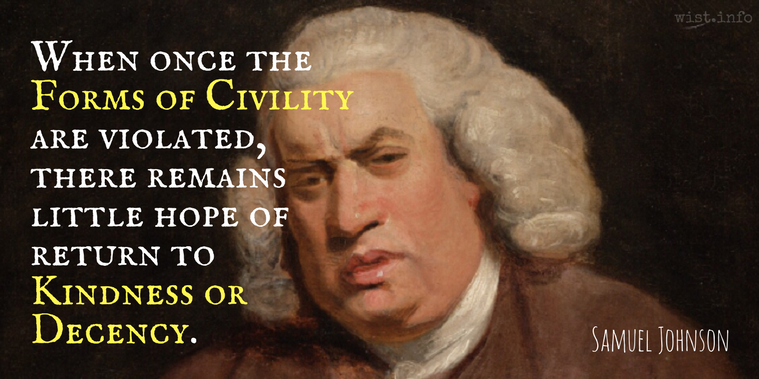
When once the forms of civility are violated, there remains little hope of return to kindness or decency.
Samuel Johnson (1709–1784) English writer, lexicographer, critic
The Rambler, #50 (25 Sep 1750)
(Source)
Couched as a letter to the paper from a woman.

Time indeed changes manners and notions, and so far we must expect institutions to bend to them. But time produces also corruption of principles, and against this it is the duty of good citizens to be ever on the watch, and if the gangrene is to prevail at last, let the day be kept off as long as possible.
Thomas Jefferson (1743–1826) American political philosopher, polymath, statesman, US President (1801–09)
Letter (1821-03-09) to Spencer Roane
(Source)

Every age has its pleasures, its style of wit, and its own ways.
Nicolas Boileau-Despréaux (1636–1711) French poet and critic
The Art of Poetry [L’Art Poétique], Canto 3 (1674)

Nature is often hidden, sometimes overcome, seldom extinguished.
Francis Bacon (1561–1626) English philosopher, scientist, author, statesman
“Of Nature in Men,” Essays, No. 38 (1625)
(Source)