

Accept modestly; surrender gracefully.
[Ἄτύφως μὲν λαβεῖν, εὐλύτως δὲ ἀφεῖναι.]
Marcus Aurelius (AD 121–180) Roman emperor (161–180), Stoic philosopher
Meditations [To Himself; Τὰ εἰς ἑαυτόν], Book 6, ch. 33 (8.33) (AD 161-180) [tr. Staniforth (1964)]
(Source)
(Source (Greek)). Other translations:Receive temporal blessings without ostentation, when they are sent and thou shalt be able to part with them with all readiness and facility when they are taken from thee again.
[tr. Casaubon (1634), 8.31]As to the Case of good Fortune; Take it without Pride, and Resign without Reluctance.
[tr. Collier (1701)]Receive the gifts of fortune, without pride; and part with them, without reluctance.
[tr. Hutcheson/Moor (1742); Hutcheson/Chrystal (1902)]Receive any good fortune which falls to your lot, without being too much elated; and resign it, if necessary, without being dejected.
[tr. Graves (1792), 8.32]Receive [wealth or prosperity] without arrogance; and be ready to let it go.
[tr. Long (1862)]As to the case of good fortune, take it without pride, and resign it without reluctance.
[tr. Collier/Zimmern (1887)]Modestly take, cheerfully resign.
[tr. Rendall (1898)]Accept without arrogance, surrender without reluctance.
[tr. Haines (Loeb) (1916)]Accept without pride, relinquish without a struggle.
[tr. Farquharson (1944)]Accept without arrogance, relinquish without demur.
[tr. Hard (1997 ed.)]To accept it without arrogance, to let it go with indifference.
[tr. Hays (2003)]Accept humbly; let go easily.
[tr. Hammond (2006)]Accept without arrogance, relinquish without a struggle.
[tr. Hard (2011 ed.)]
Quotations about:
modesty
Note not all quotations have been tagged, so Search may find additional quotes on this topic.
It is, indeed, a trial to maintain the virtue of humility when one can’t help being right.
Judith Martin (b. 1938) American author, journalist, etiquette expert [a.k.a. Miss Manners]
“Miss Manners,” syndicated column (1999-02-02)
(Source)

All greatness is unconscious, or it is little and naught.
Thomas Carlyle (1795–1881) Scottish essayist and historian
Essay (1837-12-06), “On Sir Walter Scott,” The London and Westminster Review, No. 12/55, Art. 2 (1838-01)
(Source)
Review of J. G. Lockhart, Memoirs of the Life of Sir Walter Scott, Baronet, 6 vols. (1837). Collected in Carlyle, Critical and Miscellaneous Essays (1827-1855).
ELMIRE: However high the passion which inflames us,
Still, to confess its power somehow shames us.[Quelque raison qu’on trouve à l’amour qui nous dompte,
On trouve à l’avouer toujours un peu de honte.]Molière (1622–1673) French playwright, actor [stage name for Jean-Baptiste Poquelin]
Tartuffe, or the Hypocrite [Le Tartuffe, ou L’Imposteur], Act 4, sc. 5 (1669) [tr. Wilbur (1963)]
(Source)
On women modestly protesting against the advances of lovers.
(Source (French)). Alternate translations:Whatever Reason we may find for the Passion that subdues us, we shall always be a little ashm'd to own it.
[tr. Clitandre (1672)]Whatever reason we may find for the passion that subdues us, we always feel some shame in owning it.
[tr. Van Laun (1876)]Whatever reasons we may find to justify the love that conquers us, there is always a certain shame attached to the avowal of it.
[tr. Wall (1879)]Whatever gratification we may find for the passion that subdues us, we shall always be rather ashamed to own it.
[tr. Mathew (1890). 4.4]Whatever reasons we may find for the love which conquers us, there is always a little shame in the avowal of it.
[tr. Waller (1903)]Whatever cause we find to justify
The love that masters us, we still must feel
Some little shame in owning it.
[tr. Page (1909)]Even though overmastered by our feelings,
We always find it shameful to admit them.
[tr. Bishop (1957)]However strong and justified our flame,
We never can admit it without shame.
[tr. Frame (1967)]No matter how much love persuades us,
we always feel a tiny bit of shame.
[tr. Steiner (2008)]
We refuse praise from a desire to be praised twice.
[Le refus des louanges est un désir d’être loué deux fois.]
François VI, duc de La Rochefoucauld (1613–1680) French epigrammatist, memoirist, noble
Réflexions ou sentences et maximes morales [Reflections; or Sentences and Moral Maxims], ¶149 (1665-1678) [tr. Kronenberger (1959)]
(Source)
Present since the 1st edition. Brund/Friswell note a variant 1665 version which they translate: "The modesty which pretends to refuse praise is but in truth a desire to be praised more highly."
See also ¶327, and Chesterfield (1750).
(Source (French)). Other translations:That Modesty which stands so much upon the refusal of [praises], is indeed but a desire of having such as are more delicate.
[tr. Davies (1669), ¶151]He that refuses Praises the first time it is offered, does it, because he would hear it a second.
[tr. Stanhope (1694), ¶150]A refusal of praise is a desire to be praised twice.
[pub. Donaldson (1783), ¶368; ed. Lepoittevin-Lacroix (1797), ¶143]Resistance to praise is a desire to be praised twice.
[ed. Carvill (1835), ¶325]A refusal of praise; is a desire to be praised twice.
[ed. Gowens (1851), ¶152]The refusal of praise is only the wish to be praised twice.
[tr. Bund/Friswell (1871), ¶149]We decline commendation that we may be twice commended.
[tr. Heard (1917), ¶149]To disclaim admiration is to desire it in double measure.
[tr. Stevens (1939), ¶149]The refusal to accept praise is the desire to be praised twice over.
[tr. FitzGibbon (1957), ¶149]To refuse to accept praise is to want to be praised twice over.
[tr. Tancock (1959), ¶149]The refusal of praise is a desire to be praised twice over.
[tr. Siniscalchi (c. 1994)]The refusal of praise is a desire to be praised twice.
[tr. Whichello (2016) ¶149]
You have a good many little gifts and virtues, but there is no need of parading them, for conceit spoils the finest genius. There is not much danger that real talent or goodness will be overlooked long, and the great charm of all power is modesty.
Louisa May Alcott (1832–1888) American writer
Little Women, ch. 7 “Amy’s Valley of Humiliation” [Mrs. March] (1868)
(Source)
And it is not always because of valour or chastity that men are valiant or women chaste.
[Et ce n’est pas toujours par valeur et par chasteté que les hommes sont vaillants et que les femmes sont chastes.]François VI, duc de La Rochefoucauld (1613–1680) French epigrammatist, memoirist, noble
Réflexions ou sentences et maximes morales [Reflections; or Sentences and Moral Maxims], ¶1 (1665-1678) [tr. Tancock (1959)]
(Source)
Introduced in the 4th ed. (1665).
(Source (French)). Other translations:It may be further affirmed, that Valour in Men, and Chastity in Women, two qualifications which make so much noise in the World, are the products of Vanity and Shame, and principally of their particular Temperaments.
[tr. Davies (1669), ¶94]And we are much mistaken, if we think that Men are always stout from a principle of Valour, or Women chast from a principle of Modesty.
[tr. Stanhope (1694)]It is not always from the principles of valour and chastity that men are valiant, and that women are chaste.
[pub. Donaldson (1783), ¶446]It is not always from valor and from chastity that men are valiant, and that women are chaste.
[ed. Gowens (1851), ¶2]It is not always from valour or from chastity that men are brave, and women chaste.
[tr. Bund/Friswell (1871)]Men are not always brave because courageous, nor women chaste because virtuous.
[tr. Heard (1917)]So it is not always courage that makes the hero, nor modesty the chaste woman.
[tr. Stevens (1939)]It is not always valor which makes men valiant, nor chastity that renders women chaste.
[tr. FitzGibbon (1957)]And it is not always through valor and chastity that men are valiant and women chaste.
[tr. Kronenberger (1959)]It is not always because of bravery or chastity that men are brave, and women chaste.
[tr. Whichello (2016)]
Modesty is to merit as shadows are to the figure in a painting: it strengthens it and sets it off.
[La modestie est au mérite ce que les ombres sont aux figures dans un tableau: elle lui donne de la force et du relief.]Jean de La Bruyère (1645–1696) French essayist, moralist
The Characters [Les Caractères], ch. 2 “Of Personal Merit [Du Mérite Personnel],” § 17 (2.17) (1688) [tr. Stewart (1970)]
(Source)
(Source (French)). Other translations:Modesty is to Merit, what Shades are to the Figures in a Picture; it gives it Strength and Heightening.
[Curll ed. (1713)]Modesty is to Merit as Shades to Figures in a Picture; giving it Strength and Beauty.
[Browne ed. (1752)]Modesty is to merit what shade is to figures in a picture; it gives it strength and makes it stand out.
[tr. Van Laun (1885)]

The superior man in everything considers righteousness to be essential. He performs it according to the rules of propriety. He brings it forth in humility. He completes it with sincerity. This is indeed a superior man.
[君子義以為質,禮以行之,孫以出之,信以成之,君子哉]
Confucius (c. 551- c. 479 BC) Chinese philosopher, sage, politician [孔夫子 (Kǒng Fūzǐ, K'ung Fu-tzu, K'ung Fu Tse), 孔子 (Kǒngzǐ, Chungni), 孔丘 (Kǒng Qiū, K'ung Ch'iu)]
The Analects [論語, 论语, Lúnyǔ], Book 15, verse 18 (15.18) (6th C. BC – 3rd C. AD) [tr. Legge (1861), 15.17]
(Source)
(Source (Chinese)). Other translations, noting where Legge's numbering is used:When the "superior man" regards righteousness as the thing material, gives operation to it according to the rules of propriety, lets it issue in humility, and become complete in sincerity, -- there indeed is your superior man!
[tr. Jennings (1895), 15.17]A wise and good man makes Right the substance of his being; he cries it out with judgment and good sense; he speaks it with modesty; and he attains it with sincerity: -- such a man is a really good and wise man!
[tr. Ku Hung-Ming (1898), 15.17]The noble man takes the Right as his foundation principle, reduces it to practice with all courtesy, carries it out with modesty, and renders it perfect with sincerity, -- such is the noble man.
[tr. Soothill (1910), 15.17]When a princely man makes the Right his fundamental principle, makes Courtesy his rule in evolving it, Modesty his rule for exhibiting it, and Sincerity his rule for effectuating it perfectly, -- what a princely man he is!
[tr. Soothill (1910), 15.17, alternate]The proper man gives substance to his acts by equity. He proceeds according to the rites, puts them forth modestly, and makes them perfect by sticking to his word. That's the proper man (in whom's the voice of his forebears).
[tr. Pound (1933), 15.17]The gentleman who takes the right as his material to work upon and ritual as the guide in putting what is right into practice, who is modest in setting out his projects and faithful in carrying them to their conclusions, he indeed is a true gentleman.
[tr. Waley (1938), 15.17]He whose very substance is justice; whose actions are governed by the rites; whose participation in affairs is compliant; and whose crowning perfection is truthfulness -- that man is a perfect gentleman.
[tr. Ware (1950)]The gentleman has morality as his basic stuff and by observing the rites puts it into practice, by being modest gives it expression, and by being trustworthy in word brings it to completion. Such is a gentleman indeed!
[tr. Lau (1979)]Righteousness the gentleman regards as the essential stuff and the rites are his means of putting it into effect. If modesty is the quality with which he reveals it and good faith is his method of bringing it to completion, he is indeed a gentleman.
[tr. Dawson (1993)]A gentleman takes justice as his basis, enacts it in conformity with the ritual, expounds it with modesty, and through good faith, brings it to fruition. That is how a gentleman proceeds.
[tr. Leys (1997)]A gentleman considers righteousness his major principle; he practices it in accordance with the rituals, utters it in modest terms, and fulfils it with truthfulness. A gentleman indeed!
[tr. Huang (1997)]A gentleman takes the righteousness as his essence, practices with the rituals, words with modesty, and gets achievement with honesty. It is the gentleman.
[tr. Cai/Yu (1998), v. 402]Having a sense of appropriate conduct [yi] as one's basic disposition [zhi], developing it in observing ritual propriety [li], expressing it with modesty, and consummating it in making good on one's word [xin]; this then is an exemplary person [junzi].
[tr. Ames/Rosemont (1998)]If a gentleman has right as his substance, and puts it in practice with propriety, promulgates it with lineality, and brings it to a conclusion with fidelity, he is a gentleman indeed!
[tr. Brooks/Brooks (1998), LY17 c0270 addition]The noble-minded make Duty their very nature. They put it into practice through Ritual; they make it shine through humility; and standing by their words, they perfect it. Then they are noble-minded indeed!
[tr. Hinton (1998)]The gentleman takes rightness as his substance, puts it into practice by means of ritual, gives it expression through modesty, and perfects it by being trustworthy. Now that is a gentleman!
[tr. Slingerland (2003)]The gentleman makes rightness the substance, practices it through ritual, displays it with humility, brings it to completion with trustworthiness. That’s the gentleman.
[tr. Watson (2007)]The gentleman makes rightness the substance. He works at it through ritual propriety; he expresses it with modesty; he brings it to completion by being trustworthy. Now that is a gentleman!
[tr. Annping Chin (2014)]A Jun Zi regards righteousness and honor as fundamental bases, acts in line with Li, shows humility, delivers promises, and completes contracts with sincerity and trust. If so, he is indeed a Jun Zi.
[tr. Li (2020)]A leader takes rightness as their essence, puts it into practice through ritual, manifests it through humility, and brings it to fruition through trustworthiness. This is how a leader behaves.
[tr. Brown (2021)]

Why then should I give my Readers bad Lines of my own, when good Ones of other People’s are so plenty? ‘Tis methinks a poor Excuse for the bad Entertainment of Guests, that the Food we set before them, tho’ coarse and ordinary, is of one’s own Raising, off one’s own Plantation, &c. when there is Plenty of what is ten times better, to be had in the Market. — On the contrary, I assure ye, my Friends, that I have procur’d the best I could for ye, and much Good may’t do ye.
Benjamin Franklin (1706–1790) American statesman, scientist, philosopher, aphorist
Poor Richard (1747 ed.)
(Source)
On his (uncredited) borrowing of poetry and aphorisms from others for his almanac.
Be your character what it will, it will be known; and nobody will take it up on your own word. Never imagine that anything you can say yourself will varnish your defects or add lustre to your perfections! but, on the contrary, it may, and nine times in ten will, make the former more glaring, and the latter obscure.
Lord Chesterfield (1694–1773) English statesman, wit [Philip Dormer Stanhope]
Letter to his son, #166 (19 Oct 1748)
(Source)
They continued to mount the winding staircase. A high wind, blowing through the loopholes, went rushing up the shaft, and filled the girl’s skirts like a balloon, so that she was ashamed, until he took the hem of her dress and held it down for her. He did it perfectly simply, as he would have picked up her glove. She remembered this always.
David Herbert "D. H." Lawrence (1885–1930) English novelist
Sons and Lovers, Part 2, ch. 7 “Lad-and-Girl Love” (1913)
(Source)

You can tell the character of every man when you see how he gives and receives praise.
Seneca the Younger (c. 4 BC-AD 65) Roman statesman, philosopher, playwright [Lucius Annaeus Seneca]
Moral Letters to Lucilius [Epistulae morales ad Lucilium], Letter 52 “On choosing our teachers,” Sec. 12
(Source)
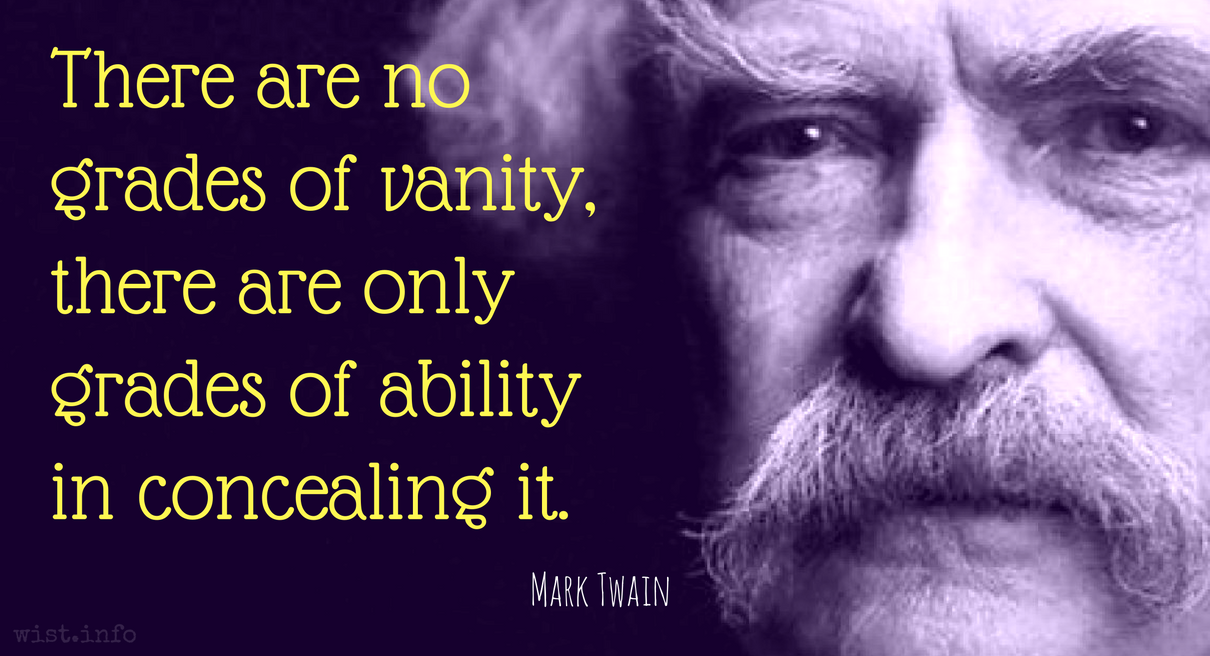
There are no grades of vanity, there are only grades of ability in concealing it.
Mark Twain (1835–1910) American writer [pseud. of Samuel Clemens]
Note (1898-07-04)), Mark Twain’s Notebook, ch. 21 “In Vienna” (1935) [ed. Albert Bigelow Paine]
(Source)
While summering in Kaltenleutgeben, Austria.
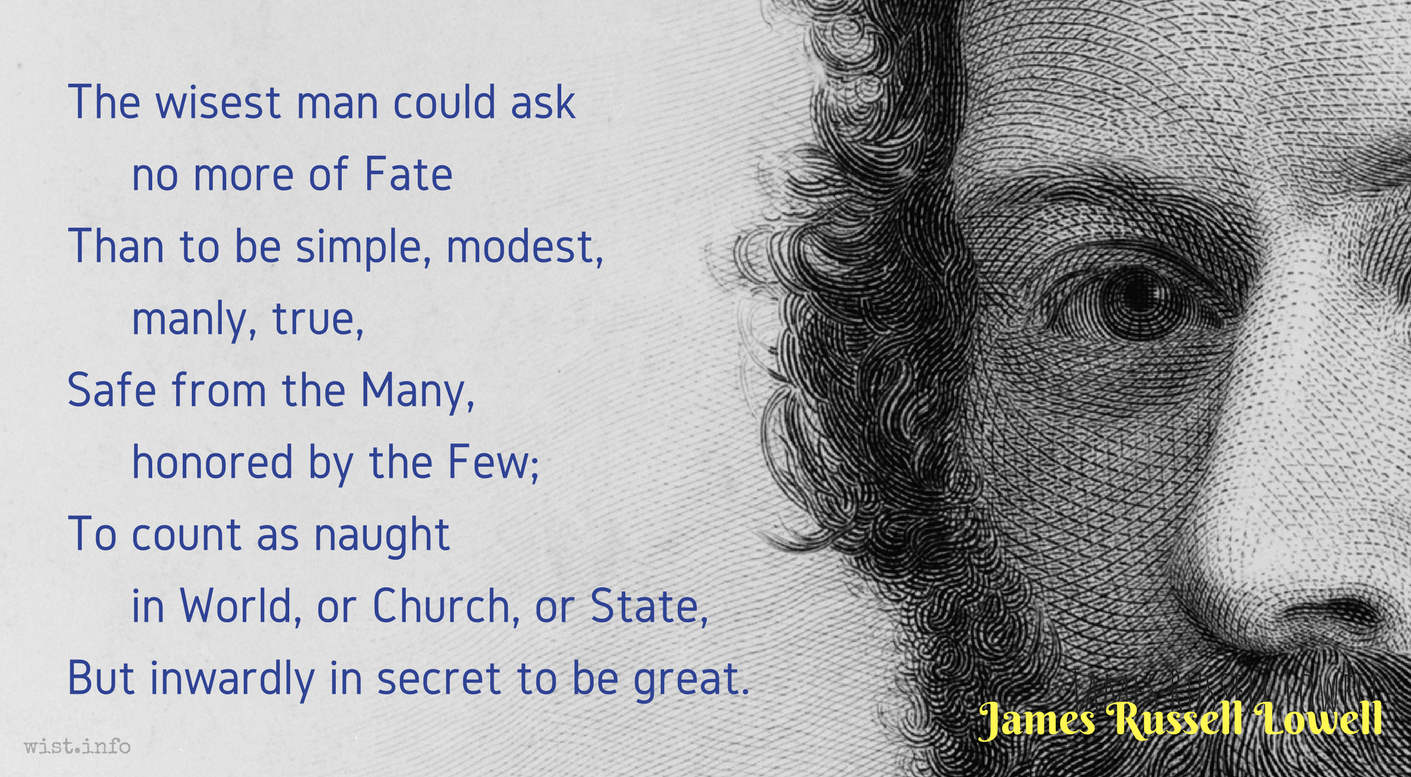
The wisest man could ask no more of Fate
Than to be simple, modest, manly, true,
Safe from the Many, honored by the Few;
To count as naught in World, or Church, or State,
But inwardly in secret to be great.
James Russell Lowell (1819–1891) American diplomat, essayist, poet
“Jeffries Wyman,” The Nation #484 (8 Oct 1874)
(Source)
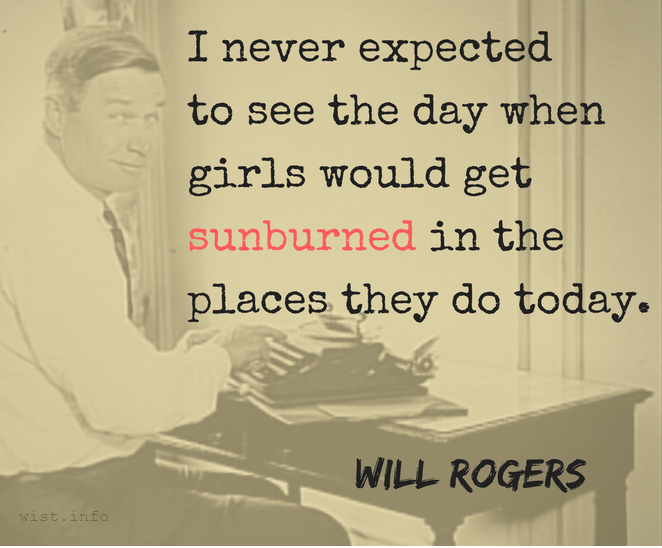
I never expected to see the day when girls would get sunburned in the places they do today.
Will Rogers (1879–1935) American humorist
(Misattributed)
Widely attributed to Rogers, but I was unable to find it in any published primary source. That's because it appears to have been said by a different Will Rogers.
In The Pathfinder, "Art of Wisecracking Takes on New Significance," Issue 1866 (1929-10-05), the results of "Wisecrack Contest" among the weekly periodical's readers provides the following second place winner (earning it $10).Grandpa Wayback rises to remark: “I never expected to live to see the day when the girls would get sunburned on the places they do now.” Won by Will B. Rogers, Atlanta, Ga
That is not the famous Oklahoman humorist (William Penn Adair Rogers), though the latter is mentioned (along with Ring Lardner) in the text of the story as a famous wisecracker.
This appears to be the origin of the quotation, and an explanation as to why it was quickly associated with the more famous figure by that name, an association that occurred very quickly when the Rogers from Georgia was forgotten.
Variants (mostly attributed to Rogers):I never expected to see the day when the girls would get sunburned in the places they do now.
[Albert Shaw, ed., Review of Reviews (1935-02)]I never expected to see the day when girls would get sunburned in the places they do.
[P.G. Wodehouse & Guy Bolton, Bring on the Girls: The Improbable Story of Our Life in Musical Comedy (1953)]Few men expected to see the day when women would get sunburned in the places they do now.
[Louis T. Stanley, The London Season, "Feminine Wiles" (1956), used without attribution to Rogers]I never expected to see the day when the girls would get sunburned in the places they do now.
[John Birch Society, American Opinion, Vol. 4 (1961)]
For as blushing will sometimes make a whore pass for a virtuous woman, so modesty may make a fool seem a man of sense.
Women commend a modest Man, but like him not.
Thomas Fuller (1654–1734) English physician, preacher, aphorist, writer
Gnomologia: Adages and Proverbs (compiler), # 5805 (1732)
(Source)
Modesty is the only sure bait when you angle for praise.
Lord Chesterfield (1694–1773) English statesman, wit [Philip Dormer Stanhope]
Letter to his son, #225 (17 May 1750)
(Source)
The first rule is, to keep an untroubled spirit; for all things must bow to Nature’s law, and soon enough you must vanish into nothingness, like Hadrian and Augustus. The second is to look things in the face and know them for what they are, remembering that it is your duty to be a good man. Do without flinching what man’s nature demands; say what seems to you most just — though with courtesy, modesty, and sincerity.
[Τὸ πρῶτον μὴ ταράσσου: πάντα γὰρ κατὰ τὴν τοῦ ὅλου φύσιν καὶ ὀλίγου χρόνου οὐδεὶς οὐδαμοῦ ἔσῃ, ὥσπερ οὐδὲ Ἁδριανὸς οὐδὲ Αὔγουστος. ἔπειτα ἀτενίσας εἰς τὸ πρᾶγμα ἴδε αὐτὸ καὶ συμμνημονεύσας ὅτι ἀγαθόν σε ἄνθρωπον εἶναι δεῖ καὶ τί τοῦ ἀνθρώπου ἡ φύσις ἀπαιτεῖ, πρᾶξον τοῦτο ἀμεταστρεπτὶ καὶ εἰπέ, ὡς δικαιότατον φαίνεταί σοι: μόνον εὐμενῶς καὶ αἰδημόνως καὶ ἀνυποκρίτως.]
Marcus Aurelius (AD 121–180) Roman emperor (161–180), Stoic philosopher
Meditations [To Himself; Τὰ εἰς ἑαυτόν], Book 8, ch. 5 (8.5) (AD 161-180) [tr. Staniforth (1964)]
(Source)
This translation was adapted (and significantly shortened) by Norman Vincent Peale in You Can If You Think You Can (1974): "The first rule is to keep an untroubled spirit. The second is to look things in the face and know them for what they are."
Peale's paraphrase significantly changes the meaning (by removing the fatalism and the sense of duty in the face of the actions of great men from the past, and turning it into a general call for calm and clarity). Nonetheless, Peale's version of this translation shows up all over the place, and generally without reference to him.
Original Greek. Other translations:First; let it not trouble thee. For all things both good and evil come to pass according to the nature and general condition of the universe, and within a very little while, all things will be at an end; no man will be remembered: as now of Africanus (for example) and Augustus it is already come to pass. Then secondly; fix thy mind upon the thing itself; look into it, and remembering thyself, that thou art bound nevertheless to be a good man, and what it is that thy nature requireth of thee as thou art a man, be not diverted from what thou art about, and speak that which seemeth unto thee most just: only speak it kindly, modestly, and without hypocrisy.
[tr. Casaubon (1634), 8.4]In the first place , keep your self easie, for all things are govern'd by the Laws, and Order of Providence: Besides, you'l quickly go the way of all Flesh, as Augustus, Adrian, and the rest of the Emperours have done before you. Farther, Examine the matter to the bottom , and remember, that the top of your business is to be a Good Man : Therefore whatever the Dignity of Humane Nature requires of you, set about it presently , without Ifs, or Ands : And speak always according to your Conscience , but let it be done in the Terms of Good Nature and Civility.
[tr. Collier (1701)]In the first place, be not disturbed or put into confusion. All things happen according to the nature of the whole. In a little time you shall be gone, as Hadrian, and Augustus. And, then, attentively consider the nature of what occurs to you: Remember you must persist in the purpose of being a good man. Act, then, inflexibly what suits the nature of a man, and speak always what appears to you just, and yet with calm good-nature and modesty; and without Hypocrisy.
[tr. Hutcheson/Moor (1742)]Let it be a principal part of your philosophy to preserve your tranquility: for all things come to pass by the direction of Providence. And, in a few years, you yourself must leave this world, as Hadrian and Augustus have done before you.
In the next place, consider the affair in its proper light, and you will find, that your whole business here is to be a good man. Whatever teh nature of man therefore requires of you, perform it strenuously and with assiduity; and whatever justice dictates on every occasion, speak it boldly, but with good-nature, modesty, and sincerity.
[tr. Graves (1792)]This is the chief thing: Be not perturbed, for all things are according to the nature of the universal; and in a little time thou wilt be nobody and nowhere, like Hadrianus and Augustus. In the next place, having fixed thy eyes steadily on thy business, look at it, and at the same time remembering that it is thy duty to be a good man, and what man's nature demands, do that without turning aside; and speak as it seems to thee most just, only let it be with a good disposition and with modesty and without hypocrisy.
[tr. Long (1862)]In the first place, keep yourself easy, for all things are governed by the universal nature. Besides, you'll quickly go the way of all flesh, as Augustus and Hadrian have done before you. Farther, examine the matter from top to bottom, and remember that your business is to be a good man. Therefore, whatever the dignity of human nature requires of you, set about it at once, without "ifs" or "ands"; and speak always according to your conscience, but let it be done in the terms of good nature and modesty and sincerity.
[tr. Collier/Zimmern (1887)]First and foremost, keep unperturbed. For all things follow the law of Nature: and in a little while you will vanish and be nought, even as are Hadrian and Augustus. Secondly, face facts open-eyed, bearing in mind that it is your duty to be a man and to do good; what man's nature demands, that you do without swerving; so speak, as seems to you most just; only be it considerately, modestly, and with sincerity.
[tr. Rendall (1898)]Before all things, be not perturbed. Everything comes to pass as directed by universal Nature, and in a little time you will be departed and gone, like Hadrianus and Augustus. Then, scan closely the nature of what has befallen, remembering that it is your duty to be a good man. Do unflinchingly whatever man’s nature requires, and speak as seems most just, yet in kindliness, modesty, and sincerity.
[tr. Hutcheson/Chrystal (1902)]Firstly, fret not thyself, for all things are as the Nature of the Universe would have them, and within a little thou shalt be non-existent, and nowhere, like Hadrianus and Augustus. Secondly, look steadfastly at the thing, and see it as it is and, remembering withal that thou must be a good man, and what the Nature of man calls for, do this without swerving, and speak as seemeth to thee most just, only be it graciously, modestly, and without feigning.
[tr. Haines (Loeb) (1916)]In the first place, be not troubled; for all things are according to Universal Nature, and in a little while you will be no one and nowhere, even as Hadrian and Augustus are no more. Next, looking earnestly at the question, perceive its essence, and reminding yourself that your duty is to be a good man, and what it is that man's nature demands, do that without swerving, and speak the thing that appears to you to be most just, provided only that it is with kindness and modesty, and without hypocrisy
. [tr. Farquharson (1944)]First of all, be untroubled in your mind; for all things come about as universal nature would have them, and in a short while you will be no one and nowhere, as are Hadrian and Augustus. And next, keep your eyes fixed on the matter in hand and observe it well, remembering that it is your duty to be a good person, and that whatever human nature demands, you must fulfil without the slightest deviation and in the manner that seems most just to you; only do so with kindness and modesty, and without false pretences.
[tr. Hard (1997 ed.), Hard (2011 ed.)]The first step: Don't be anxious. Nature controls it all. And before long you'll be no one, nowhere -- like Hadrian, like Augustus. The second step: Concentrate on what you have to do. Fix your eyes on it. Remind yourself that your task is to be a good human being; remind yourself what nature demands of people. Then do it, without hesitation, and speak the truth as you see it. But with kindness. With humility. Without hypocrisy.
[tr. Hays (2003)]First, do not be upset: all things follow the nature of the Whole, and in a little while you will be no one and nowhere, as is true now even of Hadrian and Augustus. Next, concentrate on the matter in hand and see it for what it is. Remind yourself of your duty to be a good man and rehearse what man’s nature demands: then do it straight and unswerving, or say what you best think right. Always, though, in kindness, integrity, and sincerity.
[tr. Hammond (2006)]