The intensity of the favour of fortune is often balanced by the shortness of its duration, for fortune gets tired of carrying any one very long upon her shoulders.
[Recompénsase tal vez la brevedad de la duración con la intensión del favor. Cánsase la fortuna de llevar a uno a cuestas tan a la larga.]
Baltasar Gracián y Morales (1601–1658) Spanish Jesuit priest, writer, philosopher
The Art of Worldly Wisdom [Oráculo Manual y Arte de Prudencia], § 38 (1647) [tr. Duff (1877)]
(Source)
(Source (Spanish)). Other translations:The quality of the pleasure makes sometimes amends for the shortness of the enjoyment. Fortune is weary to carry one and the same man always upon her shoulders.
[Flesher ed. (1685)]Fortune pays you sometimes for the intensity of her favours by the shortness of their duration. She soon tires of carrying any one long on her shoulders.
[tr. Jacobs (1892)]Luck always compensates her intensity by her brevity. Fortune wearies of carrying anyone long upon her shoulders.
[tr. Fischer (1937)]Sometimes Lady Luck compensates us, trading intensity for duration. She grows tired when she has to carry someone on her back for a long time.
[tr. Maurer (1992)]
Quotations about:
good luck
Note not all quotations have been tagged, so Search may find additional quotes on this topic.

Accept modestly; surrender gracefully.
[Ἄτύφως μὲν λαβεῖν, εὐλύτως δὲ ἀφεῖναι.]
Marcus Aurelius (AD 121–180) Roman emperor (161–180), Stoic philosopher
Meditations [To Himself; Τὰ εἰς ἑαυτόν], Book 6, ch. 33 (8.33) (AD 161-180) [tr. Staniforth (1964)]
(Source)
(Source (Greek)). Other translations:Receive temporal blessings without ostentation, when they are sent and thou shalt be able to part with them with all readiness and facility when they are taken from thee again.
[tr. Casaubon (1634), 8.31]As to the Case of good Fortune; Take it without Pride, and Resign without Reluctance.
[tr. Collier (1701)]Receive the gifts of fortune, without pride; and part with them, without reluctance.
[tr. Hutcheson/Moor (1742); Hutcheson/Chrystal (1902)]Receive any good fortune which falls to your lot, without being too much elated; and resign it, if necessary, without being dejected.
[tr. Graves (1792), 8.32]Receive [wealth or prosperity] without arrogance; and be ready to let it go.
[tr. Long (1862)]As to the case of good fortune, take it without pride, and resign it without reluctance.
[tr. Collier/Zimmern (1887)]Modestly take, cheerfully resign.
[tr. Rendall (1898)]Accept without arrogance, surrender without reluctance.
[tr. Haines (Loeb) (1916)]Accept without pride, relinquish without a struggle.
[tr. Farquharson (1944)]Accept without arrogance, relinquish without demur.
[tr. Hard (1997 ed.)]To accept it without arrogance, to let it go with indifference.
[tr. Hays (2003)]Accept humbly; let go easily.
[tr. Hammond (2006)]Accept without arrogance, relinquish without a struggle.
[tr. Hard (2011 ed.)]

O Fortune, cruellest of heavenly powers,
Why make such game of this poor life of ours?[Heu, Fortuna, quis est crudelior in nos
Te Deus? Ut semper gaudes illudere rebus
Humanis!]Horace (65–8 BC) Roman poet, satirist, soldier, politician [Quintus Horatius Flaccus]
Satires [Saturae, Sermones], Book 2, # 8 “Ut Nasidieni,” l. 61ff (2.8.61-63) (30 BC) [tr. Conington (1874)]
(Source)
When "disaster" befalls the dinner party of Nasidienus (Rufus), Nomentanus tries to snap him out of a funk by philosophically / melodramatically bemoaning how Fortune treats humanity.
(Source (Latin)). Other translations:Some mourne and blame their sorie fate, why Fortune shoulde be suche,
That they suche blouddes shoulde nothinge have, and others overmuche.
[tr. Drant (1567)]Fortune our Foe, thou art a scurvy Puss!
Ah what a cruel Vixen th' art! ah how
Do'st thou delight to mock us here below!
[tr. I. W. Esq.; ed. Brome (1666)]Unlucky Chance what God is so unkind,
Thou lov'st to break the measures Man design'd.
[tr. Creech (1684)]Fortune, thou cruelest of powers divine,
To joke poor mortals is a joke of thine.
[tr. Francis (1747)]Ah cruel Fortune, foe to human bliss!
Invidious power, it seems thy sole delight
All our enjoyments in the bud to blight.
[tr. Howes (1845)]Alas! O fortune, what god is more cruel to us than thou? How dost thou always take pleasure in sporting with human affairs!
[tr. Smart/Buckley (1853)]O Fortune, what divinity so cruel against us as thou? What joy to thee 'tis ever to frustrate the plans of men!
[tr. Millington (1870)]Ah Fortune, what divine power is more cruel towards us than thou! How thou delightest ever to make sport of human affairs!
[tr. Wickham (1903)]Ah, Fortune, what god is more cruel toward us than thou! How thou dost ever delight to make sport of the life of man!
[tr. Fairclough (Loeb) (1926)]Oh, Fortune, what god
Is more cruel to us than you are! You always have fun
Making fun of mankind!
[tr. Palmer Bovie (1959)]Ah, Fortune! What god more cruel to us than you?
You always like to play around with mankind’s hopes!
[tr. Fuchs (1977)]Ah, Fortune! Is there a crueler god?
How you love to toy with us, playing with our lives!
[tr. Raffel (1983)]What god,
O Fortune, is more cruel toward us than Thou?
How you rejoice in upsetting man’s hopes!
[tr. Alexander (1999)]Fortune, most cruel of all the gods, what
would you do for laughs without us humans?
[tr. Matthews (2002)]Shame on you Lady Luck!
No other god is so cruel. What pleasure you get from mocking
the plans of men!
[tr. Rudd (2005 ed.)]O Fortune, what deity treats us more
Cruelly than you? How you always delight in mocking
Human affairs!
[tr. Kline (2015)]
HERO: If it prove so, then loving goes by haps;
Some Cupid kills with arrows, some with traps.William Shakespeare (1564–1616) English dramatist and poet
Much Ado About Nothing, Act 3, sc. 1, l. 111ff (3.1.111-112) (1598)
(Source)
For "haps" read "happenstance" or "chance." Often elided in the front to "Love goes by haps ...."

It is easy enough to be pleasant,
When life flows by like a song,
But the man worth while is one who will smile,
When everything goes dead wrong.Ella Wheeler Wilcox (1850–1919) American author, poet, temperance advocate, spiritualist
Poem (1892), “Worth While,” st. 1, An Erring Woman’s Love
(Source)
Sometimes called "The Man Worth While." Collected again in Poems of Cheer (1910).

In retrospect, our triumphs could as easily have happened to someone else; but our defeats are uniquely our own.
Mignon McLaughlin (1913–1983) American journalist and author
The Neurotic’s Notebook, ch. 9 (1963)
(Source)

Mild success can be explainable by skills and labor. Wild success is attributable to variance.
Nassim Nicholas Taleb (b. 1960) Lebanese-American essayist, statistician, risk analyst, aphorist
Fooled by Randomness, Part 1, ch. 1 (2001)
(Source)

CHORUS: Goodbye! Good luck! If you can, be lucky, steer clear of disaster. That’s happiness for mortals.
[ΧΟΡΟΣ: χαίρετε: χαίρειν δ᾽ ὅστις δύναται
καὶ ξυντυχίᾳ μή τινι κάμνει
θνητῶν, εὐδαίμονα πράσσει.]Euripides (485?-406? BC) Greek tragic dramatist
Electra [Ἠλέκτρα], l. 1357ff (c. 420 BC) [tr. Wilson (2016)]
(Source)
Closing lines.
(Source (Greek)). Other translations:Farewell. And sure the man
To whom this wish is granted, he who feels
No pressure of calamity, is blest.
[tr. Wodhull (1809)]Farewell! Any mortal who is able to fare well, and is not worn down by any misfortune, achieves happiness.
[tr. Coleridge (1891)]Farewell; but whosoever of mortals is able to fare well, and bends not under some misfortune, fares happily.
[tr. Buckley (1892)]Farewell! Ah, whosoe'er may know this blessing,
To fare well, never crushed 'neath ills oppressing,
Alone of mortals tastes abiding bliss.
[tr. Way (1896)]Farewell, farewell! -- But he who can so fare,
And stumbleth not on mischief anywhere,
Blessèd on earth is he!
[tr. Murray (1905)]Farewell! truly that mortal's is a happy lot, who can thus fare, unafflicted bv any woe.
[tr. Coleridge (1938 ed.)]Good bye. Blessed is the human who can live happily without the weight of suffering.
[tr. Theodoridis (2006)]Farewell. Any mortal who can indeed live well
without being ground down by misfortune,
that man will find his happiness.
[tr. Johnston (2009)]
When I contemplate the common lot of mortality, I must acknowledge that I have drawn a high prize in the lottery of life. The far greater part of the globe is overspread with barbarism or slavery: in the civilized world the most numerous class is condemned to ignorance and poverty; and the double fortune of my birth in a free and enlightened country, in an honourable and wealthy family, is the lucky chance of an unit against millions.
Diligence is the Mother of Good-Luck.
Benjamin Franklin (1706–1790) American statesman, scientist, philosopher, aphorist
Poor Richard (1736 ed.)
(Source)
You never know what worse luck your bad luck has saved you from.
Cormac McCarthy (1933–2023) American novelist, playwright, screenwriter
No Country for Old Men (2005)
(Source)
KENT: Fortune, good-night. Smile once more; turn thy wheel.
William Shakespeare (1564–1616) English dramatist and poet
King Lear, Act 2, sc. 2, l. 188 (2.2.188) (1606)
(Source)
Blest is the man who cheats the stormy sea
And safely moors beside the sheltering quay;
So, blest is he who triumphs over trial.
One man, by various means, in wealth or strength
Outdoes his neighbour; hope in a thousand hearts
Colours a thousand different dreams; at length
Some find a dear fulfilment, some denial.
But this I say,
That he who best
Enjoys each passing day
Is truly blest.[εὐδαίμων μὲν ὃς ἐκ θαλάσσας
ἔφυγε χεῖμα, λιμένα δ᾽ ἔκιχεν:
εὐδαίμων δ᾽ ὃς ὕπερθε μόχθων
ἐγένεθ᾽: ἑτέρᾳ δ᾽ ἕτερος ἕτερον
ὄλβῳ καὶ δυνάμει παρῆλθεν.
μυρίαι δ᾽ ἔτι μυρίοις
εἰσὶν ἐλπίδες: αἳ μὲν
τελευτῶσιν ἐν ὄλβῳ
βροτοῖς, αἳ δ᾽ ἀπέβησαν:
τὸ δὲ κατ᾽ ἦμαρ ὅτῳ βίοτος
εὐδαίμων, μακαρίζω.]Euripides (485?-406? BC) Greek tragic dramatist
Bacchæ [Βάκχαι], l. 902ff (Stasimon 3, Epode) [Chorus/Χορός] (405 BC) [tr. Vellacott (1973)]
(Source)
(Source (Greek)). Other translations:Blest is the man who 'scapes the stormy wave.
And in the harbour finds repose:
He too is blest, 'midst dangers brave,
Who soars above the malice of his foes:
And now these, now those possess
Superior talents or success;
Distinct their aims; but hope each bosom fires.
There are, a rich encrease who find,
The vows of some are scatter'd in the wind:
But in my judgement blest are they
Who taste, tho' only for the day.
The joys their soul desires.
[tr. Wodhull (1809)]Happy is he who has fled a storm on the sea, and reached harbor. Happy too is he who has overcome his hardships. One surpass another in different ways, in wealth or power. There are innumerable hopes to innumerable men, and some result in wealth to mortals, while others fail. But I call him blessed whose life is happy day today.
[tr. Buckley (1850)]Who hath 'scaped the turbulent sea,
And reached the haven, happy he!
Happy he whose toils are o'er
In the race of wealth and power!
This one her, and that one there,
Passes by, and everywhere
Still expectant thousands over
Thousands hopes are seen to hover,
Some to mortals end in bliss;
Some have already fled away:
Happiness alone is his
That happy is to-day.
[tr. Milman (1865)]Happy he, who from the storm,
Has the breaker escaped, and the harbour has reached;
Happy he who after toil
Is the victor, for many the ways in which man
Wins him power, and wins him wealth.
Thousand-fold ever to thousands of men,
Hope follows upon hope,
With some it grows unceasingly,
With some it wastes to nothingness.
But he whose life is ever fresh,
Lives in unbroken happiness.
[tr. Rogers (1872), l. 865ff.]Happy is he who hath escaped the wave from out the sea, and reached the haven; and happy he who hath triumphed o’er his troubles; though one surpasses another in wealth and power; yet there be myriad hopes for all the myriad minds; some end in happiness for man, and others come to naught; but him, whose life from day to day is blest, I deem a happy man.
[tr. Coleridge (1891)]Blest who from ravening seas
Hath 'scaped to haven-peace,
Blest who hath triumphed in endeavour's toil and throe.
This man to higher height
Attains, of wealth, of might,
Than that; yet myriad hopes in myriad hearts still glow:
To fair fruition brought
Are some, some come to nought:
Happy is he whose bliss from day to day doth grow.
[tr. Way (1898)]Happy he, on the weary sea
Who hath fled the tempest and won the haven.
Happy whoso hath risen, free,
Above his striving. For strangely graven
Is the orb of life, that one and another
In gold and power may outpass his brother.
And men in their millions float and flow
And seethe with a million hopes as leaven;
And they win their Will, or they miss their Will,
And the hopes are dead or are pined for still;
But whoe'er can know,
As the long days go,
That To Live is happy, hath found his Heaven!
[tr. Murray (1902)]-- Blessèd is he who escapes the storm at sea,
who comes home to his harbor.
-- Blessèd is he who emerges from under affliction.
-- In various ways one man outraces another in the race for wealth and power.
-- Ten thousand men possess ten thousand hopes.
-- A few bear fruit in happiness; the others go awry.
-- But he who garners day by day the good of life, he is happiest. Blessèd is he.
[tr. Arrowsmith (1960)]Happy the man who from the sea
escapes the storm and finds harbor;
happy he who has surmounted
toils; and in different ways one surpasses another
in prosperity and power.
Besides this, for countless men there are countless
hopes -- some of them
reach to the end in prosperity
for mortals, and others depart;
but him whose life day by day
is happy do I count blessed.
[tr. Kirk (1970)]Happy he from the sea escaping
out of the storm, arriving at anchorage;
happy he fleeing labour's straining;
in many manners may men surpass other men
in prosperity and in power.
Thousand-fold upon thousand-fold
hopes come crowding upon us,
and some finally prosper
for mortals, some are vanish'd:
who day by day has a livelihood of happiness, he is blessed
[tr. Neuburg (1988)]Happy the man who withstands
life's assaults.
Somehow, in some way, some man surpasses some other
in position and fortune.
For millions of men there are millions of hopes.
For some, these ripen into happiness,
for others into nothing.
Count lucky the man who is happy on this one day.
[tr. Cacoyannis (1982)]That man is blessed who fled the storm
At sea and reached the bay.
And he is blessed who rose above
His toil. In various ways
One man outstrips in wealth and power
Another: countless men
Have countless hopes: some end in joy,
But others drift way.
The man who day to day has luck
In life -- that man I bless.
[tr. Blessington (1993)]Happy the man who escapes
the storm at sea and reaches harbor.
Happy, too, is he who overcomes
his toils. And in different ways one man
surpasses another in prosperity and power.
Besides, countless are the hopes
of countless men, Some of those hopes
end in prosperity for mortals, others vanish.
But I count him blessed whose life,
from day to day, is happy.
[tr. Esposito (1998)]Happy the man who has come away
safe on the beach from a storm at sea,
happy the man who has risen above
trouble and toil. Many are the ways
one man may surpass another
in wealth or power,
and beyond each hope there beckons another
hope without number.
Hope may lead a man to wealth,
hope may pass away;
but I admire a man when he
is happy in an ordinary life.
[tr. Woodruff (1999)]Happy is he who escapes
A storm at sea and finds safe harbor.
Happy is he who has risen above
Great toils. In different ways,
Some persons outdo others
In their wealth and power.
And hopes are as many as those who hope --
Some will end in rich reward, others in nothing.
But those whose lives are happy
Day by day -- those
I call the blesséd.
[tr. Gibbons/Segal (2000)]Blessed is he that out of the sea
escapes the storm and wins the harbor;
blessed he who triumphs over
trouble: one man surpasses another
in respect to wealth or power.
Furthermore, in countless hearts
there live countless hopes, some
ending in good fortune,
though some vanish away.
But the man whose life today is happy,
him I count blessed.
[tr. Kovacs (2002)]Joy of the storm endured,
And the harbour safely reached.
Joy of hardship overcome.
Joy of striving for wealth and power.
Joy of hope. Joy of dreams,
Fulfilled or unfulfilled.
And most blessed they who takes their joy
In the simple detail of the day by day --
[tr. Teevan (2002)]Happy is the man who has escaped the storms of life’s angry seas and found a harbour; and happy is the man who have endured those storms.
Men are infinite in number and their hopes have no end and some of these hopes bring joy to some and nothing to others.
I say blessed is the man whose life has been happy -- so far.
These are useful pieces of advice. True wisdom.
[tr. Theodoridis (2005)]Blessed is the one who's fled the
Storm at sea and come to harbour;
And happy is he who rises above
Hardships; for one may sur-
Pass another in wealth or in power,
But these are a lot hopes to a lot of
Different people; and many end in
Happiness while others fail mis’rably
But the one who's happy day-to-day,
Is the one who's truly blessed.
[tr. Valerie (2005)]Whoever has escaped a storm at sea
is a happy man in harbour,
whoever overcomes great hardship
is likewise another happy man.
Various men outdo each other
in wealth, in power,
in all sorts of ways.
The hopes of countless men
are infinite in number.
Some make men rich;
some come to nothing,
So I consider that man blessed
who lives a happy life
existing day by day.
[tr. Johnston (2008), l. 1106ff]Lucky is the man who escapes a storm at sea
and finds his way home to safe harbour --
the man delivered from hardship.
We all compete for wealth and power,
and for every thousand hearts a thousand hopes.
Some wither, some bear fruit.
But the one who lives from day to day,
finding good where he can:
he is happy --
he is a lucky man.
[tr. Robertson (2014)]Fortunate is the one who flees
The swell of the sea and returns to harbor.
Fortunate is the one who survives through troubles.
One is greater than another in different things,
He surpasses in fortune and power --
But in numberless hearts still
Are numberless hopes: some result
In good fortune, but other mortal dreams
Just disappear.
Whoever has a happy life to-day,
I consider fortunate.
[tr. @sentantiq (2018)]Happy is the one who escapes a sea-storm
and comes home to the harbor.
And happy is the one who stands against their hardships.
Happy are they who endure.
One man may exceed another, in his own way.
In wealth.
In power.
Countless hopes for yet-more-countless people.
Sometimes hope wins out, gives us riches --
And sometimes it doesn’t. Sometimes we fail.
But the one who can live in spite of this,
who is happy day to day.
That one is blessed.
[tr. Pauly (2019)]Blessed is the one who finds a harbour safe from the winter sea. Blessed is the one who travels beyond affliction. Blessed is the one who wins great joy. Numberless more have their dreams. Some hopes are fulfilled, some vanish. Whoever lives happily from day to day I bless.
[tr. Behr/Foster (2019)]Fortunate [eudaimōn] is he who has fled a storm on the sea and reached harbor. Eudaimōn too is he who has overcome his toils. Different people surpass others in various ways, be it in wealth [olbos] or in power. Mortals have innumerable hopes, and some come to telos in prosperity [olbos], while others fail. I deem him blessed whose life is eudaimōn day by day.
[tr. Buckley/Sens/Nagy (2020)]
Such is the life of man, nor wholly blest,
Nor wholly wretched; on her votaries Fortune
now smiles, then frowns. Since our prosperity
Is thus unstable, is not an exemption
From grief the greatest pleasure life can yield?[τοιόσδε ϑνητῶν τῶν ταλαιπώρων βίος’
οὔτ᾽ εὐτυχεῖ τὸ πάμπαν οὔτε δυστυχεῖ,
εὐδαιμονεῖ δὲ καύϑις οὐκ εὐδαιμονεῖ.
τί δῆτ᾽ ἐν ὄλβω μὴ σαφεῖ βεβηκότες
οὐ ξῶμεν ὡς ἥδιστα μὴ λυπούμενοι;]Euripides (485?-406? BC) Greek tragic dramatist
Antiope [Αντιοπη], frag. 196 (TGF, Kannicht) (c. 410 BC) (Amphion?) [tr. Wodhall (1809)]
(Source)
(Source (Greek)). Other translation:Such is the life of wretched mortals;
a man is neither wholly fortunate nor unfortunate;
why then, on entering prosperity which may be insecure,
do we not live as pleasantly as possible, without distress?
[Source]Such it is, the life of miserable mortals:
neither wholly fortunate nor unfortunate.
He is prosperous and then he is not prosperous.
Why then, when we stand in uncertain happiness,
do we not live as pleasurably as possible, without distress.
[tr. Will (2015)]
Every time it rains, it rains
Pennies from heaven.
Don’t you know each cloud contains
Pennies from heaven?You’ll find your fortune falling
All over town
Be sure that your umbrella
Is upside down.Johnny Burke (1908–1964) American lyricist [John Francis Burke]
“Pennies from Heaven” (1936)
(Source)

Good luck is another name for tenacity of purpose.
Ralph Waldo Emerson (1803–1882) American essayist, lecturer, poet
Essay (1860), “Wealth,” The Conduct of Life, ch. 3
(Source)
Based on a course of lectures, "The Conduct of Life," delivered in Pittsburg (1851-03).
We must learn to suffer whatever we cannot avoid. Our life is composed, like the harmony of the world, of discords as well as of different tones, sweet and harsh, sharp and flat, soft and loud. If a musician liked only some of them, what could he sing? He has got to know how to use all of them and blend them together. So too must we with good and ill, which are of one substance with our life. Without such blending our being cannot be: one category is no less necessary than the other.
[Il faut apprendre à souffrir, ce qu’on ne peut eviter. Nostre vie est composee, comme l’harmonie du monde, de choses contraires, aussi de divers tons, doux & aspres, aigus & plats, mols & graves : Le Musicien qui n’en aymeroit que les uns, que voudroit il dire ? Il faut qu’il s’en sçache servir en commun, & les mesler. Et nous aussi, les biens & les maux, qui sont consubstantiels à nostre vie. Nostre estre ne peut sans ce meslange, & y est l’une bande non moins necessaire que l’autre. ]
Michel de Montaigne (1533–1592) French essayist
Essays, Book 3, ch. 13 (3.13), “Of Experience [De l’Experience] (1587) [tr. Screech (1987)]
(Source)
This essay and this quotation were both first present in the 2nd (1588) edition.
(Source (French)). Other translations:A man must learne to endure that patiently, which he cannot avoyde conveniently. Our life is composed, as is the harmonie of the World, of contrary things; so of divers tunes, some pleasant, some harsh, some sharpe, some flat, some low and some high: What would that Musition say, that should love but some one of them? He ought to know how to use them severally and how to entermingle them. So should we both of goods and evils, which are consubstantiall to our life. Our being cannot subsist without this commixture, whereto one side is no lesse necessarie than the other.
[tr. Florio (1603)]We must learn to suffer what we cannot evade. Our Life, like the Harmony of the World, is compos'd of contrary Things, of several Notes, sweet and harsh, sharp and flat, spritely and solemn, and the Musician who should only affect one fo these, what would he be able to do? He must know how to make use of them all, and to mix them; and we likewise the Goods and Evils which are consubstantial with Life: Our Being cannot subsist without this Mixture, and the one are no less necessary to it than the other.
[tr. Cotton (1686)]We must learn to suffer what we cannot evade; our life, like the harmony of the world, is composed of contrary things -- of diverse tones, sweet and harsh, sharp and flat, sprightly and solemn: the musician who should only affect some of these, what would he be able to do? he must know how to make use of them all, and to mix them; and so we should mingle the goods and evils which are consubstantial with our life; our being cannot subsist without this mixture, and the one part is no less necessary to it than the other.
[tr. Cotton/Hazlitt (1877)]We must learn to suffer what can not be avoided. Our life, like teh harmony of the world, is composed of contrary things, also of diverse tones, sweet and harsh, keen and dull, soft and solemn. If a musician should like only some of them, what would it mean? It is necessary for him to know how to employ them all in common, and blend them; and so must we the goods and ills which are consubstantial with our life.
[tr. Ives (1925)]We must learn to endure what we cannot avoid. Our life is composed, like the harmony of the world, of contrary things, also of different tones, sweet and harsh, sharp and flat, soft and loud. If a musician liked only one kind, what would he have to say? He must know how to use them together and blend them. And so must we do with good and evil, which are consubstantial with our life. Our existence is impossible without this mixture, and one element is no less necessary for it than the other.
[tr. Frame (1943)]One must learn to endure what one cannot avoid. Our life, like the harmony of the world, is composed of contrarieties, also of varying tones, sweet and harsh, sharp and flat, soft and loud. If a musician liked one sort only, what effect would he make? He must be able to employ them together and blend them. And we too must accept the good and evil that are consubstantial with our life. Our existence is impossible without this mixture, and one side is no less necessary to us than the other.
[tr. Cohen (1958)]

Here’s a man who’s wangled millions;
Yet the parasite’s not done.
Fortune gives too much to many,
Yet, strange to say, enough to none.[Habet Africanus miliens, tamen captat.
Fortuna multis dat nimis, satis nulli.]Martial (AD c.39-c.103) Spanish Roman poet, satirist, epigrammatist [Marcus Valerius Martialis]
Epigrams [Epigrammata], Book 12, epigram 10 (12.10) (AD 101) [tr. Marcellino (1968)]
(Source)
"On Africanus." Africanus is identified in some sources as a captator, one who sucked up to a childless millionaire in order to inherit part or all of their estate.
(Source (Latin)). Other translations:As riche as Cresus Afric is:
for more yet hunts the chuffe:
To muche to many, fortune gives,
and yet to none inuffe.
[tr. Kendall (1577)]Fortune, some say, doth give too much to many:
And yet she never gave enough to any.
[tr. Harington (fl. c. 1600); Book 4, ep. 56; overall ep. 310]African has a thousand pounds in store,
Yet he desires, and hunts, and rakes for more:
Fortune hath overmuch bestow'd on some;
But plenary content doth give to none.
[tr. Fletcher (1656)]He fawns for more, though he his thousands touch:
Fortune gives one enough, but some too much.
[tr. Hay (1755)]Millions has Africa; yet grasps at more:
Too much have many, none sufficient store.
[tr. Elphinston (1782), 12.65]Africanus possesses a hundred thousand sesterces, but is always striving by servility to acquire more. Fortune gives too much to many, enough to none.
[tr. Amos (1858), ch. 3, ep. 92, "Sufficient Fortune"]Africanus possesses a hundred thousand sesterces, and yet covets more. Fortune gives too much to many, enough to none.
[tr. Bohn's Classical (1859)]Fortune to many gives too much, enough to none.
[ed. Harbottle (1897)]African us possesses a hundred millions, yet he angles for more. Fortune to many gives too much, enough to none.
[tr. Ker (1919)]Although he is a millionaire,
He courts the rich who lack an heir;
Fortune gives much to many a one,
But just enough she grants to none.
[tr. Pott & Wright (1921)]Africanus has a hundred million, but still he fishes for legacies. Fortune gives too much to many, to none enough.
[tr. Shackleton Bailey (1993)]Africanus is a tireless legacy-hunter
though he's a wealthy man.
Fortune gives too much to many,
enough to none
[tr. Kennelly (2008)]Although worth millions, Africanus hunts a legacy.
To many Fortune gives too much, enough to nobody.
[tr. McLean (2014)]Africanus has a hundred million, and still he's hunting legacies. Fortune gives too much to many, but "enough" to none.
[tr. Nisbet (2015)]
“Well?” said Greycat. “Does fortune smile upon us?”
“She smiles,” said Dunaan. “And she frowns.”
“How, at the same time?”
“Yes.”
“Fortune has a very flexible countenance.”
“That is well known.”Steven Brust (b. 1955) American writer, systems programmer
Five Hundred Years After (1994)

When I contemplate the common lot of mortality, I must acknowledge that I have drawn a high prize in the lottery of life … the double fortune of my birth in a free and enlightened country, in an honourable and wealthy family, is the lucky chance of an unit against millions.
Edward Gibbon (1737–1794) English historian
Memoirs of My Life and Writings (1796)
CALAMITY, n. A more than commonly plain and unmistakable reminder that the affairs of this life are not of our own ordering. Calamities are of two kinds: misfortune to ourselves, and good fortune to others.

A man who gets too happy when prosperity comes
trembles when it goes.[Quem res plus nimio delectavere secundae,
mutatae quatient.]Horace (65–8 BC) Roman poet, satirist, soldier, politician [Quintus Horatius Flaccus]
Epistles [Epistularum, Letters], Book 1, ep. 10 “To Aristius Fuscus,” l. 30ff (1.10.30-31) (20 BC) [tr. Fuchs (1977)]
(Source)
(Source (Latin)). Other translations:Who so was to much ravished and to much joy did take
In flow of wealth, him chaunge of flow yea to much shall yshake.
[tr. Drant (1567)]Him, whom a prosp'rous State did too much please;
Chang'd, it will shake.
[tr. Fanshawe; ed. Brome (1666)]Those whom the smiles of Fate too much delight,
Their sudden Frowns more shake and more affright.
[tr. Creech (1684)]They who in Fortune's smiles too much delight,
Shall tremble when the goddess takes her flight.
[tr. Francis (1747)]Who prizes fortune at too high a rate,
Will shrink with horror at an alter'd state.
[tr. Howes (1845)]He who has been overjoyed by prosperity, will be shocked by a change of circumstances.
[tr. Smart/Buckley (1853)]Take too much pleasure in good things, you'll feel
The shock of adverse fortune makes you reel.
[tr. Conington (1874)]Whoe'er hath wildly wantoned in success.
Him will adversity the more depress.
[tr. Martin (1881)]Him whom prosperity too much elates adversity will shake.
[tr. Elgood (1893)]One whom Fortune's smiles have delighted overmuch, will reel under the shock of change.
[tr. Fairclough (Loeb) (1926)]One overmuch elated with success
A change of fortune plunges in distress.
[tr. A. F. Murison (1931)]One whom a favorable turn of events overjoys
A change for the worse undermines.
[tr. Palmer Bovie (1959)]If Fortune’s been kind
-- Too kind! -- loss will seem more than loss, will seem
Catastrophe.
[tr. Raffel (1983)]Change will upset the man who's always been lucky.
[tr. Ferry (2001)]Those who are overjoyed when the breeze of luck is behind them
are wrecked when it changes.
[tr. Rudd (2005 ed.)]Those who’ve been quick to enjoy a following wind,
Are wrecked when it veers.
[tr. Kline (2015)]
Pleasure is very seldom found where it is sought. Our brightest blazes of gladness are commonly kindled by unexpected sparks. The flowers which scatter their odours from time to time in the paths of life, grow up without culture from seeds scattered by chance.
Samuel Johnson (1709–1784) English writer, lexicographer, critic
Essay (1759-05-26), The Idler, No. 58
(Source)
Fortune favors the bold.
[Audentis Fortuna iuvat]
Virgil (70–19 BC) Roman poet [b. Publius Vergilius Maro; also Vergil]
The Aeneid [Ænē̆is], Book 10, l. 284 (10.284) [Turnus] (29-19 BC) [tr. West (1990)]
(Source)
The Rutulian prince exhorting his men to meet Aeneas' Trojans on the beach as they land. Not a sentiment invented by Virgil. See also Terence.
(Source (Latin)). Other translations:Fortune assists the bold.
[tr. Ogilby (1649)]Fortune befriends the bold.
[tr. Dryden (1697)]Fortune assists the daring.
[tr. Davidson/Buckley (1854)]Fair fortune aids the bold.
[tr. Conington (1866)]Fortune assists the bold.
[tr. Cranch (1872), l. 380]Fortune aids daring.
[tr. Mackail (1885)]For Fortune helpeth them that dare.
[tr. Morris (1900)]Fair Fortune aids the bold.
[tr. Taylor (1907), st. 37, l. 342]Fortune will help the brave.
[tr. Williams (1910)]Fortune aids the daring.
[tr. Fairclough (1918)]And luck helps men who dare.
[tr. Humphries (1951)]Fortune always fights for the bold.
[tr. Day-Lewis (1952)]For fortune
helps those who dare.
[tr. Mandelbaum (1971), ll. 395-96]Fortune
favors men who dare!
[tr. Fitzgerald (1981), ll. 392-93]Fortune favours the brave.
[tr. Kline (2002)]Fortune speeds the bold!
[tr. Fagles (2006), l. 341]
I only ask that Fortune send
A little more than I shall spend.Oliver Wendell Holmes, Sr. (1809–1894) American poet, essayist, scholar
Poem (1858) “Contentment,” st. 3
(Source)
Finally, in every event which leads you to sorrow, remember to use this principle: that this is not a misfortune, but that to bear it like a brave man is good fortune.
[μέμνησο λοιπὸν ἐπὶ παντὸς τοῦ εἰς λύπην σε προαγομένου τούτῳ χρῆσθαι τῷ δόγματι: οὐχ ὅτι τοῦτο ἀτύχημα, ἀλλὰ τὸ φέρειν αὐτὸ γενναίως εὐτύχημα.]
Marcus Aurelius (AD 121–180) Roman emperor (161–180), Stoic philosopher
Meditations [To Himself; Τὰ εἰς ἑαυτόν], Book 4, ch. 49 (4.49) (AD 161-180) [tr. Farquharson (1944)]
(Source)
(Source (Greek)). Other translations:Now to conclude; upon all occasion of sorrow remember henceforth to make use of this dogma, that whatsoever it is that hath happened unto thee, is in very deed no such thing of itself, as a misfortune; but that to bear it generously, is certainly great happiness.
[tr. Casaubon (1634), 4.41]When any thing grows troublesome recollect this Maxim; That generous Behaviour is to strong for Ill Fortune, and turns it to an Advantage.
[tr. Collier (1701)]And then, upon every occasion of sorrow, remember the maxim, that this event is not a misfortune, but the bearing it courageously is a great felicity.
[tr. Hutcheson/Moor (1742)]As often therefore as any thing befalls you, which may occasion you any concern or sorrow, recollect this maxim, That what has happened is no misfortune, but the opportunity of bearing it with fortitude is a real felicity.
[tr. Graves (1792), 4.40]Remember too on every occasion which leads thee to vexation to apply this principle; not that this is a misfortune, but that to bear it nobly is good fortune.
[tr. Long (1862)]Farther, when anything grows troublesome, recollect this maxim: This accident is not a misfortune, but bearing it well turns it to an advantage.
[tr. Collier/Zimmern (1887)]Remember then henceforth in every case where you are tempted to repine, to apply this principle -- not, "The thing is a misfortune," but "To bear it bravely is good fortune."
[tr. Rendall (1898)]Remember, therefore, for the future, upon all occasions of sorrow, to use the maxim: this thing is not misfortune, but to bear it bravely is good fortune.
[tr. Hutcheson/Chrystal (1902)]Forget not in the future, when anything would lead thee to feel hurt, to take thy stand upon this axiom: This is no misfortune, but to bear it nobly is good fortune.
[tr. Haines (Loeb) (1916)]So here is a rule to remember in future, when anything tempts you to feel bitter: not, "This is a misfortune," but "To bear this worthily is good fortune."
[tr. Staniforth (1964)]So henceforth, in the face of every difficulty that leads you to feel distress, remember to apply this principle: this is no misfortune, but in bearing it nobly there is good fortune.
[tr. Hard (1997 ed.)]So remember this principle when something threatens to cause you pain: the thing itself was no misfortune at all; to endure it and prevail is great good fortune.
[tr. Hays (2003)]So in all future events which might induce sadness remember to call on this principle: "this is no misfortune, but to bear it true to yourself is good fortune."
[tr. Hammond (2006)]For the remainder of your life, whenever anything causes pain for you, make use of this principle: “This is not unfortunate. Indeed, to bear such things nobly is good fortune."
[tr. Needleman/Piazza (2008)]So henceforth, in the face of every difficulty that leads you to feel distress, remember to apply this principle: this is no misfortune, but to bear it with a noble spirit is good fortune.
[tr. Hard (2011 ed.)]So in future in every event that might lead you to get upset, remember to adopt this principle: this is not bad luck, but bearing it nobly is good luck.
[tr. Gill (2013)]
No occurrences are so unfortunate that the shrewd cannot turn them to some advantage, nor so fortunate that the imprudent cannot turn them to their own disadvantage.
[Il n’y a point d’accidents si malheureux dont les habiles gens ne tirent quelque avantage, ni de si heureux que les imprudents ne puissent tourner à leur préjudice.]François VI, duc de La Rochefoucauld (1613–1680) French epigrammatist, memoirist, noble
Réflexions ou sentences et maximes morales [Reflections; or Sentences and Moral Maxims], ¶59 (1665-1678) [tr. Tancock (1959)]
(Source)
Present in the original 1665 edition. In manuscript, this was originally drafted as:One could say that there are no lucky or unfortunate accidents, because clever people know how to take advantage of bad ones, and the imprudent very often turn the most advantageous harm to themselves.
[On pourrait dire qu’il n’y a point d’heurcux ni de malheureux accidents, parce que les habiles gens savent profiter des mauvais, et que les imprudents tournent bien souvent à leur préjudice les plus avantageux.]
(Source (French)). Other translations:It may be affirm'd that either there are not any happy or unhappy accidents, or that all accidents are both happy and unhappy, inasmuch as the prudent know how to make their advantages of the bad, and the imprudent many times turn the most advantageous emergencies to their own prejudice.
[tr. Davies (1669), ¶128]There is no accident so exquisitely unfortunate, but wise Men will make some advantage of it; nor any so entirely fortunate, but Fools may turn it to their own prejudice.
[tr. Stanhope (1694), ¶60]No accidents are so unlucky, but that the prudent may draw some advantage from them: nor are there any so lucky, but what the imprudent may turn to their prejudice.
[pub. Donaldson (1783), ¶8; [ed. Lepoittevin-Lacroix (1797), ¶58]No accidents are so unlucky, but what the prudent may draw some advantages from; nor are there any so lucky, but what the imprudent may turn to their prejudice.
[ed. Carville (1835), ¶5]There are no circumstances, however unfortunate, that clever people do not extract some advantage from; and none, however fortune, that the imprudent cannot turn to their own prejudice.
[ed. Gowens (1851), ¶60]There are no accidents so unfortunate from which skillful men will not draw some advantage, nor so fortunate that foolish men will not turn them to their hurt.
[tr. Bund/Friswell (1871)]A clever man reaps some benefit from the worst catastrophe, and a fool can turn even good luck to his disadvantage.
[tr. Heard (1917)]No event is so disastrous that the adroit cannot derive some benefit from it, nor so auspicious that fools cannot turn it to their detriment.
[tr. Stevens (1939)]There is no accident so disastrous that a clever man cannot derive some profit from it: nor any so fortunate that a fool cannot turn it to his disadvantage.
[tr. FitzGibbon (1957)]There are no experiences so disastrous that thoughtful men cannot derive some profit from them, nor so happy that the thoughtless cannot use them to their harm.
[tr. Kronenberger (1959)]There are no accidents so unfortunate that clever men may not draw some advantage from them, nor so fortunate that imprudent men may not turn them to their own detriment.
[tr. Whichello (2016)]

Fortunate people seldom mend their ways, for when good luck crowns their misdeeds with success they think it is because they are right.
[Les gens heureux ne se corrigent guère; ils croient toujours avoir raison quand la fortune soutient leur mauvaise conduite.]
François VI, duc de La Rochefoucauld (1613–1680) French epigrammatist, memoirist, noble
Réflexions ou sentences et maximes morales [Reflections; or Sentences and Moral Maxims], ¶227 (1665-1678) [tr. Tancock (1959)]
(Source)
First appeared in the 5th Edition (1678).
(Source (French)). Other translations:Prosperous Persons seldom mend much; they always think themselves in the right, so long as Fortune approves their ill Conduct.
[tr. Stanhope (1694), ¶102]Fortunate people never correct themselves. They always fancy they are in the right as long as fortune supports their ill conduct.
[ed. Gowens (1851), ¶376]Lucky people are bad hands at correcting their faults; they always believe that they are right when fortune backs up their vice or folly.
[tr. Bund/Friswell (1871), ¶227]Happy people rarely correct their faults; they consider themselves vindicated, since fortune endorses their evil ways.
[tr. Heard (1917), ¶373]Lucky people scarcely ever correct their faults; they always believe that they have acted rightly if fortune has smiled on their evil ways.
[tr. FitzGibbon (1957), ¶227]Lucky men seldom mend their ways; they always feel in the right so long as luck favors their ill behavior.
[tr. Kronenberger (1959), ¶227]Prosperous people hardly ever rectify their faults: for while Fortune lends her support to their bad conduct, they always believe themselves to be in the right.
[tr. Whichello (2016) ¶227]
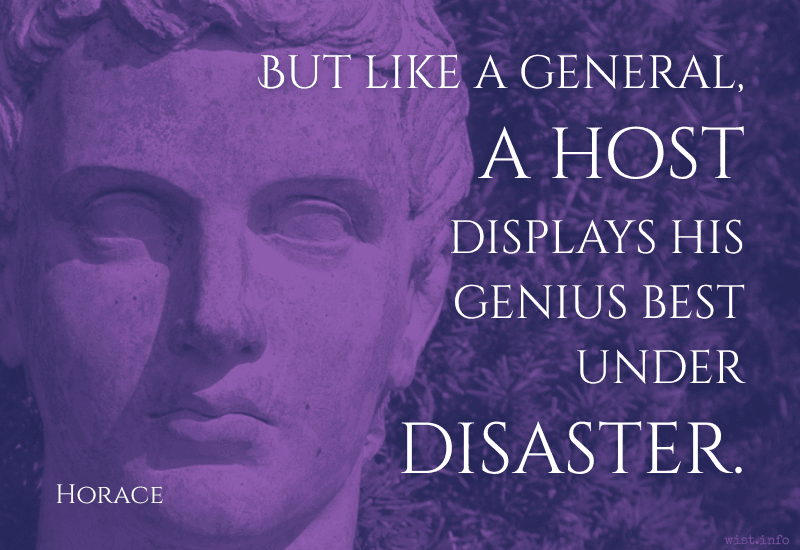
But like a general, a host displays
his genius best under disaster.[Sed convivatoris uti ducis ingenium res
Adversae nudare solent, celare secundae.]
Horace (65–8 BC) Roman poet, satirist, soldier, politician [Quintus Horatius Flaccus]
Satires [Saturae, Sermones], Book 2, # 8 “Ut Nasidieni,” l. 73ff (2.8.73-74) (30 BC) [tr. Matthews (2002)]
(Source)
Balatro speaking somewhat sarcastically to the host, Nasidienus (Rufus), about the misfortunes that are "ruining" his dinner party.
(Source (Latin)). Other translations:But (General-like) Masters of Feasts reveal
That temper by cross hits, the good conceal.
[tr. "I. W. Esq"; ed. Brome (1666)]But as in Captains oft ill chance reveals
The Entertainers Wit, which good conceals.
[tr. Creech (1684)]Good fortune hides, adversity calls forth,
A landlord's genius, and a general's worth.
[tr. Francis (1747)]But then a host's, like a commander's, skill,
Obscured by good success, shines forth in ill.
[tr. Howes (1845)]But adversity is wont to disclose, prosperity to conceal, the abilities of a host as well as of a general.
[tr. Smart/Buckley (1853)]But yet misfortune will bring forth to view the talents of a host as of a general, as will success conceal the same.
[tr. Millington (1870)]Adversity has the effect of eliciting talents, which in prosperous circumstances would have lain dormant.
[E.g. (1872)]But gifts, concealed by sunshine, are displayed
In hosts, as in commanders, by the shade.
[tr. Conington (1874)]But as with a commander, so with a host -- it is rough weather that discovers the genius, fair weather puts it out of sight.
[tr. Wickham (1903)]But one who entertains is like a general: mishaps oft reveal his genius, smooth going hides it.
[tr. Fairclough (Loeb) (1926)]But the host plays a role like the general's:
when things go wrong, his genius comes most into play;
When the going is smooth, you'd never know he had any.
[tr. Palmer Bovie (1959)]But a party-giver's talent, like a general's, comes out
in case of trouble, lies hidden when the going's good.
[tr. Fuchs (1977)]But giving a banquet is like fighting a battle:
A general's real talents show when he's losing, not winning in a walk.
[tr. Raffel (1983)]But such adversities reveal,
while prosperities conceal, the true qualities
of a host which are like those of a general.
[tr. Alexander (1999)]But as with a general so with a host: adverse fortune
has a way of revealing his genius; good fortune obscures it.
[tr. Rudd (2005 ed.)]But as with a general, so a host: adversity
Often reveals his genius, success conceals it.
[tr. Kline (2015)]
Adversity is sometimes hard upon a man; but for one man who can stand prosperity there are a hundred that will stand adversity.
Thomas Carlyle (1795–1881) Scottish essayist and historian
Lecture (1840-05-19), “The Hero as Man of Letters,” Home House, Portman Square, London
(Source)
The lecture notes were collected by Carlyle into On Heroes, Hero-Worship, & the Heroic in History, Lecture 5 (1841).
A wise man turns Chance into good Fortune.
Thomas Fuller (1654–1734) English physician, preacher, aphorist, writer
Gnomologia: Adages and Proverbs (compiler), # 475 (1732)
(Source)