Accept modestly; surrender gracefully.
[Ἄτύφως μὲν λαβεῖν, εὐλύτως δὲ ἀφεῖναι.]
Marcus Aurelius (AD 121-180) Roman emperor (161-180), Stoic philosopher
Meditations [To Himself; Τὰ εἰς ἑαυτόν], Book 6, ch. 33 (8.33) (AD 161-180) [tr. Staniforth (1964)]
(Source)
(Source (Greek)). Alternate translations:Receive temporal blessings without ostentation, when they are sent and thou shalt be able to part with them with all readiness and facility when they are taken from thee again.
[tr. Casaubon (1634), 8.31]As to the Case of good Fortune; Take it without Pride, and Resign without Reluctance.
[tr. Collier (1701)]Receive the gifts of fortune, without pride; and part with them, without reluctance.
[tr. Hutcheson/Moor (1742); Hutcheson/Chrystal (1902)]Receive any good fortune which falls to your lot, without being too much elated; and resign it, if necessary, without being dejected.
[tr. Graves (1792), 8.32]Receive [wealth or prosperity] without arrogance; and be ready to let it go.
[tr. Long (1862)]As to the case of good fortune, take it without pride, and resign it without reluctance.
[tr. Collier/Zimmern (1887)]Modestly take, cheerfully resign.
[tr. Rendall (1898)]Accept without arrogance, surrender without reluctance.
[tr. Haines (Loeb) (1916)]Accept without pride, relinquish without a struggle.
[tr. Farquharson (1944)]Accept without arrogance, relinquish without demur.
[tr. Hard (1997 ed.)]To accept it without arrogance, to let it go with indifference.
[tr. Hays (2003)]Accept humbly; let go easily.
[tr. Hammond (2006)]Accept without arrogance, relinquish without a struggle.
[tr. Hard (2011 ed.)]
Quotations about:
bad fortune
Note not all quotations have been tagged, so Search may find additional quotes on this topic.

O Fortune, cruellest of heavenly powers,
Why make such game of this poor life of ours?[Heu, Fortuna, quis est crudelior in nos
Te Deus? Ut semper gaudes illudere rebus
Humanis!]Horace (65–8 BC) Roman poet, satirist, soldier, politician [Quintus Horatius Flaccus]
Satires [Saturae, Sermones], Book 2, # 8 “Ut Nasidieni,” l. 61ff (2.8.61-63) (30 BC) [tr. Conington (1874)]
(Source)
When "disaster" befalls the dinner party of Nasidienus (Rufus), Nomentanus tries to snap him out of a funk by philosophically / melodramatically bemoaning how Fortune treats humanity.
(Source (Latin)). Alternate translations:Some mourne and blame their sorie fate, why Fortune shoulde be suche,
That they suche blouddes shoulde nothinge have, and others overmuche.
[tr. Drant (1567)]Fortune our Foe, thou art a scurvy Puss!
Ah what a cruel Vixen th' art! ah how
Do'st thou delight to mock us here below!
[tr. I. W. Esq.; ed. Brome (1666)]Unlucky Chance what God is so unkind,
Thou lov'st to break the measures Man design'd.
[tr. Creech (1684)]Fortune, thou cruelest of powers divine,
To joke poor mortals is a joke of thine.
[tr. Francis (1747)]Ah cruel Fortune, foe to human bliss!
Invidious power, it seems thy sole delight
All our enjoyments in the bud to blight.
[tr. Howes (1845)]Alas! O fortune, what god is more cruel to us than thou? How dost thou always take pleasure in sporting with human affairs!
[tr. Smart/Buckley (1853)]O Fortune, what divinity so cruel against us as thou? What joy to thee 'tis ever to frustrate the plans of men!
[tr. Millington (1870)]Ah Fortune, what divine power is more cruel towards us than thou! How thou delightest ever to make sport of human affairs!
[tr. Wickham (1903)]Ah, Fortune, what god is more cruel toward us than thou! How thou dost ever delight to make sport of the life of man!
[tr. Fairclough (Loeb) (1926)]Oh, Fortune, what god
Is more cruel to us than you are! You always have fun
Making fun of mankind!
[tr. Palmer Bovie (1959)]Ah, Fortune! What god more cruel to us than you?
You always like to play around with mankind’s hopes!
[tr. Fuchs (1977)]Ah, Fortune! Is there a crueler god?
How you love to toy with us, playing with our lives!
[tr. Raffel (1983)]What god,
O Fortune, is more cruel toward us than Thou?
How you rejoice in upsetting man’s hopes!
[tr. Alexander (1999)]Fortune, most cruel of all the gods, what
would you do for laughs without us humans?
[tr. Matthews (2002)]Shame on you Lady Luck!
No other god is so cruel. What pleasure you get from mocking
the plans of men!
[tr. Rudd (2005 ed.)]O Fortune, what deity treats us more
Cruelly than you? How you always delight in mocking
Human affairs!
[tr. Kline (2015)]
So live, my boys, as brave men; and if fortune is adverse, front its blows with brave hearts.
[Quocirca vivite fortes
fortiaque adversis opponite pectora rebus.]Horace (65–8 BC) Roman poet, satirist, soldier, politician [Quintus Horatius Flaccus]
Satires [Saturae, Sermones], Book 2, # 2 “Quae virtus et quanta,” l. 135ff (2.2.135-136) (30 BC) [tr. Wickham (1903)]
(Source)
Often misattributed to Cicero.
(Source (Latin)). Alternate translations:Live bravely then,
And in all troubles quit your selves like men.
[tr. A. B.; ed. Brome (1666)]Then live Resolv'd, my Sons, refuse to yield,
And when Fates press make Constancy your shield.
[tr. Creech (1684)]Then be not with your present lot deprest,
And meet the future with undaunted breast
[tr. Francis (1747)]Bear up then, Boys! and stem the adverse tide,
Patience your stay and providence your guide!
[tr. Howes (1845)]Wherefore, live undaunted; and oppose gallant breasts against the strokes of adversity.
[tr. Smart/Buckley (1853)]So, then, live bravely on, and bravely stem adversity's opposing stream.
[tr. Millington (1870)]Then live like men of courage, and oppose
Stout hearts to this and each ill wind that blows.
[tr. Conington (1874)]Live, then, as brave men, and with brave hearts confront the strokes of fate.
[tr. Fairclough (Loeb) (1926)]SO LIVE BRAVE LIVES: STAND UP TO THE BLOWS OF FATE!
[tr. Palmer Bovie (1959)]So then, live, live and endure.
Meet life's difficulties with strong, enduring hearts.
[tr. Fuchs (1977)]Good reason whereby you should be
happy and confront adversity
with an undaunted soul.
[tr. Alexander (1999)]Live as brave men,
then, standing chest to chest with changeful fate.
[tr. Matthews (2002)]So be brave
and bravely throw out your chest to meet the force of fate!
[tr. Rudd (2005 ed.)]So live bravely, as men
With brave hearts do, and confront the vagaries of fate.
[tr. Kline (2015)]
It is easy enough to be pleasant,
When life flows by like a song,
But the man worth while is one who will smile,
When everything goes dead wrong.Ella Wheeler Wilcox (1850-1919) American author, poet, temperance advocate, spiritualist
Poem (1892), “Worth While,” st. 1, An Erring Woman’s Love
(Source)
Sometimes called "The Man Worth While." Collected again in Poems of Cheer (1910).

A man who gets too happy when prosperity comes
trembles when it goes.[Quem res plus nimio delectavere secundae,
mutatae quatient.]Horace (65–8 BC) Roman poet, satirist, soldier, politician [Quintus Horatius Flaccus]
Epistles [Epistularum, Letters], Book 1, ep. 10 “To Aristius Fuscus,” l. 30ff (1.10.30-31) (20 BC) [tr. Fuchs (1977)]
(Source)
(Source (Latin)). Other translations:Who so was to much ravished and to much joy did take
In flow of wealth, him chaunge of flow yea to much shall yshake.
[tr. Drant (1567)]Him, whom a prosp'rous State did too much please;
Chang'd, it will shake.
[tr. Fanshawe; ed. Brome (1666)]Those whom the smiles of Fate too much delight,
Their sudden Frowns more shake and more affright.
[tr. Creech (1684)]They who in Fortune's smiles too much delight,
Shall tremble when the goddess takes her flight.
[tr. Francis (1747)]Who prizes fortune at too high a rate,
Will shrink with horror at an alter'd state.
[tr. Howes (1845)]He who has been overjoyed by prosperity, will be shocked by a change of circumstances.
[tr. Smart/Buckley (1853)]Take too much pleasure in good things, you'll feel
The shock of adverse fortune makes you reel.
[tr. Conington (1874)]Whoe'er hath wildly wantoned in success.
Him will adversity the more depress.
[tr. Martin (1881)]Him whom prosperity too much elates adversity will shake.
[tr. Elgood (1893)]One whom Fortune's smiles have delighted overmuch, will reel under the shock of change.
[tr. Fairclough (Loeb) (1926)]One overmuch elated with success
A change of fortune plunges in distress.
[tr. A. F. Murison (1931)]One whom a favorable turn of events overjoys
A change for the worse undermines.
[tr. Palmer Bovie (1959)]If Fortune’s been kind
-- Too kind! -- loss will seem more than loss, will seem
Catastrophe.
[tr. Raffel (1983)]Change will upset the man who's always been lucky.
[tr. Ferry (2001)]Those who are overjoyed when the breeze of luck is behind them
are wrecked when it changes.
[tr. Rudd (2005 ed.)]Those who’ve been quick to enjoy a following wind,
Are wrecked when it veers.
[tr. Kline (2015)]
MARCUS: You know, I used to think it was awful that life was so unfair; then I thought, ‘Wouldn’t it be much worse if life were fair, and all the terrible things that happened to us come because we actually deserved them?’ So now I take great comfort in the general hostility and unfairness of the universe.
J. Michael (Joe) Straczynski (b. 1954) American screenwriter, producer, author [a/k/a "JMS"]
Babylon 5, 3×13 “A Late Delivery from Avalon” (22 Apr 1996)

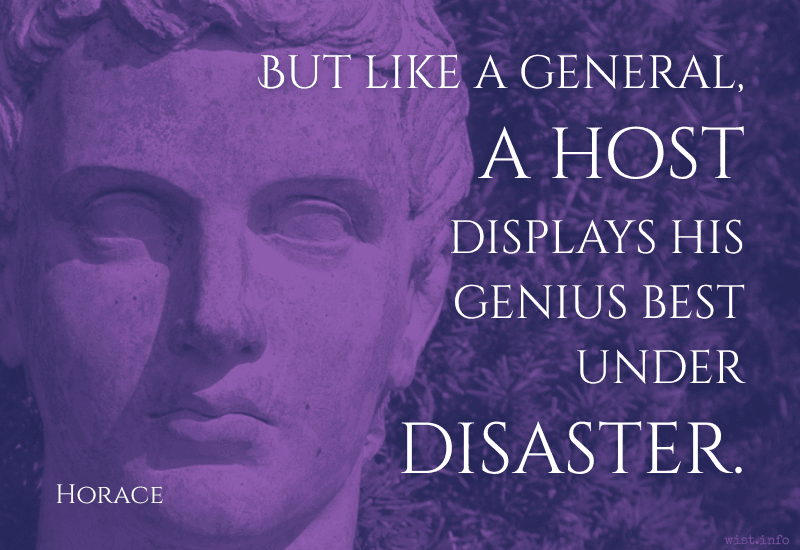
But like a general, a host displays
his genius best under disaster.[Sed convivatoris uti ducis ingenium res
Adversae nudare solent, celare secundae.]
Horace (65–8 BC) Roman poet, satirist, soldier, politician [Quintus Horatius Flaccus]
Satires [Saturae, Sermones], Book 2, # 8 “Ut Nasidieni,” l. 73ff (2.8.73-74) (30 BC) [tr. Matthews (2002)]
(Source)
Balatro speaking somewhat sarcastically to the host, Nasidienus (Rufus), about the misfortunes that are "ruining" his dinner party.
(Source (Latin)). Alternate translations:But (General-like) Masters of Feasts reveal
That temper by cross hits, the good conceal.
[tr. "I. W. Esq"; ed. Brome (1666)]But as in Captains oft ill chance reveals
The Entertainers Wit, which good conceals.
[tr. Creech (1684)]Good fortune hides, adversity calls forth,
A landlord's genius, and a general's worth.
[tr. Francis (1747)]But then a host's, like a commander's, skill,
Obscured by good success, shines forth in ill.
[tr. Howes (1845)]But adversity is wont to disclose, prosperity to conceal, the abilities of a host as well as of a general.
[tr. Smart/Buckley (1853)]But yet misfortune will bring forth to view the talents of a host as of a general, as will success conceal the same.
[tr. Millington (1870)]Adversity has the effect of eliciting talents, which in prosperous circumstances would have lain dormant.
[E.g. (1872)]But gifts, concealed by sunshine, are displayed
In hosts, as in commanders, by the shade.
[tr. Conington (1874)]But as with a commander, so with a host -- it is rough weather that discovers the genius, fair weather puts it out of sight.
[tr. Wickham (1903)]But one who entertains is like a general: mishaps oft reveal his genius, smooth going hides it.
[tr. Fairclough (Loeb) (1926)]But the host plays a role like the general's:
when things go wrong, his genius comes most into play;
When the going is smooth, you'd never know he had any.
[tr. Palmer Bovie (1959)]But a party-giver's talent, like a general's, comes out
in case of trouble, lies hidden when the going's good.
[tr. Fuchs (1977)]But giving a banquet is like fighting a battle:
A general's real talents show when he's losing, not winning in a walk.
[tr. Raffel (1983)]But such adversities reveal,
while prosperities conceal, the true qualities
of a host which are like those of a general.
[tr. Alexander (1999)]But as with a general so with a host: adverse fortune
has a way of revealing his genius; good fortune obscures it.
[tr. Rudd (2005 ed.)]But as with a general, so a host: adversity
Often reveals his genius, success conceals it.
[tr. Kline (2015)]