

Nice people made the best Nazis.
Or so I have been told. My mother was born in Munich in 1934, and spent her childhood in Nazi Germany surrounded by nice people who refused to make waves. When things got ugly, the people my mother lived alongside chose not to focus on “politics,” instead busying themselves with happier things. They were lovely, kind people who turned their heads as their neighbors were dragged away.Naomi Shulman (contemp.), American writer, essayist, editor
Essay (2016-11-17), “No Time To Be Nice: Now Is Not the Moment to Remain Silent,” WBUR, National Public Radio
(Source)
This is a revised version of the following, more commonly-seen quotation, which I have seen suggested was an earlier iteration of the above on her Facebook account (though it does not appear to be posted there any longer):Nice people made the best Nazis. My mom grew up next to them. They got along, refused to make waves, looked the other way when things got ugly and focused on happier things than “politics.” They were lovely people who turned their heads as their neighbors were dragged away. You know who weren’t nice people? Resisters.
The earliest quotation I can find of this earlier version is from 2016-11-13 (followed by these two from 2016-11-22).
Quotations about:
compliance
Note not all quotations have been tagged, so Search may find additional quotes on this topic.

Heaven alone can produce devout people; Princes produce hypocrites.
[Le Ciel seul peut faire les dévots; les Princes font les hypocrites.]
Charles-Lewis de Secondat, Baron de Montesquieu (1689–1755) French political philosopher
Pensées Diverses [Assorted Thoughts], # 630 / 1007 “General Maxims of Politics,” No. 10 (1720-1755) [tr. Clark (2012)]
(Source)
In the French, "seul [alone, solely]" is an amendment above the line in manuscript.(Source (French)).
Liberty is often a heavy burden on a man. It involves that necessity for perpetual choice which is the kind of labor men have always dreaded. In common life we shirk it by forming habits, which take the place of self-determination. In politics party-organization saves us the pains of much thinking before deciding how to cast our vote. In religious matters there are great multitudes watching us perpetually, each propagandist ready with his bundle of finalities, which having accepted we may be at peace. The more absolute the submission demanded, the stronger the temptation becomes to those who have been long tossed among doubts and conflicts.
Oliver Wendell Holmes, Sr. (1809–1894) American poet, essayist, scholar
Article (1860-09), “The Professor’s Story [Elsie Venner],” ch. 18, Atlantic Monthly, Vol. 6, No. 35
(Source)
Originally serialized as “The Professor’s Story,” but collected as the novel Elsie Venner, ch. 18 (1861).
It has always seemed absurd to suppose that a god would choose for his companions, during all eternity, the dear souls whose highest and only ambition is to obey.
Robert Green Ingersoll (1833–1899) American lawyer, freethinker, orator
Lecture (1873-12) “Individuality,” Chicago Free Religious Society
(Source)
Full title "Arraignment of the Church and a Plea for Individuality." Collected in The Gods and Other Lectures (1876).
When I see flags sprouting on official lapels, I think of the time in China when I saw Mao’s Little Red Book on every official’s desk, omnipresent and unread.
Bill Moyers (1934–2025) American journalist and public commentator
Essay (2003-02-28), “Patriotism and the Flag,” NOW with Bill Moyers (PBS)
(Source)
Moyers quoted the comments a few years later in a speech to the National Conference for Media Reform (St Louis) (2005-05-15); the phrase is often cited to that occasion.

Questions are a burden to others
Answers a prison for oneselfGeorge Markstein (1926–1987) British journalist, author, screenwriter
The Prisoner, 01×01 “Arrival” (1967-09-29) [with David Tomblin]
(Source)
Sign in the Labour Exchange office of the Village.


You may force men, by interest or punishment, to say or swear they believe, and to act as if they believed; you can go no farther.

When you think of the long and gloomy history of man, you will find that far more, and far more hideous, crimes have been committed in the name of obedience than have ever been committed in the name of rebellion.
C. P. Snow (1905–1980) English novelist, physical chemist, bureaucrat [Charles Percy Snow]
“The Moral Un-Neutrality of Science,” speech, American Association for the Advancement of Science, New York City (27 Dec 1960)
(Source)
Reprinted in Science (27 Jan 1961) and then in Public Affairs (1971).
It is necessary to distinguish between the virtue and the vice of obedience.
Lemuel K. Washburn (1846–1927) American freethinker, writer
Is the Bible Worth Reading and Other Essays, Epigram (1911)
(Source)
By force you can make hypocrites — men who will agree with you from the teeth out, and in their hearts hate you. We want no more hypocrites. We have enough in every community. And how are you going to keep from having more? By having the air free, — by wiping from your statute books such miserable and infamous laws as this.
Robert Green Ingersoll (1833–1899) American lawyer, freethinker, orator
Speech to the Jury, Trial of C. B. Reynolds for Blasphemy, Morristown, New Jersey (May 1887)
(Source)
The total moral collapse of respectable society during the Hitler regime may teach us that under such circumstances those who cherish values and hold fast to moral norms and standards are not reliable: we now know that moral norms and standards can be changed overnight, and that all that then will be left is the mere habit of holding fast to something.
Much more reliable will be the doubters and skeptics, not because skepticism is good or doubting wholesome, but because they are used to examine things and to make up their own minds.
Best of all will be those who know only one thing for certain: that whatever else happens, as long as we live we shall have to live together with ourselves.

For the lesson of such stories is simple and within everybody’s grasp. Politically speaking, it is that under conditions of terror, most people will comply but some people will not, just as the lesson of the countries to which the Final Solution was proposed is that “it could happen” in most places but it did not happen everywhere. Humanly speaking, no more is required, and no more can reasonably be asked, for this planet to remain a place fit for human habitation.
Hannah Arendt (1906–1975) German-American philosopher, political theorist
Eichmann in Jerusalem: A Report on the Banality of Evil, ch. 14 (1963)
(Source)
Speaking of resistance to Nazi atrocities.
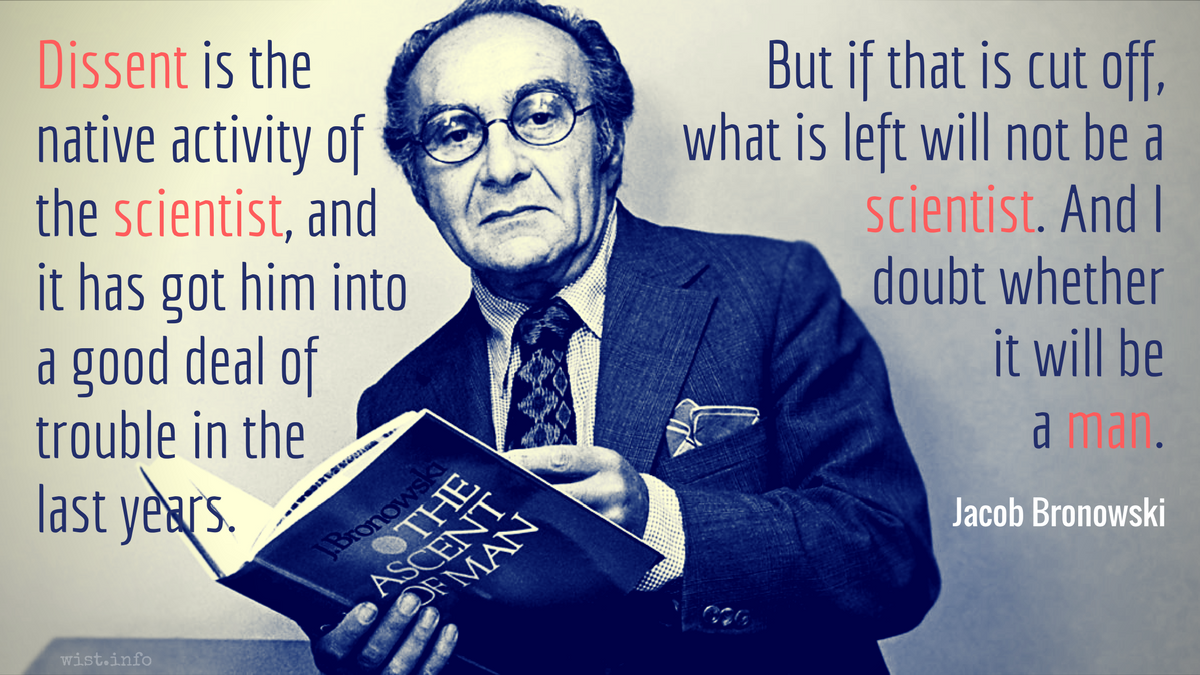
Dissent is the native activity of the scientist, and it has got him into a good deal of trouble in the last years. But if that is cut off, what is left will not be a scientist. And I doubt whether it will be a man.
Jacob Bronowski (1908–1974) Polish-English humanist and mathematician
Lecture, MIT (19 Mar 1953)
(Source)
Reprinted as Science and Human Values, Part 3, sec. 5 "The Sense of Human Dignity" (1961).
To work a Man to thy Bent: 1. Know his Inclinations. 2. Observe his Ends. 3. Search out his Weakness. And so thou mayst either draw or drive him.
Thomas Fuller (1654–1734) English physician, preacher, aphorist, writer
Introductio ad Prudentiam, Vol. 1, # 1067 (1725)
(Source)

Let them hate me, so long as they fear me.
[Óderint, dum métuant.]
Accius (170-c. 86 BC) Roman tragic poet, literary scholar [Lucius Accius, Lucius Attius]
Atreus (fragment 168) [tr. Kline (2010)]
(Source)
A fragment from Accius' work, known only by its quotation by others. The phrase was often used by classical writers as a hallmark of a tyrannical ruler. This includes:(Source (Latin)). Other translations (from the above works):
- Cicero, Pro Sestio, 48/102 (where he regrets that Accius had "used words for evil-minded men to lay hold of").
- Cicero, Philippics 1.14
- Cicero, De Officiis, 1.28/97.
- Seneca the Younger, De Ira, 1.20.4 (referring to the line as "dread and abominable").
- Seneca the Younger, De Clementia, 1.12.
- Suetonius, Life of Caligula, 30.1 (noting that the emperor liked to quote it).
- Suetonius, Life of Tiberius, 59 (quoting Caligula, and contrasting to Tiberius use of the similar Oderint dum probent ("Let them hate me so long as they approve [of my deeds]").
Ev'n let them hate me, whilst they dread me too.
[tr. Cockman (1699)]Let them hate me, provided they fear me.
[tr. McCartney (1798)]Let them hate me, so they fear me.
[tr. Edmonds (1865)]I scorn their hatred, if they do but fear me.
[tr. Thomson (1883)]No matter how they hate me while they fear me.
[tr. Peabody (1883)]Let them hate, provided they fear me!
[tr. Hickie (1888)]Let them hate me, as long as they fear.
[tr. Yonge (1891)]Let them hate, so long as they fear.
[tr. Gardiner (1899)]Let them hate me, provided they fear me.
[tr. Stewart (1900)]Why, let them hate me, if they fear me too!
[tr. Stewart (1900)]What care I though all men should hate my name,
So long as fear accompanies their hate?
[tr. Yonge (1903)]Let them hate provided that they fear.
[ed. Harbottle (1906); tr. Cooper (1995)]Let them hate me, so they but fear me.
[tr. Rolfe (Loeb) (1913)]Let them hate, if only they fear.
[tr. Miller (1913), Basore (1928)]Let them hate, so but they fear.
[tr. Gardner (Loeb) (1958)]Let them hate me, as long as they fear me.
[tr. @aleator (2010)]They can hate as long as they are in fear.
[tr. Edinger (1974)]Let them hate, so long as they fear.
[tr. Kaster]Let them hate me, so long as they fear me.
[Source]

Conscience: the inner voice which warns us that someone may be looking.
H. L. Mencken (1880–1956) American writer and journalist [Henry Lewis Mencken]
A Little Book in C Major, ch. 4, § 12 (1916)
(Source)
Variants:CONSCIENCE. The inner voice which warns us that someone is looking.
[A Book of Burlesques, "The Jazz Webster" (1924)]Conscience is the inner voice which warns us that someone may be looking.
[Chrestomathy, ch. 30 "Sententiae" (1949)]
The basic test of freedom is perhaps less in what we are free to do than in what we are free not to do.
Eric Hoffer (1902–1983) American writer, philosopher, longshoreman
Passionate State of Mind, Aphorism 176 (1955)
(Source)
COLE: We were supposed to draw a picture. Anything we wanted. I drew a man. He got hurt in the neck by another man with a screwdriver.
MALCOLM: You saw that on TV, Cole?
COLE: Everyone got upset. They had a meeting. Mom started crying. I don’t draw like that anymore.
MALCOLM: How do you draw now?
COLE: I draw — people smiling, dogs running, rainbows. They don’t have meetings about rainbows.
M. Night Shyamalan (b. 1970) Indian-American screenwriter, director
The Sixth Sense (1999)
(Source)
(Source (Video); dialog confirmed)