Look high and fall into a Cow-turd.
James Howell (c. 1594–1666) Welsh historian, writer, aphorist
Paroimiographia [Παροιμιογραφία]: Proverbs, or, Old Sayed Sawes & Adages, “English Proverbs” (1659) [compiler]
(Source)
Quotations about:
pay attention
Note not all quotations have been tagged, so Search may find additional quotes on this topic.

No person is so foolish that they don’t understand that if we remain asleep at this moment we will have to live through a rule that is not only cruel and arrogant but ignoble and disgraceful too. You know this man’s arrogance, his friends, and his whole household. To serve shameful lusts, bullies, disgusting and irreverent thieves, those drunkards — well, that is the worst suffering married to the greatest dishonor.
[Nemo est tam stultus qui non intellegat, si indormierimus huic tempori, non modo crudelem superbamque dominationem nobis sed ignominiosam etiam et flagitiosam ferendam. Nostis insolentiam Antoni, nostis amicos, nostis totam domum. Libidinosis, petulantibus, impuris, impudicis, aleatoribus, ebriis servire, ea summa miseria est summo dedecore coniuncta.]
Marcus Tullius Cicero (106–43 BC) Roman orator, statesman, philosopher
Philippics [Philippicae; Antonian Orations], No. 3, ch. 14 / sec. 34-35 (3.14/3.34-35) (44-12-20 BC) [tr. @sentantiq (2021)]
(Source)
Warning of Mark Antony's intentions to succeed Julius Caesar. Once Antony was in power, under the Triumvirate, he had Cicero killed.
(Source (Latin)). Other translations:There is no one so foolish as not to perceive that if we go to sleep over this opportunity we shall have to endure a tyranny which will be not only cruel and haughty, but also ignominious and flagitious. You know the insolence of Antonius; you know his friends, you know his whole household. To be slaves to lustful, wanton, debauched, profligate, drunken gamblers, is the extremity of misery combined with the extremity of infamy.
[tr. Yonge (1903)]No man is so foolish as not to understand that, if we sleep on this crisis, we must bear a tyranny, not merely cruel and arrogant, but also ignominious and infamous. You know Antonius' insolence, you know his friends, you know his whole household. Slavery under men lustful, wanton, foul, unchaste, gamblers and drunkards, this is the utmost misery allied with the utmost disgrace.
[tr. Ker (Loeb) (1926)]No man is so dull as not to realize that if we doze over this crisis we shall have to endure a despotism not only cruel and arrogant but ignominious and disgraceful. You now Antonius' insolence, you know his friends, you know his whole retinue. To be slave to libertines, bullies, foul profligates, gamblers, drunkards, that is the ultimate in misery joined with the ultimate in dishonor.
[tr. Manuwald (2007)]
People encounter God under shady oak trees, on riverbanks, at the tops of mountains, and in long stretches of barren wilderness. God shows up in whirlwinds, starry skies, burning bushes, and perfect strangers. When people want to know more about God, the son of God tells them to pay attention to the lilies of the field and the birds of the air, to women kneading bread and workers lining up for their pay. Whoever wrote this stuff believed that people could learn as much about the ways of God from paying attention to the world as they could from paying attention to scripture. What is true is what happens, even if what happens is not always right. People can learn as much about the ways of God from business deals gone bad or sparrows falling to the ground as they can from reciting the books of the Bible in order. They can learn as much from a love affair or a wildflower as they can from knowing the Ten Commandments by heart.
Barbara Brown Taylor (b. 1951) American minister, academic, author
An Altar in the World, ch. 1 (2009)
(Source)

Nobody really listens to anyone else, and if you try it for a while you’ll see why.
Mignon McLaughlin (1913–1983) American journalist and author
The Second Neurotic’s Notebook, ch. 3 (1966)
(Source)

To a talkative fellow, who poured out a torrent of words and then said, “Let’s hope I haven’t been boring you with my chatter!” he replied, “No, by Zeus, I haven’t been listening.”
[πρὸς τὸν εἰπόντα ἀδολέσχην, ἐπειδὴ αὐτοῦ πολλὰ κατήντλησε, “μήτι σου κατεφλυάρησα;” “μὰ Δί᾽,” εἶπεν: “οὐ γάρ σοι προσεῖχον.]
Aristotle (384–322 BC) Greek philosopher
Attributed in Diogenes Laërtius, Lives and Opinions of Eminent Philosophers [Vitae Philosophorum], Book 5, sec. 11 [tr. Mensch (2018)]
(Source)
(Source (Greek)). Other translations:A chattering fellow, who had been abusing him, said to him, “Have not I been jeering you properly?” “Not that I know of,” said he, “for I have not been listening to you.”
[tr. Yonge (1853)]To the chatterbox who poured out a flood of talk upon him and then inquired, "Have I bored you to death with my chatter?" he replied, "No, indeed; for I was not attending to you."
[tr. Hicks (1925), sec. 20]To the man talking endlessly when he assailed him with words and asked “Have I worn you out with nonsense”, he said “By Zeus, no! I wasn’t listening to you.”
[tr. @sentantiq (2016)]

Not listening is probably the commonest unkindness of married life, and one that creates — more devastatingly than an eternity of forgotten birthdays and misguided Christmas gifts — an atmosphere of not loving and not caring.
Judith Viorst (b. 1931) American writer, journalist, psychoanalysis researcher
Yes, Married (1972)

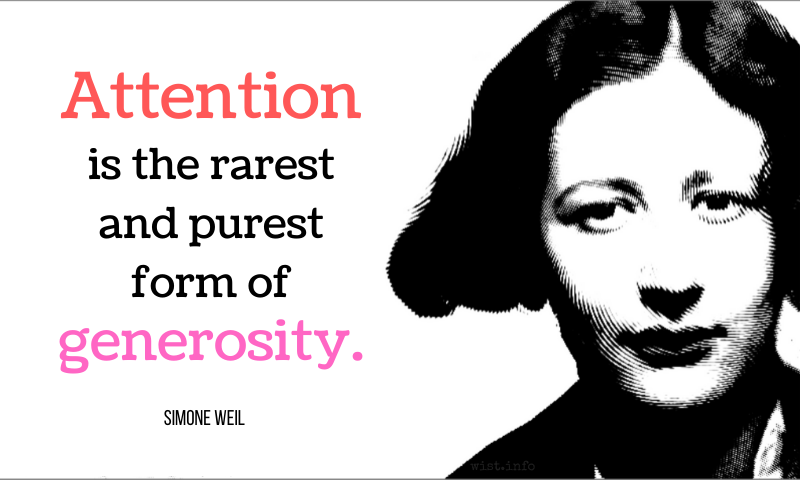
Attention is the rarest and purest form of generosity.
Simone Weil (1909–1943) French philosopher
Letter to Joë Bousquet (13 Apr 1942)
Quoted in Simone Pétrement, Simone Weil: A Life (1976) [tr. Rosenthal].

Not everyone is worth listening to.
Alain de Botton (b. 1969) Swiss-British author
The Consolations of Philosophy, ch. 1 “Consolation For Unpopularity” (2000)
(Source)

ARTHUR: You know, it’s at times like this, when I’m trapped in a Vogon airlock with a man from Betelgeuse, and about to die of asphyxiation in deep space that I really wish I’d listened to what my mother told me when I was young.
FORD: Why, what did she tell you?
ARTHUR: I don’t know, I didn’t listen.
Douglas Adams (1952–2001) English author, humorist, screenwriter
Hitchhiker’s Guide to the Galaxy, Phase 1, “Fit the 2nd” (BBC Radio) (1978-03-15)
(Source)
Adapted into book form in Hitchhiker's Guide to the Galaxy No. 1, The Hitchhiker's Guide to the Galaxy, ch. 7 (1979), with identical dialog. The only difference between the two is that after these lines, in the radio play Ford replies, "Huh! Terrific," while in the book he says, "Oh," and carries on humming.

This is a column for everyone in the path of Hurricane Katrina who ever said, “I’m sorry, I’m just not interested in politics,” or, “There’s nothing I can do about it,” or, “Eh, they’re all crooks anyway.”
Look around you this morning. I suppose the NRA would argue, “Government policies don’t kill people, hurricanes kill people.” Actually, hurricanes plus government policies kill people. […] This, my friends, is why we need to pay attention to government policies, not political personalities, and to know whereon we vote. It is about our lives.Molly Ivins (1944–2007) American writer, political columnist [Mary Tyler Ivins]
Essay (2005-09-09), “Katrina and You,” Texas Observer
A close variant of this (and usually quoted, as below, with elisions) ran in as the essay (2005-10), "Policies That Kill," The Progressive, Vol. 69, No. 10:This is a column for everyone who ever said, "I'm sorry, I'm just not interested in politics," or, "There's nothing I can do about it," or, "Hey, they're all crooks anyway." ... I've got one word for all of you: Katrina. ... This, friends, is why we need to pay attention to government policies, not political personalities, and to know whereon we vote. It is about our lives.
This was included in the Progressive's memorial retrospective on Ivins in 2007-02.

To see what is in front of one’s nose needs a constant struggle.
George Orwell (1903–1950) English journalist, essayist, writer [pseud. of Eric Arthur Blair]
Essay (1946-03-22), “In Front of Your Nose,” “As I Please” column, Tribune Newspaper
(Source)

If I were to begin life again, I should want it as it was. I would only open my eyes a little more.
Jules Renard (1864–1910) French writer
Journal