A writer should cultivate only what naturally absorbs his fancy, whether it be freedom or cinch bugs, and should write in the way that comes easy.
E. B. White (1899–1985) American author, critic, humorist [Elwyn Brooks White]
Essay (1939-01), “One Man’s Meat,” Harper’s Magazine, Vol. 178
(Source)
When collected in his book, One Man's Meat (1944), the essay was renamed "Salt Water Farm." Sometimes the excerpted third section of the essay is referred to as "The Duty of Writers."
Quotations about:
subject
Note not all quotations have been tagged, so Search may find additional quotes on this topic.
For it is clear that in a monarchy, where the person who executes the laws holds himself above them, less virtue is required than in a popular government, where the person who executes the laws is aware that he himself is subject to them and that he will feel their weight.
[Car il est clair que, dans une monarchie, où celui qui fait exécuter les loix se juge au-dessus des loix, on a besoin de moins de vertu que dans un gouvernement populaire, où celui qui fait exécuter les loix, sent qu’il y est soumis lui-même, & qu’il en portera le poids.]
Charles-Lewis de Secondat, Baron de Montesquieu (1689–1755) French political philosopher
Spirit of Laws [The Spirit of the Laws; De l’esprit des lois], Book 3, ch. 3 (3.3) (1748) [tr. Stewart (2018)]
(Source)
(Source (French)). Other translations:For it is clear that in a monarchy, where he who commands the execution of the laws generally thinks himself above them, there is less need of virtue than in a popular government, where the person entrusted with the execution of the laws is sensible of his being subject to their direction.
[tr. Nugent (1750)]For it is clear that less virtue is needed in a monarchy, where the one who sees to the execution of the laws judges himself above the laws, than in a popular government, where the one who sees the execution of the laws feels that he is subject to them himself and that he will bear their weight.
[tr. Cohler/Miller/Stone (1989)]
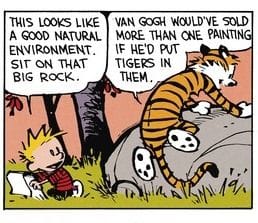
HOBBES: Van Gogh would’ve sold more than one painting if he’d put tigers in them.

The writer, like a swimmer caught by an undertow, is borne in an unexpected direction. He is carried to a subject which has awaited him — a subject sometimes no part of his conscious plan. Reality, the reality of sensation, has accumulated where it was least sought. To write is to be captured — captured by some experience to which one may have given hardly a thought.
The ideal subject of totalitarian rule is not the convinced Nazi or the convinced Communist, but people for whom the distinction between fact and fiction (i.e., the reality of experience) and the distinction between true and false (i.e., the standards of thought) no longer exist.
Hannah Arendt (1906–1975) German-American philosopher, political theorist
Origins of Totalitarianism, Part 3, ch. 13 “Ideology and Terror” (1951)
(Source)

The young man appeared disconcerted at the vehemence of Phryne’s discourse, and she changed the subject. One did not wantonly disconcert young men on whom one might be having designs in future.
Kerry Greenwood (b. 1954) Australian author and lawyer
Phryne Fisher, Book 3, Murder on the Ballarat Train (1991)

Why laugh? Change but the name, and the tale is told of you.
[Quid rides? Mutato nomine de te
fabula narratur.]Horace (65–8 BC) Roman poet, satirist, soldier, politician [Quintus Horatius Flaccus]
Satires [Saturae, Sermones], Book 1, # 1 “Qui fit, Mæcenas,” l. 68ff (1.1.68-69) (35 BC) [tr. Fairclough (Loeb) (1926)]
(Source)
After the Miser scoffs at the story of Tantalus.
Latin sometimes given as "... fabula de te narratur."
(Source (Latin)). Other translations:Takynge but his name,
This tale maye well be toulde of the, thou arte the veray same.
[tr. Drant (1567)]Do you but change the name
Of you is saide the same.
[tr. Florio (1603): Montaigne, Essays, Preface]Why laughst thou Miser? if thy name should be
A little chang'd, the Fables told of thee.
[tr. A. B.; ed. Brome (1666)]What dost Thou laugh? and think that Thou art
Fool change the Name, the Story's told of Thee.
[tr. Creech (1684)]Wherefore do you laugh?
Change but the name, of thee the tale is told.
[tr. Francis (1747)]You smile, as if the story were not true!
Change but the name, and it applies to you.
[tr. Howes (1845)]Why do you laugh? The name changed, the tale is told of you.
[tr. Smart/Buckley (1853)]Well, why that laugh? but change the name, and the then the story's told of you.
[tr. Millington (1870)]Laughing, are you? why?
Change but the name, of you the tale is told.
[tr. Conington (1874)]You laugh? Well, just change the name and you'll find that this story,
as a matter of fact, means YOU.
[tr. Palmer Bovie (1959)]What's so funny? Change the name and it's you
the myth's about.
[tr. Fuchs (1977)]You laugh? Change
The name, and it's your story too!
[tr. Raffel (1983)]Why laugh? Change the name of the fable
and it applies to you.
[tr. Alexander (1999)]What are you laughing at? Just change the name and the joke's on you.
[Source (2002)]You laugh? Change but
the names and this old story's about you.
[tr. Matthews (2002)]What are you laughing at? Change the name and you're the subject
of the story.
[tr. Rudd (2005 ed.)]Why do you mock him? Alter a name and the same tale
Is told of you.
[tr. Kline (2015)]