

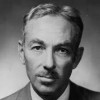
Old age is a special problem for me because I’ve never been able to shed the mental image I have of myself — a lad of about nineteen.
E. B. White (1899–1985) American author, critic, humorist [Elwyn Brooks "Andy" White]
“E. B. White: Notes and Comment by Author,” interview by Israel Shenker, New York Times (1969-07-11)
(Source)
On his 70th birthday.
Quotations by:
White, E. B.

I am inordinately proud these days of the quill, for it has shown itself, historically, to be the hypodermic which inoculates men and keeps the germ of freedom always in circulation, so that there are individuals in every time in every land who are the carriers, the Typhoid Mary’s, capable of infecting others by mere contact and example. These persons are feared by every tyrant — who shows his fear by burning the books and destroying the individuals.
E. B. White (1899–1985) American author, critic, humorist [Elwyn Brooks "Andy" White]
“Freedom” (Jul 1940)
Democracy is the recurrent suspicion that more than half of the people are right more than half of the time.
E. B. White (1899–1985) American author, critic, humorist [Elwyn Brooks "Andy" White]
“Notes and Comments,” New Yorker (3 Jul 1943)
(Source)
Humor can be dissected, as a frog can, but the thing dies in the process and the innards are discouraging to any but the purely scientific mind.
E. B. White (1899–1985) American author, critic, humorist [Elwyn Brooks "Andy" White]
“The Preaching Humorist,” The Saturday Review of Literature (1941-10-18) [with Katherine White]
(Source)
The apparent origin of "Analyzing humor is a bit like dissecting a frog: You learn how it works but you end up with a dead frog" (and variants).
Also attributed to Mark Twain (not found in his writing) and André Maurois (who said something similar in 1960). See here for more discussion.
If the world were merely seductive, that would be easy. If it were merely challenging, that would be no problem. But I arise in the morning torn between a desire to improve the world, and a desire to enjoy the world. This makes it hard to plan the day.
E. B. White (1899–1985) American author, critic, humorist [Elwyn Brooks "Andy" White]
(Attributed)
We should all do what, in the long run, gives us joy, even if it is only picking grapes or sorting laundry.
E. B. White (1899–1985) American author, critic, humorist [Elwyn Brooks "Andy" White]
(Attributed)
I have one share in corporate Earth, and I am nervous about the management.
E. B. White (1899–1985) American author, critic, humorist [Elwyn Brooks "Andy" White]
(Attributed)
Weather is a great bluffer. I guess the same is true of our human society — things can look dark, then a break shows in the clouds, and all is changed.
E. B. White (1899–1985) American author, critic, humorist [Elwyn Brooks "Andy" White]
(Attributed)
I get up every morning determined to both change the world and have one hell of a good time. Sometimes this makes planning my day difficult.
E. B. White (1899–1985) American author, critic, humorist [Elwyn Brooks "Andy" White]
(Attributed)
When liberty’s position is challenged, artists and writers are the ones who first take up the sword. They do so without persuasion, for the battle is peculiarly their own. In the nature of things, a person engaged in the flimsy business of expressing himself on paper is dependent on the large general privilege of being heard. Any intimation that this privilege may be revoked throws a writer into a panic. His is a double allegiance to freedom — an intellectual one springing from the conviction that pure thought has a right to function unimpeded, and a selfish one springing from his need, as a breadwinner, to be allowed to speak his piece.
E. B. White (1899–1985) American author, critic, humorist [Elwyn Brooks "Andy" White]
Essay (1939-01), “One Man’s Meat,” Harper’s Magazine, Vol. 178
(Source)
When collected in his book, One Man's Meat (1944), the essay was renamed "Salt Water Farm." Sometimes the excerpted third section of the essay is referred to as "The Duty of Writers."
A writer should cultivate only what naturally absorbs his fancy, whether it be freedom or cinch bugs, and should write in the way that comes easy.
E. B. White (1899–1985) American author, critic, humorist [Elwyn Brooks "Andy" White]
Essay (1939-01), “One Man’s Meat,” Harper’s Magazine, Vol. 178
(Source)
When collected in his book, One Man's Meat (1944), the essay was renamed "Salt Water Farm." Sometimes the excerpted third section of the essay is referred to as "The Duty of Writers."
I know of one gifted crackpot who used to be employed gainfully in the fields of humor and satire, who has taken a solemn pledge not to write anything funny or lighthearted or “insignificant” again till things get straightened around in the world. This seems to me distinctly deleterious and a little silly. A literature composed of nothing but liberty-loving thoughts is little better than the propaganda which it seeks to defeat.
E. B. White (1899–1985) American author, critic, humorist [Elwyn Brooks "Andy" White]
Essay (1939-01), “One Man’s Meat,” Harper’s Magazine, Vol. 178
(Source)
When collected in his book, One Man's Meat (1944), the essay was renamed "Salt Water Farm." Sometimes the excerpted third section of the essay is referred to as "The Duty of Writers."
In a free country it is the duty of writers to pay no attention to duty. Only under a dictatorship is literature expected to exhibit an harmonious design or an inspirational tone.
E. B. White (1899–1985) American author, critic, humorist [Elwyn Brooks "Andy" White]
Essay (1939-01), “One Man’s Meat,” Harper’s Magazine, Vol. 178
(Source)
On the call for writers to dutifully do those things during times of national crisis or war.
When collected in his book, One Man's Meat (1942), the essay was renamed "Salt Water Farm." Sometimes the excerpted third section of the essay is referred to as "The Duty of Writers."
A despot doesn’t fear eloquent writers preaching freedom — he fears a drunken poet who may crack a joke that will take hold. His gravest concern is lest gaiety, or truth in sheep’s clothing, somewhere gain a foothold, lest joy in some unguarded moment be unconfined.
E. B. White (1899–1985) American author, critic, humorist [Elwyn Brooks "Andy" White]
Essay (1939-01), “One Man’s Meat,” Harper’s Magazine, Vol. 178
(Source)
When collected in his book, One Man's Meat (1942), the essay was renamed "Salt Water Farm." Sometimes the excerpted third section of the essay is referred to as "The Duty of Writers."
It is easier for a man to be loyal to his club than to his planet; the bylaws are shorter, and he is personally acquainted with the other members. A club, moreover, or a nation, has a most attractive offer to make: it offers the right to be exclusive. There are not many of us who are physically constituted to resist this strange delight, this nourishing privilege. It is at the bottom of all fraternities, societies, orders. It is at the bottom of most trouble. The planet holds out no such inducement. The planet is everybody’s. All it offers is the grass, the sky, the water, the ineluctable dream of peace and fruition.
E. B. White (1899–1985) American author, critic, humorist [Elwyn Brooks "Andy" White]
Essay (1941-12), “Intimations,” Harper’s Magazine, Vol. 184
(Source)
Collected in his book, One Man's Meat (1942).
Anyone who writes down to children is simply wasting his time. You have to write up, not down. Children are demanding. They are the most attentive, curious, eager, observant, sensitive, quick, and generally congenial readers on earth. They accept, almost without question, anything you present them with, as long as it is presented honestly, fearlessly, and clearly.
Children are game for anything. I throw them hard words, and they backhand them over the net. They love words that give them a hard time, provided they are in a context that absorbs their attention.
When you consider that there are a thousand ways to express even the simplest idea, it is no wonder writers are under a great strain. Writers care greatly how a thing is said — it makes all the difference. So they are constantly faced with too many choices and must make too many decisions.
A writer who waits for ideal conditions under which to work will die without putting a word on paper.
E. B. White (1899–1985) American author, critic, humorist [Elwyn Brooks "Andy" White]
Interview by George Plimpton and Frank H. Crowther, “E. B. White, The Art of the Essay No. 1,” Paris Review #48 (Fall 1969)
(Source)
I am beginning to feel a little more like an author now that I have had a book banned. The literary life, in this country, begins in jail.
E. B. White (1899–1985) American author, critic, humorist [Elwyn Brooks "Andy" White]
Letter to Stanley Hart White (1944-06)
(Source)
On reading that the US Army and Navy had refused to publish an "Armed Services Edition" of his Harper's magazine essay collection, One Man's Meat (1942), for "political implications." The decision was later rescinded.
The press in our free country is reliable and useful not because of its good character but because of its great diversity. As long as there are many owners, each pursuing his own brand of truth, we the people have an opportunity to arrive at the truth and to dwell in the light. The multiplicity of ownership is crucial. It’s only when there are a few owners, or, as in a government-controlled press, one owner, that truth becomes illusive and the light fails.
E. B. White (1899–1985) American author, critic, humorist [Elwyn Brooks "Andy" White]
Letter to W. B. Jones (30 Jan 1976)
I arise in the morning torn between a desire to improve (or save) the world and a desire to enjoy (or savor) the world. This makes it hard to plan the day.
E. B. White (1899–1985) American author, critic, humorist [Elwyn Brooks "Andy" White]
Recalled on his death, Newsweek (14 Oct 1985)