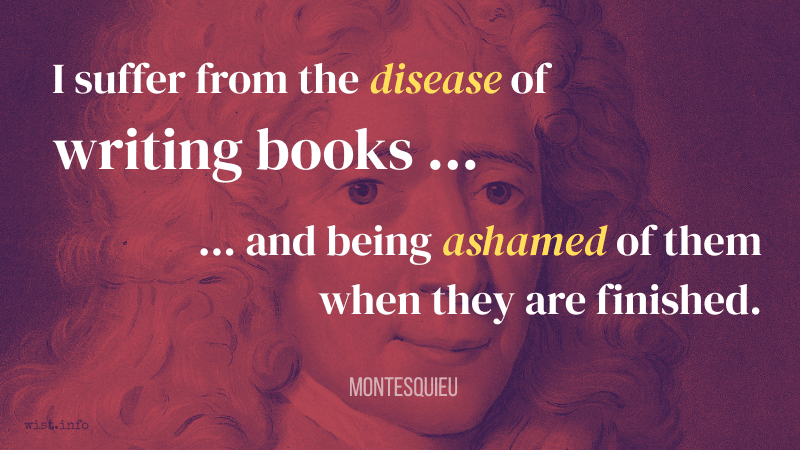
I suffer from the disease of writing books and being ashamed of them when they are finished.
[J’ai la maladie de faire des livres et d’en être honteux quand je les ai faits.]
Charles-Lewis de Secondat, Baron de Montesquieu (1689–1755) French political philosopher
Pensées Diverses [Assorted Thoughts], # 83 / 837 (1720-1755)
(Source)
(Source (French)). Other translations:It is a kind of sickness with me to compose books and to be ashamed of them afterwards.
[ed. Guterman (1963)]I have the disease of writing books and being ashamed of them when I have written them.
[tr. Clark (2012)]
Quotations about:
self-perception
Note not all quotations have been tagged, so Search may find additional quotes on this topic.
RICHARD: And therefore, since I cannot prove a lover
To entertain these fair well-spoken days,
I am determinèd to prove a villain
And hate the idle pleasures of these days.William Shakespeare (1564–1616) English dramatist and poet
Richard III, Act 1, sc. 1, l. 28ff (1.1.28-31) (1592)
(Source)

There is another kind of “glory”: conceiving too high an opinion of our worth. This is an undeserved feeling by which we value ourselves, and that makes us think ourselves different than we are, just as the passion of love lends beauties and graces to the object it embraces and makes those smitten by it — with their judgment blurred and altered — find what they love different, and more perfect, than it is.
[Il y a une autre sorte de gloire, qui est une trop bonne opinion, que nous concevons de nostre valeur. C’est un’affection inconsideree, dequoy nous nous cherissons, qui nous represente à nous mesmes, autres que nous ne sommes. Comme la passion amoureuse preste des beautez, & des graces, au subject qu’elle embrasse ; & fait que ceux qui en sont espris, trouvent d’un jugement trouble & alteré, ce qu’ils aiment, autre & plus parfait qu’il n’est.]
Michel de Montaigne (1533–1592) French essayist
Essays, Book 2, ch. 17 (2.17), “Of Presumption [De la Presomption]” (1578) [tr. Atkinson/Sices (2012)]
(Source)
This essay and passage were in the 1st (1580) edition.
(Source (French)). Other translations:There is another kinde of glorie, which is an over-good opinion we conceive of our worth. It is an inconsiderate affection, wherewith wee cherish our selves, which presents-us unto our selves other then wee are. As an amorous passion addeth beauties, and lendeth graces to the subject it embraceth, and maketh such as are therewith possessed, with a troubled conceite, and distracted Judgement, to deeme what they love, and finde what they affect, to bee other, and seeme more perfect, then in trueth it is. [tr. Florio (1603)]There is another sort of glory, which is the having too good an opinion of our own merit. It is an inconsiderate affection, with which we flatter ourselves, and that represents us to ourselves other than what we truly are: like the passion of love, that lends beauties and graces to the object of it; and makes those who are caught with it, by a depraved and corrupt judgment, consider the thing they love other and more perfect than it is.
[tr. Cotton (1686)]There is another sort of glory, which is the having too good an opinion of our own worth. ’Tis an inconsiderate affection with which we flatter ourselves, and that represents us to ourselves other than we truly are: like the passion of love, that lends beauties and graces to the object, and makes those who are caught by it, with a depraved and corrupt judgment, consider the thing which they love other and more perfect than it is.
[tr. Cotton/Hazlitt (1877)]There is another sort of glory, which is a too high opinion that we conceive of our worth. It is an ill-advised affection with which we flatter ourselves, which represents us to ourselves other than we are; as amourous passion lends beauties and charms to that which it embraces, and causes those who are possessed by it, their judgement being disturbed and diverted, to deem what they love different from what it is, and more perfect.
[tr. Ives (1925)]There is another sort of glory, which is to have too good an opinion of our own worth. It is an unthinking affection with which we flatter ourselves, that represents us to ourselves other than we truly are: like the passion of love, that lends beauties and charms to the object it embraces, and makes those who are possessed by it, with a troubled and corrupt judgment, consider the thing they love other and more perfect than it is.
[tr. Zeitlin (1934)]There is another kind of vainglory, which is an over-good opinion we form of our own worth. It is an unreasoning affection, by which we cherish ourselves, which represents us to ourselves as other than we are; as the passion of love lends beauties and graces to the object it embraces, and makes its victims, with muddled and unsettled judgment, think that what they love is other and more perfect than it is.
[tr. Frame (1943)]There is another kind of glory, which is to have too good an opinion of our own worth. It is an unthinking affection with which we flatter ourselves, and which presents us to ourselves as other than we are; just as the passion of love lends beauties and charms to the object it embraces in such a way that the love's judgement is troubled and distracted, and he finds the lady he loves other and more perfect than she is.
[tr. Cohen (1958)]There is another kind of "glory": the over-high opinion we conceive of our own worth. It is an imprudent affection by which we hold our own self dear, presenting ourself to ourself other than we are, just as passionate love lends grace and beauty to the person it embraces and leads to those who are enraptured by it being disturbed and confused in their judgement, so finding their Beloved other than she is, and more perfect.
[tr. Screech (1987)]

“And how are you?” said Winnie-the-Pooh.
Eeyore shook his head from side to side.
“Not very how,” he said. “I don’t seem to have felt at all how for a long time.”A. A. Milne (1882–1956) English poet and playwright [Alan Alexander Milne]
Winnie-the-Pooh, ch. 4 “Eeyore Loses a Tail” (1926)
(Source)
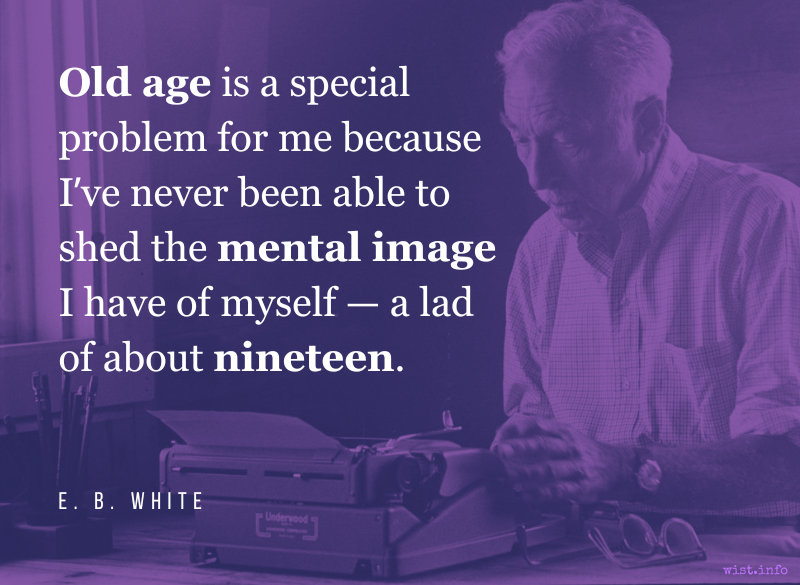
Old age is a special problem for me because I’ve never been able to shed the mental image I have of myself — a lad of about nineteen.
E. B. White (1899–1985) American author, critic, humorist [Elwyn Brooks White]
“E. B. White: Notes and Comment by Author,” interview by Israel Shenker, New York Times (1969-07-11)
(Source)
On his 70th birthday.

Doesn’t matter how pretty you are. What’s important is how pretty you feel. No one feels pretty when they hear “no” often enough.
Jim Butcher (b. 1971) American author
Skin Game (2014)

If ever there’s a tomorrow where we’re not together, there is something you must remember. You’re braver than you believe, and stronger than you seem, and smarter than you think.
A. A. Milne (1882–1956) English poet and playwright [Alan Alexander Milne]
(Misattributed)
(Source)
Christopher Robin to Pooh Bear. The quotation is broadly attributed to Milne and Winnie the Pooh, but is actually from the 1997 Disney video Pooh's Grand Adventure: The Search for Christopher Robin, written by Carter Crocker and Karl Geurs, based on the characters created by Milne.
To know what you like is the beginning of wisdom and of old age. Youth is wholly experimental. The essence and charm of that unquiet and delightful epoch is ignorance of self as well as ignorance of life. These two unknowns the young man brings together again and again, now in the airiest touch, now with a bitter hug; now with exquisite pleasure, now with cutting pain; but never with indifference, to which he is a total stranger, and never with that near kinsman of indifference, contentment.
To become different from what we are, we must have some awareness of what we are.
Eric Hoffer (1902–1983) American writer, philosopher, longshoreman
Passionate State of Mind, Aphorism 151 (1955)
(Source)

A man’s private thought can never be a lie; what he thinks, is to him the truth, always.
Mark Twain (1835–1910) American writer [pseud. of Samuel Clemens]
Letter to Louis Pendleton (4 Aug 1888)
We are never quite as happy, or as unhappy, as we think.
[On n’est jamais si heureux ni si malheureux qu’on s’imagine.]
François VI, duc de La Rochefoucauld (1613–1680) French epigrammatist, memoirist, noble
Réflexions ou sentences et maximes morales [Reflections; or Sentences and Moral Maxims], ¶49 (1665-1678) [tr. FitzGibbon (1957)]
(Source)
Present in the first edition. In the first four editions, the concluding words were "... que l’on pense [whatever one thinks]." In the manuscript, this maxim read:One is never so unhappy as one fears, nor so happy as one hopes.
[On n’est jamais si malheureux qu’on craint, ni si heureux qu’on espère.]
Another manuscript version is what the Davies translation below derives from:Les biens et les maux sont plus grands dans notre imagination qu’ils ne le sont en effet, et on n’est jamais si heureux ni si malheureux que l’on pense.
Above notes. (Source (French)). Other translations:Goods and Evils are much greater in our imaginations of them, than they are in effect; and men are never so happy or unhappy, as they think themselves.
[tr. Davies (1669), ¶128; see above.]None are either so happy or so unhappy, as they imagine.
[pub. Donaldson (1783), ¶211; ed. Lepoittevin-Lacroix (1797), ¶49]No person is either so happy;, or so unhappy, as he imagines.
[ed. Carville (1835), ¶184]We are never so happy, or so unhappy, as we imagine.
[ed. Gowens (1851), ¶50]We are never so happy or so unhappy as we suppose.
[tr. Bund/Friswell (1871); tr. Stevens (1939)]We are never as happy or unhappy as we think.
[tr. Heard (1917)]We are never so happy or so unhappy as we think.
[tr. Kronenberger (1959)]We are never as fortunate or as unfortunate as we suppose.
[tr. Tancock (1959)]We are never so happy nor so unhappy as we imagine.
[tr. Whichello (2016)]

We judge ourselves by what we feel capable of doing, while others judge us by what we have already done.