When a sieve is shaken, the refuse appears;
so does a person’s waste when he speaks.
The kiln tests the potter’s vessels,
and the test of a person is in his conversation.
Its fruit discloses the cultivation of a tree;
so does speech the thoughts of the human mind.
Do not praise anyone before he speaks,
for this is the way people are tested.[Ἐν σείσματι κοσκίνου διαμένει κοπρία,
οὕτως σκύβαλα ἀνθρώπου ἐν λογισμῷ αὐτοῦ.
σκεύη κεραμέως δοκιμάζει κάμινος,
καὶ πειρασμὸς ἀνθρώπου ἐν διαλογισμῷ αὐτοῦ.
γεώργιον ξύλου ἐκφαίνει ὁ καρπὸς αὐτοῦ,
οὕτως λόγος ἐνθυμήματος καρδίας ἀνθρώπου.
πρὸ λογισμοῦ μὴ ἐπαινέσῃς ἄνδρα·
οὗτος γὰρ πειρασμὸς ἀνθρώπων]The Bible (The Old Testament) (14th - 2nd C BC) Judeo-Christian sacred scripture [Tanakh, Hebrew Bible], incl. the Apocrypha (Deuterocanonicals)
Book 22b. Sirach (Ecclesiasticus) 27: 4ff (Sir 27:4–7) [tr. NRSV (2021 ed.)]
(Source)
More on the history and acceptance of this Apocryphal book here and here.
(Source (Greek)). Alternate translations:As when one sifteth with a sieve, the refuse remaineth; so the filth of man in his talk.
The furnace proveth the potter's vessels; so the trial of man is in his reasoning.
The fruit declareth if the tree have been dressed; so is the utterance of a conceit in the heart of man.
Praise no man before thou hearest him speak; for this is the trial of men.
[tr. KJV (1611)]As when one sifteth with a sieve, the dust will remain:
so will the perplexity of a man in his thoughts.
The furnace trieth the potter's vessels,
and the trial of affliction just men.
Be the dressing of a tree sheweth the fruit thereof,
so a word out of the thought of the heart of man.
Praise not a man before he speaketh,
for this is the trial of men.
[tr. DRA (1899), 27:5–8]In a shaken sieve the rubbish is left behind,
so too the defects of a man appear in his talk.
The kiln tests the work of the potter,
the test of a man is in his conversation.
The orchard where the tree grows is judged on the quality of its fruit,
similarly a man's words betray what he feels.
Do not praise a man before he has spoken,
since this is the test of men.
[tr. JB (1966)]In a shaken sieve the rubbish is left behind,
so too the defects of a person appear in speech.
The kiln tests the work of the potter,
the test of a person is in conversation.
The orchard where the tree grows is judged by its fruit,
similarly words betray what a person feels.
Do not praise anyone who has not yet spoken,
since this is where people are tested.
[tr. NJB (1985)]Your talk shows your faults; it is like a sieve that separates out the rubbish. The way you think shows your character just as surely as a kiln shows any flaws in the pottery being fired. You can tell how well a tree has been cared for by the fruit it bears, and you can tell a person's feelings by the way he expresses himself. Never praise anyone before you hear him talk; that is the real test.
[tr. GNT (1992 ed.)]When a sieve is shaken,
rubbish remains behind;
so in the process of reasoning,
a person’s flaws appear.
A kiln tests a potter’s jars,
and decision making tests a person.
A tree’s fruit reveals
how well it has been cultivated.
In the same way, reasoning makes plain
a person’s thoughts.
Don’t praise people
until after they present an argument,
for this is how people are tested.
[tr. CEB (2011)]
Quotations about:
self-expression
Note not all quotations have been tagged, so Search may find additional quotes on this topic.
Soliloquy is the smoke exhaled by the inmost fires of the soul.
[Le monologue est la fumée des feux intérieurs de l’esprit.]
Victor Hugo (1802–1885) French writer, journalist, human rights activist, politician
The Man Who Laughs [L’Homme qui rit; The Laughing Man; By Order of the King], Part 1, Book 2, ch. 4 (1.2.4) (1869) [tr. Unknown (1869)]
(Source)
The same wording was used in the Authorized translation (1871).
(Source (French)). Other translations:Monologue is the smoke of the internal fires of the soul.
[tr. Hapgood (1888); Phillips (1894)]The monologue is the smoke of the inner fires of the mind.
[tr. Lavelle (2003)]
Stranger, pause and look;
From the dust of ages
Lift this little book,
Turn the tattered pages,
Read me, do not let me die!
Search the fading letters, finding
Steadfast in the broken binding
All that once was I!Edna St. Vincent Millay (1892–1950) American poet
“The Poet and His Book,” st. 6, Second April (1921)
(Source)
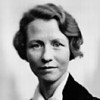
So while our art cannot, as we wish it could, save us from wars, privation, envy, greed, old age, or death, it can revitalize us amidst it all.
Ray Bradbury (1920–2012) American writer, futurist, fabulist
Zen in the Art of Writing, Preface (1994)
(Source)
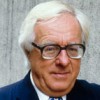
Giving is more joyous than receiving, not because it is a deprivation, but because in the act of giving lies the expression of my aliveness.
Erich Fromm (1900–1980) American psychoanalyst and social philosopher
The Art of Loving, ch. 2, sec. 1 (1956)
(Source)
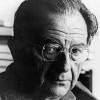
Behavior is a mirror in which everyone displays his own image.
[Das Betragen ist ein Spiegel in welchem jeder sein Bild zeigt.]
Johann Wolfgang von Goethe (1749–1832) German poet, statesman, scientist
Elective Affinities [Die Wahlverwandtschaften], Part 2, ch. 5, “From Ottilie’s Journal [Aus Ottiliens Tagebuche]” (1809) [tr. Hollingdale (1971)]
(Source)
(Source (German)). Other translation:Behavior is a mirror in which every one shows his image.
[Niles ed. (1872)]
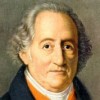
Art is anything you can get away with.
Marshall McLuhan (1911–1980) Canadian philosopher, communication theorist, educator
The Medium is the Massage: An Inventory of Effects (1967) [with Quentin Fiore]
(Source)
More discussion of this quotation: Art Is Anything You Can Get Away With – Quote Investigator.
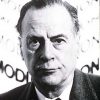
Art is born and takes hold wherever there is a timeless and insatiable longing for the spiritual, for the ideal: that longing which draws people to art. Modern art has taken the wrong turn in abandoning the search for the meaning of existence in order to affirm the value of the individual for his own sake.
Andrei Tarkovsky (1932–1986) Russian film director, screenwriter, film theorist [Андрей Арсеньевич Тарковский]
Sculpting in Time (1986) [tr. Hunter-Blair]
(Source)
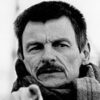
KEATING: Boys, you must strive to find your own voice. Because the longer you wait to begin, the less likely you are to find it at all. Thoreau said, “Most men lead lives of quiet desperation.” Don’t be resigned to that. Break out! Break out!

Better to write for yourself and have no public, than to write for the public and have no self.
Cyril Connolly (1903–1974) English intellectual, literary critic and writer.
“Miscellany: Last Words,” The New Statesman (25 Feb 1933)
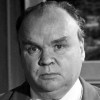
An author, like any other so-called artist, is a man in whom the normal vanity of all men is so vastly exaggerated that he finds it a sheer impossibility to hold it in. His overpowering impulse is to gyrate before his fellow men, flapping his wings and emitting defiant yells. This being forbidden by the police of all civilized countries, he takes it out by putting his yells on paper. Such is the thing called self-expression.
H. L. Mencken (1880–1956) American writer and journalist [Henry Lewis Mencken]
“The Fringes of Lovely Letters,” Prejudices: Fifth Series (1926)
(Source)
The emotions I feel are no more meant to be shown in their unadulterated state than the inner organs by which we live.
Hannah Arendt (1906–1975) German-American philosopher, political theorist
Life of the Mind, Vol. 1 “Thinking,” Part 1, ch. 4 “Body and soul; soul and mind” (1977)
(Source)
Originally printed as an essay (1977-11-14), "Thinking -- I," The New Yorker (1977-11-21).
Another point of disagreement [over Lesser Evil Voting] is not factual but involves the ethical/moral principle […] sometimes referred to as the “politics of moral witness.” Generally associated with the religious left, secular leftists implicitly invoke it when they reject LEV on the grounds that “a lesser of two evils is still evil.” Leaving aside the obvious rejoinder that this is exactly the point of lesser evil voting — i.e. to do less evil, what needs to be challenged is the assumption that voting should be seen a form of individual self-expression rather than as an act to be judged on its likely consequences. […] The basic moral principle at stake is simple: not only must we take responsibility for our actions, but the consequences of our actions for others are a far more important consideration than feeling good about ourselves.
Noam Chomsky (b. 1928) American linguist and activist
“An Eight Point Brief for LEV (Lesser Evil Voting)” (2016-06-15) [with John Halle]
(Source)
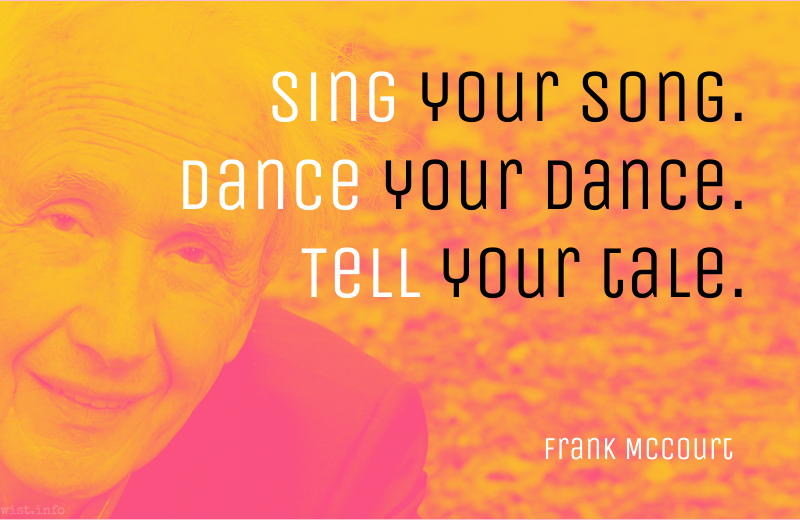
Sing your song. Dance your dance. Tell your tale.
Frank McCourt (1930–2009) Irish-American teacher and writer
Angela’s Ashes (1996)
Also included in the dedication to Teacher Man (2006).
I am sure that in nine out of ten cases the original wish to write is the wish to make oneself felt … the non-essential writer never gets past that wish.
Elizabeth Bowen (1899–1973) Irish author
Letter to Graham Greene, quoted in Why Do I Write? (1948)
Ellipses in the original.
To know what you like is the beginning of wisdom and of old age. Youth is wholly experimental. The essence and charm of that unquiet and delightful epoch is ignorance of self as well as ignorance of life. These two unknowns the young man brings together again and again, now in the airiest touch, now with a bitter hug; now with exquisite pleasure, now with cutting pain; but never with indifference, to which he is a total stranger, and never with that near kinsman of indifference, contentment.
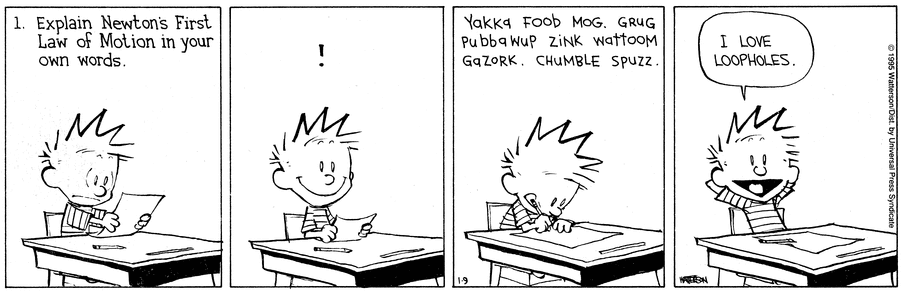
INSTRUCTIONS: “1. Explain Newton’s First Law of Motion in your own words.”
CALVIN: (writing, after a moment of inspiration) Yakka foob mog. Grug pubbawup zink wattoom gazork. Chumble spuzz.