

The miser prays God for the vain and superfluous preservation of his hoard; the ambitious man, for success and the achievement of his desires; the thief uses God to help him overcome the dangers and difficulties which obstruct his nefarious designs or else thanks God when he finds it easy to slit the gizzard of some passer-by. At the foot of the mansion which they are about to climb into and blow up, men say their prayers, while their purposes and hopes are full of cruelty, lust, and greed.
[L’avaricieux le prie pour la conservation vaine & superflue de ses thresors : l’ambitieux pour ses victoires, & conduite de sa fortune : le voleur l’employe à son ayde, pour franchir le hazard & les difficultez, qui s’opposent à l’execution de ses meschantes entreprinses : ou le remercie de l’aisance qu’il a trouvé à desgosiller un passant. Au pied de la maison, qu’ils vont escheller ou petarder, ils font leurs prieres, l’intention & l’esperance pleine de cruauté, de luxure, & d’avarice.]
Michel de Montaigne (1533–1592) French essayist
Essays, Book 1, ch. 56 (1.56), “Of Prayers [Des prieres]” (1572-1580) [tr. Screech (1987)]
(Source)
Most of the passage appeared in the 1st (1580) edition; the last example (the military assault) appeared in the 3rd (1595) edition.
(Source (French)). Alternate translations:The covetous man sueth and praieth unto him for the vaine encrease and superfluous preservation of his wrong-gotten treasure. The ambitious, he importuneth God for the conduct of his fortune, and that he may have the victorie of all his desseignes. The theefe, the pirate, the murtherer, yea and the traitor, all call upon him, all implore his ayde, and all solicite him, to give them courage in their attempts, constancie in their resolutions, to remove all lets and difficulties, that in any sorte may withstand their wicked executions, and impious actions; or give him thanks, if they have had good successe; the one if he have met with a good bootie, the other if he returne home rich, the third if no man have seene him kill his enemie, and the last, though he have caused any execrable mischiefe. The Souldier, if he but go to besiege a cottage, to scale a Castle, to robbe a Church, to Pettard a gate, to force a religious house, or any villanous act, before he attempt-it, praieth to God for his assistance, though his intents and hopes be full-fraught with crueltie, murther, covetise, luxurie, sacriledge, and all iniquitie.
[tr. Florio (1603)]The covetous man prays for the vain and superfluous preservation of his riches; the ambitious, for victory and the conduct of his fortune; the thief calls God to his assistance to deliver him from the dangers and difficulties that obstruct his wicked designs; or returns him thanks for the facility he has met with in cutting a traveller's throat. At the door of the house they are going to storm, or break into by force of a petard, they fall to prayers for success, having their intention and hopes full of cruelty, avarice, and luxury.
[tr. Cotton (1686)]The covetous man prays for the conservation of his vain and superfluous riches; the ambitious for victory and the good conduct of his fortune; the thief calls Him to his assistance, to deliver him from the dangers and difficulties that obstruct his wicked designs, or returns Him thanks for the facility he has met with in cutting a man’s throat; at the door of the house men are going to storm or break into by force of a petard, they fall to prayers for success, their intentions and hopes of cruelty, avarice, and lust.
[tr. Cotton/Hazlitt (1877)]The avaricious man prays to him for the vain and superfluous of his riches; the ambitious man for his triumphs and the guidance of his passion; the thief employs him for aid in overcoming the risk and difficulties which impede the execution of his evil enterprises, or thanks him for the ease with which a traveler has had his throat cut. At the wall of the house they are about to scale or blow up, they say their prayers, their purpose and hope being full of cruelty, lust, greed.
[tr. Ives (1925)]The miser prays to him for the vain and superfluous conservation of his treasures; the ambitious man, for his victories and the guidance of this passion; the thief uses his help to pass through the risks and difficulties that oppose the execution of his wicked enterprises, or thanks him for having found it easy to cut a passer-by's throat. Standing beside the house they are going to scale or blow up, they say their prayers, with their intention and hopes full of cruelty, lust, and avarice.
[tr. Frame (1943)]
Quotations about:
cognitive dissonance
Note not all quotations have been tagged, so Search may find additional quotes on this topic.

We know that war depresses public dialogue and debate, enlarges executive power, diminishes citizens’ rights, encourages governmental secrecy and deception, and deforms the outlines of human decency. Thus a government making war for the sake of peace, freedom, and human dignity — as it will never cease to declare — will curtail the rights of prisoners, resort to torture, deny its errors, exaggerate its virtues, demonize the enemy, and (as is inevitable in modern war) kill many innocent people, including, of course, many children.
Wendell Berry (b. 1934) American farmer, educator, poet, conservationist
Speech (2005-05-14), Commencement, Lindsey Wilson College, Columbia, Kentucky
(Source)
This was either excerpted from, or included in, his undated essay "Letter to Daniel Kemmis," collected in The Way of Ignorance and Other Essays, Part 2 (2005).

We make war, we are told, for the love of peace. We subvert our Bill of Rights and impose our will abroad for the sake of freedom and the rule of law. We honor greed and waste with the name of economy. We allow ever greater wealth and power to accumulate in the hands of a privileged few only to provide jobs for working people and charity to the poor. And we sanctify all this as Christian, though the Gospels support none of it by so much as a line or a word.
Wendell Berry (b. 1934) American farmer, educator, poet, conservationist
Speech (2005-05-14), Commencement, Lindsey Wilson College, Columbia, Kentucky
(Source)
This was either excerpted from, or included in, his undated essay "Letter to Daniel Kemmis," collected in The Way of Ignorance and Other Essays, Part 2 (2005).
The chaplain had mastered, in a moment of divine intuition, the handy technique of protective rationalization, and he was exhilarated by his discovery. It was miraculous. It was almost no trick at all, he saw, to turn vice into virtue and slander into truth, impotence into abstinence, arrogance into humility, plunder into philanthropy, thievery into honor, blasphemy into wisdom, brutality into patriotism, and sadism into justice. Anybody could do it; it required no brains at all. It merely required no character.
One of the most amazing and perplexing features of mainstream Christianity is that seminarians who learn the historical-critical method in their Bible classes appear to forget all about it when it comes time for them to be pastors. They are taught critical approaches to Scripture, they learn about the discrepancies and contradictions, they discover all sorts of historical errors and mistakes, they come to realize that it is difficult to know whether Moses existed or what Jesus actually said and did, they find that there are other books that were at one time considered canonical but that ultimately did not become part of Scripture (for example, other Gospels and Apocalypses), they come to recognize that a good number of the books of the Bible are pseudonymous (for example, written in the name of an apostle by someone else), that in fact we don’t have the original copies of any of the biblical books but only copies made centuries later, all of which have been altered. They learn all this, and yet when they enter church ministry they appear to put it back on the shelf.
Bart D. Ehrman (b. 1955) American Biblical scholar, author
Jesus, Interrupted, ch. 1 “A Historical Assault on Faith” (2009)
(Source)

That the world can be improved and yet must be celebrated as it is are contradictions. The beginning of maturity may be the recognition that both are true.
William M. Stott (b. 1940) American diplomat, academic in American Studies and English, author
Documentary Expression and Thirties America, ch. 15 (1973)
(Source)
Closing words of the book.

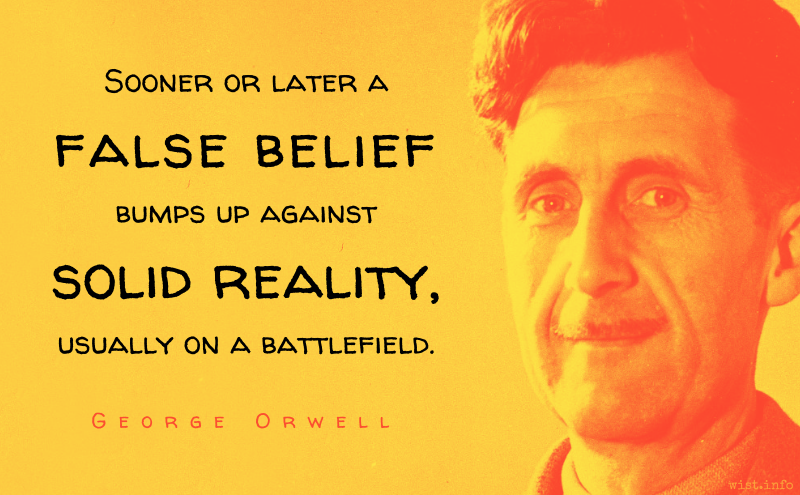
The point is that we are all capable of believing things which we know to be untrue, and then, when we are finally proved wrong, impudently twisting the facts so as to show that we were right. Intellectually, it is possible to carry on this process for an indefinite time: the only check on it is that sooner or later a false belief bumps up against solid reality, usually on a battlefield.
George Orwell (1903–1950) English journalist, essayist, writer [pseud. of Eric Arthur Blair]
Essay (1946-03-22), “In Front of Your Nose,” “As I Please” column, Tribune Newspaper
(Source)

In nationalist thought there are facts which are both true and untrue, known and unknown. A known fact may be so unbearable that it is habitually pushed aside and not allowed to enter into logical processes, or on the other hand it may enter into every calculation and yet never be admitted as a fact, even in one’s own mind.
George Orwell (1903–1950) English journalist, essayist, writer [pseud. of Eric Arthur Blair]
Essay (1945-05), “Notes on Nationalism,” Polemic Magazine (1945-10)
(Source)
Politics demands a great capacity for self-deception, which rescues the politician from hypocrisy. He can normally manage to believe what he is saying for the time it takes him to say it. This gives him a certain sincerity even when he is saying opposite things to opposite people.
Garry Wills (b. 1934) American author, journalist, historian
Confessions of a Conservative, ch. 15 (1979)
(Source)

Mass propaganda discovered that its audience was ready at all times to believe the worst, no matter how absurd, and did not particularly object to being deceived because it held every statement to be a lie anyhow. The totalitarian mass leaders based their propaganda on the correct psychological assumption that, under such conditions, one could make people believe the most fantastic statements one day, and trust if the next day they were given irrefutable proof of their falsehood, they would take refuge in cynicism; instead of deserting the leaders who had lied to them, they would protest that they had known all along the statement was a lie and would admire the leaders for their superior tactical cleverness.
Hannah Arendt (1906–1975) German-American philosopher, political theorist
Origins of Totalitarianism, Part 3, ch. 11 “The Totalitarian Movement,” sec. 2 (1951)
(Source)

What are you pretending not to know?
Sig Lines
~

The further a society drifts from the truth, the more it will hate those who speak it.
George Orwell (1903–1950) English journalist, essayist, writer [pseud. of Eric Arthur Blair]
(Attributed)
Near eighty years ago we began by declaring that all men are created equal; but now from that beginning we have run down to the other declaration, that for some men to enslave others is a “sacred right of self-government.” These principles can not stand together. They are as opposite as God and mammon; and whoever holds to the one, must despise the other.
Abraham Lincoln (1809–1865) American lawyer, politician, US President (1861–65)
Speech (1854-10-16), “In Reply to Senator Douglas,” Peoria, Illinois
(Source)
Speaking on the 1854 Kansas-Nebraska Act, which repealed the Missouri Compromise and allowed as "self-government" for residents of those two territories to decide locally whether to allow slavery there.
Lincoln is referencing both the Declaration of Independence and the Bible (Luke 16:13).

I can believe things that are true and I can believe things that aren’t true and I can believe things where nobody knows if they’re true or not. I can believe in Santa Claus and the Easter Bunny and Marilyn Monroe and the Beatles and Elvis and Mister Ed. Listen — I believe that people are perfectible, that knowledge is infinite, that the world is run by secret banking cartels and is visited by aliens on a regular basis, nice ones who look like wrinkledy lemurs and bad ones who mutilate cattle and want our water and our women. I believe that the future sucks and I believe that the future rocks and I believe that one day White Buffalo Woman is going to come back and kick everyone’s ass. I believe that all men are just overgrown boys with deep problems communicating and that the decline of good sex in America is coincident with the decline in drive-in movie theaters from state to state. I believe that all politicians are unprincipled crooks and I still believe that they are better than the alternative. I believe that California is going to sink into the sea when the Big One comes, while Florida is going to dissolve into madness and alligators and toxic waste. I believe that antibacterial soap is destroying our resistance to dirt and disease so that one day we’ll all be wiped out by the common cold like the Martians in War of The Worlds. I believe that the greatest poets of the last century were Edith Sitwell and Don Marquis, that jade is dried dragon sperm, and that thousands of years ago in a former life I was a one-armed Siberian shaman. I believe that mankind’s destiny lies in the stars. I believe that candy really did taste better when I was a kid, that it’s aerodynamically impossible for a bumblebee to fly, that light is a wave and a particle, that there’s a cat in a box somewhere who’s alive and dead at the same time (although if they don’t ever open the box to feed it it’ll eventually just be two different kinds of dead), and that there are stars in the universe billions of years older than the universe itself. I believe in a personal god who cares about me and worries and oversees everything I do. I believe in an impersonal god who set the universe in motion and went off to hang with her girlfriends and doesn’t even know that I’m alive. I believe in an empty and godless universe of causal chaos, background noise, and sheer blind luck. I believe that anyone who says that sex is overrated just hasn’t done it properly. I believe that anyone who claims to know what’s going on will lie about the little things too. I believe in absolute honesty and sensible social lies too. I believe in a woman’s right to choose, a baby’s right to live, that while all human life is sacred there’s nothing wrong with the death penalty if you can trust the legal system implicitly, and that no one but a moron would ever trust the legal system. I believe that life is a game, that life is a cruel joke, and that life is what happens when you’re alive and that you might as well lie back and enjoy it.
Neil Gaiman (b. 1960) British author, screenwriter, fabulist
American Gods, Part 2, ch. 13 [Sam] (2001)
(Source)

Formerly there were those who said: You believe things that are incomprehensible, inconsistent, impossible because we have commanded you to believe them; go then and do what is unjust because we command it. Such people show admirable reasoning. Truly, whoever is able to make you absurd is able to make you unjust. If the God-given understanding of your mind does not resist a demand to believe what is impossible, then you will not resist a demand to do wrong to that God-given sense of justice in your heart. As soon as one faculty of your soul has been dominated, other faculties will follow as well. And from this derives all those crimes of religion which have overrun the world.
[Il y a eu des gens qui ont dit autrefois: Vous croyez des choses incompréhensibles, contradictoires, impossibles, parce que nous vous l’avons ordonné; faites donc des choses injustes parce que nous vous l’ordonnons. Ces gens-là raisonnaient à merveille. Certainement qui est en droit de vous rendre absurde est en droit de vous rendre injuste. Si vous n’opposez point aux ordres de croire l’impossible l’intelligence que Dieu a mise dans votre esprit, vous ne devez point opposer aux ordres de malfaire la justice que Dieu a mise dans votre coeur. Une faculté de votre âme étant une fois tyrannisée, toutes les autres facultés doivent l’être également. Et c’est là ce qui a produit tous les crimes religieux dont la terre a été inondée.]
Voltaire (1694–1778) French writer [pseud. of Francois-Marie Arouet]
Questions sur les miracles (1765)
(Source)
Commonly translated: "Those who can make you believe absurdities can make you commit atrocities."


THE DOCTOR: The very powerful and the very stupid have one thing in common. They don’t alter their views to the facts, they alter the facts to fit their views, which can be uncomfortable, if you happen to be one of the facts that needs altering.
Doctor Who (1963–1989) British science fiction television series, original run (BBC)
14×04 “The Face of Evil,” Part 4 (1977-01-22) [w. Chris Boucher]
(Source)
