

Cheerfulness is, in the first place, the best promoter of health. Repinings, and secret murmurs of heart, give imperceptible strokes to those delicate fibres of which the vital parts are composed, and wear out the machine insensibly; not to mention those violent ferments which they stir up in the blood, and those irregular disturbed motions which they raise in the animal spirits.
Joseph Addison (1672–1719) English essayist, poet, statesman
Essay (1712-05-24), The Spectator, No. 387
(Source)
Quotations about:
cheer
Note not all quotations have been tagged, so Search may find additional quotes on this topic.

I felt an earnest and humble desire, and shall do till I die, to increase the stock of harmless cheerfulness.
Charles Dickens (1812–1870) English writer and social critic
Speech (1841-06-25), Shakespeare Club Dinner, Waterloo Rooms, Edinburgh, Scotland
(Source)

Cheerfullness makes the plainest features butiful, the severest winter agreeable; it elevates the lowly, and adds a charm tew grateness, all its own.
[Cheerfulness makes the plainest features beautiful, the severest winter agreeable; it elevates the lowly, and adds a charm to greatness.]
Josh Billings (1818–1885) American humorist, aphorist [pseud. of Henry Wheeler Shaw]
Everybody’s Friend, Or; Josh Billing’s Encyclopedia and Proverbial Philosophy of Wit and Humor, ch. 281 “Variety: Bred and Butter” (1874)
(Source)

I have always been — I think any student of history almost inevitably is — a cheerful pessimist.
Jacques Barzun (1907–2012) French-American historian, educator, polymath
Quoted in Thomas Vinciguerra, “Jacques Barzun ’27: Columbia Avatar,” Columbia College Today (2006-01)
(Source)
Barzun is being quoted in this particular instance from an unclear source, possibly the Independent Women's Forum in 2000.

There is no logical explanation for despair. You can no more reason yourself into cheerfulness than you can reason yourself an extra six inches in height. You can only be better prepared.
Stephen Fry (b. 1957) British actor, writer, comedian
Speech, Samaritans annual report launch, London (1996-05-17)
Regarding the emotional breakdown which led him once to abandon a play in mid-production, and subsequently again contemplate suicide. The Samaritans are a suicide-prevention group.
Quoted in Gary Younge, "Enter Fry, centre stage, for bravura performance on depression and suicide," The Guardian (1996-05-18).

And know, reader, that an ounce of mirth, with the same degree of grace, will serve God farther than a pound of sadness.
Thomas Fuller (1608–1661) English churchman, historian
The History of the Worthies of England, “Worthies of Hertfordshire,” “Writers” (1662)
(Source)
Writing of Jeremiah Dike. By the late 19th Century, Fuller's comment had been paraphrased into something simpler, though still attributed to him:An ounce of cheerfulness is worth a pound of sadness to serve God with.
[Source 1872, 1895, 1867]
This sentiment is not unique to Fuller. In Richard Baxter's A Treatise of Self-Denial (1659), in "A Dialog of Self-Denial" between Flesh and Spirit, Flesh says:Why should I think of what will be tomorrow?
An ounce of mirth is worth a pound of sorrow.
The second line here may have been a common English aphorism prior to Fuller and Baxter.

Cheerfulness is to the spiritual atmosphere what sunshine is to the earthly landscape. I am resolved to cherish cheerfulness with might and main.
Lydia Maria Child (1802–1880) American abolitionist, activist, journalist, suffragist
Letter to Lucy Osgood (1865)
(Source)
I like the man who faces what he must,
With steps triumphant and a heart of cheer;
Who fights the daily battle without fear.Sarah Knowles Bolton (1841–1916) American writer, poet, journalist, activist
“The Inevitable” (1895)
(Source)

A good laugh is sunshine in a house.
William Makepeace Thackeray (1811–1863) English novelist
“On Love, Marriage, Men, and Women,” Sketches and Travels in London (1856)
(Source)
This particular line is widely attributed to Thackeray, but rarely cited. Part of the problem is that it is almost always given as "A good laugh is sunshine in the house," rather than "a house."
It is also sometimes cited to his famous novel Vanity Fair (1848), though the quotation cannot be found there.
To laughter! The bright coinage of the bank of good will.
Minna Antrim (1861–1950) American epigrammatist, writer
Naked Truth and Veiled Allusions (1901)

it s cheerio
my deario
that pulls a lady throughDon Marquis (1878–1937) American journalist and humorist
archy and mehitabel, “cheerio, my deario” (1927)
(Source)

At Christmas play, and make good cheer,
For Christmas comes but once a year.Thomas Tusser (1524–1580) English poet and farmer
A Hundred Good Points of Husbandry, “The Farmer’s Daily Diet” (1557)
(Source)

Tolerance, good temper and sympathy — they are what matter really, and if the human race is not to collapse they must come to the front before long.
E. M. Forster (1879–1970) English novelist, essayist, critic, librettist [Edward Morgan Forster]
“What I Believe,” The Nation (16 Jul 1938)
(Source)
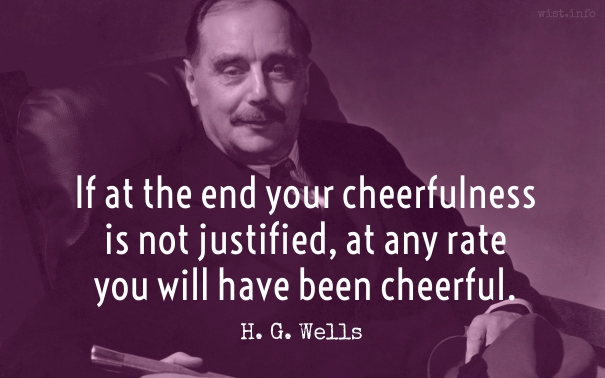
While there is a chance of the world getting through its troubles I hold that a reasonable man has to behave as though he was sure of it. If at the end your cheerfulness is not justified, at any rate you will have been cheerful.
H. G. Wells (1866–1946) British writer [Herbert George Wells]
Apropos of Dolores, ch. 2 (1938)
(Source)
It is a dear and lovely disposition, and a most valuable one, that can brush away indignities and discourtesies and seek and find the pleasanter features of an experience.
Mark Twain (1835–1910) American writer [pseud. of Samuel Clemens]
In The North American Review (1906)
(Source)

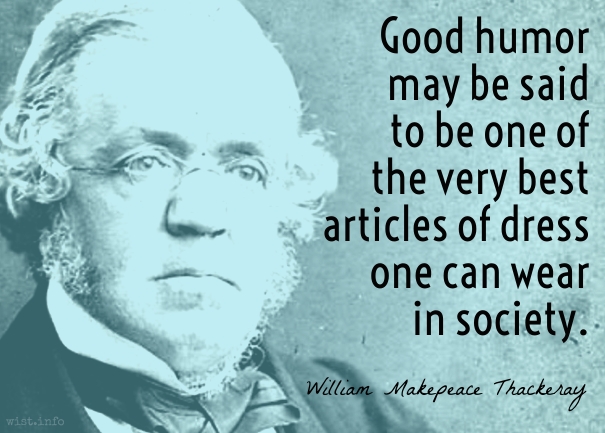
Good humor may be said to be one of the very best articles of dress one can wear in society.
William Makepeace Thackeray (1811–1863) English novelist
Sketches and Travels in London, “On Tailoring — and Toilets in General” (1856)
I have always preferred cheerfulness to mirth. The latter I consider as an act, the former as an habit of mind. Mirth is short and transient, cheerfulness fixed and permanent. Those are often raised into the greatest transports of mirth who are subject to the greatest depressions of melancholy. On the contrary, cheerfulness, though it does not give the mind such an exquisite gladness, prevents us from falling into any depths of sorrow. Mirth is like a flash of lightning, that breaks through a gloom of clouds, and glitters for a moment; cheerfulness keeps up a kind of daylight in the mind, and fills it with a steady and perpetual serenity.
Joseph Addison (1672–1719) English essayist, poet, statesman
Essay (1712-05-17), The Spectator, No. 381
(Source)
KATHERINE: He made her melancholy, sad, and heavy,
And so she died. Had she been light like you,
Of such a merry, nimble, stirring spirit,
She might ha’ been a grandam ere she died.
And so may you, for a light heart lives long.William Shakespeare (1564–1616) English dramatist and poet
Love’s Labour’s Lost, Act 5, sc. 2, l. 15ff (5.2.15-19) (c. 1595)
(Source)
To Rosaline.

He who walks through a great city to find subjects for weeping, may find plenty at every corner to wring his heart; but let such a man walk on his course, and enjoy his grief alone—we are not of those who would accompany him. The miseries of us poor earth-dwellers gain no alleviation from the sympathy of those who merely hunt them out to be pathetic over them. The weeping philosopher too often impairs his eyesight by his woe, and becomes unable from his tears to see the remedies for the evils which he deplores. Thus it will often be found that the man of no tears is the truest philanthropist, as he is the best physician who wears a cheerful face, even in the worst of cases.
Charles Mackay (1814–1889) Scottish poet, journalist, song writer
Memoirs of Extraordinary Popular Delusions and the Madness of Crowds, “Popular Follies of Great Cities” (1841)
(Source)
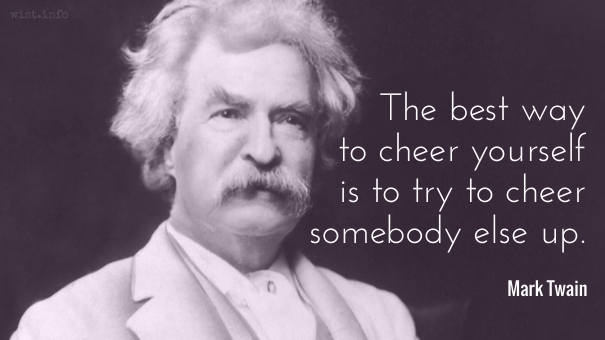
The best way to cheer yourself is to try to cheer somebody else up.
Mark Twain (1835–1910) American writer [pseud. of Samuel Clemens]
Note (1896-11-26), Mark Twain’s Notebook, ch. 27 “England” (1935) [ed. Albert Bigelow Paine]
(Source)
Written while in Guilford, England, shortly after the death of his daughter Susy in America.
Often given as "The best way to cheer yourself up is to try to cheer somebody else up." More discussion here.
You find yourself refreshed by the presence of cheerful people. Why not make earnest efforts to confer that pleasure on others? You will find half the battle is gained, if you never allow yourself to say anything gloomy.
Lydia Maria Child (1802–1880) American abolitionist, activist, journalist, suffragist
Looking Toward Sunset (1874, 10th ed.)
A cheerful, easy countenance and behavior are very useful: they make fools think you a good-natured man, and they make designing men think you an undesigning one.

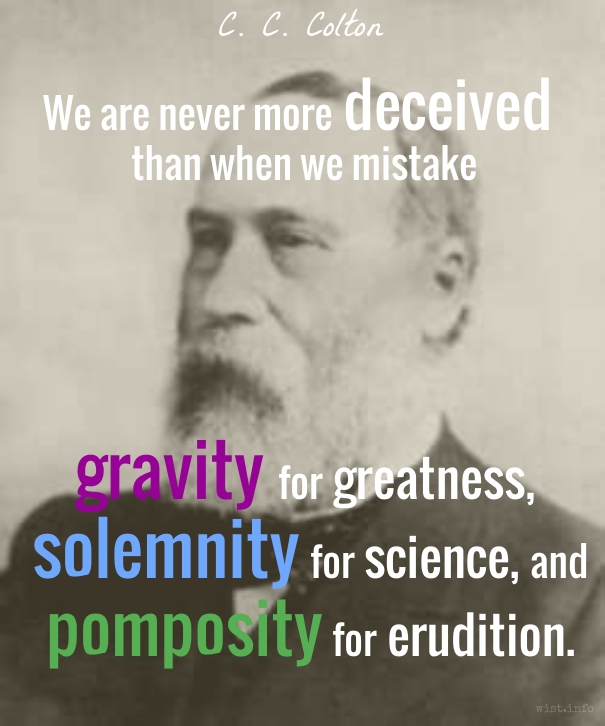
A harmless hilarity and a buoyant cheerfulness are not infrequent concomitants of genius; and we are never more deceived than when we mistake gravity for greatness, solemnity for science, and pomposity for erudition.
Charles Caleb "C. C." Colton (1780–1832) English cleric, writer, aphorist
Lacon: Or, Many Things in Few Words, Vol. 1, § 202 (1820)
(Source)
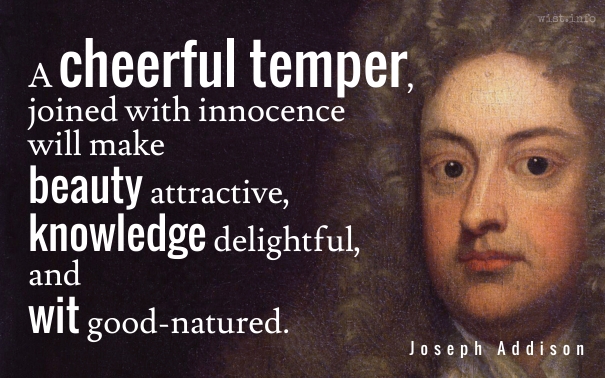
A cheerful temper, joined with innocence, will make beauty attractive, knowledge delightful, and wit good-natured.
Joseph Addison (1672–1719) English essayist, poet, statesman
Essay (1710-07-01), The Tatler, No. 192
(Source)
[F]or cheerfulness and content are great beautifiers, and are famous preservers of youthful looks, depend upon it.
Charles Dickens (1812–1870) English writer and social critic
Barnaby Rudge, ch. 82 (1841)
(Source)
Often given as "Cheerfulness and contentment are great beautifiers and are famous preservers of youthful looks."
There is more in you of good than you know, child of the kindly West. Some courage and some wisdom, blended in measure. If more of us valued food and cheer and song above hoarded gold, it would be a merrier world.
J.R.R. Tolkien (1892–1973) English writer, fabulist, philologist, academic [John Ronald Reuel Tolkien]
The Hobbit, ch. 18 “The Return Journey” [Thorin] (1937)
(Source)
Even in common people, conceit has the virtue of making them cheerful; the man who thinks his wife, his baby, his house, his horse, his dog, and himself severally unequalled, is almost sure to be a good-humored person, though liable to be tedious at times.
Oliver Wendell Holmes, Sr. (1809–1894) American poet, essayist, scholar
Article (1857-11), “The Autocrat of the Breakfast-Table,” Atlantic Monthly
Collected in The Autocrat of the Breakfast-Table, ch. 1 (1858)

Let the world slide, let the world go:
A fig for care, and a fig for woe!
If I can’t pay, why, I can owe;
And death makes equal the high and low.
Be merry, friends!John Heywood (1497?-1580?) English playwright and epigrammist
Ballad (1576), “Be Merry Friends,” st. 17
(Source)
Collected in John Payne Collier (ed.), A Book of Roxburghe Ballads (1847), which includes more history about it.
This quote from the final stanza of the ballad (as reconstructed) was popularized when quoted in Bartlett's Familiar Quotations, 5th Ed. (1870) and subsequent editions.
The ballad also shows up in a collection of James Orchard Halliwell (ed.), The Moral Play of Wit and Science (1848) for the Shakespeare Society. This has an earlier version of the ballad, which does not include this stanza. (It also wavers in spelling between "mery" / "merye" and "frends" / "freendes.") This is in turn endnoted with five contemporary English stanzas, replacing the last two given, which includes that quoted above.
"Let the world slide" is used by the Beggar (Sly) in Shakespeare's Taming of the Shrew, Induction, sc. 1 (c. 1590).

Gentleness and cheerfulness, these come before all morality; they are the perfect duties.
Robert Louis Stevenson (1850–1894) Scottish essayist, novelist, poet
Essay (1888-12), “A Christmas Sermon,” sec. 2, Scribner’s Magazine, Vol. 4
(Source)
In context, Stevenson is using "morality" in terms of legalistic religion.
Originally written in the winter of 1887-88. Collected in Across the Plains, ch. 12 (1892).
Good-nature is more agreeable in conversation than wit, and gives a certain air to the countenance which is more amiable than beauty. It shows virtue in the fairest light, takes off in some measure from the deformity of vice, and makes even folly and impertinence supportable.
Joseph Addison (1672–1719) English essayist, poet, statesman
Essay (1711-09-13), The Spectator, No. 169
(Source)
You must have been warned against letting the golden hours slip by. Yes, but some of them are golden only because we let them slip.
J. M. Barrie (1860–1937) Scottish novelist and dramatist [James Matthew Barrie]
Speech (1922-05-03), “Courage,” Rectoral Address, University of St. Andrews, Scotland
(Source)
Cheerfulness keeps up a kind of daylight in the mind, and fills it with a steady and perpetual serenity.
Joseph Addison (1672–1719) English essayist, poet, statesman
Essay (1712-05-17), The Spectator, No. 381
(Source)