I know of one gifted crackpot who used to be employed gainfully in the fields of humor and satire, who has taken a solemn pledge not to write anything funny or lighthearted or “insignificant” again till things get straightened around in the world. This seems to me distinctly deleterious and a little silly. A literature composed of nothing but liberty-loving thoughts is little better than the propaganda which it seeks to defeat.
E. B. White (1899–1985) American author, critic, humorist [Elwyn Brooks White]
Essay (1939-01), “One Man’s Meat,” Harper’s Magazine, Vol. 178
(Source)
When collected in his book, One Man's Meat (1944), the essay was renamed "Salt Water Farm." Sometimes the excerpted third section of the essay is referred to as "The Duty of Writers."
Quotations about:
gravity
Note not all quotations have been tagged, so Search may find additional quotes on this topic.

SARAH JANE: You’re serious, aren’t you?
THE DOCTOR: About what I do, yes. Not necessarily the way I do it.
Doctor Who (1963–1989) British science fiction television series, original run (BBC)
11×01 “The Time Warrior,” Part 3 (1973-12-29) [w. Robert Holmes]
(Source)
(Source (Video)). Often Sarah Jane's line is misquoted as "Doctor, are you serious?"

It is a mathematical fact that the casting of this pebble from my hand alters the center of gravity of the Universe.
Thomas Carlyle (1795–1881) Scottish essayist and historian
Sartor Resartus, Book 3, ch. 7 (1834)
(Source)
Quoting Herr Teufelsdröckh. This chapter first appeared in Fraser's Magazine for Town and Country, Vol. 10, No. 55 (1834-07).

Solemnity is the fool’s shield and buckler.
[La gravité est la bouclier des sots.]
Charles-Lewis de Secondat, Baron de Montesquieu (1689–1755) French political philosopher
Pensées Diverses [Assorted Thoughts], # 1637 / 1051 (1720-1755) [ed. Guterman (1963)]
(Source)
(Source (French), # 1051). Other translations:Gravity is the shield of fools.
[tr. Clark (2012), # 1637]Solemnity is the shield of idiots.
[E.g.]
Nothing’s more playful than a young Cat, nor more grave than an old One.
Thomas Fuller (1654–1734) English physician, preacher, aphorist, writer
Gnomologia: Adages and Proverbs (compiler), # 3680 (1732)
(Source)

In times like the present, men should utter nothing for which they would not willingly be responsible through time and in eternity.
Abraham Lincoln (1809–1865) American lawyer, politician, US President (1861–65)
Message (1862-12-01) to Congress, Annual Message (State of the Union)
(Source)

The ships hung in the sky in much the same way that bricks don’t.
Douglas Adams (1952–2001) English author, humorist, screenwriter
Hitchhiker’s Guide No. 1, The Hitchhiker’s Guide to the Galaxy, ch. 3 (1979)
(Source)
This line (and much of its surroundings) are not in the original radio play.

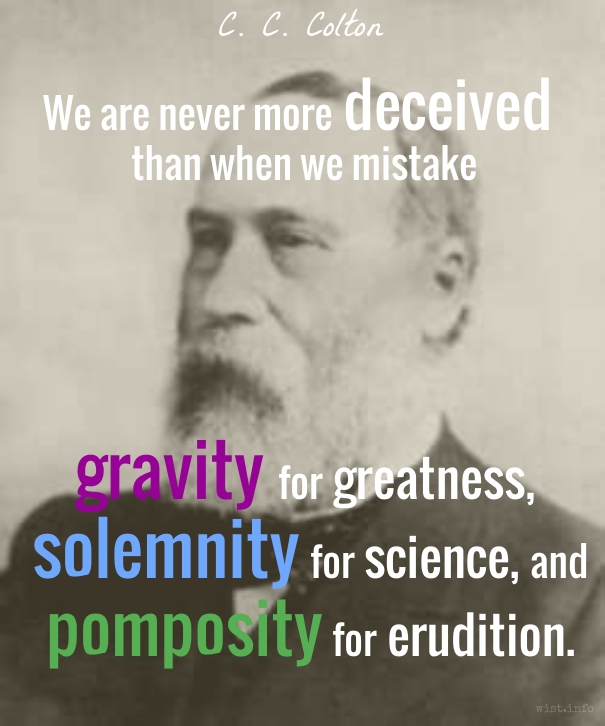
A harmless hilarity and a buoyant cheerfulness are not infrequent concomitants of genius; and we are never more deceived than when we mistake gravity for greatness, solemnity for science, and pomposity for erudition.
Charles Caleb "C. C." Colton (1780–1832) English cleric, writer, aphorist
Lacon: Or, Many Things in Few Words, Vol. 1, § 202 (1820)
(Source)

Life is much too important a thing ever to talk seriously about it.
Oscar Wilde (1854–1900) Irish poet, wit, dramatist
Vera; or, The Nihilists, Act 2 [Prince Paul] (1881)
(Source)
Almost always paraphrased, "Life is too important to be taken seriously."
In Lady Windermere's Fan, Act 2 (1892), he recycled the line as "Life is far too important a thing ever to talk seriously about it."
Also (mis)attributed to G.K. Chesterton. More discussion of this quotation: Life Is Too Important To Be Taken Seriously – Quote Investigator.

‘Twas the saying of an ancient Sage, “That Humour was the only Test of Gravity, and Gravity of Humour. For a Subject which would not bear Raillery is suspicious; and a Jest which would not bear a serious Examination is certainly false Wit.”
Anthony Cooper, 3rd Earl of Shaftesbury (1671–1713) English politician and philosopher
Characteristics, Treatise 2 “Freedom of Wit and Humour,” Part 1, sec. 5 (1709)
(Source)
Shaftesbury, according to his footnote, is paraphrasing from Aristotle, Rhetoric, Book 3, ch. 18, 1419b, in turn quoting Gorgias Leontinus. The phrase is sometimes incorrectly attributed directly to Aristotle. The Greek here is:δεῖν ἔφη Γοργίας τὴν μὲν σπουδὴν διαφθείρειν τῶν ἐναντίων γέλωτι, τὸν δὲ γέλωτα σπουδῇ
The Latin translation of the Greek is "Seria risu, risum seriis discutere" ("In arguing one should meet serious pleading with humor, and humor with serious pleading"). Shaftesbury's second sentence is actually his own commentary. Lord Chesterfield, in a letter to his son (1752-02-06), renders down the Latin as "Ridicule is the best test of truth" (Chesterfield disagrees with the sentiment).
Shaftesbury actually misuses the quotation. In context Gorgias is offering rhetorical advice in argument, to meet seriousness with humor, and humor with seriousness, not to use humor as a test of the argument.
Shaftesbury used to this theme on a number of occasions. Elsewhere in the same Treatise, Part 1, sec. 1 (1709):Truth, 'tis supposed, may bear all lights; and one of those principal lights, or natural mediums, by which things are to be viewed, in order to a thorough recognition, is ridicule itself, or that manner of proof by which we discern whatever is liable to just raillery in any subject.
In Characteristics, Treatise 1 "Enthusiasm," sec. 2 (1708):How comes it to pass, then, that we appear such cowards in reasoning, and are so afraid to stand the test of ridicule? O! say we, the subjects are too grave. Perhaps so: but let us see first whether they are really grave or no: for in the manner we may conceive them they may, peradventure, be very grave and weighty in our imagination, but very ridiculous and impertinent in their own nature.
Thomas Carlyle in Foreign Review, No. 6, "Voltaire" (1829), lacking access to the Internet, noted:We have oftener than once endeavoured to attach some meaning to that aphorism, vulgarly imputed to Shaftesbury, which however we can find nowhere in his works, that "ridicule is the test of truth."
Carlyle also disagreed with the sentiment, on the grounds that finding something humorous is subjective, and there is no reason to think that a subjective reaction defines the truth of the matter.

The one serious conviction that a man should have is that nothing is to be taken too seriously.
Samuel Butler (1835–1902) English novelist, satirist, scholar
The Note-Books of Samuel Butler (1912)