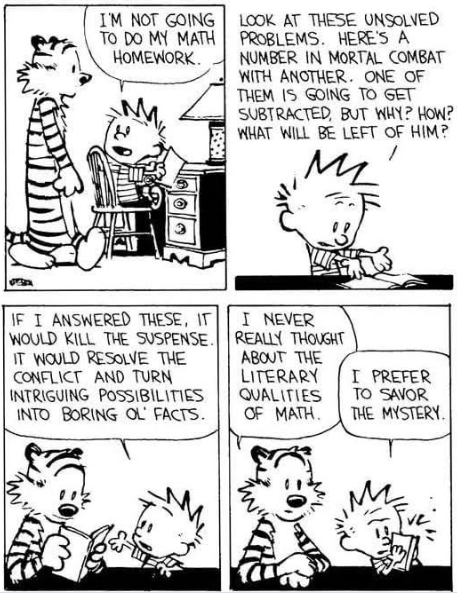
CALVIN: I’m not going to do my math homework. Look at these unsolved problems. Here’s a number in mortal combat with another. One of them is going to get subtracted. But why? How? What will be left of him? If I answered these, it would kill the suspense. It would resolve the conflict and turn intriguing possibilities into boring ol’ facts.
HOBBES: I never really thought about the literary qualities of math.
CALVIN: I prefer to savor the mystery.
Quotations about:
math
Note not all quotations have been tagged, so Search may find additional quotes on this topic.

CALVIN: Miss Wormwood, I have a question about this math lesson.
TEACHER: Yes?
CALVIN: Given that, sooner or later, we’re all just going to die, what’s the point of learning about integers?
TEACHER: Turn to page 83, class.
CALVIN: (sulking) Nobody likes us “big picture” people.

It is a mathematical fact that the casting of this pebble from my hand alters the center of gravity of the Universe.
Thomas Carlyle (1795–1881) Scottish essayist and historian
Sartor Resartus, Book 3, ch. 7 (1834)
(Source)
Quoting Herr Teufelsdröckh. This chapter first appeared in Fraser's Magazine for Town and Country, Vol. 10, No. 55 (1834-07).
If people do not believe that mathematics is simple, it is only because they do not realize how complicated life is.
John von Neumann (1903–1957) Hungarian-American mathematician, physicist, inventor, polymath [János "Johann" Lajos Neumann]
Speech, Association for Computing Machinery inaugural conference, Columbia University, New York (15 Sep 1947)
(Source)
Von Neumann insisted that ENIAC's command language could encompass all mathematics, given how only a thousand words could handle most needs of life, and mathematics was, he insisted, simpler than life. When the audience laughed, he replied with this comment. Quoted in Franz L. Alt, "Archaeology of computers: Reminiscences, 1945-1947," Communications of the ACM, Vol 15, #7 (Jul 1972).
Science: essentially math disguised as dinosaurs and outer space in order to seem interesting.
John Oliver (b. 1977) British-American comedian, writer, producer, political commentator
Last Week Tonight, ep. 136 (1 Jul 2018)
Segment on CRISPR and genome editing.

If a man were to leap off the Eiffel Tower, mathematics could predict how long it would take him to hit the ground, but not why he chose to jump in the first place.
Ian Stewart b. 1945) English mathematician, author
Does God Play Dice? (1989)

Resolutions cannot nullify the truths of the multiplication table.
James A. Garfield (1831–1881) US President (1881), lawyer, lay preacher, educator
“The Currency,” Speech, House of Representatives (15 May 1868)
(Source)
A favorite phrase of Garfield's regarding the dangers of inflation, e.g., "I will not vote against the truths of the multiplication table" (Letter to Harmon Austin (4 Feb 1874)).
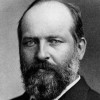
Histories make men wise; poets, witty; the mathematics, subtle; natural philosophy, deep; moral, grave; logic and rhetoric, able to contend.
Francis Bacon (1561–1626) English philosopher, scientist, author, statesman
“Of Studies,” Essays, No. 50 (1625)
(Source)

It is known that there are an infinite number of worlds, simply because there is an infinite amount of space for them to be in. However, not every one of them is inhabited. Therefore, there must be a finite number of inhabited worlds. Any finite number divided by infinity is as near to nothing as makes no odds, so the average population of all the planets in the Universe can be said to be zero. From this it follows that the population of the whole Universe is also zero, and that any people you may meet from time to time are merely the products of a deranged imagination.
Douglas Adams (1952–2001) English author, humorist, screenwriter
Hitchhiker’s Guide No. 2, The Restaurant at the End of the Universe, ch. 19 (1980)
(Source)

“Reeling and Writhing, of course, to begin with,” the Mock Turtle replied: “and then the different branches of Arithmetic — Ambition, Distraction, Uglification, and Derision.”
“I never heard of ‘Uglification,'” Alice ventured to say. “What is it?”
The Gryphon lifted up both its paws in surprise. “Never heard of uglifying!” it exclaimed. “You know what to beautify is, I suppose?”
“Yes,” said Alice, doubtfully: “it means — to — make — anything — prettier.”
“Well then,” the Gryphon went on, “if you don’t know what to uglify is, you are a simpleton.”
Alice did not feel encouraged to ask any more questions about it, so she turned to the Mock Turtle, and said, “What else had you to learn?”
“Well, there was Mystery,” the Mock Turtle replied, counting off the subjects on his flappers, — “Mystery, ancient and modern, with Seaography: then Drawling — the Drawling-master was an old conger-eel, that used to come once a week: he taught us Drawling, Stretching, and Fainting in Coils.”Lewis Carroll (1832–1898) English writer and mathematician [pseud. of Rev. Charles Lutwidge Dodgson]
Alice’s Adventures in Wonderland, ch. 9 “The Mock Turtle’s Story” (1865)
(Source)
Describing the "regular course" at the school he attended.
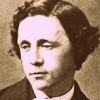
Insofar as statements of mathematics refer to reality, they are uncertain, and insofar as they are certain, they do not refer to reality.
[Insofern sich die Sätze der Mathematik auf die Wirklichkeit beziehen, sind sie nicht sicher, und insofern sie sicher sind, beziehen sie sich nicht auf die Wirklichkeit.]
Albert Einstein (1879–1955) German-American physicist
“Geometry and Experience [Geometrie und Erfahrung],” lecture (27 Jan 1921)
(Source)
Sometimes given as "Insofar as the statements of geometry speak about reality, they are not certain, and in so far as they are certain, they do not speak about reality. [Sofern die Sätze der Geometrie streng gültig sind, beziehen sie sich nicht auf de Wirklichkeit; sofern sie sich auf dei Wirklichkeit beziehen, sind sie nicht streng gültig.]" -- this version was popularized by Karl Popper, but it was from a misquote by Morris Schlick.