CHORUS:But why
Be sure of the worst, and weep too soon?[ΧΟΡΟΣ: μὴ πρόμαντις ἀλγέων
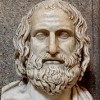
προλάμβαν᾽, ὦ φίλα, γόους.]Euripides (485?-406? BC) Greek tragic dramatist
Helen [Ἑλένη], l. 338ff (412 BC) [tr. Vellacott (1954)]
(Source)
Counseling Helen not to catastrophize about her fate or that of her husband until she has talked with the prophetess Theonoë.
(Source (Greek)). Other translations:Do not, dear lady, do not thus, in thought
Presaging ill, anticipate thy griefs.
[tr. Potter (1783), l. 370ff]Forbear these plaintive strains, my dearest queen,
Nor with presaging soul anticipate
Evils to come.
[tr. Wodhull (1809)]Do not, O dear one, anticipate lamentations like a prophetess of woes.
[tr. Buckley (1850)]Do not be a prophetess of sorrow, dear friend, anticipating lamentation.
[tr. Coleridge (1891)]Nay, forestall not, O friend, lamentation
Prophetic of grief.
[tr. Way (Loeb) (1912)]Lady, till the truth appear,
Gentle lady, grieve not so.
Weep not till you know.
[tr. Sheppard (1925)]Do not anticipate your grief,
dear lady, do not cry before you know.
[tr. Warner (1951)]Do not be prophetic of grief.
Do not, dear, anticipate sorrow.
[tr. Lattimore (1956)]Dear lady, do not prophesy sorrow yet nor weep too soon!
[tr. Davie (2002)]Dear mistress mine, be not a prophetess of sorrow, forestalling lamentation.
[tr. Athenian Society (2006)]Wait till you're certain, don't jump to conclusions.
[tr. A. Wilson (2007)]Why prophesy grief, Helen?
Why cry before you have to?
[tr. Theodoridis (2011)]As a prophetess of woe
do not, my dear, lament too soon.
[tr. Ambrose et al. (2018)]Do not be a prophetess of sorrow, dear friend [phila], anticipating lamentation.
[tr. Coleridge / Helen Heroization Team]
Quotations about:
woe
Note not all quotations have been tagged, so Search may find additional quotes on this topic.
When one is past, another care we have:
Thus woe succeeds a woe, as wave a wave.
By those, that deepest feel, are ill exprest
The indistinctness of the suffering breast;
Where thousand thoughts begin to end in one,
Which seeks from all the refuge found in none;
No words suffice the secret soul to show.
And Truth denies all eloquence to Woe.George Gordon, Lord Byron (1788–1824) English poet
The Corsair, Canto 3, st. 22, l. 1807ff (1814)
(Source)
Perhaps if we saw what was ahead of us, and glimpsed the crimes, follies, and misfortunes that would befall us later on, we would all stay in our mother’s wombs, and there would be nobody in the world but a great number of very fat, very irritated women.
Lemony Snicket (b. 1970) American author, screenwriter, musician (pseud. for Daniel Handler)
The End (2006)

Let the world slide, let the world go:
A fig for care, and a fig for woe!
If I can’t pay, why, I can owe;
And death makes equal the high and low.
Be merry, friends!John Heywood (1497?-1580?) English playwright and epigrammist
Ballad (1576), “Be Merry Friends,” st. 17
(Source)
Collected in John Payne Collier (ed.), A Book of Roxburghe Ballads (1847), which includes more history about it.
This quote from the final stanza of the ballad (as reconstructed) was popularized when quoted in Bartlett's Familiar Quotations, 5th Ed. (1870) and subsequent editions.
The ballad also shows up in a collection of James Orchard Halliwell (ed.), The Moral Play of Wit and Science (1848) for the Shakespeare Society. This has an earlier version of the ballad, which does not include this stanza. (It also wavers in spelling between "mery" / "merye" and "frends" / "freendes.") This is in turn endnoted with five contemporary English stanzas, replacing the last two given, which includes that quoted above.
"Let the world slide" is used by the Beggar (Sly) in Shakespeare's Taming of the Shrew, Induction, sc. 1 (c. 1590).