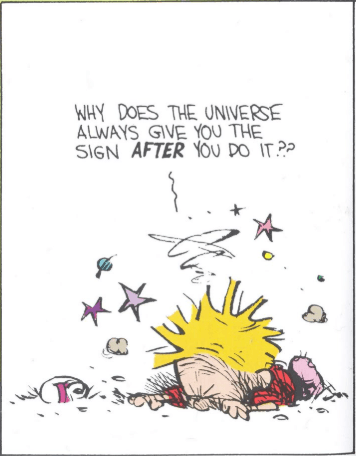
CALVIN: Why does the universe always give you the sign after you do it?
Quotations about:
confirmation
Note not all quotations have been tagged, so Search may find additional quotes on this topic.

FAUSTUS. Come, I think hell’s a fable.
MEPHISTOPHILES: Ay, think so still, till experience change thy mind.
Christopher "Kit" Marlowe (1564–1593) English dramatist and poet
The Tragicall History of the Life and Death of Doctor Faustus, Act 2, sc. 1 (sc. 5), l. 573ff (1594; 1604 “A” text)
(Source)
The "B" text (1594; 1616) as a slight variance in Faust's line:FAUSTUS: I think hell's a mere fable.
MEPHISTOPHILES: Aye, think so still, till experience change thy mind.

CHORUS:But why
Be sure of the worst, and weep too soon?[ΧΟΡΟΣ: μὴ πρόμαντις ἀλγέων
προλάμβαν᾽, ὦ φίλα, γόους.]Euripides (485?-406? BC) Greek tragic dramatist
Helen [Ἑλένη], l. 338ff (412 BC) [tr. Vellacott (1954)]
(Source)
Counseling Helen not to catastrophize about her fate or that of her husband until she has talked with the prophetess Theonoë.
(Source (Greek)). Other translations:Do not, dear lady, do not thus, in thought
Presaging ill, anticipate thy griefs.
[tr. Potter (1783), l. 370ff]Forbear these plaintive strains, my dearest queen,
Nor with presaging soul anticipate
Evils to come.
[tr. Wodhull (1809)]Do not, O dear one, anticipate lamentations like a prophetess of woes.
[tr. Buckley (1850)]Do not be a prophetess of sorrow, dear friend, anticipating lamentation.
[tr. Coleridge (1891)]Nay, forestall not, O friend, lamentation
Prophetic of grief.
[tr. Way (Loeb) (1912)]Lady, till the truth appear,
Gentle lady, grieve not so.
Weep not till you know.
[tr. Sheppard (1925)]Do not anticipate your grief,
dear lady, do not cry before you know.
[tr. Warner (1951)]Do not be prophetic of grief.
Do not, dear, anticipate sorrow.
[tr. Lattimore (1956)]Dear lady, do not prophesy sorrow yet nor weep too soon!
[tr. Davie (2002)]Dear mistress mine, be not a prophetess of sorrow, forestalling lamentation.
[tr. Athenian Society (2006)]Wait till you're certain, don't jump to conclusions.
[tr. A. Wilson (2007)]Why prophesy grief, Helen?
Why cry before you have to?
[tr. Theodoridis (2011)]As a prophetess of woe
do not, my dear, lament too soon.
[tr. Ambrose et al. (2018)]Do not be a prophetess of sorrow, dear friend [phila], anticipating lamentation.
[tr. Coleridge / Helen Heroization Team]
Better ask twice than lose your way once.
Proverbs, Sayings, and Adages
Danish Proverb

We don’t exist unless there is someone who can see us existing, what we say has no meaning until someone can understand, while to be surrounded by friends is constantly to have our identity confirmed; their knowledge and care for us have the power to pull us from our numbness. In small comments, many of them teasing, they reveal they know our foibles and accept them and so, in turn, accept that we have a place in the world.
Alain de Botton (b. 1969) Swiss-British author
The Consolations of Philosophy, ch. 2 “Consolation For Not having Enough Money” (2000)
(Source)

The truth seems to be that propaganda on its own cannot force its way into unwilling minds; neither can it inculcate something wholly new; nor can it keep people persuaded once they have ceased to believe. It penetrates only into minds already open, and rather than instill opinion it articulates and justifies opinions already present in the minds of its recipients. The gifted propagandist brings to a boil ideas and passions already simmering in the minds of his hearers. he echoes their innermost feelings. Where opinion is not coerced, people can be made to believe only in what they already “know.”
Eric Hoffer (1902–1983) American writer, philosopher, longshoreman
True Believer: Thoughts on the Nature of Mass Movements, Part 3, ch. 14, § 83 (3.14.83) (1951)
(Source)
By doubting we come at truth.
Marcus Tullius Cicero (106–43 BC) Roman orator, statesman, philosopher
(Attributed)
Widely attributed, but no citation found.
RECONSIDER, v. To seek a justification for a decision already made.
Ambrose Bierce (1842–1914?) American writer and journalist
“Reconsider,” The Devil’s Dictionary (1911)
(Source)
Originally published in the The Devil's Dictionary [A-Z] as Vol. 7 of his Collected Works.