Civil Service Reform had two sides. There was, first, the effort to secure a more efficient administration of the public service, and, second, the even more important effort to withdraw the administrative offices of the Government from the domain of spoils politics, and thereby cut out of American political life a fruitful source of corruption and degradation.
The spoils theory of politics is that public office is so much plunder which the victorious political party is entitled to appropriate to the use of its adherents. […] Yet there were many flagrant instances of inefficiency, where a powerful chief quartered friend, adherent, or kinsman upon the Government. Moreover, the necessarily haphazard nature of the employment, the need of obtaining and holding the office by service wholly unconnected with official duty, inevitably tended to lower the standard of public morality, alike among the office-holders and among the politicians who rendered party service with the hope of reward in office.Theodore Roosevelt (1858–1919) American politician, statesman, conservationist, writer; US President (1901–09)
Autobiography, ch. 5 “Applied Idealism” (1913)
(Source)
Quotations about:
administration
Note not all quotations have been tagged, so Search may find additional quotes on this topic.

People do not always remember that politics, economics, and social organisation generally, belong in the realm of means, not ends. Our political and social thinking is prone to what may be called the “administrator’s fallacy,” by which I mean the habit of looking upon a society as a systematic whole, of a sort that is thought good if it is pleasant to contemplate as a model of order, a planned organism with parts neatly dove-tailed into each other. But a society does not, or at least should not, exist to satisfy an external survey, but to bring a good life to the individuals who compose it. It is in the individuals, not in the whole, that ultimate value is to be sought. A good society is a means to a good life for those who compose it, not something having a separate kind of excellence on its own account.
Bertrand Russell (1872–1970) English mathematician and philosopher
Lecture (1949-01-30), “Individual and Social Ethics,” Reith Lecture, “Authority and the Individual” No. 6, BBC Radio
(Source)

Organizing is what you do before you do something, so that when you do it, it is not all mixed up.
A. A. Milne (1882–1956) English poet and playwright [Alan Alexander Milne]
(Attributed)
Widely quoted and attributed to Milne, but I can find no instance of it with an actual, proven citation.
Ross Webber in Management: Basic Elements of Managing Organizations (1979) gives the following:In A. A. Milne's childhood classic Winnie the Pooh, Christopher Robin tells his group of stuffed-animal friends that before they can search for the North Pole they ought to get organized. Pooh asks what getting organized means, and Christopher replies, "Organizing is what you do before you do something, so that when you do it, it is not all mixed up."
All well and good, and Christopher Robin does organize such an expedition ("expotition") to the North Pole in that book -- but never says anything of the sort. It is possible that the line derives from a Disney animated adaptation, but could not confirm this.

Though in reviewing the incidents of my Administration I am unconscious of intentional error, I am nevertheless too sensible of my defects not to think it probable that I may have committed many errors. Whatever they may be, I fervently beseech the Almighty to avert or mitigate the evils to which they may tend. I shall also carry with me the hope that my country will never cease to view them with indulgence, and that, after forty-five years of my life dedicated to its service with an upright zeal, the faults of incompetent abilities will be consigned to oblivion, as myself must soon be to the mansions of rest.
George Washington (1732–1799) American military leader, Founding Father, US President (1789–1797)
Letter (1796-09-17), “Farewell Address” [with J. Madison, A. Hamilton]
(Source)
Published in the American Daily Advertiser, Philadelphia (1796-09-19).

Somehow, things just didn’t work out the way the books on administration and on leadership said they should, and I early became aware that I could never qualify as a leader, if it were really necessary that I possess the twenty or so qualities most books or articles on leadership claimed to be necessary. So far, I have found no one in the Navy or in industry who possesses more than a few of these qualities, and so I have regretfully come to the conclusion that the only person who ever possessed all of them died some 1900 years ago.
Hyman Rickover (1900–1986) Polish-American naval engineer, admiral [b. Chaim Gdala Rykower]
Speech (1954-03-16), “Administering a Large Military Development Project,” US Naval Postgraduate School, Monterey, California
(Source)

I like bats much better than bureaucrats. I live in the Managerial Age, in a world of “Admin.” The greatest evil is not now done in those sordid “dens of crime” that Dickens loved to paint. It is not done even in concentration camps and labour camps. In those we see its final result. But it is conceived and ordered (moved, seconded, carried, and minuted) in clean, carpeted, warmed, and well-lighted offices, by quiet men with white collars and cut fingernails and smooth-shaven cheeks who do not need to raise their voice. Hence, naturally enough, my symbol for Hell is something like the bureaucracy of a police state or the offices of a thoroughly nasty business concern.
C. S. Lewis (1898–1963) English writer, literary scholar, lay theologian [Clive Staples Lewis]
The Screwtape Letters, Preface to the 1961 edition (1961)
(Source)

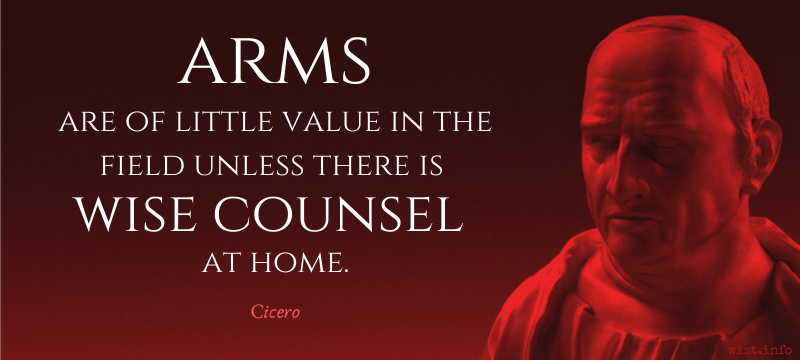
For arms are of little value in the field unless there is wise counsel at home.
[Parvi enim sunt foris arma, nisi est consilium domi.]
Marcus Tullius Cicero (106–43 BC) Roman orator, statesman, philosopher
De Officiis [On Duties; On Moral Duty; The Offices], Book 1, ch. 22 (1.22) / sec. 76 (44 BC) [tr. Miller (1913)]
(Source)
Peabody comments, "A verse, quoted probably from some lost comedy, the measure being one employed by the comic poets." None of the other translators call this out or show the text as separate except Peabody.
(Source (Latin)). Other translations:For armies can signify but little abroad, unless there be counsel and wise management at home.
[tr. Cockman (1699)]Armies abroad avail little, unless there be wisdom at home.
[tr. McCartney (1798)]An army abroad is but of small service unless there be a wise administration at home.
[tr. Edmonds (1865)]Valor abroad is naught, unless at home be wisdom.
[tr. Peabody (1883)]An army in the field is nothing without wisdom at home.
[tr. Gardiner (1899)]For weapons have small value abroad unless there is good advice at home.
[tr. Edinger (1974)]

Good government makes everything well ordered and fit,
And at the same time it throws shackles on the unjust.
It levels out the rough, stops insolence, and weakens arrogance.
It causes the growing blossoms of blindness to wither.
It straightens crooked judgments and it levels out over-reaching deeds.
It stops the acts of civil conflict and
It stops the anger of grievous strife and because of it
Everything among men is wisely and appropriately done.[Εὐνομίη δ’ εὔκοσμα καὶ ἄρτια πάντ’ ἀποφαίνει,
καὶ θαμὰ τοῖς ἀδίκοις ἀμφιτίθησι πέδας·
τραχέα λειαίνει, παύει κόρον, ὕβριν ἀμαυροῖ,
αὑαίνει δ’ ἄτης ἄνθεα φυόμενα,
εὐθύνει δὲ δίκας σκολιάς, ὑπερήφανά τ’ ἔργα
πραΰνει· παύει δ’ ἔργα διχοστασίης,
παύει δ’ ἀργαλέης ἔριδος χόλον, ἔστι δ’ ὑπ’ αὐτῆς
πάντα κατ’ ἀνθρώπους ἄρτια καὶ πινυτά.]Solon (c. 638 BC - 558 BC) Athenian statesman, lawmaker, poet
Fragment 4.32-39 W [tr. @sententiq (2015)]
(Source)
Solon's description of eunomiē (lawfulness). Other translations:Lawfulness, puts all things into good order and makes them sound,
And often places shackles about those who are unjust.
She smooths what is rough, puts an end to excess, enfeebles arrogance;
She withers the flowers of ruin as they spring up;
She straightens crooked judgments, and overbearing acts she turns to gentleness;
She puts an end to acts of dissension,
Puts an end to the bitterness of painful strife:
Beneath her hand all things among mankind are sound and prudent.
[tr. Miller (1996)]Good Government displays all neatness and order,
And many times she must put shackles on the breakers of laws
She levels rough places, stops Glut and Greed, takes the force from Violence:
She dries up the growing flowers of Despair as they grow;
She straightens out crooked judgments given, gentles the swollen ambitions,
And puts an end to acts of divisional strife;
She stills the gall of wearisome Hate,
And under her influence all life among mankind is harmonious and does well.
[tr. Lattimore]

BETTY OLDHAM: Look, Sir Humphrey, whatever we ask the Minister, he says is an administrative question for you, and whatever we ask you, you say is a policy question for the Minister. How do you suggest we find out what is going on?
SIR HUMPHREY: Yes, yes, yes, I do see that there is a real dilemma here. In that, while it has been government policy to regard policy as a responsibility of Ministers and administration as a responsibility of Officials, the questions of administrative policy can cause confusion between the policy of administration and the administration of policy, especially when responsibility for the administration of the policy of administration conflicts, or overlaps with, responsibility for the policy of the administration of policy.
BETTY OLDHAM: Well, that’s a load of meaningless drivel. Isn’t it?
SIR HUMPHREY: It’s not for me to comment on government policy. You must ask the Minister.
Jonathan Lynn (b. 1943) English actor, comedy writer, director
Yes Minister, 02×07 “A Question of Loyalty” (BBC2 Television) (1981-04-09) [with Anthony Jay]

The Presidency is not merely an administrative office. That’s the least of it. It is more than an engineering job, efficient or inefficient. It is pre-eminently a place of moral leadership. All our great Presidents were leaders of thought at times when certain historic ideas in the life of the nation had to be clarified.
Franklin Delano Roosevelt (1882–1945) American lawyer, politician, statesman; US President (1933–45)
Interview (1932-09-11), New York Times Magazine
(Source)
My life has been largely spent in affairs that required organization. But organization itself, necessary as it is, is never sufficient to win a battle.
Dwight David Eisenhower (1890–1969) American general, US President (1953–61)
Speech, Young Republican National Leadership Training School (20 Jan 1960)
But now Nixon has come along and everything I’ve worked for is ruined. There’s a story in the paper every day about him slashing another one of my Great Society programs. I can just see him waking up in the morning, making that victory sign of his and deciding which program to kill. It’s a terrible thing for me to sit by and watch someone else starve my Great Society to death. She’s getting thinner and thinner and uglier and uglier all the time; now her bones are beginning to stick out and her wrinkles are beginning to show. Soon she’ll be so ugly that the American people will refuse to look at her; they’ll stick her in a closet to hide her away and there she’ll die. And when she dies, I, too, will die.
Lyndon B. Johnson (1908–1973) American politician, educator, US President (1963–69)
Comment (1971) to Doris Kearns Goodwin
(Source)
Quoted in Doris Kearns Goodwin, Lyndon Johnson and the American Dream, ch. 10 "Things Go Wrong" (1976). Kearns was an intern and staff member in the Johnson White House, and worked with him on his memoirs.

Me, I think government is a tool, like a hammer. You can use a hammer to build with or you can use a hammer to destroy with. Whether government is good or bad depends on what you use it for and how well you use it. On the whole, it’s a poor idea to put people in charge of government who don’t believe in using it.
Molly Ivins (1944–2007) American writer, political columnist [Mary Tyler Ivins]
Essay (1992-03-01), “Good morning, Fort Worth! Glad to be here,” Fort Worth Star-Telegram
(Source)
Responding to Ronald Reagan's famous quip, "Government is not the solution; government is the problem." Collected in Nothin' But Good Times Ahead (1993).
Ivins used a similar comment in her essay, "Wiggy Republicans," Mother Jones (1992-09/10) (also collected in Nothin' but Good Times Ahead (1993)):Government is just a tool, like a hammer. There’s nothing intrinsically good or evil about the hammer; it all depends on what it’s used for and the skill with which it is used.
She reworked this in the introduction to her book You Got to Dance with Them What Brung You, (1998):Personally, I think government is a tool, like a hammer. You can use a hammer to build or you can use a hammer to destroy; there is nothing intrinsically good or evil about the hammer itself. It is the purposes to which it is put and the skill with which it is used that determine whether the hammer's work is good or bad.


I believe that the public temper is such that the voters of the land are prepared to support the party which gives the best promise of administering the government in the honest, simple, and plain manner which is consistent with its character and purposes. They have learned that mystery and concealment in the management of their affairs cover tricks and betrayal. The statesmanship they require consists in honesty and frugality, a prompt response to the needs of the people as they arise, and a vigilant protection of all their varied interests.
Grover Cleveland (1837–1908) American President (1885–1889, 1893–1897)
Letter accepting Democratic nomination for President (8 Aug 1884)
(Source)
In the tragic days of Mussolini, the trains in Italy ran on time as never before and I am told in their way, their horrible way, that the Nazi concentration-camp system in Germany was a model of horrible efficiency. The really basic thing in government is policy. Bad administration, to be sure, can destroy good policy, but good administration can never save bad policy.
Adlai Stevenson II (1900–1965) American politician, diplomat, statesman
Speech (1952-09-11), “On Political Morality,” Town Hall Luncheon, Biltmore Hotel, Los Angeles
(Source)

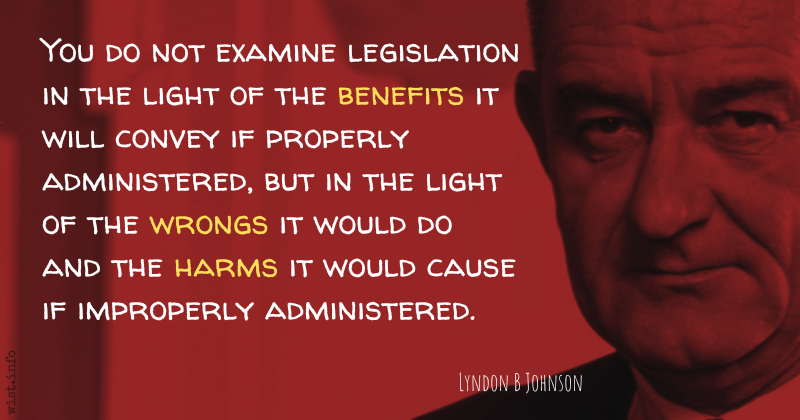
You do not examine legislation in the light of the benefits it will convey if properly administered, but in the light of the wrongs it would do and the harms it would cause if improperly administered.
Lyndon B. Johnson (1908–1973) American politician, educator, US President (1963–69)
(Attributed)
Widely attributed to Johnson, and in keeping with his reputation as a wily legislator, but no actual source found.
I desire to conduct the affairs of this administration that if at the end, when I come to lay down the reins of power, I have lost every other friend on earth, I shall at least have one friend left, and that friend shall be down inside of me.
Abraham Lincoln (1809–1865) American lawyer, politician, US President (1861–65)
Speech (1863-09-30) to the Missouri Committee of Seventy
(Source)
A committee of seventy "Radical Union Men of Missouri," selected by a state convention, visited Lincoln in the White House, demanding immediate abolition of slavery in the border states, the recruitment of Black soldiers to the Union Army, and that action be taken regarding the factional conflicts (Radicals vs Conservatives) stirred up by the state governor and the US military governor overseeing the state militia. This was Lincoln's concluding remark in reply to the committee's petition.
This was not a prepared speech, so there is no "official" version. These words were later reported by Enos Clarke, one of the committee members, as recorded in Ida Tarbell's The Life of Abraham Lincoln (1895). Tarbell's book was a best-seller, and the quotation is usually given as above.
However, Clarke's report as recorded by Walter Stevens in the Missouri State Historical Society book Lincoln and Missouri (1916) is a bit different:It is my ambition and desire to so administer the affairs of the government while I remain President that if at the end I shall have lost every other friend on earth I shall at least have one friend remaining and that one shall be down inside of me.
The difference between the two may be between different instances across the years of Clarke reporting on Lincoln's comments. Neither Tarbell nor Stevens give notes as to when and where their statements from Clarke derive.