

What is less recognized is that we all suffer, to a greater or less degree, from nervous disorders having an emotional origin. A man is called sane when he is as sane as the average of his contemporaries; but in the average man many of the mechanisms which determine his opinions and actions are quite fantastic, so much so that in a world of real sanity they would be called insane.
Bertrand Russell (1872–1970) English mathematician and philosopher
Education and the Social Order [Education and the Modern World], ch. 4 “Emotion and Discipline” (1932)
(Source)
Quotations about:
nerves
Note not all quotations have been tagged, so Search may find additional quotes on this topic.

Things are neither so grievous nor so difficult in themselves, but our weakness and cowardice make them so.
[Les choses ne sont pas si douloureuses, ny difficiles d’elles mesmes: mais nostre foiblesse & lascheté les fait telles.]
Michel de Montaigne (1533–1592) French essayist
Essays, Book 1, ch. 14 (1.14), “The Taste of Good and Bad Things Depends Mostly on the Opinion We Have of Them [Que le goust des biens et des maux despend en bonne partie de l’opinion que nous en avons]” (1572) [tr. Ives (1925)]
(Source)
See Shakespeare (1600).
This essay, including this passage, were in the 1st (1580) edition. The chapter as a whole was numbered ch. 14 in the 1580 and 1588 editions, and rearranged to become ch. 40 for the 1595 ed. Most modern translations use the original numbering.
(Source (French)). Alternate translations:Things are not of themselves so irksome, nor so hard, but our basenes, and weakenesse maketh them such.
[tr. Florio (1603)]The things are not so painful, and difficult of themselves, but our weakness or cowardice makes them so.
[tr. Cotton (1686); Cotton/Hazlitt (1877)]Things are not that painful or difficult of themselves; it is our weakness and cowardice that make them so.
[tr. Frame (1943)]Things are not all that painful nor harsh in themselves: it is our weakness, our slackness, which makes them so.
[tr. Screech (1987)]Things are not so painful or difficult in and of themselves. But our weakness and cowardice make them so.
[tr. HyperEssays (2025)]

Forecasting by bureaucrats tends to be used for anxiety relief rather than for adequate policy making.
Nassim Nicholas Taleb (b. 1960) Lebanese-American essayist, statistician, risk analyst, aphorist
The Black Swan, Part 2, ch. 10 “The Scandal of Prediction” (2007)
(Source)

The only real difference between Anxiety and Excitement was my willingness to let go of Fear.
Barbara Brown Taylor (b. 1951) American minister, academic, author
Learning to Walk in the Dark, ch. 4 (2014)
(Source)

The neurotic circles ceaselessly above a fogged-in airport.
Mignon McLaughlin (1913–1983) American journalist and author
The Neurotic’s Notebook, ch. 4 (1963)
(Source)

We are willing enough to praise freedom when she is safely tucked away in the past and cannot be a nuisance. In the present, amidst dangers whose outcome we cannot foresee, we get nervous about her, and admit censorship.
E. M. Forster (1879–1970) English novelist, essayist, critic, librettist [Edward Morgan Forster]
“The Tercentenary of the Areopagitica,” Two Cheers for Democracy (1951)
(Source)
But I must submit all my Hopes and Fears, to an overruling Providence, in which, unfashionable as the Faith may be, I firmly believe.
John Adams (1735–1826) American lawyer, Founder, statesman; US President (1797–1801)
Letter (1776-07-03) to Abigail Adams
(Source)
On the approval of the resolution for Independence, approved the day before, and his worries over the the future held for the new United States.

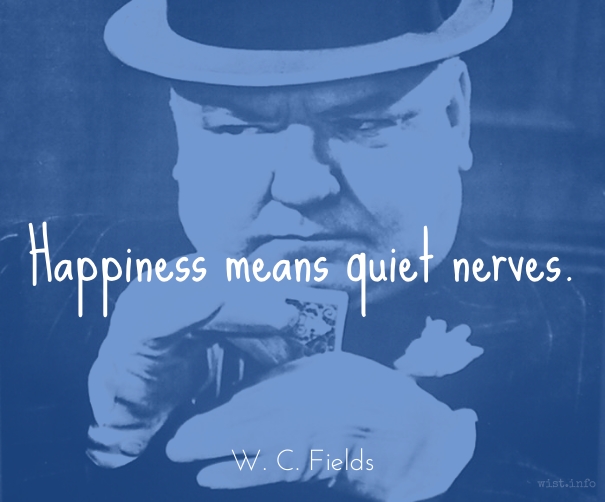
Happiness means quiet nerves.
W. C. Fields (1880–1946) American entertainer [b. William Claude Dukenfield]
(Attributed)
Quoted in Robert Lewis Taylor, W.C. Fields, His Follies and Fortunes (1949).
It is said that our anxiety does not empty tomorrow of its sorrows, but only empties today of its strength.
Charles Spurgeon (1834–1892) British Baptist preacher, author [Charles Haddon (C.H.) Spurgeon]
The Salt-Cellars (1889)
(Source)

Worry is interest paid on trouble before it falls due.
William Ralph Inge (1860–1954) English prelate [Dean Inge]
Sermon (1932-02-09), St. Paul’s Cathedral, London
(Source)
As reported in The Shields Daily News, "Far and Near: Dean Inge on Worry," Northumberland, England (1932-02-10). In context:Christ condemned worry as a sin -- perhaps He was the first to do so. And what good advice this was! "I have had many troubles," said someone, looking back on his life. "Most of them never happened." Worry is interest paid on trouble before it falls due.
Though Inge employed the phrase, it was in wide use already, having been crafted in 1905 by H. A. Thompson. See more here: Quote Origin: Worry Is Like Paying Interest On a Debt You Don’t Owe – Quote Investigator®.
One of the symptoms of approaching nervous break-down is the belief that one’s work is terribly important, and that to take a holiday would bring all kinds of disaster.
Bertrand Russell (1872–1970) English mathematician and philosopher
Conquest of Happiness, Part 1, ch. 5 “Fatigue” (1930)
(Source)
