A love of heavenly beauty does not preclude
A proper love for earthly pulchritude.[L’amour qui nous attache aux beautés éternelles
N’étouffe pas en nous l’amour des temporelles.]Molière (1622–1673) French playwright, actor [stage name for Jean-Baptiste Poquelin]
Tartuffe, or the Hypocrite [Le Tartuffe, ou L’Imposteur], Act 3, sc. 3 (1669) [tr. Wilbur (1963)]
(Source)
When Elmire suggests that the (falsely) pious Tartuffe must surely be focused solely on Heaven.
(Source (French)). Other translations:The Love which engages us to eternal Beauties, does not extinguish in us the Love of temporal ones.
[tr. Clitandre (1672)]The love which attaches us to eternal beauties does not stifle in us the love of earthly things.
[tr. Van Laun (1876)]Our love for the beauty which is eternal, stifles not in us love for that which is fleeting and temporal.
[tr. Wall (1879)]The love which leads us to eternal beauties does not extinguish in us the love of temporal ones.
[tr. Mathew (1890)]Our love for the beauty which is eternal does not stifle in us the love for things fleeting.
[tr. Waller (1903)]Love for the beauty of eternal things
Cannot destroy our love for earthly beauty.
[tr. Page (1909)]The love which draws us to eternal beauty
Does not exclude the love of temporal things.
[tr. Bishop (1957)]To love eternal beauties far above
Is not to be immune to other love.
[tr. Frame (1967)]The love that draws us to eternal beauty does not stifle love of this world.
[tr. Steiner (2008)]The love that binds us to eternal beauties
Does not entirely stifle in us the love of temporal.
[tr. Campbell (2013)]
Quotations about:
earthly
Note not all quotations have been tagged, so Search may find additional quotes on this topic.

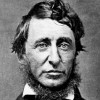
Objects close to the eye shut out much larger objects on the horizon; and splendors born only of the earth eclipse the stars. So a man sometimes covers up the entire disk of eternity with a dollar, and quenches transcendent glories with a little shining dust.

No man ever stood the lower in my estimation for having a patch in his clothes; yet I am sure that there is greater anxiety, commonly, to have fashionable, or at least clean and unpatched clothes, than to have a sound conscience.
Henry David Thoreau (1817–1862) American philosopher and writer
Walden; or, Life in the Woods, ch. 1 “Economy” (1854)
(Source)
He shrugged his shoulders. “I have known many gods. He who denies them is as blind as he who trusts them too deeply. I seek not beyond death. It may be the blackness averred by the Nemedian skeptics, or Crom’s realm of ice and cloud, or the snowy plains and vaulted halls of the Nordheimer’s Valhalla. I know not, nor do I care. Let me live deep while I live; let me know the rich juices of red meat and stinging wine on my palate, the hot embrace of white arms, the mad exultation of battle when the blue blades flame and crimson, and I am content. Let teachers and priests and philosophers brood over questions of reality and illusion. I know this: if life is illusion, then I am no less an illusion, and being thus, the illusion is real to me. I live, I burn with life, I love, I slay, and am content.”
Robert E. Howard (1906–1936) American author
“Queen of the Black Coast” (1934)

The snow covers many a dunghill, so doth prosperity many a rotten heart.
Thomas Brooks (1608–1680) English Puritan divine, writer
Precious Remedies Against Satan’s Devices (1652)
Who loves not wine, women, and song
Remains a fool his whole life long.[Wer nicht liebt Weib, Wein und Gesang,
A Der bleibt ein Narr sein Leben lang.]Martin Luther (1483–1546) German priest, theologian, writer, religious reformer
(Attributed)
Attributed in Matthias Claudius, Der Wandsbecker Bothe (1775). Inscription in the Luther Room, Wartburg, Germany.