“Some people say we shouldn’t give alms to the poor, Shirley.”
“They are great fools for their pains. For those who are not hungry, it is easy to palaver about the degradation of charity, and so on; but they forget the brevity of life, as well as its bitterness. We have none of us long to live: let us help each other through seasons of want and woe, as well as we can, without heeding in the least the scruples of vain philosophy.”
Charlotte Brontë (1816–1855) British novelist [pseud. Currer Bell]
Shirley, ch. 14 [Lina and Shirley] (1849)
(Source)
Quotations about:
moral hazard
Note not all quotations have been tagged, so Search may find additional quotes on this topic.

No one just starts giggling and wearing black and signs up to become a villainous monster. How the hell do you think it happens? It happens to people. Just people. They make questionable choices, for what might be very good reasons. They make choice after choice, and none of them is slaughtering roomfuls of saints, or murdering hundreds of baby seals, or rubber-room irrational. But it adds up. And then one day they look around and realized that they’re so far over the line that they can’t remember where it was.

We are to look upon it as more beneficial, that many guilty persons should escape unpunished, than one innocent person should suffer. The reason is, because it’s of more importance to community, that innocence should be protected, than it is, that guilt should be punished; for guilt and crimes are so frequent in the world, that all of them cannot be punished; and many times they happen in such a manner, that it is not of much consequence to the public, whether they are punished or not.
But when innocence itself, is brought to the bar and condemned, especially to die, the subject will exclaim, it is immaterial to me, whether I behave well or ill; for virtue itself, is no security. And if such a sentiment as this, should take place in the mind of the subject, there would be an end to all security what so ever.John Adams (1735–1826) American lawyer, Founder, statesman; US President (1797–1801)
Speech (1770-12-03/04), Argument for the Defense, Boston Massacre Trial
(Source)
This is frequently (in social media) paraphrased down to:It is more important that innocence be protected than it is that guilt be punished, for guilt and crimes are so frequent in this world that they cannot all be punished. But if innocence itself is brought to the bar and condemned, perhaps to die, then the citizen will say, “whether I do good or whether I do evil is immaterial, for innocence itself is no protection,” and if such an idea as that were to take hold in the mind of the citizen that would be the end of security whatsoever.
Adams volunteered to represent the British against murder charges, even though it was a very unpopular thing to do.
More info here: Quote Files: John Adams on Innocence, Guilt, and Punishment – The Skeptical Libertarian.

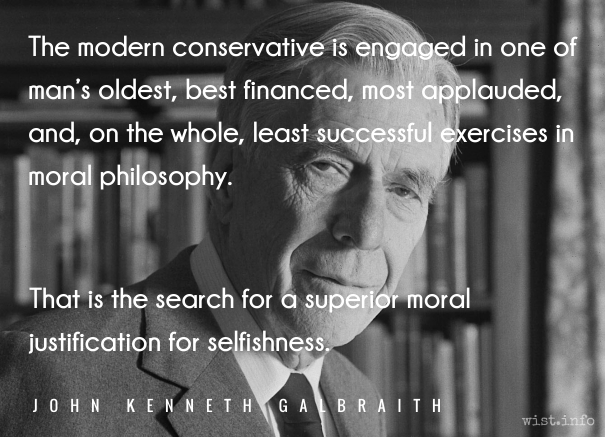
The modern conservative is not even especially modern. He is engaged, on the contrary, in one of man’s oldest, best financed, most applauded, and, on the whole, least successful exercises in moral philosophy. That is the search for a superior moral justification for selfishness. It is an exercise which always involves a certain number of internal contradictions and even a few absurdities. The conspicuously wealthy turn up urging the character-building value of privation for the poor. The man who has struck it rich in minerals, oil, or other bounties of nature is found explaining the debilitating effect of unearned income from the state. The corporate executive who is a superlative success as an organization man weighs in on the evils of bureaucracy. Federal aid to education is feared by those who live in suburbs that could easily forgo this danger, and by people whose children are in public schools. Socialized medicine is condemned by men emerging from Walter Reed Hospital. Social Security is viewed with alarm by those who have the comfortable cushion of an inherited income. Those who are immediately threatened by public efforts to meet their needs — whether widows, small farmers, hospitalized veterans, or the unemployed — are almost always oblivious to the danger.
John Kenneth Galbraith (1908–2006) Canadian-American economist, diplomat, author
Speech (1963-12-13), “Wealth and Poverty,” National Policy Committee on Pockets of Poverty
(Source)
Galbraith used variations on this quote over the years.
- The above quotation was from a speech given, that was then entered into the Congressional Record, Vol. 109, Senate (1963-12-18).
- This material was reworked into an article "Let us begin: An invitation to action on poverty," in Harper's (1964-03), which was in turn again entered into the Congressional Record, Vol. 110 (1964).
- One of the last is most often cited: "The modern conservative is engaged in one of man’s oldest exercises in moral philosophy, that is the search for a superior moral justification for selfishness. It is an exercise which always involves a certain number of internal contradictions and even a few absurdities. The conspicuously wealthy turn up urging the character-building value of privation for the poor." ["Stop the Madness," Interview with Rupert Cornwell, Toronto Globe and Mail (2002-07-06)]