By seeing one thou knowest him half, by hearing him speak thou knowst all.
[Vedendo uno conosci mezzo, udendolo parlar il conosci tutto.]
Quotations about:
sight
Note not all quotations have been tagged, so Search may find additional quotes on this topic.
Afflicted by love’s madness all are blind.
[Scilicet insano nemo in amore videt.]
Propertius (50–16 BC) Roman elegiac poet [Sextus Propertius]
Elegies, Book 2, Elegy 14, l. 18ff (2.14.18) [ed. Harbottle (1906)]
(Source)
(Source (Latin)). Other translations:And surely no one sees when love his senses steals away.
[tr. Cranstoun (1875); 3.5]To be sure, when mad with love no one can see.
[tr. Gantillon (1884); 3.5]This is the truth of the adage "Madly in love, nobody uses his eyes."
[tr. Phillimore (1906)]But men love-maddened one and all are blind.
[tr. Butler (Loeb) (1912)]A man in love, as I am, stumbles blindly.
[tr. Carrier (1963)]But who in love’s madness retains his sight?
[tr. Musker (1972)]Of course no one uses his eyes when he is madly in love.
[tr. Goold (Loeb) (1990)]In mad love no one can see straight.
[tr. Lee (1992)]No one of course can see when crazed with love.
[tr. Kline (2001)]In lover’s madness none can see.
[tr. Holcombe (2009)]
Unsourced variant: "No one in love can see."
You see, but you do not observe. The distinction is clear.
Arthur Conan Doyle (1859–1930) British writer and physician
Story (1891-07), “A Scandal in Bohemia,” ch. 1 [Holmes], The Strand Magazine, Vol. 2, No. 1
(Source)
There is a road from the eye to the heart that does not go through the intellect. Men do not quarrel about the meaning of sunsets; they never dispute that the hawthorn says the best and wittiest thing about the spring.
Gilbert Keith Chesterton (1874–1936) English journalist and writer
“A Defence of Heraldry,” The Defendant (1901)
(Source)
Only a child sees things with perfect clarity, because it hasn’t developed all those filters which prevent us from seeing things that we don’t expect to see.
Douglas Adams (1952–2001) English author, humorist, screenwriter
Dirk Gently No. 1, Dirk Gently’s Holistic Detective Agency, ch. 23 [Dirk] (1987)
(Source)
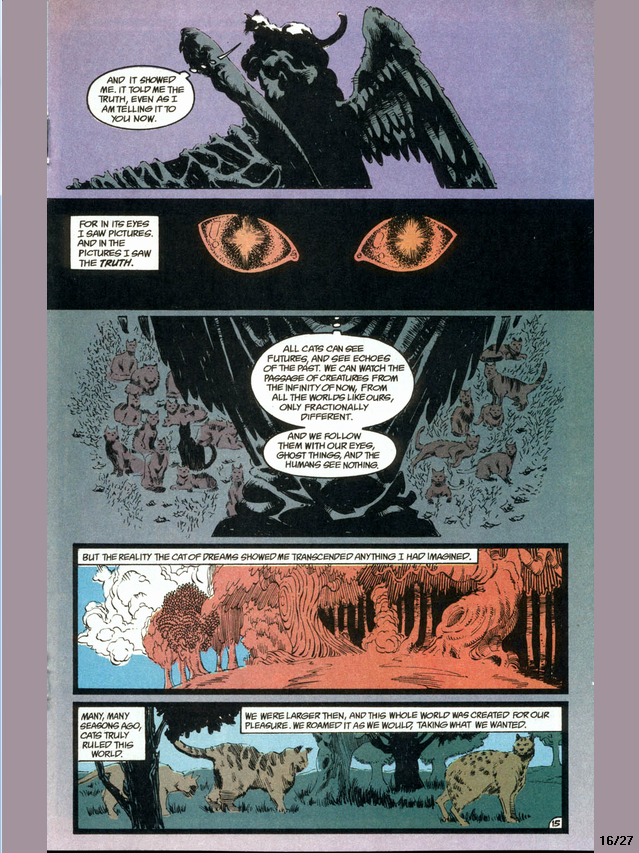
THE PROPHET: All cats can see futures, and see echoes of the past. We can watch the passage of creatures from the infinity of now, from all the worlds like ours, only fractionally different. And we follow them with our eyes, ghost things, and the humans see nothing.
Neil Gaiman (b. 1960) British author, screenwriter, fabulist
Sandman, Book 3. Dream Country, # 18 “A Dream of a Thousand Cats” (1990-08)
(Source)
Many eyes go through the meadow, but few see the flowers in it.
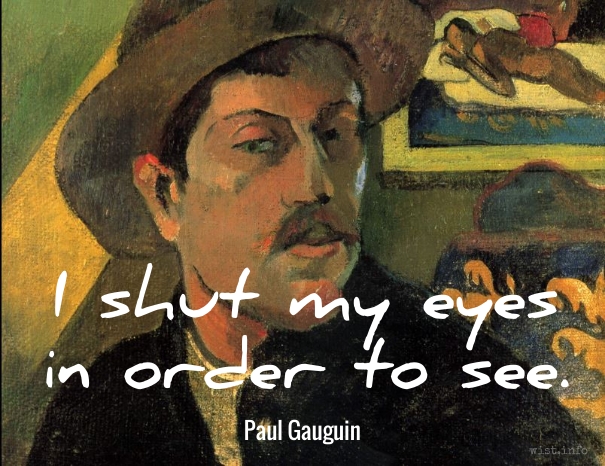
I shut my eyes in order to see.
Paul Gauguin (1848–1903) French painter [Eugène Henri Paul Gauguin]
(Attributed)
Nothing we use or hear or touch can be expressed in words that equal what is given by the senses.
Hannah Arendt (1906–1975) German-American philosopher, political theorist
Life of the Mind, Vol. 1 “Thinking,” Introduction (1977)
(Source)
Originally printed as an essay (1977-11-14), "Thinking -- I," The New Yorker (1977-11-21).
In every object there is inexhaustible meaning; the eye sees in it what the eye brings means of seeing.
Thomas Carlyle (1795–1881) Scottish essayist and historian
(Misattributed)
Carlyle uses this phrase in his The French Revolution: A History, Part 1, Book 1, ch. 2 (1.1.2) (1837), but brackets it in quotations, and prefaces it with "For indeed it is well said ...." Nevertheless, the phrase is often misattributed directly to Carlyle.
The second half of the phrase (and sometimes the whole thing) has also been misattributed to Johann von Goethe, as "The eye sees only what the eye brings means of seeing." This is not found in Goethe's work, but may be distorted from a line in the Prologue to Goethe's Faust: "Each one sees what he carries in his heart."