

It was one Sunday evening early in September of the year 1903 that I received one of Holmes’s laconic messages: “Come at once if convenient — if inconvenient come all the same. S.H.'”
Arthur Conan Doyle (1859–1930) British writer and physician
“The Adventure of the Creeping Man,” Strand Magazine (Mar 1923)
(Source)
Reprinted in The Case-Book of Sherlock Holmes (1927).
Quotations by:
Doyle, Arthur Conan
I have no desire to make mysteries, but it is impossible at the moment of action to enter into long and complex explanations.
Arthur Conan Doyle (1859–1930) British writer and physician
“The Dancing Men” [Sherlock Holmes], The Strand Magazine (Dec 1903)
(Source)
Reprinted as "The Adventure of the Dancing Men" in The Return of Sherlock Holmes, ch. 3 (1905).
A man should keep his little brain-attic stocked with all the furniture that he is likely to use, and the rest he can put away in the lumber-room of his library, where he can get it if he wants it.
Arthur Conan Doyle (1859–1930) British writer and physician
“The Five Orange Pips,” The Strand (Nov 1891)
(Source)
The world is full of obvious things which nobody by any chance ever observes.
Arthur Conan Doyle (1859–1930) British writer and physician
The Hound of the Baskervilles, ch. 3 [Holmes] (1901-02)
(Source)
When the spirits are low, when the day appears dark, when work becomes monotonous, when hopes hardly seems worth having, just mount a bicycle and go for a good spin down the road, without thought of anything but the ride you are taking.
Arthur Conan Doyle (1859–1930) British writer and physician
In The American Bee Keeper (May 1895)
Got up late and would have liked to have got up later, which is a sad moral state to be in.
Arthur Conan Doyle (1859–1930) British writer and physician
Journal of Arctic voyage (11 Jul 1880)
(Source)
Blowing a gale all day. Nothing to do and we did it.
Arthur Conan Doyle (1859–1930) British writer and physician
Journal of Arctic voyage (19 Jul 1880)
(Source)
You see, I consider that a man’s brain originally is like a little empty attic, and you have to stock it with such furniture as you choose. A fool takes in all the lumber of every sort that he comes across, so that the knowledge which might be useful to him gets crowded out, or at best is jumbled up with a lot of other things, so that he has a difficulty in laying his hands upon it. Now the skilful workman is very careful indeed as to what he takes into his brain-attic. He will have nothing but the tools which may help him in doing his work, but of these he has a large assortment, and all in the most perfect order. It is a mistake to think that that little room has elastic walls and can distend to any extent. Depend upon it there comes a time when for every addition of knowledge you forget something that you knew before. It is of the highest importance, therefore, not to have useless facts elbowing out the useful ones.
Arthur Conan Doyle (1859–1930) British writer and physician
Story (1886-04), “A Study in Scarlet,” Part 1, ch. 2 [Holmes], Beeton’s Christmas Annual, Vol. 28 (1887-11-21)
(Source)
Connected to this passage.
Published in novel form 1888-07. See also "The Five Orange Pips."
In the Sherlock TV episode 01x03 "The Great Game" (w. Mark Gatiss) (2010-08-08), this explanation is reworked:SHERLOCK: Listen: (points to his head) This is my hard-drive, and it only makes sense to put things in there that are useful. Really useful. Ordinary people fill their heads with all kinds of rubbish, and that makes it hard to get at the stuff that matters! Do you see?
Well, I have a trade of my own. I suppose I am the only one in the world. I’m a consulting detective, if you can understand what that is. Here in London we have lots of government detectives and lots of private ones. When these fellows are at fault, they come to me, and I manage to put them on the right scent. They lay all the evidence before me, and I am generally able, by the help of my knowledge of the history of crime, to set them straight. There is a strong family resemblance about misdeeds, and if you have all the details of a thousand at your finger ends, it is odd if you can’t unravel the thousand and first.
Arthur Conan Doyle (1859–1930) British writer and physician
Story (1886-04), “A Study in Scarlet,” Part 1, ch. 2 [Holmes], Beeton’s Christmas Annual, Vol. 28 (1887-11-21)
(Source)
I had no idea that such individuals exist outside of stories.
Arthur Conan Doyle (1859–1930) British writer and physician
Story (1886-04), “A Study in Scarlet,” Part 1, ch. 2 [Watson], Beeton’s Christmas Annual, Vol. 28 (1887-11-21)
(Source)
Watson to Holmes, comparing him to Edgar Allan Poe's Dupin (a comparison that Holmes sniffs at).
Published in novel form 1888-07.
“You appeared to be surprised when I told you, on our first meeting, that you had come from Afghanistan.”
“You were told, no doubt.”
“Nothing of the sort. I knew you came from Afghanistan. From long habit the train of thoughts ran so swiftly through my mind that I arrived at the conclusion without being conscious of intermediate steps. There were such steps, however. The train of reasoning ran, ‘Here is a gentleman of a medical type, but with the air of a military man. Clearly an army doctor, then. He has just come from the tropics, for his face is dark, and that is not the natural tint of his skin, for his wrists are fair. He has undergone hardship and sickness, as his haggard face says clearly. His left arm has been injured. He holds it in a stiff and unnatural manner. Where in the tropics could an English army doctor have seen much hardship and got his arm wounded? Clearly in Afghanistan.’ The whole train of thought did not occupy a second. I then remarked that you came from Afghanistan, and you were astonished.”Arthur Conan Doyle (1859–1930) British writer and physician
Story (1886-04), “A Study in Scarlet,” Part 1, ch. 2, Beeton’s Christmas Annual, Vol. 28 (1887-11-21)
(Source)
Holmes and Watson. Published in novel form 1888-07.
In the Sherlock TV episode 01x01 "A Study in Pink" (w. Steven Moffat) (2010-07-25), this explanation is reworked:HOLMES: When I met you for the first time yesterday, I said "Afghanistan or Iraq?" You looked surprised.
WATSON: How did you know?
HOLMES: I didn't know, I saw. Your haircut, the way you hold yourself, says military. But your conversation as you entered the room said trained at Bart's, so army doctor. Obvious. Your face is tanned, but no tan above the wrists: you've been abroad but not sunbathing. The limp's really bad when you walk, but you don't ask for a chair when you stand, like you've forgotten about it, so it's at least partly psychosomatic. That says the original circumstances of the injury were probably traumatic: wounded in action, then. Wounded in action, suntan: Afghanistan or Iraq.
My surprise reached a climax, however, when I found incidentally that he was ignorant of the Copernican Theory and of the composition of the Solar System. That any civilized human being in this nineteenth century should not be aware that the earth travelled round the sun appeared to be to me such an extraordinary fact that I could hardly realize it. […] “But the Solar System!” I protested.
“What the deuce is it to me?” he interrupted impatiently; “you say that we go round the sun. If we went round the moon it would not make a pennyworth of difference to me or to my work.”Arthur Conan Doyle (1859–1930) British writer and physician
Story (1886-04), “A Study in Scarlet,” Part 1, ch. 2, Beeton’s Christmas Annual, Vol. 28 (1887-11-21)
(Source)
Watson speaking of and with Holmes. This passage is followed by this one.
Published in novel form 1888-07.
In the Sherlock TV episode 01x03 "The Great Game" (w. Mark Gatiss) (2010-08-08), this explanation is reworked (including this analogous passage):HOLMES: Look, it doesn't matter to me who's Prime Minister, or who's sleeping with whom --
WATSON: Or that the earth goes around the sun.
HOLMES: Oh God, that again! It's not important!
WATSON: Not important? It's primary school stuff! How can you not know that?
HOLMES: Well, if I ever did, I've deleted it.
WATSON: "Deleted it"?
HOLMES: Listen: (points to his head) This is my hard-drive, and it only makes sense to put things in there that are useful. Really useful. Ordinary people fill their heads with all kinds of rubbish, and that makes it hard to get at the stuff that matters! Do you see?
WATSON: (brief silence) But it's the solar system!
HOLMES: Oh, hell! What does that matter?! So we go around the sun! If we went around the moon or round and round the garden like a teddy bear, it wouldn't make any difference! All that matters to me is the work!
It was easier to know it than to explain why I know it. If you were asked to prove that two and two made four, you might find some difficulty, and yet you are quite sure of the fact.
Arthur Conan Doyle (1859–1930) British writer and physician
Story (1886-04), “A Study in Scarlet,” Part 1, ch. 3 [Holmes], Beeton’s Christmas Annual, Vol. 28 (1887-11-21)
(Source)
“You don’t seem to give much thought to the matter in hand,” I said at last, interrupting Holmes’s musical disquisition.
“No data yet,” he answered. “It is a capital mistake to theorize before you have all the evidence. It biases the judgement.”Arthur Conan Doyle (1859–1930) British writer and physician
Story (1886-04), “A Study in Scarlet,” Part 1, ch. 3, Beeton’s Christmas Annual, Vol. 28 (1887-11-21)
(Source)
“They say that genius is an infinite capacity for taking pains,” he [Holmes] remarked with a smile. “It’s a very bad definition, but it does apply to detective work.”
Arthur Conan Doyle (1859–1930) British writer and physician
Story (1886-04), “A Study in Scarlet,” Part 1, ch. 3, Beeton’s Christmas Annual, Vol. 28 (1887-11-21)
(Source)
Published in novel form 1888-07.
The quote Holmes refers to is usually attributed to Scottish historian and essayist Thomas Carlyle, but is a misquote of what he says on the subject. Interestingly, Holmes, in the same story, earlier claims not to know Carlyle's works, though he here supposedly quotes him.
I’m not going to tell you much more of the case, Doctor. You know a conjurer gets no credit once he has explained his trick; and if I show you too much of my method of working, you will come to the conclusion that I am a very ordinary individual after all.
Arthur Conan Doyle (1859–1930) British writer and physician
Story (1886-04), “A Study in Scarlet,” Part 1, ch. 4 [Holmes], Beeton’s Christmas Annual, Vol. 28 (1887-11-21)
(Source)
“What you do in this world is a matter of no consequence,” returned my companion, bitterly. “The question is, what can you make people believe that you have done?”
Arthur Conan Doyle (1859–1930) British writer and physician
Story (1886-04), “A Study in Scarlet,” Part 2, ch. 7 [Holmes], Beeton’s Christmas Annual, Vol. 28 (1887-11-21)
(Source)
Detection is, or ought to be, an exact science and should be treated in the same cold and unemotional manner. You have attempted to tinge it with romanticism, which produces much the same effect as if you worked a love-story or an elopement into the fifth proposition of Euclid.
Arthur Conan Doyle (1859–1930) British writer and physician
Story (1890-02), “The Sign of the Four,” ch. 1 [Holmes], Lippincott’s Monthly Magazine, Vol. 45 (US) / 1 (UK)
(Source)
Critiquing Watson's writing in A Study in Scarlet (1887). More on Euclid's Fifth Proposition here.
The original publication, and Doyle's manuscript (along with many other iterations across media) use "The Sign of the Four" as the title, while others (including the first book publications) use "The Sign of Four." The five-word form is used most commonly in the story, but the four-word form does show up. (More info.)
Published in novel form as The Sign of Four (1890-10).
No, no: I never guess. It is a shocking habit, — destructive to the logical faculty.
Arthur Conan Doyle (1859–1930) British writer and physician
Story (1890-02), “The Sign of the Four,” ch. 1 [Holmes], Lippincott’s Monthly Magazine, Vol. 45 (US) / 1 (UK)
(Source)
The original publication, and Doyle's manuscript (along with many other iterations across media) use "The Sign of the Four" as the title, while others (including the first book publications) use "The Sign of Four." The five-word form is used most commonly in the story, but the four-word form does show up. (More info.)
Published in novel form as The Sign of Four (1890-10).
I cannot live without brain-work. What else is there to live for? Stand at the window here. Was ever such a dreary, dismal, unprofitable world? See how the yellow fog swirls down the street and drifts across the dun-coloured houses. What could be more hopelessly prosaic and material? What is the use of having powers, doctor, when one has no field upon which to exert them? Crime is commonplace, existence is commonplace, and no qualities save those which are commonplace have any function upon earth.
Arthur Conan Doyle (1859–1930) British writer and physician
Story (1890-02), “The Sign of the Four,” ch. 1 [Holmes], Lippincott’s Monthly Magazine, Vol. 45 (US) / 1 (UK)
(Source)
The original publication, and Doyle's manuscript (along with many other iterations across media) use "The Sign of the Four" as the title, while others (including the first book publications) use "The Sign of Four." The five-word form is used most commonly in the story, but the four-word form does show up. (More info.)
Published in novel form as The Sign of Four (1890-10).
“Which is it to-day,” I asked, “morphine or cocaine?”
He raised his eyes languidly from the old black-letter volume which he had opened. “It is cocaine,” he said, “a seven-per-cent solution. Would you care to try it?”Arthur Conan Doyle (1859–1930) British writer and physician
Story (1890-02), “The Sign of the Four,” ch. 1, Lippincott’s Monthly Magazine, Vol. 45 (US) / 1 (UK)
(Source)
Watson and Holmes.
The original publication, and Doyle's manuscript (along with many other iterations across media) use "The Sign of the Four" as the title, while others (including the first book publications) use "The Sign of Four." The five-word form is used most commonly in the story, but the four-word form does show up. (More info.)
Published in novel form as The Sign of Four (1890-10).
It is of the first importance not to allow your judgment to be biased by personal qualities. A client is to me a mere unit, a factor in a problem. The emotional qualities are antagonistic to clear reasoning. I assure you that the most winning woman I ever knew was hanged for poisoning three little children for their insurance-money, and the most repellent man of my acquaintance is a philanthropist who has spent nearly a quarter of a million upon the London poor.
Arthur Conan Doyle (1859–1930) British writer and physician
Story (1890-02), “The Sign of the Four,” ch. 2 [Holmes], Lippincott’s Monthly Magazine, Vol. 45 (US) / 1 (UK)
(Source)
The original publication, and Doyle's manuscript (along with many other iterations across media) use "The Sign of the Four" as the title, while others (including the first book publications) use "The Sign of Four." The five-word form is used most commonly in the story, but the four-word form does show up. (More info.)
Published in novel form as The Sign of Four (1890-10).
How often have I said to you that when you have eliminated the impossible, whatever remains, however improbable, must be the truth?
Arthur Conan Doyle (1859–1930) British writer and physician
Story (1890-02), “The Sign of the Four,” ch. 6 [Holmes], Lippincott’s Monthly Magazine, Vol. 45 (US) / 1 (UK)
(Source)
The first appearance of the phrase in its most quoted form. However, earlier in the story, chapter 1, Holmes tells Watson:Eliminate all other factors, and the one which remains must be the truth.
Similar expressions occur in The Adventures of Sherlock Holmes ("The Adventure of the Beryl Coronet"), The Memoirs of Sherlock Holmes ("Silver Blaze"), The Return of Sherlock Holmes ("The Adventure of the Priory School"), His Last Bow ("The Adventure of the Bruce-Partington Plans"), and The Case-Book of Sherlock Holmes ("The Adventure of the Blanched Soldier").
The original publication, and Doyle's manuscript (along with many other iterations across media) use "The Sign of the Four" as the title, while others (including the first book publications) use "The Sign of Four." The five-word form is used most commonly in the story, but the four-word form does show up. (More info.)
Published in novel form as The Sign of Four (1890-10).
You know my methods. Apply them.
Arthur Conan Doyle (1859–1930) British writer and physician
Story (1890-02), “The Sign of the Four,” ch. 6 [Holmes], Lippincott’s Monthly Magazine, Vol. 45 (US) / 1 (UK)
(Source)
The original publication, and Doyle's manuscript (along with many other iterations across media) use "The Sign of the Four" as the title, while others (including the first book publications) use "The Sign of Four." The five-word form is used most commonly in the story, but the four-word form does show up. (More info.)
Published in novel form as The Sign of Four (1890-10).
You see, but you do not observe. The distinction is clear.
Arthur Conan Doyle (1859–1930) British writer and physician
Story (1891-07), “A Scandal in Bohemia,” ch. 1 [Holmes], The Strand Magazine, Vol. 2, No. 1
(Source)
I have no data yet. It is a capital mistake to theorize before one has data. Insensibly one begins to twist facts to suit theories, instead of theories to suit facts.
Arthur Conan Doyle (1859–1930) British writer and physician
Story (1891-07), “A Scandal in Bohemia,” ch. 1 [Holmes], The Strand Magazine, Vol. 2, No. 1
(Source)
Collected in The Adventures of Sherlock Holmes, No. 1, ch. 1 (1892).
Holmes uses a similar phrase in The Sign of the Four (1890).
To Sherlock Holmes she is always the woman. I have seldom heard him mention her under any other name. In his eyes she eclipses and predominates the whole of her sex. It was not that he felt any emotion akin to love for Irene Adler. All emotions, and that one particularly, were abhorrent to his cold, precise but admirably balanced mind. He was, I take it, the most perfect reasoning and observing machine that the world has seen, but as a lover he would have placed himself in a false position. He never spoke of the softer passions, save with a gibe and a sneer. They were admirable things for the observer — excellent for drawing the veil from men’s motives and actions. But for the trained reasoner to admit such intrusions into his own delicate and finely adjusted temperament was to introduce a distracting factor which might throw a doubt upon all his mental results. Grit in a sensitive instrument, or a crack in one of his own high-power lenses, would not be more disturbing than a strong emotion in a nature such as his. And yet there was but one woman to him, and that woman was the late Irene Adler, of dubious and questionable memory.
Arthur Conan Doyle (1859–1930) British writer and physician
Story (1891-07), “A Scandal in Bohemia,” ch. 1, The Strand Magazine, Vol. 2, No. 1
(Source)
“It is simplicity itself,” said [Holmes]; “my eyes tell me that on the inside of your left shoe, just where the firelight strikes it, the leather is scored by six almost parallel cuts. Obviously they have been caused by someone who has very carelessly scraped round the edges of the sole in order to remove crusted mud from it. Hence, you see, my double deduction that you had been out in vile weather, and that you had a particularly malignant boot-slitting specimen of the London slavey.
“As to your practice, if a gentleman walks into my rooms smelling of iodoform, with a black mark of nitrate of silver upon his right forefinger, and a bulge on the right side of his top-hat to show where he has secreted his stethoscope, I must be dull, indeed, if I do not pronounce him to be an active member of the medical profession.
I could not help laughing at the ease with which he explained his process of deduction. “When I hear you give your reasons,” I remarked, “the thing always appears to me to be so ridiculously simple that I could easily do it myself, though at each successive instance of your reasoning I am baffled until you explain your process. And yet I believe that my eyes are as good as yours.”Arthur Conan Doyle (1859–1930) British writer and physician
Story (1891-07), “A Scandal in Bohemia,” ch. 1, The Strand Magazine, Vol. 2, No. 1
(Source)
Beyond the obvious facts that he has at some time done manual labor, that he takes snuff, that he is a Freemason, that he has been in China, and that he has done a considerable amount of writing lately, I can deduce nothing else.
Arthur Conan Doyle (1859–1930) British writer and physician
Story (1891-08), “The Red-Headed League,” [Holmes], The Strand Magazine, Vol. 2, No. 2
(Source)
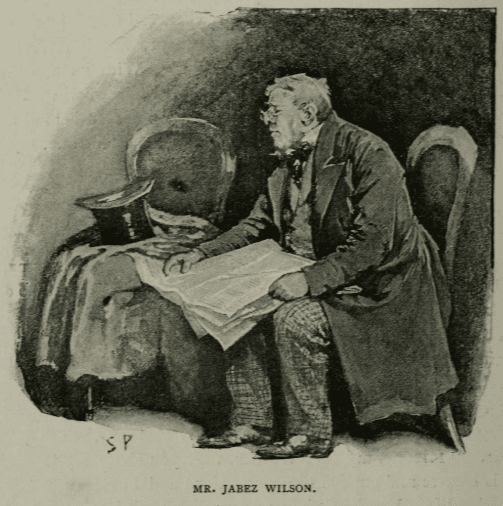
I know, my dear Watson, that you share my love of all that is bizarre and outside the conventions and humdrum routine of everyday life. You have shown your relish for it by the enthusiasm which has prompted you to chronicle, and, if you will excuse my saying so, somewhat to embellish so many of my own little adventures.
Arthur Conan Doyle (1859–1930) British writer and physician
Story (1891-08), “The Red-Headed League,” [Holmes], The Strand Magazine, Vol. 2, No. 2
(Source)
“You will remember that I remarked the other day, just before we went into the very simple problem presented by Miss Mary Sutherland, that for strange effects and extraordinary combinations we must go to life itself, which is always far more daring than any effort of the imagination.”
“A proposition which I took the liberty of doubting.”
“You did, Doctor, but none the less you must come round to my view, for otherwise I shall keep on piling fact upon fact on you until your reason breaks down under them and acknowledges me to be right.”Arthur Conan Doyle (1859–1930) British writer and physician
Story (1891-08), “The Red-Headed League,” The Strand Magazine, Vol. 2, No. 2
(Source)
My dear fellow, life is infinitely stranger than anything which the mind of man could invent. We would not dare to conceive the things which are really mere commonplaces of existence. If we could fly out of that window hand in hand, hover over this great city, gently remove the roofs, and peep in at the queer things which are going on, the strange coincidences, the plannings, the cross-purposes, the wonderful chains of events, working through generations, and leading to the most outré results, it would make all fiction with its conventionalities and foreseen conclusions most stale and unprofitable.
Arthur Conan Doyle (1859–1930) British writer and physician
Story (1891-09), “A Case of Identity,” [Holmes], The Strand Magazine, Vol. 2, No. 3
(Source)
‘Pon my word, Watson, you are coming along wonderfully. You have really done very well indeed. It is true that you have missed everything of importance, but you have hit upon the method, and you have a quick eye for colour. Never trust to general impressions, my boy, but concentrate yourself upon details.
Arthur Conan Doyle (1859–1930) British writer and physician
Story (1891-09), “A Case of Identity,” [Holmes], The Strand Magazine, Vol. 2, No. 3
(Source)
The relations between us in those latter days were peculiar. He was a man of habits, narrow and concentrated habits, and I had become one of them. As an institution I was like the violin, the shag tobacco, the old black pipe, the index books, and others perhaps less excusable.
Arthur Conan Doyle (1859–1930) British writer and physician
Story (1923-03), “The Adventure of the Creeping Man,” The Strand Magazine, Vol 65
(Source)
Watson on his relationship with Holmes.