When Jesus had lifted up himself, and saw none but the woman, he said unto her, Woman, where are those thine accusers? hath no man condemned thee?
She said, No man, Lord.
And Jesus said unto her, Neither do I condemn thee: go, and sin no more.[ἀνακύψας δὲ ὁ Ἰησοῦς εἶπεν αὐτῇ, Γύναι, ποῦ εἰσιν; οὐδείς σε κατέκρινεν;
ἡ δὲ εἶπεν, Οὐδείς, κύριε.
εἶπεν δὲ ὁ Ἰησοῦς, Οὐδὲ ἐγώ σε κατακρίνω· πορεύου, [καὶ] ἀπὸ τοῦ νῦν μηκέτι ἁμάρτανε.]The Bible (The New Testament) (AD 1st - 2nd C) Christian sacred scripture
Book 4. Gospel of John 8:10ff (John 8:10–11) [KJV (1611)]
(Source)
No Synoptic parallels.
The conclusion of the Pericope Adulterae. John 8:1-11 (or even back to John 7:53) is not in many early NT manuscripts and translations; others sometimes put it after John 21:24, John 7:35, or even Luke 21:38, with varying text (References 1, 2, 3, 4). Most scholars agree this parable was not in the original versions of John's Gospel, but an oral tradition added afterward.(Source (Greek)). Alternate translations:He looked up and said, 'Woman, where are they? Has no one condemned you?'
'No one, sir' she replied.
'Neither do I condemn you,' said Jesus 'go away, and don't sin any more.'
[JB (1966)]Jesus again straightened up and said, 'Woman, where are they? Has no one condemned you?'
'No one, sir,' she replied.
'Neither do I condemn you,' said Jesus. 'Go away, and from this moment sin no more.'
[NJB (1985)]He straightened up and said to her, “Where are they? Is there no one left to condemn you?”
“No one, sir,” she answered.
“Well, then,” Jesus said, “I do not condemn you either. Go, but do not sin again.”
[GNT (1992 ed.)]Jesus stood up and said to her, “Woman, where are they? Is there no one to condemn you?”
She said, “No one, sir.”
Jesus said, “Neither do I condemn you. Go, and from now on, don’t sin anymore.”
[CEB (2011)]Jesus straightened up and said to her, “Woman, where are they? Has no one condemned you?”
She said, “No one, sir.”
And Jesus said, “Neither do I condemn you. Go your way, and from now on do not sin again.”
[NRSV (2021 ed.)]
Quotations about:
try again
Note not all quotations have been tagged, so Search may find additional quotes on this topic.

If you always do what you always did, you will always get what you always got.
Jackie "Moms" Mabley (1894–1975) American standup comedian [stage name of Loretta Mary Aiken]
(Attributed)
Also attributed to a number of other comics of the era.

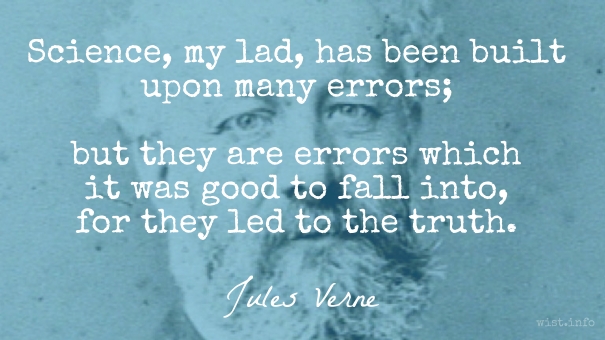
Science, my lad, has been built upon many errors; but they are errors which it was good to fall into, for they led to the truth.
[La science, mon garçon, est faite d’erreurs, mais d’erreurs qu’il est bon de commettre, car elles mènent peu à peu à la vérité.]
Jules Verne (1828–1905) French novelist, poet, playwright
Journey to the Center of the Earth, ch. 31 (1864) [tr. Malleson (1877)]
(Source)
Alt. trans.: "Science, my lad, is made up of mistakes, but they are mistakes which it is useful to make, because they lead little by little to the truth."

Every great improvement has come after repeated failures. Virtually nothing comes out right the first time. Failures, repeated failures, are finger posts on the road to achievement. One fails forward toward success.
Charles F. Kettering (1876–1958) American inventor, engineer, researcher, businessman
(Attributed)
(Source)
Failure is a bruise, not a tattoo.
(Other Authors and Sources)
Jon Sinclair

Our business in this world is not to succeed, but to continue to fail, in good spirits.
Robert Louis Stevenson (1850–1894) Scottish essayist, novelist, poet
Essay (1880-01/02?), “Reflections and Remarks on Human Life,” § 7.4 “Discipline of Conscience”
(Source)
A collection of aphorisms and musings, first published in the Edinburgh Edition of his Works, vol. 28 (1898).

The country needs and, unless I mistake its temper, the country demands bold, persistent experimentation. It is common sense to take a method and try it: If it fails, admit it frankly and try another. But above all, try something.
Franklin Delano Roosevelt (1882–1945) American lawyer, politician, statesman; US President (1933–45)
Speech (1932-05-22), Commencement, Oglethorpe University, Atlanta, Georgia
(Source)

Never let your head hang down. Never give up and sit down and grieve. Find another way. And don’t pray when it rains if you don’t pray when the sun shines.
Satchel Paige (1906–1982) American baseball player [Leroy Robert Paige]
Quoted in “Hal Boyle Says –” syndicated AP column, New York Post (1959-10-04)
Boyle was a Pulitzer-prize-winning journalist working for the AP. This is usually cited to the New York Post appearance. Other examples include the Oswego Palladium-Times (1959-10-02), and the Key West Citizen (1959-10-07).