

Though a man has all other perfections, and wants discretion, he will be of no great consequence in the world; but if he has this single talent in perfection, and but a common share of others, he may do what he pleases in his station of life.
Joseph Addison (1672–1719) English essayist, poet, statesman
Essay (1711-11-17), The Spectator, No. 225
(Source)
Quotations about:
subtlety
Note not all quotations have been tagged, so Search may find additional quotes on this topic.

CREON: A woman of hot temper — and a man the same —
Is a less dangerous enemy than one quiet and clever.[ΚΡΈΩΝ: Γυνὴ γὰρ ὀξύθυμος, ὡς δ᾽ αὔτως ἀνήρ,
ῥᾴων φυλάσσειν ἢ σιωπηλὸς σοφή.]Euripides (485?-406? BC) Greek tragic dramatist
Medea [Μήδεια], l. 319ff (431 BC) [tr. Vellacott (1963)]
(Source)
Expressing his mistrust of how reasonably, if tragically, Medea is presenting herself.
(Source (Greek)). Other translations:For 'gainst those
Of hasty tempers with more ease we guard.
Or men or women, than the silent foe
Who acts with prudence.
[tr. Wodhull (1782)]A woman, or a man, whose fiery spirit
Flames out with anger, puts us on our guard,
More than the prudent calmness that conceals
Its hate in silence.
[tr. Potter (1814)]For a woman passionate, yea and a man,
Is easier warded than a silent plotter.
[tr. Webster (1868)]For cunning woman, and man likewise, is easier to guard against when quick-tempered than when taciturn.
[tr. Coleridge (1891)]For a woman that is quick to anger, and a man likewise, is easier to guard against, than one that is crafty and keeps silence.
[tr. Buckley (1892)]The vehement-hearted woman -- yea, or man --
Is easier watched-for than the silent-cunning.
[tr. Way (Loeb) (1894)]A woman quick of wrath, aye, or a man,
Is easier watching than the cold and still.
[tr. Murray (1906)]A sharp-tempered woman, or, for that matter, a man,
Is easier to deal with than the clever type
Who holds her tongue.
[tr. Warner (1944)]A woman, just like a man, who is quick to wrath
Is easier guarded than one wise and silent.
[tr. Podlecki (1989)]A hot-tempered woman -- and a hot-tempered man likewise -- is easier to guard against than a clever woman who keeps her own counsel.
[tr. Kovacs (1994)]A woman who is hot-tempered, and likewise a man, is easier to guard against than one who is clever and controls her tongue.
[tr. Davie (1996)]You’re too silent now and whilst it is easy to protect oneself from a hot-headed man or woman, it is impossible to do so when the woman is scheming and silent.
[tr. Theodoridis (2004)]For a quick-tempered woman -- the same goes for a man --
is easier to guard against than a silent clever one.
[tr. Luschnig (2007)]Passionate people, women as well as men,
are easier to protect oneself against,
than someone clever who keeps silent.
[tr. Johnston (2008)]It is easier to guard against a hot-headed woman, or a man, than against one who is scheming and silent.
[ed. Yeroulanos (2016)]A woman of sharp temper or indeed a man is easier to guard against than one who's clever and stays silent.
[tr. Ewans (2022)]For a woman with a sharp thūmos, and likewise a man, is easier to guard against than a sophē one who is silent.
[tr. Coleridge / Ceragioli / Nagy / Hour25]
For who could see the passage of a goddess
Unless she wished his mortal eyes aware?[τίς ἂν θεὸν οὐκ ἐθέλοντα
ὀφθαλμοῖσιν ἴδοιτ᾽ ἢ ἔνθ᾽ ἢ ἔνθα κιόντα]Homer (fl. 7th-8th C. BC) Greek author
The Odyssey [Ὀδύσσεια], Book 10, l. 575ff (10.575–576) [Odysseus] (c. 700 BC) [tr. Fitzgerald (1961)]
(Source)
On Circe providing, unseen, a ram and ewe for sacrifice, tied to Odysseus' departing ship.
(Source (Greek)). Alternate translations:For who would see God, loth to let us see,
This way or that bent; still his ways are free.
[tr. Chapman (1616)]For Gods, but when they list, cannot be spied.
[tr. Hobbes (1675)]The paths of gods what mortal can survey?
Who eyes their motion? who shall trace their way?
[tr. Pope (1725)]For who hath eyes that can discern a God
Going or coming, if he shun the view?
[tr. Cowper (1792)]For who with eyes may know
Against their will immortals moving to and fro?
[tr. Worsley (1861), st. 65]Who could see a god
With his own eyes, if he should not be willing, --
Whether he hied him here, or hied him there?
[tr. Bigge-Wither (1869)]Who may behold a god against his will, whether going to or fro?
[tr. Butcher/Lang (1879)]For what man's eyes may see<
A God that is loth to be looked on, whether here or there he be?
[tr. Morris (1887)]When a god does not will, what man can spy him moving to and fro?
[tr. Palmer (1891)]For who can see the comings and goings of a god, if the god does not wish to be seen?
[tr. Butler (1898), rev. Power/Nagy (1900)]Who with his eyes could behold a god against his will, whether going to or fro?
[tr. Murray (1919)]What mortal eye can see a God going up and down if He wills not to be seen?
[tr. Lawrence (1932)]And when a god wishes to remain unseen, what eye can observe his coming or his going?
[tr. Rieu (1946)]Whose eyes can follow the movement
of a god passing from place to place, unless the god wishes?
[tr. Lattimore (1965)]How can
a man detect a god who comes and goes
if gods refuse to have their movements known?
[tr. Mandelbaum (1990)]Who can glimpse a god
who wants to be invisible gliding here and there?
[tr. Fagles (1996)]Who could see
A god on the move against the god's will?
[tr. Lombardo (2000)]When a god wishes to remain unseen, what eye can observe his coming of going?
[tr. DCH Rieu (2002)]Who can observe a goddess passing to and fro, if she wishes otherwise?
[tr. Kline (2004)]For when a god does not wish to be observed who can cast an eye upon his going back and forth?
[tr. Verity (2016)]Who can see the gods go by unless they wish to show themselves to us?
[tr. Wilson (2017)]When the gods don't desire it, who can witness their passage, either coming or going?
[tr. Green (2018)]For who can see a god move back and forth,
if she has no desire to be observed?
[tr. Johnston (2019)]

It pays to be obvious, especially if you have a reputation for subtlety.
Isaac Asimov (1920–1992) Russian-American author, polymath, biochemist
Foundation, ch. 2 (1942)
(Source)
Epigram attributed to Salvor Hardin.
If a theme or idea is too near the surface, the novel becomes simply a tract illustrating an idea.

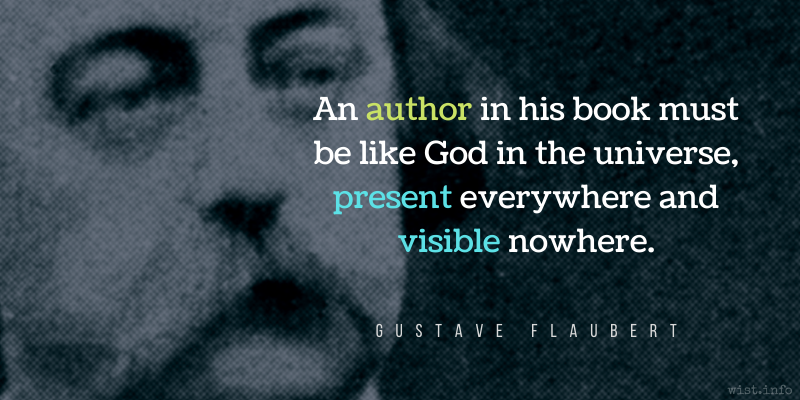
An author in his book must be like God in the universe, present everywhere and visible nowhere.
Gustave Flaubert (1821–1880) French writer, novelist
Letter to Louise Colet (9 Dec 1852)
(Source)
In a later letter to Leoroyer de Chanepie (18 Mar 1857), he repeated the sentiment: "The artist must be in his work as God is in creation, invisible and all-powerful; one must sense him everywhere but never see him."
Khaavren stood. “I will go now.”
“If you don’t mind, I shall await you here.”
“Certainly,” said Khaavren, smiling. “That will make it easier for you to look through my files.”
“Now my friend, have you ever known me to do anything so obvious?”
“Never.” Khaavren stood and strode to the door. “Which is exactly what makes it subtle.”
Steven Brust (b. 1955) American writer, systems programmer
Tiassa (2011)

Elves are wonderful. They provoke wonder.
Elves are marvelous. They cause marvels.
Elves are fantastic. They create fantasies.
Elves are glamorous. They project glamour.
Elves are enchanting. They weave enchantment.
Elves are terrific. They beget terror.
The thing about words is that meanings can twist just like a snake, and if you want to find snakes look for them behind words that have changed their meaning.
No one ever said elves are nice.
Elves are bad.

Questions show the mind’s range, and answers, its subtlety.
[Les questions montrent l’étendue de l’esprit, et les réponses sa finesse.]Joseph Joubert (1754–1824) French moralist, philosopher, essayist, poet
Pensées [Thoughts], ch. 4 “De la Nature des Esprits [On the Nature of Minds],” ¶ 62 (1850 ed.) [tr. Lyttelton (1899), ch. 3, ¶ 21]
(Source)
(Source (French))
While confirmed as an entry in the French, I was unable to find translations other than Lyttelton's in my various sources.
Don’t write anything you can phone. Don’t phone anything you can talk. Don’t talk anything you can whisper. Don’t whisper anything you can smile. Don’t smile anything you can nod. Don’t nod anything you can wink.
Earl Kemp Long (1895–1960) American politician, orator.
(Attributed)
Advice on political discretion. Widely attributed to Long (the brother of Huey Long, governor of Louisiana multiple times in the 1940s–60s), but with no primary sourcing or particular context I can find. Quoted in his biography, Michael L. Kurtz, Earl K. Long: The Saga of Uncle Earl and Louisiana Politics, ch. 7 (1990).
A similar quote is attributed in an essay (1948-12) by A. D. Van Nostrand , "The Lomasaney Legend," The New England Quarterly, Vol. 21, No. 4, to Martin Lomasney (1859–1933), the long-time political boss of Boston's West End: "Don’t write when you can talk; don’t talk when you can nod your head."

Chains do not hold a marriage together. It is threads, hundreds of tiny threads which sew people together through the years. That is what makes a marriage last — more than passion or even sex!
Simone Signoret (1921–1985) German-French actress [b. Simone Kaminker]
Daily Mail (London) (4 Jul 1978)