Carrot often struck people as simple. And he was.
Where people went wrong was thinking that simple meant the same thing as stupid.
Quotations about:
straightforwardness
Note not all quotations have been tagged, so Search may find additional quotes on this topic.

The good and straightforward person should resemble one who stinks of goat, in the sense that whoever comes close will immediately sense him, whether they want to or not.
[τοιοῦτον ὅλως δεῖ τὸν ἁπλοῦν καὶ ἀγαθὸν εἶναι, οἶον γράσωνα, ἵνα ὁ παραστὰς ἅμα τῷ προσελθεῖν, θέλει οὐ θέλει, αἴσθηται.]
Marcus Aurelius (AD 121–180) Roman emperor (161–180), Stoic philosopher
Meditations [To Himself; Τὰ εἰς ἑαυτόν], Book 11, ch. 15 (11.15) [tr. Needleman/Piazza (2008)]
(Source)
(Source (Greek)). Other translations:Such must he be for all the world, that is truly simple and good, as he whose arm-holes are offensive, that whosoever stands by, as soon as ever he comes near him, may as it were smell him whether he will or no.
[tr. Casaubon (1634), 11.14]I would have Honesty so incorporated with the Constitution, so mixed up with the Blood and Spirits, that it should be discoverable by the Sences, and as easily distinguish'd as Rankness, or a strong Breath; so that a Man must be forced to find it out whether he would or no.
[tr. Collier (1701)]The man of simplicity and goodness should, in this, resemble such as have a disagreeable smell in their arm-pits; his disposition should be perceived by all who approach him, whether they will or not.
[tr. Hutcheson/Moor (1742)]A truly good and sincere man should be so palpably such, that no one could be a moment in his company or approach him, without being sensibly and necessarily convinced of it.*
*The expression in the original is rather coarse; which the translators have rather heightened than shorted as they might have done.
[tr. Graves (1792)]The man who is honest and good ought to be exactly like a man who smells strong, so that the bystander as soon as he comes near him must smell whether he choose or not.
[tr. Long (1862)]Goodness, true and simple, should be like musk, so redolent that, will-he nill-he, every one who draws near perceives its fragrance.
[tr. Rendall (1898)]The straightforward, good man should be like one of rank odour who can be recognised by the passer by as soon as he approaches, whether he will or no.
[tr. Hutcheson/Chrystal (1902)]The simple and good man should in fact be like a man who has a strong smell about him, so that, as soon as ever he comes near, his neighbour is, will-he nill-he, aware of it.
[tr. Haines (Loeb) (1916)]The simple and good man ought to be entirely such, like the unsavoury man, that those who stand by detect him at once, whether he will or not, as soon as he comes near.
[tr. Farquharson (1944)]Sincerity and goodness ought to have their own unmistakable odor, so that one who encounters this becomes straightaway aware of it despite himself.
[tr. Staniforth (1964)]A good and honest man should be so right through, like one who smells like a goat, so that anyone who comes near him is immediately aware of it whether he wishes it or not.
[tr. Hard (1997 ed.)]A straightforward, honest person should be like someone who stinks: when you're in the same room as them, you know it.
[tr. Hays (2003)]In short, the good and honest man should have the same effect as the unwashed -- anyone close by as he passes detects the aura, willy-nilly, at once.
[tr. Hammond (2006)]In short, a good and honest person should resemble one who smells like a goat in this respect, that anyone who comes near him is immediately aware of it whether he wishes it or not.
[tr. Hard (2011 ed.)]A person who is honest and good is immediately seen as such even by people who were not looking for any such assurance.
[tr. McNeill (2019)]

I think I could turn and live with animals, they are so placid and self-contain’d,
I stand and look at them long and long.
They do not sweat and whine about their condition,
They do not lie awake in the dark and weep for their sins,
They do not make me sick discussing their duty to God,
Not one is dissatisfied, not one is demented with the mania of owning things,
Not one kneels to another, nor to his kind that lived thousands of years ago,
Not one is respectable or unhappy over the whole earth.
Walt Whitman (1819–1892) American poet
Poem (1855), “Song of Myself,” sec. 32, l. 684ff, Leaves of Grass
(Source)

Questions about the reproductive system should be answered as naturally as ones about the railroad system.
Marcelene Cox (1900–1998) American writer, columnist, aphorist
“Ask Any Woman” column, Ladies’ Home Journal (1946-02)
(Source)

It pays to be obvious, especially if you have a reputation for subtlety.
Isaac Asimov (1920–1992) Russian-American author, polymath, biochemist
Foundation, ch. 2 (1942)
(Source)
Epigram attributed to Salvor Hardin.
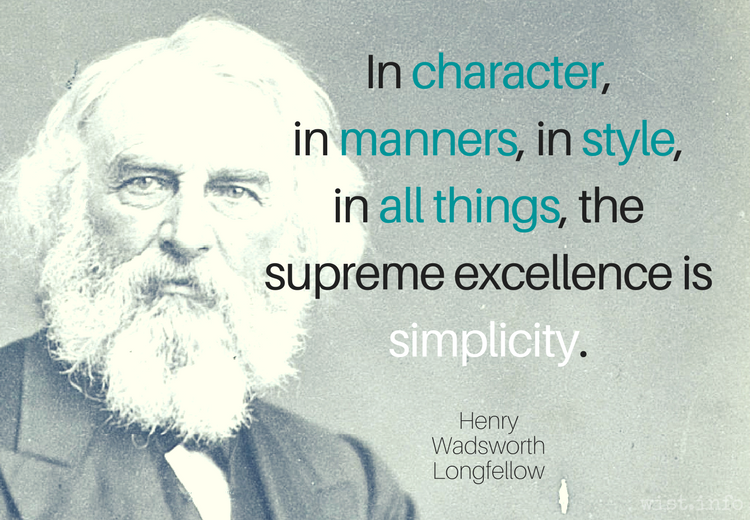
In character, in manners, in style, in all things, the supreme excellence is simplicity.
Respectfulness, without the rules of propriety, becomes laborious bustle; carefulness, without the rules of propriety, becomes timidity; boldness, without the rules of propriety, becomes insubordination; straightforwardness, without the rules of propriety, becomes rudeness.
[恭而無禮則勞、愼而無禮則葸、勇而無禮則亂、直而無禮則絞。]
Confucius (c. 551- c. 479 BC) Chinese philosopher, sage, politician [孔夫子 (Kǒng Fūzǐ, K'ung Fu-tzu, K'ung Fu Tse), 孔子 (Kǒngzǐ, Chungni), 孔丘 (Kǒng Qiū, K'ung Ch'iu)]
The Analects [論語, 论语, Lúnyǔ], Book 8, verse 2 (8.2.1) (6th C. BC – AD 3rd C.) [tr. Legge (1861)]
(Source)
(Source (Chinese)). Brooks (below) believes this text was interpolated into Book 8 at the time that Book 14 was collected. Other translations:Without the Proprieties, we have these results: for deferential demeanour, a worried one; for calm attentiveness, awkward bashfulness; for manly conduct, disorderliness; for straightforwardness, perversity.
[tr. Jennings (1895)]Earnestness without judgment becomes pedantry; caution without judgment becomes timidity; courage without judgment leads to crime; uprightness without judgment makes men tyrannical.
[tr. Ku Hung-Ming (1898)]Courtesy uncontrolled by the laws of good taste becomes labored effort, caution uncontrolled becomes timidity, boldness uncontrolled becomes recklessness, and frankness uncontrolled become effrontery.
[tr. Soothill (1910)]Respect without rules of procedure becomes laborious fuss: scrupulosity without rules of procedure, timidity (fear to show the thought); boldness without such rules breeds confusion; directness without rules of procedure becomes rude.
[tr. Pound (1933)]Courtesy not bounded by the prescriptions of ritual becomes tiresome. Caution not bounded by the prescriptions of ritual becomes timidity, daring becomes turbulence, inflexibility becomes harshness.
[tr. Waley (1938)]Not to follow the rites in being modest is annoyance. Not to follow them in exercising care is timidity. Not to follow them in acts of bravery is confusion. Not to follow them in our uprightness is brusqueness.
[tr. Ware (1950)]Unless a man has the spirit of the rites, in being respectful he will wear himself out, in being careful he will become timid, in having courage he will become unruly, and in being forthright he will become intolerant.
[tr. Lau (1979)]If one is courteous but does without ritual, then one dissipates one's energies; if one is cautious but does without ritual, then one becomes timid; if one is bold but does without ritual, then one becomes reckless; if one is forthright but does without ritual, then one becomes rude.
[tr. Dawson (1993)]Without ritual, courtesy is tiresome; without ritual, prudence is timid; without ritual, bravery is quarrelsome; without ritual, frankness is hurtful.
[tr. Leys (1997)]Respectfulness without the rituals becomes laboriousness; discretion without the rituals becomes apprehensiveness; courage without the rituals becomes rebelliousness; straightforwardness without the rituals becomes impetuosity.
[tr. Huang (1997)]One would be tired if one is humble but not polite; One would be week if one is cautious but not polite; One would be foolhardy if one is brave but not polite; One would be caustic if one is frank but not polite.
[tr. Cai/Yu (1998), #190]Deference unmediated by observing ritual propriety [li] is lethargy; caution unmediated by observing ritual propriety is timidity; boldness unmediated by observing ritual propriety is rowdiness; candor unmediated by observing ritual propriety is rudeness.
[tr. Ames/Rosemont (1998)]If he is respectful without propriety, he becomes wearisome. If he is careful without propriety, he becomes finicky. If he is brave without propriety, he becomes disruptive. If he is upright without propriety, he becomes censorious.
[tr. Brooks/Brooks (1998)]Reverence becomes tedium without Ritual, and caution becomes timidity. Without Ritual, courage becomes recklessness, and truth becomes intolerance.
[tr. Hinton (1998)]If you are respectful but lack ritual you will become exasperating; if you are careful but lack ritual you will become timid; if you are courageous but lack ritual you will become unruly; and if you are upright but lack ritual you will become inflexible.
[tr. Slingerland (2003)]Courtesy without ritual becomes labored; caution without ritual becomes timidity; daring without ritual becomes riotousness; directness without ritual becomes obtrusiveness.
[tr. Watson (2007)]Unless a man acts according to the spirit of the rites, in being respectful, he will tire himself out; in being cautious, he will become timid; in being brave, he will become unruly; in being forthright, he will become derisive.
[tr. Chin (2014)]

A candor affected is a dagger concealed.
[ἐπιτήδευσις δὲ ἁπλότητος σκάλμη ἐστίν.]
Marcus Aurelius (AD 121–180) Roman emperor (161–180), Stoic philosopher
Meditations [To Himself; Τὰ εἰς ἑαυτόν], Book 11, ch. 15 (11.15) (AD 161-180) [tr. Staniforth (1964)]
(Source)
Depending on the source material, the weapon reference is either from a native Thracian (foreign) weapon (σκάλμη) -- thus translators who use "stiletto," etc. -- or a proverbial "crooked stick" (σκαμβή), referring to a Greek proverb "You can't make a crooked stick straight." See 1, 2, 3, 4 for more details.
(Source (Greek)). Other translations:But the affectation of simplicity is nowise laudable.
[tr. Casaubon (1634), 11.14]But on the other side, an Affectation of being Real, is an untoward pretence.
[tr. Collier (1701)]The ostentation of simplicity is like a dagger for insidious designs.
[tr. Hutcheson/Moor (1742)]In short, the affectation of simplicity is often a concealed dagger.
[tr. Graves (1792)]But the affectation of simplicity is like a crooked stick.
[tr. Long (1862)]An affectation of sincerity is a very dagger.
[tr. Collier/Zimmern (1887)]But the affectation of simpleness is a dagger in the sleeve.
[tr. Rendall (1898)]The ostentation of straightforwardness is the knife under the cloak.
[tr. Hutcheson/Chrystal (1902)]A calculated simplicity is a stiletto.
[tr. Haines (Loeb) (1916)]But the affectation of simplicity is like a razor.
[tr. Farquharson (1944)]But the mere pretence of simplicity is like an open blade.
[tr. Hard (1997 ed.), (2011 ed.)]But false straightforwardness is like a knife in the back.
[tr. Hays (2003)]Calculated honesty is a stiletto.
[tr. Hammond (2006)]A contrived simplicity is like a dagger.
[tr. Needleman/Piazza (2008)]
Nothing astonishes men so much as common sense and plain dealing.
Ralph Waldo Emerson (1803–1882) American essayist, lecturer, poet
Essay (1841), “Art,” Essays: First Series, No. 12
(Source)