THE DOCTOR: Which is the quickest way out of here?
(Each of the women at the fountain point in different directions.)
THE DOCTOR: Yes, well, that’s democracy for you. Come on.
Doctor Who (1963–1989) British science fiction television series, original run (BBC)
19×01 “Castrovalva,” Part 3 (1982-01-11) [w. Christopher H. Bidmead]
(Source)
(Source (Video); dialogue confirmed)
Quotations about:
answer
Note not all quotations have been tagged, so Search may find additional quotes on this topic.

LEELA: Never mind, Doctor, I’ve found the answer.
THE DOCTOR: You have?
LEELA: Knife them in the neck!
Doctor Who (1963–1989) British science fiction television series, original run (BBC)
15×02 “The Invisible Enemy,” Part 4 (1977-10-22) [w. Bob Baker, Dave Martin]
(Source)
(Source (Video), dialog verified). Sometimes paraphrased: "Don't worry, Doctor. I found the answer: knife them in the neck!"
DOCTOR: Ah! (shows her an odd device) Eureka! Do you know what that is?
LEELA: You ask me so that you can tell me.
DOCTOR: That’s right.
Doctor Who (1963–1989) British science fiction television series, original run (BBC)
14×06 “The Talons of Weng-Chiang,” Part 5 (1977-03-26) [w. Robert Holmes]
(Source)
(Source (Video); dialogue confirmed)
I mean there’s no single answer that will solve all our future problems. There’s no magic bullet. Instead there are thousands of answers — at least. You can be one of them if you choose to be.
Octavia Butler (1947–2006) American writer
Essay (2000-05), “A Few Rules for Predicting the Future,” Essence Magazine
(Source)

I have for some time thought that a few of our present day ills stem from this childish faith in the existence of perfect answers. It requires a degree of maturity to realize that all solutions are partial ones.
Hyman Rickover (1900–1986) Polish-American naval engineer, admiral [b. Chaim Gdala Rykower]
Speech (1954-03-16), “Administering a Large Military Development Project,” US Naval Postgraduate School, Monterey, California
(Source)
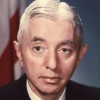
CALVIN: Why does ice float?
CALVIN’S DAD: Because it’s cold. Ice wants to get warm, so it goes to the top of liquids in order to be nearer to the sun.
CALVIN: Is that true?
CALVIN’S DAD: Look it up and find out.
CALVIN: (stomping off, frowning) I should just look stuff up in the first place.
CALVIN’S DAD: You can learn a lot, talking to me.
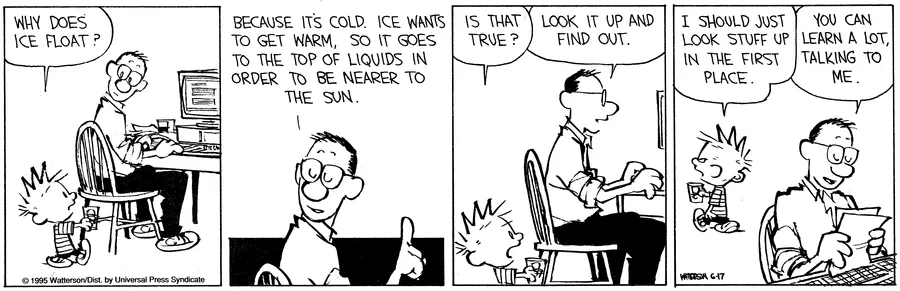

Why? Because. The most terrible of motives, the most unanswerable of retorts — Because.
[Pourquoi ? Parce que. Le plus terrible des motifs et la plus indiscutable des réponses: Parce que.]
Victor Hugo (1802–1885) French writer, journalist, human rights activist, politician
Les Misérables, Part 4 “Saint Denis,” Book 6 “Little Gavroche,” ch. 1 (4.6.1) (1862) [tr. Hapgood (1887)]
(Source)
On Mme Thenardier hating her sons.
(Source (French)). Alternate translations:Why? Because. The most terrible of motives and the most unanswerable of responses: Because.
[tr. Wilbour (1862)]Why? because she did. The most terrible of motives and most indisputable of answers is, Because.
[tr. Wraxall (1862)]Why? Because. The most terrible and unanswerable of reasons.
[tr. Denny (1976)]Why? Because. The most terrible of motives and the most unanswerable of responses: Because.
[tr. Wilbour/Fahnestock/MacAfee (1987)]Why? Because. The most terrible of motives, the most indisputable of responses. Because.
[tr. Donougher (2013)]
You can see how infinitely laborious and fruitless it would be to try to refute every objection they offer, when they have resolved never to think before they speak provided that somehow or other they contradict our arguments.
[Quorum dicta contraria si totiens uelimus refellere, quotiens obnixa fronte statuerint non cogitare quid dicant, dum quocumque modo nostris disputationibus contradicant, quam sit infinitum et aerumnosum et infructuosum uides.]
Augustine of Hippo (354–430) Christian church father, philosopher, saint [b. Aurelius Augustinus]
City of God [De Civitate Dei], Book 2, ch. 1 (2.1) (AD 412-416) [tr. Bettenson (1972)]
(Source)
(Source (Latin)). Other translations:If we should bind ourselves to give an answer to every contradiction that their impudence will thrust forth (how falsely they care not, for they do but make a show of opposition into our assertions), you see what a trouble it would be, how endless, and how fruitless.
[tr. Healey (1610)]Now, if we were to propose to confute their objections as often as they with brazen face chose to disregard our arguments, and so often as they could by any means contradict our statements, you see how endless, and fruitless, and painful a task we should be undertaking.
[tr. Dods (1871)]You can easily see what an endless, wearisome, and fruitless task it would be, if I were to refute all the unconsidered objections of people who pig-headedly contradict everything I say.
[tr. Zema/Walsh (1950)]If we were bound to refute their objections every time they make their bull-headed resolve not to consider the meaning of their words as long as they deny our arguments, no matter how, you see how endless and wearisome and unprofitable it would be.
[tr. McCracken (Loeb) (1957)]If we resolved to refute their contrary arguments as often as they resolve obstinately to contradict our reasoning in whatever way they can, without considering the truth of what they say, you see what an infinite and toilsome and fruitless task we should have.
[tr. Dyson (1998)]So you see how endlessly futile and fruitless it would be if we wanted to refute their objections every time they obstinately resolved not to think through what they say but merely to speak, just so long as they contradict our arguments in any way they can.
[tr. Babcock (2012)]

Questions about the reproductive system should be answered as naturally as ones about the railroad system.
Marcelene Cox (1900–1998) American writer, columnist, aphorist
“Ask Any Woman” column, Ladies’ Home Journal (1946-02)
(Source)

The best way to get the right answer on the Internet is not to ask a question; it’s to post the wrong answer.
Howard G. "Ward" Cunningham (b. 1949) American computer scientist
“Cunningham’s Law”
(Source)
Cunningham himself denies having said this. It was attributed to him (and so named) by Steven McGeady in the early 1980s.

A good question is never answered. It is not a bolt to be tightened into place, but a seed to be planted and to bear more seed, toward the hope of greening the landscape of an idea. The difference between a seed and an inert speck can be hard to see, but only one of them will grow and return itself in kind and be multiplied.
John Ciardi (1916–1986) American poet, writer, critic
Manner of Speaking (1972)
The highest truth is daiji, translated as dai jiki in Chinese scriptures. This is the subject of the question the emperor asked Bodhidharma: “What is the First Principle?” Bodhidharma said, “I don’t know.” “I don’t know” is the First Principle.
Shunryū Suzuki (1905–1971) Japanese Zen Buddhist master
Lotus Sutra No. 6 lecture, Tassajara, California (Feb 1968)
(Source)

SIR HUMPHREY: Well, Minister, if you ask me for a straight answer, then I shall say that, as far as we can see, looking at it by and large, taking one thing with another in terms of the average of departments, then in the final analysis it is probably true to say, that at the end of the day, in general terms, you would probably find that, not to put too fine a point on it, there probably wasn’t very much in it one way or the other. As far as one can see, at this stage.
Jonathan Lynn (b. 1943) English actor, comedy writer, director
Yes Minister, 01×05 “The Writing on the Wall” (BBC2 Television) (1980-03-24) [with Anthony Jay
An answer is invariably the parent of a great family of new questions.
John Steinbeck (1902–1968) American writer
The Log from the Sea of Cortez, ch. 16, March 25 (1951)
(Source)
To really ask is to open the door to the whirlwind. The answer may annihilate the question and the questioner.
Anne Rice (b. 1941) American author [b. Howard Allen Frances O'Brien]
The Vampire Lestat, Part 5, ch. 3 (1992)
(Source)

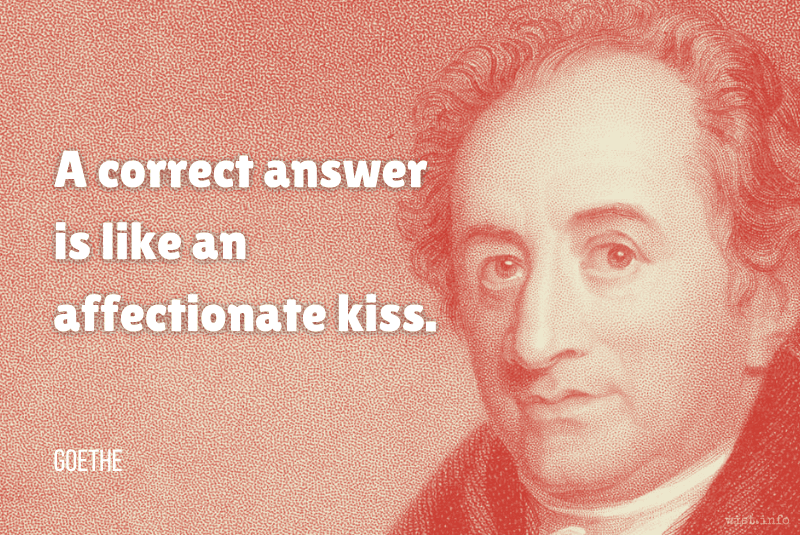
A correct answer is like an affectionate kiss.
[Eine richtige Antwort ist wie ein lieblicher Kuß.]
Johann Wolfgang von Goethe (1749–1832) German poet, statesman, scientist
Sprüche in Prosa: Maximen und Reflexionen [Proverbs in Prose: Maxims and Reflections] (1833) [tr. Mann (1948)]
(Source)
See Proverbs 24:26.
(Source (German)). Other translation:A right answer is like a loving kiss.
[tr. Stopp (1995), "Posthumous," "On Literature and Life," #888]
There are answers which, in turning away wrath, only send it to the other end of the room.
George Eliot (1819–1880) English novelist [pseud. of Mary Ann Evans]
Middlemarch, Book 3, ch. 24 (1871)
(Source)
An allusion to Proverbs 15:1 "A soft answer turneth away wrath."
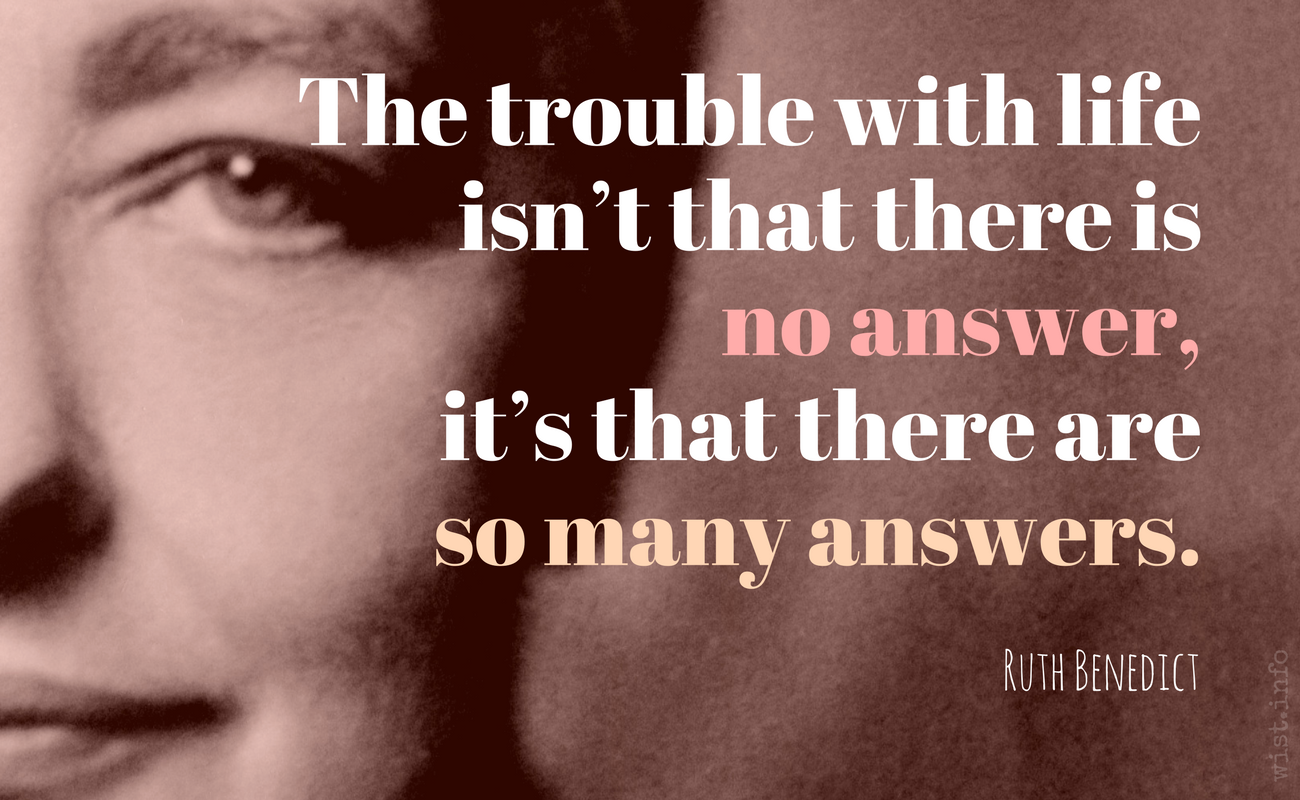
The trouble with life isn’t that there is no answer, it’s that there are so many answers.
Ruth Benedict (1887–1947) American anthropologist
An Anthropologist at Work, Journal Entry, 7 Jan 1913 (1959)

“My lord,” said Lar, falling back upon the single statement that a servant may always rely upon when any other response is fraught with peril.
Steven Brust (b. 1955) American writer, systems programmer
The Lord of Castle Black (2003)
I doubt if there is in the world a single problem, whether social, political, or economic, which would not find ready solution if men and nations would rule their lives according to the plain teaching of the Sermon on the Mount.
Franklin Delano Roosevelt (1882–1945) American lawyer, politician, statesman; US President (1933–45)
Letter (1938-06-15) to Rev. Daniel Poling, “Greeting to the World’s Christian Endeavor Convention in Melbourne, Australia”
(Source)
“I suppose there are two views about everything,” said Mark.
“Eh? Two views? There are a dozen views about everything until you know the answer. Then there’s never more than one.”
C. S. Lewis (1898–1963) English writer, literary scholar, lay theologian [Clive Staples Lewis]
That Hideous Strength (1945)
That is the essence of science: ask an impertinent question, and you are on the way to a pertinent answer.
Jacob Bronowski (1908–1974) Polish-English humanist and mathematician
The Ascent of Man ch. 4 (1973)
Sir, calumnies are answer’d best with silence.
Most people today don’t want honest answers insofar as honest means unpleasant or disturbing. They want a soft answer that turneth away anxiety. They want answers that are, in effect, escapes.
Louis Kronenberger (1904–1980) American critic, novelist, biographer
“Unbrave New World,” The Cart and the Horse (1964)
An allusion to Proverbs 15:1 "A soft answer turneth away wrath."
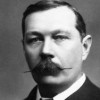
How often have I said to you that when you have eliminated the impossible, whatever remains, however improbable, must be the truth?
Arthur Conan Doyle (1859–1930) British writer and physician
Story (1890-02), “The Sign of the Four,” ch. 6 [Holmes], Lippincott’s Monthly Magazine, Vol. 45 (US) / 1 (UK)
(Source)
The first appearance of the phrase in its most quoted form. However, earlier in the story, chapter 1, Holmes tells Watson:Eliminate all other factors, and the one which remains must be the truth.
Similar expressions occur in The Adventures of Sherlock Holmes ("The Adventure of the Beryl Coronet"), The Memoirs of Sherlock Holmes ("Silver Blaze"), The Return of Sherlock Holmes ("The Adventure of the Priory School"), His Last Bow ("The Adventure of the Bruce-Partington Plans"), and The Case-Book of Sherlock Holmes ("The Adventure of the Blanched Soldier").
The original publication, and Doyle's manuscript (along with many other iterations across media) use "The Sign of the Four" as the title, while others (including the first book publications) use "The Sign of Four." The five-word form is used most commonly in the story, but the four-word form does show up. (More info.)
Published in novel form as The Sign of Four (1890-10).
Life is made up of constant calls to action, and we seldom have time for more than hastily contrived answers; to follow one’s hunch is usually better than lying doggo, and rough generalizations that have worked well in the past easily easily take on the authority of universals. It does violence to our inner being to be obliged to give a hearing to opinions widely at variance with those we are accustomed to, and to come to a conclusion unweighted by desire.
Learned Hand (1872–1961) American jurist
“At Fourscore,” speech, Harvard Club of New York (1952-01-18)
(Source)
First published in the Harvard Alumni Bulletin (23 Feb 1952).
I was gratified to be able to answer promptly, and I did. I said I didn’t know.
Mark Twain (1835–1910) American writer [pseud. of Samuel Clemens]
Life on the Mississippi, ch. 6 (1883)
“From what I remember,” replied Crowley, thoughtfully, “– and we were never actually on what you might call speaking terms — He wasn’t exactly one for a straight answer. In fact, in fact, He’d never answer at all. He’d just smile, as if He knew something that you didn’t.”
“And of course that’s true,” said the angel. “Otherwise, what’d be the point?”Terry Pratchett (1948–2015) English author
Good Omens, 6. “Saturday” (1990) [with Neil Gaiman]
(Source)
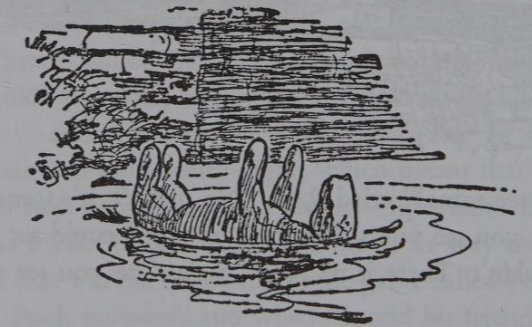
“Eeyore, what are you doing there?” said Rabbit.
“I’ll give you three guesses, Rabbit. Digging holes in the ground? Wrong. Leaping from branch to branch of a young oak-tree? Wrong. Waiting for somebody to help me out of the river? Right. Give Rabbit time, and he’ll always get the answer.”A. A. Milne (1882–1956) English poet and playwright [Alan Alexander Milne]
House at Pooh Corner, ch. 6 “Eeyore Joins the Game” (1928)
(Source)
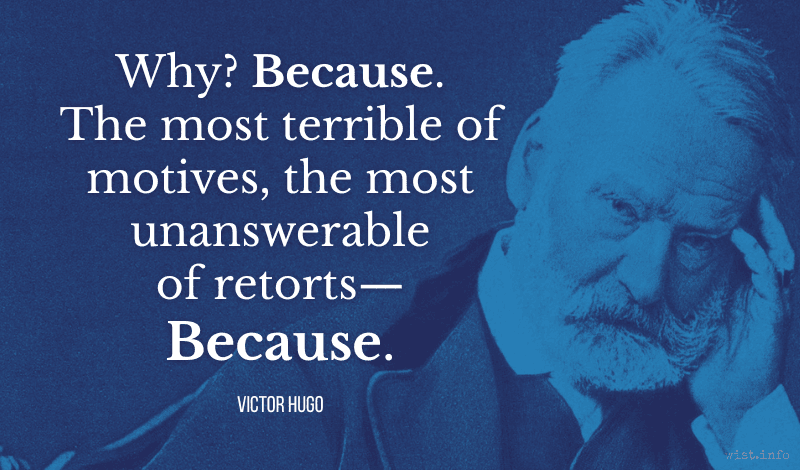
HOBBES: Did you ask your Mom if you could jump off the roof?
CALVIN: Questions I know the answers to I don’t need to ask, right?