

MARCUS: The power of separating the intellect from the senses, and reason from instinct, is characteristic of the highest genius.
[Magni autem est ingenii sevocare mentem a sensibus et cogitationem ab consuetudine abducere.]
Marcus Tullius Cicero (106–43 BC) Roman orator, statesman, philosopher
Tusculan Disputations [Tusculanae Disputationes], Book 1, ch. 16 (1.16) / sec. 38 (1.38) (45 BC) [ed. Harbottle (1897)]
(Source)
On being able to consider the immortality a disembodied soul without instinctively visualizing animate human bodies in an afterlife.
(Source (Latin)). Alternate translations:Now it is the part of a noble Wit, to call the Mind off from the Senses, and take it out of the common Road.
[tr. Wase (1643)]To withdraw the mind from sensual objects, and abstract our thoughts from what we are accustomed to, is the property of a great genius.
[tr. Main (1824)]But it is the part of great genius to call off the mind from the senses, and to abstract the thought from custom.
[tr. Otis (1839)]To withdraw the mind from sensual objects, and abstract our thoughts from what we are accustomed to, is an attribute of great genius.
[tr. Yonge (1853)]It is the work of surpassing genius to separate the mind from the senses, and to divert thought from its accustomed channels.
[tr. Peabody (1886)]Now it is an attribute of great genius; to distract the mind from the senses, and to withdraw the thoughts from every-day associations.
[tr. Black (1889)]It calls for great intelligence to separate the mind from the senses and to sever thought from mere habit.
[tr. Douglas (1985)]Still, it takes a great talent to isolate the mind from the senses and to redirect thought from its habitual patterns.
[tr. Habinek (1996)]Now, it requires considerable intelligence to separate the mind from the senses and to divide thought from mere habit.
[tr. Davie (2017)]
Quotations about:
instinct
Note not all quotations have been tagged, so Search may find additional quotes on this topic.
In every human Breast, God has implanted a Principle, which we call Love of Freedom; it is impatient of Oppression, and pants for Deliverance.
Phyllis Wheatley (1753–1784) African-American poet, manumitted (1773) enslaved person [also "Phillis" and/or "Wheatly"]
Letter (1774-02-11) to Samson Occom
(Source)
Regarding slavery. First printed in the Connecticut Gazette (1774-03-11) through Rev. Occom, her longtime friend.
It’s one of those weird truths you learn early on as police that quite a high percentage of the public have all the survival instinct of a moth in a candle factory. They run the wrong way, they refuse to move, some will run toward the danger, and others will instantly whip out their phones and take footage.

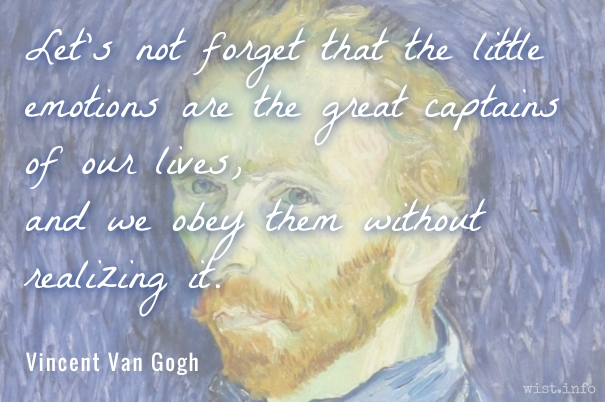
Let’s not forget that the little emotions are the great captains of our lives, and we obey them without realizing it.

The only difference between me and most people is that I’m perfectly aware that all my important decisions are made for me by my subconscious. My frontal lobes are just kidding themselves that they decide anything at all. All they do is think up reasons for the decisions that are already made.
Rex Stout (1886–1975) American writer
In “Author Rex Stout vs. the FBI,” Interview with Sandra Schmidt, Life (10 Dec 1965)
To live is like to love — all reason is against it, and all healthy instinct for it.
Samuel Butler (1835–1902) English novelist, satirist, scholar
The Note-Books of Samuel Butler, “Life and Love” (1912)
(Source)
Life is like music, it must be composed by ear, feeling and instinct, not by rule. Nevertheless one had better know the rules, for they sometimes guide in doubtful cases, though not often.
Samuel Butler (1835–1902) English novelist, satirist, scholar
The Note-Books of Samuel Butler, ch. 1, “Life” (1912)
(Source)