What do we owe our parents? No man can owe love; none can owe obedience. We owe, I think, chiefly pity; for we are the pledge of their dear and joyful union, we have been the solicitude of their days and the anxiety of their nights, we have made them, though by no will of ours, to carry the burthen of our sins, sorrows, and physical infirmities; and too many of us grow up at length to disappoint the purpose of their lives and requite their care and piety with cruel pangs.
Robert Louis Stevenson (1850–1894) Scottish essayist, novelist, poet
Essay (1880-01/02?), “Reflections and Remarks on Human Life,” § 2.2 “Parent and Child”
(Source)
A collection of aphorisms and musings, first published in the Edinburgh Edition of his Works, vol. 28 (1898).
Quotations about:
parents
Note not all quotations have been tagged, so Search may find additional quotes on this topic.
I have no sympathy with the old idea that children owe such immense gratitude to their parents that they can never fulfill their obligations to them. I think the obligation is all on the other side.
Elizabeth Cady Stanton (1815–1902) American social activist, abolitionist, woman's suffragist
Journal (1880-11-12)
(Source)
Nothing exerts a stronger psychic effect upon the human environment, and especially upon children, than the life which the parents have not lived.
Carl Jung (1875–1961) Swiss psychologist
Lecture (1929-06), “Paracelsus,” Literary Club of Zurich, Paracelsus House, Einsiedeln, Schwyz, Switzerland [tr. Hull (1966)]
(Source)
(Publication notes.) Collected in The Spirit in Man, Art, and Literature, Part 1, "Paracelsus," ¶ 3 (1929).
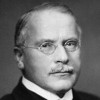
It is not a bad thing that children should occasionally, and politely, put parents in their place.
[Il n’est pas mauvais que les enfants remettent de temps en temps, avec politesse, les parents à leur place.]
Sidonie-Gabrielle Colette (1873–1954) French writer
My Mother’s House [La Maison de Claudine], “The Priest on the Wall [Le curé sur le mur]” (1922) [tr. Troubridge/McLeod (1949)]
(Source)
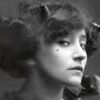
Always obey your parents, when they are present. This is the best policy in the long run, because if you don’t, they will make you. Most parents think they know better than you do, and you can generally make more by humoring that superstition than you can by acting on your own better judgment.
Mark Twain (1835–1910) American writer [pseud. of Samuel Clemens]
Essay (1882), “Advice to Youth”
(Source)
A satirical essay sometimes labeled as a speech to the Boston Saturday Morning Club (1882-04-15).
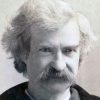
Parents of young children should realize that few people, and maybe no one, will find their children as enchanting as they do.
Barbara Walters (1929–2022) American broadcast journalist
How to Talk with Practically Anybody About Practically Anything, ch. 4 (1970)
(Source)

With him for a sire and her for a dam,
What should I be but just what I am?Edna St. Vincent Millay (1892–1950) American poet
Poem (1920-11), “The Singing-Woman from the Wood’s Edge,” Vanity Fair, Vol. 14, No. 3
(Source)
Collected in A Few Figs from Thistles (1921).
"Singing-Woman" is usually hyphenated in collections, but in Vanity Fair it was rendered "Singin' Woman" and in the original publication in Figs as "Singingwoman".
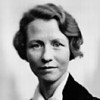
They exchanged rings. The rings were a matching pair of gold bands, left to Daniel by his parents, who had known he could never afford to buy his own. It gave her pause for thought, how after all these years, somehow, the dead still looked after the living.
Joan Slonczewski (b. 1956) American microbiologist and writer
The Wall around Eden, ch. 25 (1989)
(Source)

ORESTES: Ye Gods! There’s no art to tell a decent man,
since generations work haphazardly.
I’ve encountered worthless men, the sons
of noble fathers; good men born from bad;
and I’ve seen hunger in a rich man’s mind,
a poor man’s body housing thoughts sublime.[ὈΡΈΣΤΗΣ: φεῦ:
οὐκ ἔστ᾽ ἀκριβὲς οὐδὲν εἰς εὐανδρίαν:
ἔχουσι γὰρ ταραγμὸν αἱ φύσεις βροτῶν.
ἤδη γὰρ εἶδον ἄνδρα γενναίου πατρὸς
τὸ μηδὲν ὄντα, χρηστά τ᾿ ἐκ κακῶν τέκνα,
λιμόν τ᾿ ἐν ἀνδρὸς πλουσίου φρονήματι,
γνώμην δὲ μεγάλην ἐν πένητι σώματι.]Euripides (485?-406? BC) Greek tragic dramatist
Electra [Ἠλέκτρα], l. 367ff (c. 420 BC) [tr. Wilson (2016)]
(Source)
(Source (Greek)). Other translations:There is no certain mark of generous souls:
For in the tempers of mankind prevails
A strange confusion. I have seen the son
Of a great father dwindle into nothing.
And virtuous children spring from wicked Sires;
Among the rich a mean contracted spirit
Have I discover'd, and the poor man's breast
Withi most exalted sentiments inspir'd.
[tr. Wodhull (1809)]Ah! there is no sure mark to recognize a man's worth; for human nature hath in it an element of confusion. For I have seen ere now the son of a noble sire prove himself a worthless knave, and virtuous children sprung from evil parents; likewise dearth in a rich man's spirit, and in a poor man's frame a mighty soul.
[tr. Coleridge (1891)]Alas! there is no sure mark of manliness; for the natures of mortals exhibit a confusion. For already have I seen a man who was naught sprung from a noble sire, and good children [sprung] from bad [fathers[,. and hunger in the spirit of a rich man, and a great mind in a poor body.
[tr. Buckley (1892)]Lo, there is no sure test for manhood’s worth:
For mortal natures are confusion-fraught. --
I have seen ere now a noble father’s son
Proved nothing-worth, seen good sons of ill sires,
Starved leanness in a rich man’s very soul,
And in a poor man’s body a great heart.
[tr. Way (1896)]How dark lies honour hid! And what turmoil
In all things human: sons of mighty men
Fallen to naught, and from ill seed again
Good fruit: yea, famine in the rich man's scroll
Writ deep, and in poor flesh a lordly soul.
[tr. Murray (1905)]Ah! There is no exact way to test a man's worth; for human nature has confusion in it. I have seen before now the son of a noble father worth nothing, and good children from evil parents; famine in a rich man's spirit, and a mighty soul in a poor man's body.
[tr. Coleridge (1938 ed.)]It is impossible to judge a man’s virtue with accuracy. There’s always great confusion in the nature of mortals. I, myself, have seen worthless children born of a virtuous man and from evil parents born brilliant children. I have seen a small, poor mind in a wealthy man and in the soul of a poor man, a great one.
[tr. Theodoridis (2006)]Well, nothing is precise
when it comes to how a man is valued --
men’s natures are confusing. Before this,
I’ve seen a man worth nothing, yet he had
a noble father; I’ve known evil parents
with outstanding children, seen famine
in a rich man’s mind and a great spirit
in a poor man’s body.
[tr. Johnston (2009)]I have known a man of a noble father who turns out
To be nothing while powerful men can rise from the low.
I have seen emptiness in a rich man’s thought
And great judgement in a poor person’s frame.
[tr. @sententiq (2020)]
Adorable children are considered to be the general property of the human race. (Rude children belong strictly to their mothers.)
Judith Martin (b. 1938) American author, journalist, etiquette expert [a.k.a. Miss Manners]
Miss Manners’ Guide to Rearing Perfect Children, ch. 2 “The Nursery,” “Crade Courtesy” (1984)
(Source)
Children when they are little make parents fooles, when they are great they make them mad.
George Herbert (1593–1633) Welsh priest, orator, poet.
Jacula Prudentum, or Outlandish Proverbs, Sentences, &c. (compiler), # 939 (1640 ed.)
(Source)
Parents often talk about the younger generation as if they didn’t have anything to do with it.
Haim Ginott (1922–1973) Israeli-American school teacher, child psychologist, psychotherapist [b. Haim Ginzburg]
(Attributed)
Widely attributed to Ginott, but I cannot find it in his printed works or any primary citation.
Parents lend children their experience and a vicarious memory; children endow their parents with a vicarious immortality.
George Santayana (1863–1952) Spanish-American poet and philosopher [Jorge Agustín Nicolás Ruíz de Santayana y Borrás]
The Life of Reason, “Reason in Society,” ch. 2 “The Family” (1905-06)
(Source)
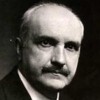
Now and in the time to be, try to be kind to your parents. If this sounds too close to “Honor thy mother and father” for your comfort, so be it. All I am trying to say is try not to rebel against them, for, in all likelihood, they will die before you do, so you can spare yourselves at least this source of guilt if not of grief. If you must rebel, rebel against those who are not so easily hurt. Parents are too close a target (so, by the way, are sisters, brothers, wives or husbands); the range is such that you can’t miss.
Joseph Brodsky (1940–1996) Russian-American poet, essayist, Nobel laureate, US Poet Laureate [Iosif Aleksandrovič Brodskij]
“Speech at the Stadium,” Commencement Address, University of Michigan (18 Dec 1988)
(Source)
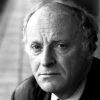
Let children read whatever they want and then talk about it with them. If parents and kids can talk together, we won’t have as much censorship because we won’t have as much fear. The fear that children’s values will change because they are exposed to other values isn’t valid if there is communication between parent and child.
Judy Blume (b. 1938) American writer
“Blume Speaks Out on Speaking Out,” Interview with Barbara Karlin, Los Angeles Times (18 Oct 1981)
(Source)
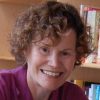
Life has a tendency to obfuscate and bewilder,
Such as fating us to spend the first part of our lives being embarrassed by our parents and the last part being embarrassed by our childer.
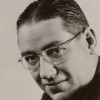
The man who has nothing to boast of but his illustrious ancestry, is somewhat like a potatoe, the only good thing is under ground.
Thomas Overbury (1581–1613) English poet
Characters (1612)
(Source)
Referenced in John Ireland, Letters and Poems by the Late Mr. John Henderson (1786).Variant: "The man who has not anything to boast of but his illustrious ancestors, is like a potatoe, the only good belonging to him is under ground." -- The Lady's Monthly Museum (June 1807).

Schoolmasters and parents exist to be grown out of.
John Wolfenden (1906–1985) British educator, author
In Sunday Times (London) (13 Jul 1958)
When one hears the argument that marriage should be indissoluble for the sake of children, one cannot help wondering whether the protagonist is really such a firm friend of childhood.
The first half of our lives is ruined by our parents and the second half by our children.
Clarence Darrow (1857–1938) American lawyer
(Attributed)
The first duty towards children is to make them happy. If you have not made them happy, you have wronged them. No other good they may get can make up for that.
Charles Buxton (1823–1871) English brewer, philanthropist, writer, politician
Notes of Thought (1873)
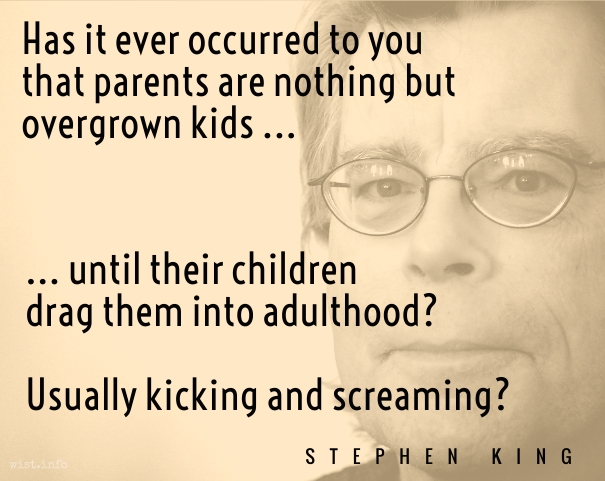
Has it ever occurred to you … that parents are nothing but overgrown kids until their children drag them into adulthood? Usually kicking and screaming?
Stephen King (b. 1947) American author
Christine, Part 1, ch. 3 (1983)

There isn’t a child who hasn’t gone out into the brave new world who eventually doesn’t return to the old homestead carrying a bundle of dirty clothes.
We cannot blame the schools alone for that dismal decline in SAT verbal scores. […] What happens at home really matters. And when our kids come home from school, do they pick up a book, or do they sit glued to the tube watching music videos? Parents: don’t make the mistake of thinking your kids only learn from 9 a.m. to 3 p.m. You are and always will be their first teachers.
George H. W. Bush (1924–2018) American politician, diplomat, US President (1989–1993)
Speech, Lewiston Comprehensive High School, Maine (3 Sep 1991)
(Source)
Often misattributed to his son, George W. Bush.
Don’t take up a man’s time talking about the smartness of your children; he wants to talk to you about the smartness of his children.
Edgar Watson "Ed" Howe (1853–1937) American journalist and author [E. W. Howe]
Country Town Sayings (1911)
The best thing to give to your enemy is forgiveness; to an opponent, tolerance; to a friend, your heart; to your child, a good example; to a father, deference; to your mother, conduct that will make her proud of you; to yourself, respect; to all men, charity.
Clara Lucas Balfour (1808–1878) English novelist, lecturer, temperance campaigner
Sunbeams for All Seasons: Counsels, Cautions, and Precepts (1861 ed.)
Wise children always choose a mother who was a shocking flirt in her maiden days, and so had several offers before she accepted their fortunate papa.
J. M. Barrie (1860–1937) Scottish novelist and dramatist [James Matthew Barrie]
The Little White Bird, ch. 19 “Joey,” Scribner’s Magazine, Vol. 32 (1902-11)
(Source)
This portion of the serial is in ch. 22 of the fully collected novel (1902).
CALVIN: If Mom and Dad cared about me at all, they’d buy me some infra-red nighttime vision goggles.

Children aren’t happy with nothing to ignore,
And that’s what parents were created for.
Psychiatry enables us to correct our faults by confessing our parents’ shortcomings.
Lawrence J. Peter (1919–1990) American educator, management theorist
(Attributed)
Children have never been very good at listening to their elders, but they have never failed to imitate them.