FORBIDDEN, pp. Invested with a new and irresistible charm.
Ambrose Bierce (1842–1914?) American writer and journalist
“Forbidden,” “Devil’s Dictionary” column, San Francisco Wasp (1884-12-13)
(Source)
Not collected in later books.
Quotations about:
attractiveness
Note not all quotations have been tagged, so Search may find additional quotes on this topic.

Dear love, dear life, you do not need adorning —
hair curled, silk rustling down your slender side.
Not by that heavy scent, those foreign bangles,
is this your natural beauty magnified.
No. Let that beauty shine in its own brilliance,
your charm, your grace, transcend what gold can buy.
Believe me, art is needless. You are lovely,
and love goes naked nor would trick the eye.[Quid iuvat ornato procedere, vita, capillo
et tenuis Coa veste movere sinus,
aut quid Orontea crines perfundere murra,
teque peregrinis vendere muneribus,
naturaeque decus mercato perdere cultu,
nec sinere in propriis membra nitere bonis?
Crede mihi, non ulla tuaest medicina figurae:
nudus Amor formam non amat artificem.]Propertius (50–16 BC) Roman elegiac poet [Sextus Propertius]
Elegies, Book 1, Elegy 2, l. 1ff (1.2.1-8) [tr. Carrier (1963)]
(Source)
(Source (Latin)). Other translations:Why walk, my love, with locks bedeck'd with gold?
And rustle Coan robes with silken fold?
Ah, why with Syrian unguents drench thy hair,
Trick'd out for sale with artificial ware?
Why scorn to please by nature's simple grace,
And seek th' allurements of a borrw'd face?
From tricks like these thy charms no fairer prove,
For artificial beauty wins not love.
[tr. Moore (1870)]Why wear, my Life, when thou abroad dost stir,
A head trimmed up to fashion's latest laws?
A Coan vestment of transparent gauze,
And hair perfumed with Orontean myrrh?
Why deck thyself with gems and costly dress?
Why mar with trinkets Nature's form divine,
And not allow thy beauties forth to shine
In all their own, their matchless loveliness?
To thee such aids can add no charms -- ah, no!
True love will aye disdain the artist's care.
[tr. Cranstoun (1875)]Why delight, my life, in walking delicately with hair elaborately decked, and in fluttering the transparent folds of a Coan vesture? Why drench your hair with Syrian myrrh? Why set yourself off by artificial means, to spoil the grace of nature by purchased adornment, and not suffer your limbs to shine in their own loveliness. Believe me, there is no improving beauty like yours by adventitious aid: geniuine Love likes not a disguised form.
[tr. Gantillon (1884)]Why to walk forth, sweet life, thy tresses braid?
Why in the Coan garb’s thin folds array’d?
Why with Orontes’ myrrh thy locks imbue?
Thy beauty’s price enhance by foreign show?
Why Nature’s charms with purchas’d lustre hide,
Nor let thy limbs disclose their genuine pride?
Trust me thy face wants no cosmetic’s aid;
Love’s naked god abhors the dressing trade.
[tr. Nott, ed. Gantillon (1884)]What does it profit, sweet life, to walk abroad with bedizened hair and play off the delicate folds in a muslin of Cos? Or to steep your locks in a perfume from the Orontes, and make a market of yourself by these outlandish dowries, using purchased braveries to spoil the grace of nature instead of letting the bodily form dazzle by its proper excellences? Take my word for it, all this leechcraft of yours to mend the looks is naught: Master Love is naked and loves not one that makes a craft of beauty.
[tr. Phillimore (1906)]What boots it, light of my life, to go forth with locks adorned, and to rustle in slender folds of Coan silk? Or avails it aught to steep thy tresses in the myrrh of Orontes, to parade thyself in the gifts that aliens bring, to spoil the grace of nature by the charms that gold can buy nor allow thy limbs to shine in the glory that is their own? Believe me, thou hast no art can make thy form more fair; Love himself goes naked and hates those that make a craft of beauty.
[tr. Butler (Loeb) (1912)]Why, dear, do you love to go out with your hair arranged
In the latest style and besprinkled with Eastern perfumes?
To parade in filmy ripples of Coān silk
And set yourself off with exotic adornments?
Such purchased graces ruin the charms of nature
And let no part of you glow with its own true light.
Believe me, they're futile -- these arts for improving your looks;
Love goes naked and has no time
For contrivers of beauty.
[tr. Musker (1972)]What avails it, my love, to step out with coiffured hair and flutter the sheer folds of a Coan dress? What avails it to drench your locks with Syrian perfume and to vaunt yourself in foreign finery, to destroy your natural charm with purchased ornament, preventing your figure from displaying its own true merits? Believe me, there is no improving your appearance. Love is naked, and loves not beauty gained by artifice.
[tr. Goold (Loeb) (1990)]Why choose, my life, to step out with styled hair
And move sheer curves in Coan costume?
Or why to drench your tresses in Orontes' myrrh
And sell yourself with foreign gifts
And lose the charm of Nature for bought elegance,
Not letting limibs shine with their own attraction?
This doctoring of your looks is pointless, believe me;
Love, being naked, does not love beauticians.
[tr. Lee (1992)]What need is there, mea vita, to come with your hair adorned, and slither about in a thin silk dress from Cos? Why drench your tresses in myrrh of Orontes, betray yourself with gifts from strangers, ruin nature’s beauty with traded refinements, nor allow your limbs to gleam to true advantage? Believe me nothing could enhance your shape: naked Amor ever hates lying forms.
[tr. Kline (2001)]Who can be pleased, my love, by such a hairdo, float
of contours through a Cōan dress?
Or curls so wetted with Orontean myrrh they frame
a face sold out to foreign ways?
You have a natural beauty with unblemished limbs
that need not trade in cultivation.
Your figure, trust me, is its own revival: how
can naked looks need artifice?
[tr. Holcombe (2009)]Cupid is naked and does not like artifices contrived by beauty.
[E.g.]
I’m tired of all this nonsense about beauty being only skin-deep. That’s deep enough. What do you want, an adorable pancreas? Personally, I find that it’s work, work, work just trying to keep this top half inch in shape.

FALSTAFF:Setting the attractions of
my good parts aside, I have no other charms.William Shakespeare (1564–1616) English dramatist and poet
Merry Wives of Windsor, Act 2, sc. 2, l. 105ff (2.2.105-106) (1597)
(Source)

In daily life we are more often liked for our defects than for our qualities.
[Nous plaisons plus souvent dans le commerce de la vie par nos défauts que par nos bonnes qualités.]
François VI, duc de La Rochefoucauld (1613–1680) French epigrammatist, memoirist, noble
Réflexions ou sentences et maximes morales [Reflections; or Sentences and Moral Maxims], ¶90 (1665-1678) [tr. Tancock (1959)]
(Source)
This first appeared in the 5th Ed. (1678). See bottom for parallel maxims.
(Source (French)). Other translations:We are often more agreeable through our faults, than through our good qualities.
[pub. Donaldson (1783), ¶130; [ed. Lepoittevin-Lacroix (1797), ¶97]We often appear to be more agreeable in our faults than in our good qualities.
[ed. Carvill (1835), ¶114]In the intercourse of life we more often please by our faults than our good qualities.
[ed. Gowens (1851), ¶232]In the intercourse of life, we please more by our faults than by our good qualities.
[tr. Bund/Friswell (1871), ¶90]In everyday existence we please others more by our faults than by our merits.
[tr. Heard (1917), ¶228]In the ordinary intercourse of life our faults give more pleasure than our virtues.
[tr. Stevens (1939), ¶90]In daily life our faults are frequently more pleasant than our good qualities.
[tr. FitzGibbon (1957), ¶90]In the business of living our faults are often more attractive than our virtues.
[tr. Kronenberger (1959), ¶90]In our dealings with the world, we often please more by our faults than by our good qualities.
[tr. Whichello (2016), ¶90]
The attractiveness of vice or faults versus virtue in human nature was not an uncommon theme in La Rochefoucauld's maxims. Consider the following:There are some who are disgusting in their merits, and others who please with their faults.
[tr. Winchello (2016), ¶155]
[Il y a des gens dégoûtants avec du mérite, et d’autres qui plaisent avec des défauts.]
[1st ed.]There are people whose faults beseem them well, and others whose good qualities disgrace them.
[tr. Winchello (2016), ¶251]
[Il y a des personnes à qui les défauts siéent bien, et d’autres qui sont disgraciées avec leurs bonnes qualités.]
[1st ed.]There are people who enjoy the approval of the world whose sole merit consists in their having vices that are useful in the general affairs of life.
[tr. Winchello (2016), ¶273]
[Il y a des gens, qu’on approuve dans le monde, qui n’ont pour tout mérite que les vices qui servent au commerce de la vie.]
[1st ed.]There are certain faults which, when displayed in a flattering light, shine more brightly than virtue itself.
[tr. Winchello (2016), ¶354]
[Il y a de certains défauts qui, bien mis en œuvre, brillent plus que la vertu même.]
[4th ed.]There are bad qualities which make for great talents.
[tr. Winchello (2016), ¶468]
[Il y a de méchantes qualités qui font de grands talents.]
[5th ed.]

BAIT, n. A preparation that renders the hook more palatable. The best kind is beauty.
Ambrose Bierce (1842–1914?) American writer and journalist
“Bait,” The Cynic’s Word Book (1906)
(Source)
Included in The Devil's Dictionary (1911). Originally published in the "Devil's Dictionary" column in the San Francisco Wasp (1881-04-23).
For the propaganda of totalitarian movements which precede and accompany totalitarian regimes is invariably as frank as it is mendacious, and would-be totalitarian rulers usually start their careers by boasting of their past crimes and carefully outlining their future ones. The Nazis were “convinced that evil-doing in our time has a morbid force of attraction,” Bolshevik assurances inside and outside Russia that they do not recognize ordinary moral standards have become a mainstay of Communist propaganda, and experience has proven time and again that the propaganda value of evil deeds and general contempt for moral standards is independent of mere self-interest, supposedly the most powerful psychological factor in politics.
Hannah Arendt (1906–1975) German-American philosopher, political theorist
Origins of Totalitarianism, Part 3, ch. 10 “A Classless Society,” sec. 1 (1951)
(Source)

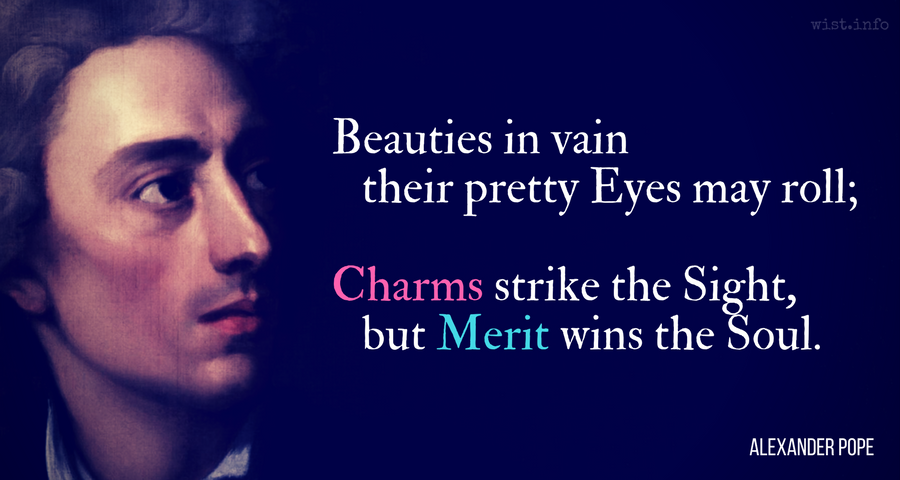
Beauties in vain their pretty Eyes may roll;
Charms strike the Sight, but Merit wins the Soul.

All of God’s children are not beautiful. Most of God’s children are, in fact, barely presentable.

“A man’s virility is in his beard,” he insisted.
To which Alexia replied, “And a woman’s is in her décolletage. Yet you don’t see me allowing mine to get out of control, now, do you?”
“If wishes were balloons,’ was his only response.
Gail Carriger (b. 1976) American archaeologist, author [pen name of Tofa Borregaard]
Timeless (2012)

FAUSTUS: Was this the face that launch’d a thousand ships,
And burnt the topless towers of Ilium —
Sweet Helen, make me immortal with a kiss. —
[They kiss]
Her lips suck forth my soul: see, where it flies! —
Come, Helen, come, give me my soul again.
[They kiss again]
Here will I dwell, for heaven is in these lips,
And all is dross that is not Helena.Christopher "Kit" Marlowe (1564–1593) English dramatist and poet
The Tragicall History of the Life and Death of Doctor Faustus, Act 5, sc. 1 (sc. 13), l. 1358ff (1594; 1604 “A” text)
(Source)
The "B" text (1594; 1616) has the same wording (l. 1874ff).