

No wind serves him who has no port of destination.
[Nul vent fait pour celuy qui n’a point de port destiné. ]
Michel de Montaigne (1533–1592) French essayist
Essays, Book 2, ch. 1 (2.1), “Of the Inconsistency of Our Actions [De l’inconstance de nos actions]” (1572) [tr. Zeitlin (1934)]
(Source)
This passage was in the essays initial 1580 printing. Likely from a quotation of Seneca the Younger (1st C AD).
(Source (French)). Alternate translations:No winde makes for him, that hath no intended port to saile-unto.
[tr. Florio (1603)]No helpe serves him that runnes uncertain courses (or knows not where to end them).
[tr. Cotgrave (1611)]No wind serves him who is bound to no certain port.
[tr. Cotton (1686)]No wind serves him who addresses his voyage to no certain port.
[tr. Cotton/Hazlitt (1877)]No wind is fair for him who has no purposed port.
[tr. Ives (1925)]No wind works for the man who has no port of destination.
[tr. Frame (1943)]No wind is right for a seaman who has no predetermined harbour.
[tr. Screech (1987)]
Quotations about:
direction
Note not all quotations have been tagged, so Search may find additional quotes on this topic.

Wherein, then, is your grievance? You are not ejected from the city [life] by any unjust judge or tyrant, but by the selfsame Nature which brought you into it; just as when an actor is dismissed by the manager who engaged him.
“But I have played no more than three of the five acts.” Just so; in your drama of life, three acts are all the play. Its point of completeness is determined by him who formerly sanctioned your creation, and today sanctions your dissolution. Neither of those decisions lay within yourself.
Pass on your way, then, with a smiling face, under the smile of him who bids you go.[τί οὖν δεινόν, εἰ τῆς πόλεως ἀποπέμπει σε οὐ τύραννος οὐδὲ δικαστὴς ἄδικος, ἀλλ̓ ἡ φύσις ἡ εἰσαγαγοῦσα, οἷον εἰ κωμῳδὸν ἀπολύοι τῆς σκηνῆς ὁ παραλαβὼν στρατηγός;—ἀλλ̓ οὐκ εἶπον τὰ πέντε μέρη, ἀλλὰ τὰ τρία.—καλῶς εἶπας: ἐν μέντοι τῷ βίῳ τὰ τρία ὅλον τὸ δρᾶμά ἐστι. τὸ γὰρ τέλειον ἐκεῖνος ὁρίζει ὁ τότε μὲν τῆς συγκρίσεως. νῦν δὲ τῆς διαλύσεως αἴτιος: σὺ δὲ ἀναίτιος ἀμφοτέρων. ἄπιθι οὖν ἵλεως: καὶ γὰρ ὁ ἀπολύων ἵλεως.]
Marcus Aurelius (AD 121–180) Roman emperor (161–180), Stoic philosopher
Meditations [To Himself; Τὰ εἰς ἑαυτόν], Book 12, ch. 36 (12.36) (AD 161-180) [tr. Staniforth (1964)]
(Source)
Concluding words of the Meditations. See Cicero (44 BC).
(Source (Greek)). Other translations:Why then should it be grievous unto thee, if (not a tyrant, nor an unjust judge, but) the same nature that brought thee in, doth now send thee out of the world? As if the praetor should fairly dismiss him from the stage, whom he had taken in to act a while.
Oh, but the play is not yet at an end, there are but three acts yet acted of it? Thou hast well said: for in matter of life, three acts is the whole play. Now to set a certain time to every man's acting, belongs unto him only, who as first he was of thy composition, so is now the cause of thy dissolution. As for thyself; thou hast to do with neither.
Go thy ways then well pleased and contented: for so is He that dismisseth thee.
[tr. Casaubon (1634), 12.27]You can't say you are sent off by a Tyrannical, and Unrighteous Sentence; No, you quit the Stage as fairly as a Player does that has his Discharge from the Master of the Revels:
But I have only gone through three Acts, and not held out to the End of the Fifth. You say well; but in Life three Acts make the Play entire. He that appoints the Entertainment is the best Judge of the length on't; and as he ordered the opening of the first Scene, so now he gives the sign for shutting up the last: You are neither accountable for one or to'ther;
Therefore retire in good Humour, for He by whom you are dismiss'd means you no harm.
[tr. Collier (1701)]What is there terrible in this, that you are sent out, not by a tyrant, or an unjust judge, but by that nature, which at first introduced you? As if the praetor who employed the player, should dismiss him again from the scene.
But, say you, I have not finished the five acts, but only three. You say true; but, in life, three acts make a complete play. For, ’tis he who appoints the end to it, who, as he was the cause of the composition, is now the cause of the dissolution. Neither of them are chargeable on you:
Depart, therefore, contented, and in good humour; for, he is propitious and kind, who dismisses you.
[tr. Hutcheson/Moor (1742)]Is it any hardship that you are sent out of the world, not by a tyrant, or an unjust judge, but by that Being which first introduced you? As the magistrate who engages an actor for the stage, dismisses him again at his pleasure.
"But I have performed only three acts of the play, and not the whole five."
Very true; but in life, even three acts may complete the whole drama. He determines the duration of the piece, who first cause it to be composed, and now orders its conclusion. You are not accountable for either.
Depart, therefore, with a good grace; for he who dismisses you is a gracious and benevolent Being.
[tr. Graves (1792)]Where is the hardship then, if no tyrant nor yet an unjust judge sends thee away from the state, but nature, who brought thee into it? the same as if a praetor who has employed an actor dismisses him from the stage.
-- "But I have not finished the five acts, but only three of them." -- Thou sayest well, but in life the three acts are the whole drama; for what shall be a complete drama is determined by him who was once the cause of its composition, and now of its dissolution: but thou art the cause of neither.
Depart then satisfied, for he also who releases thee is satisfied.
[tr. Long (1862)]Where is the hardship then if nature, that planted you here, orders your removal? You cannot say you are sent off by a tyrant or unjust judge. No; you quit the stage as fairly as a player does that has his discharge from the master of the revels.
But I have only gone through three acts, and not held out to the end of the fifth. You say well; but in life three acts make the play entire. He that ordered the opening of the first scene now gives the sign for shutting up the last; you are neither accountable for one nor the other;
Therefore retire well satisfied, for He, by whom you are dismissed, is satisfied too.
[tr. Collier/Zimmern (1887)]Why then protest? No tyrant gives you your dismissal, no unjust judge, but nature who gave you the admission. It is like the praetor discharging some player whom he has engaged.
-- "But the five acts are not complete; I have played but three." -- Good: life's drama, look you, is complete in three. The completeness is in his hands, who first authorized your composition, and now your dissolution; neither was your work.
Serenely take your leave; serene as he who gives you discharge.
[tr. Rendall (1898)]Where then is the calamity, if you are sent out of the city, by no tyrant or unjust judge, but Nature herself who at first introduced you, just as the praetor who engaged the actor again dismisses him from the stage?
“But,” say you, “I have not spoken my five acts, but only three.” True, but in life three acts make up the play. For he sets the end who was responsible for its composition at the first, and for its present dissolution. You are responsible for neither.
Depart then graciously; for he who dismisses you is gracious.
[tr. Hutcheson/Chrystal (1902)]What hardship then is there in being banished from the city, not by a tyrant or an unjust judge but by Nature who settled thee in it? So might a praetor who commissions a comic actor, dismiss him from the stage.
But I have not played my five acts, but only three. Very possibly, but in life three acts count as a full play. For he, that is responsible for thy composition originally and thy dissolution now, decides when it is complete. But thou art responsible for neither.
Depart then with a good grace, for he that dismisses thee is gracious.
[tr. Haines (Loeb) (1916)]Why is it hard, then, if Nature who brought you in, and no despot nor unjust judge, sends you out of the City -- as though the master of the show, who engaged an actor, were to dismiss him from the stage?
"But I have not spoken my five acts, only three." "What you say is true, but in life three acts are the whole play." For He determines the perfect whole, the cause yesterday of your composition, to-day of your dissolution; you are the cause of neither.
Leave the stage, therefore, and be reconciled, for He also who lets his servant depart is reconciled.
[tr. Farquharson (1944)]Where is the hardship, then, if it is no tyrant or unjust judge who sends you out of the city, but nature who brought you into it? It is just as if the director of a show, after first engaging an actor, were dismissing him from the stage.
"But I haven't played all five acts, only three!" Very well; but in life three can make up a full play. For the one who determines when it is complete is he who once arranged for your composition and now arranges for your dissolution, while you for your part are responsible for neither.
So make your departure with good grace, as he who is releasing you shows a good grace.
[tr. Hard (1997 ed.; 2011 ed.)]And to be sent away from it, not by a tyrant or a dishonest judge, but by Nature, who first invited you in -- why is that so terrible?
Like the impresario ringing down the curtain on an actor:
“But I’ve only gotten through three acts ...!”
Yes. This will be a drama in three acts, the length fixed by the power that directed your creation, and now directs your dissolution. Neither was yours to determine.
So make your exit with grace -- the same grace shown to you.
[tr. Hays (2003)]So what is there to fear in your dismissal from the city? This is no tyrant or corrupt judge who dismisses you, but the very same nature that brought you in. It is like the officer who engaged a comic actor dismissing him from the stage.
"But I have not played my five acts, only three." "True, but in life three acts can be the whole play." Completion is determined by that being who caused first your composition and now your dissolution. You have no part in either causation.
Go then in peace: the god who lets you go is at peace with you.
[tr. Hammond (2006)]

THE DOCTOR: A straight line may be the shortest distance between two points, but it is by no means the most interesting.
Doctor Who (1963–1989) British science fiction television series, original run (BBC)
11×01 “The Time Warrior,” Part 1 (1973-12-15) [w. Robert Holmes]
(Source)

Young people are ill-advised if they yield to the pressure of the old in any vital matter.
Bertrand Russell (1872–1970) English mathematician and philosopher
Conquest of Happiness, Part 1, ch. 9 “Fear of Public Opinion” (1930)
(Source)
That it is expedient to kill a king, rather than wait for his natural demise, is something a populace can come to accept, perhaps to relish. That the people’s own customs and costumes are to be radically changed by edict, rather than being allowed to evolve haphazardly and linger sentimentally beyond their time, is not. Yet messing with the national etiquette is one of the great spoils of revolutionary success.
Judith Martin (b. 1938) American author, journalist, etiquette expert [a.k.a. Miss Manners]
Star-Spangled Manners, Prologue (2003)
(Source)

When we are working at a difficult task and strive after a good thing we fight a righteous battle, the direct reward of which is that we are kept from much evil.

It iz a darned sight eazier tew find six men who kan tell exactly how a thing ought tew be did than tew find one who will do it.
[It is a darned sight easier to find six men who can tell exactly how a thing ought to be done than to find one who will do it.]
Josh Billings (1818–1885) American humorist, aphorist [pseud. of Henry Wheeler Shaw]
Everybody’s Friend, Or; Josh Billing’s Encyclopedia and Proverbial Philosophy of Wit and Humor, ch. 130 “Affurisms: Puddin & Milk” (1874)
(Source)

When the whole world is running towards a cliff, he who is running in the opposite direction appears to have lost his mind.
C. S. Lewis (1898–1963) English writer, literary scholar, lay theologian [Clive Staples Lewis]
(Spurious)
Popularly attributed to Lewis, but no citation is ever given, and it is not found in searches of his written works.
Conscience is a man’s compass, and though the needle sometimes deviates, though one often perceives irregularities in directing one’s course after it, still one must try to follow its direction.
It may be prudent in me to act sometimes by other men’s reason; but I can think only by my own.

The author always loads his dice, but he must never let the reader see that he has done so.
W. Somerset Maugham (1874–1965) English novelist and playwright [William Somerset Maugham]
The Summing Up, ch. 59 (1938)
(Source)
On using plot to direct the reader's interest.
When vision fails
Direction is lost.When direction is lost
Purpose may be forgotten.When purpose is forgotten
Emotion rules alone.When emotion rules alone,
Destruction … destruction.

The first step — especially for young people with energy and drive and talent, but not money — the first step to controlling your world is to control your culture. To model and demonstrate the kind of world you demand to live in. To write the books. Make the music. Shoot the films. Paint the art.
Chuck Palahniuk (b. 1962) American novelist and freelance journalist
Closing remarks on an eClass forum, Barnes & Noble University (5 Dec 2004)

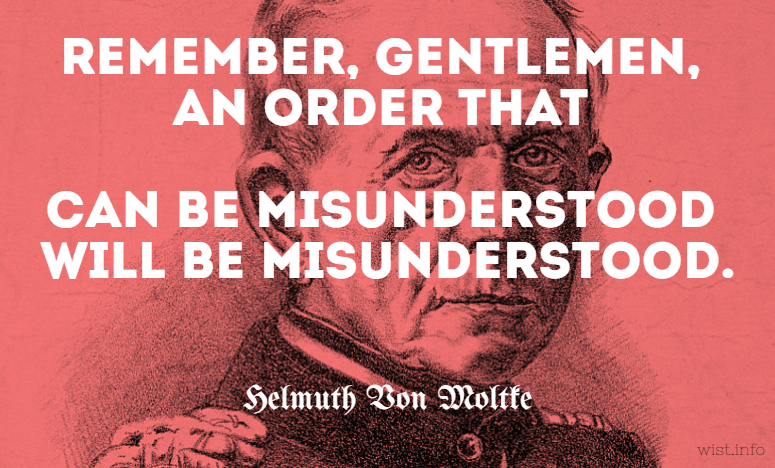
Remember, gentlemen, an order that can be misunderstood will be misunderstood.
Helmuth von Moltke (1800–1891) Prussian soldier
Comment as Chief of the Prussian General Staff, Battle of Sedan (Sep 1870)
A lot of companies — I know it sounds crazy — but a lot of companies … hire people to tell them what to do. We hire people to tell us what to do. We figure we’re paying them all this money; their job is to figure out what to do and tell us.
Steve Jobs (1955–2011) American computer inventor, entrepreneur
“Steve Jobs: ‘Computer Science Is A Liberal Art’,” interview with Terry Gross, Fresh Air, NPR (1996)
(Source)
There are a number of variants on this quotation. A common one: "It doesn't make sense to hire smart people and then tell them what to do; we hire smart people so they can tell us what to do."


Be the chief but never the lord.
Lao-tzu (604?-531? BC) Chinese philosopher, poet [also Lao-tse, Laozi]
The Way of Life, ch. 10 [tr. Blakney (1955)]

One ship drives east and another drives west,
With the self-same winds that blow,
‘Tis the set of the sails
And not the gales
That tell them way to go.
Like the winds of the sea are the winds of fate,
As we journey along through life,
‘Tis the set of the soul,
That determines the goal,
And not the calm or the strife.Ella Wheeler Wilcox (1850–1919) American author, poet, temperance advocate, spiritualist
Poem (1913), “The Winds of Fate,” Poems of Optimism (1915)
(Source)
Sometimes called "'Tis the Set of the Sail."
There is a longer variant of the poem, sometimes called "One Ship Sails East," that includes two stanzas in front, and has slightly different words in the analogous stanzas. I have not found a primary source for this version:But to every mind there openeth,
A way, and way, and away,
A high soul climbs the highway,
And the low soul gropes the low,
And in between on the misty flats,
The rest drift to and fro.
But to every man there openeth,
A high way and a low,
And every mind decideth,
The way his soul shall go.
One ship sails East,
And another West,
By the self-same winds that blow,
'Tis the set of the sails
And not the gales,
That tells the way we go.
Like the winds of the sea
Are the waves of time,
As we journey along through life,
'Tis the set of the soul,
That determines the goal,
And not the calm or the strife.

All rising to a great place is by a winding stair.
Francis Bacon (1561–1626) English philosopher, scientist, author, statesman
“Of Great Place,” Essays, No. 11 (1625)
(Source)

Without being bound to the fulfillment of promises, we would never be able to keep our identities; we would be condemned to wander helplessly and without direction in the darkness of each man’s lonely heart, caught in its contradictions and equivocalities — a darkness which only the light shed over the public realm through the presence of others, who confirm the identity between the one who promises and the one who fulfills, can dispel.
Hannah Arendt (1906–1975) German-American philosopher, political theorist
The Human Condition, Part 5, ch. 33 “Irreversibility and the Power to Forgive” (1958)
(Source)
Children have more need of models than of critics.
[Les enfants ont plus besoin de modèles que de critiques.]
Joseph Joubert (1754–1824) French moralist, philosopher, essayist, poet
Pensées [Thoughts], ch. 19 “De l’Éducation [On Education],” ¶ 3 (1850 ed.) [tr. Calvert (1866), ch. 14]
(Source)
Sometimes attributed to Carolyn Coats.
(Source (French)). Other translations:Children have more need of models than of critics.
[tr. Attwell (1896), ¶ 261]Children need models rather than critics.
[tr. Lyttelton (1899), ch. 18, ¶ 1]Children. Need models more than critics.
[tr. Auster (1983), 1800 entry]
If you don’t know where you’re going, you will probably end up somewhere else.
Lawrence J. Peter (1919–1990) American educator, management theorist
The Peter Principle (1969)
No individual or group will be judged by whether they come up to or fall short of some fixed result, but by the direction in which they are moving. The band mans is the man who no matter how good he has been is beginning to deteriorate, to grow less good. The good man in the man who no matter how morally unworthy he has been is moving to become better. Such a conception makes one severe in judging himself and humane in judging others.
John Dewey (1859–1952) American teacher and philosopher
Reconstruction in Philosophy, ch. 7 “Moral Reconstruction” (1919)
(Source)
Our plans miscarry because they have no aim. When a man does not know what harbor he is making for, no wind is the right wind.
Seneca the Younger (c. 4 BC-AD 65) Roman statesman, philosopher, playwright [Lucius Annaeus Seneca]
Moral Letters to Lucilius [Epistulae morales ad Lucilium], letter 71, sec. 3 “On the Supreme Good” [tr. Grummere (1918)]
(Source)
Alt trans.: "If one does not know to which port one is sailing, no wind is favorable."
See Montaigne (1572).
All change is not growth; all movement is not forward.
Ellen Glasgow (1874–1945) American author
In Clifton Fadiman, I Believe: The Personal Philosophies of Certain Eminent Men and Women of Our Time (1939 ed.)
(Source)
He is aloof, as if his talk
Were priced beyond the purchasing;
But once his project is contrived,
The folk will want to say of it:
“Of course! We did it by ourselves!”Lao-tzu (604?-531? BC) Chinese philosopher, poet [also Lao-tse, Laozi]
The Way of Life, ch. 17 [tr. Blakney (1955)]
Other translations:
- "A good manager is best when people barely know that he exists. Not so good when people obey and acclaim him. Worse when they despise him. But of a good leader, who talks little, when his work is done -- his aim fulfilled, they will say: 'We did it ourselves.'"
- "When the effective leader is finished with his work, the people say it happened naturally."
Ursula K. Le Guin, in her Tao Te Ching (1997) rendered it this way:True leaders
are hardly known to their followers.
Next after them are the leaders
the people know and admire;
after them, those they fear;
after them, those they despise.
[...]
When the work’s done right,
with no fuss or boasting,
ordinary people say,
Oh, we did it.