Eating grapes with a knife and fork is not what one would call refined. It is what one would call ludicrous.
Judith Martin (b. 1938) American author, journalist, etiquette expert [a.k.a. Miss Manners]
“Miss Manners,” syndicated column (1993-03-07)
(Source)
See also Miss Manners (1979).
Quotations about:
dining
Note not all quotations have been tagged, so Search may find additional quotes on this topic.

You, sir, are an anarchist, and Miss Manners is frightened to have anything to do with you.
It is true that questioning the table manners of others is rude. But to overthrow the accepted conventions of society, on the flimsy grounds that you have found them silly, inefficient and discomforting, is a dangerous step toward destroying civilization.Judith Martin (b. 1938) American author, journalist, etiquette expert [a.k.a. Miss Manners]
“Miss Manners,” syndicated column (1981-04-11)
(Source)
Mocking people who make a huge fuss when correcting someone on how they are misusing their fork at the table.
Collected in Miss Manners’ Guide to Excruciatingly Correct Behavior, Part 3 "Basic Civilization," "Table Manners" (1983).
DROMIO OF SYRACUSE: Marry, he must have a long spoon that must eat with the devil.
William Shakespeare (1564–1616) English dramatist and poet
Comedy of Errors, Act 4, sc. 3, l. 65ff (4.3.65-66) (1594)
(Source)
The phrase was popularized by Shakespeare, but had appeared earlier, e.g., Chaucer, "The Squire's Tale," ll. 602-603, Canterbury Tales (c. 1386):"Therfor bihoveth him a ful long spoon
That shal ete with a feend," thus herde I seye.

There is no known correct way to eat pistachio nuts. Nevertheless, they are delicious. The pistachio nut must therefore be Nature’s way of teaching us self-control. If so, it doesn’t work.
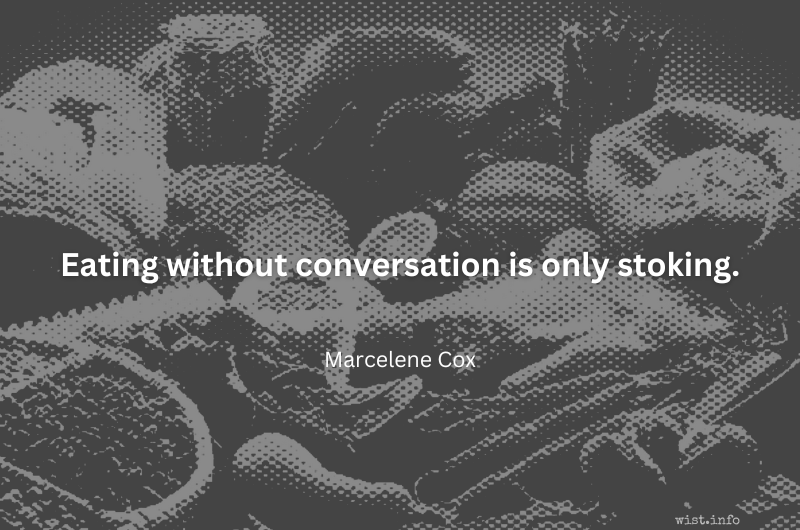
Eating without conversation is only stoking.
Marcelene Cox (1900–1998) American writer, columnist, aphorist
“Ask Any Woman” column, Ladies’ Home Journal (1943-06)
(Source)

When you are invited to dine, particularly with people you do not know very well, it always helps to have a conversational opener, a phrase which here means “an interesting sentence to say out loud in order to get people talking.” Although lately, it has become more and more difficult to attend dinner parties without the evening ending in gunfire or tapioca, I keep a list of good and bad conversational openers in my commonplace book in order to avoid awkward pauses at the dinner table. “Who would like to see an assortment of photographs taken while I was on vacation?” for instance, is a very poor conversational opener because it is likely to make your fellow diners shudder instead of talk, whereas good conversational openers are sentences such as “What would drive a man to commit arson?,” “Why do so many stories of true love end in tragedy and despair?,” and “Madam DeLustrio, I believe I’ve discovered your true identity!” all of which are likely to provoke discussions, arguments, and accusations, thus making the dinner party much more entertaining.
Lemony Snicket (b. 1970) American author, screenwriter, musician (pseud. for Daniel Handler)
The Grim Grotto (2004)

Queerly shaped pieces of flat silver, contrived for purposes known only to their designers, have no place on a well appointed table. So if you use one of these implements for a purpose not intended, it cannot be a breach of etiquette, since etiquette is founded on tradition, and has no rules concerning eccentricities.
Emily Post (1872–1960) American author, columnist [née Price]
Etiquette: The Blue Book of Social Usage, ch. 37 “Flat Silver” (1922; 1927 ed.)
(Source)
The way of Providence is a little rude. The habit of snake and spider, the snap of the tiger and other leapers and bloody jumpers, the crackle of the bones of his prey in the coil of the anaconda, — these are in the system, and our habits are like theirs. You have just dined, and however scrupulously the slaughter-house is concealed in the graceful distance of miles, there is complicity, expensive races, — race living at the expense of race.
Ralph Waldo Emerson (1803–1882) American essayist, lecturer, poet
Essay (1860), “Fate,” The Conduct of Life, ch. 1
(Source)
Based on a course of lectures by that name first delivered in Pittsburg (1851-03).

Serenely full, the epicure would say,
Fate cannot harm me, I have dined to-day.Sydney Smith (1771–1845) English clergyman, essayist, wit
Memoir of the Reverend Sydney Smith, by His Daughter, Lady Holland, Vol. 1, ch. 11 (1855)
(Source)
At the end of a recipe for highly praised potato salad dressing.

Never play cards with a man called Doc. Never eat at a place called Mom’s. Never sleep with a woman whose troubles are worse than your own.
Nelson Algren (1909–1981) American writer [b. Nelson Ahlgren Abraham]
A Walk on the Wild Side, ch. 3 (1956)