I cannot forgive God for the suffering of others; when I look abroad upon His world and behold its cruel destinies, I turn from Him with disaffection; nor do I conceive that He will blame me for the impulse. But when I consider my own fates, I grow conscious of His gentle dealing: I see Him chastise with helpful blows, I feel His stripes to be caresses; and this knowledge is my comfort that reconciles me to the world.
Robert Louis Stevenson (1850–1894) Scottish essayist, novelist, poet
Essay (1880-01/02?), “Reflections and Remarks on Human Life,” § 8.2 “Gratitude to God”
(Source)
A collection of aphorisms and musings, first published in the Edinburgh Edition of his Works, vol. 28 (1898).
Quotations about:
problem of evil
Note not all quotations have been tagged, so Search may find additional quotes on this topic.
For me, it is hard to see the plan or design in earthquakes and pestilences. It is somewhat difficult to discern the design or the benevolence in so making the world that billions of animals live only on the agonies of others. The justice of God is not visible to me in the history of this world. When I think of the suffering and death, of the poverty and crime, of the cruelty and malice, of the heartlessness of this “design” and “plan,” where beak and claw and tooth tear and rend the quivering flesh of weakness and despair, I cannot convince myself that it is the result of infinite wisdom, benevolence, and justice.

Many years ago, when A Wrinkle in Time was being rejected by publisher after publisher, I wrote in my journal, “I will rewrite for months or even years for an editor who sees what I am trying to do in this book and wants to make it better and stronger. But I will not, I cannot diminish and mutilate it for an editor who does not understand it and wants to weaken it.”
Now, the editors who did not understand the book and wanted the problem of evil soft peddled had every right to refuse to publish the book, as I had, sadly, the right and obligation to try to be true to it. If they refused it out of honest conviction, that was honorable. If they refused it for fear of trampling on someone else’s toes, that was, alas, the way of the world.Madeleine L'Engle (1918–2007) American writer
Speech (1983-11-16), “Dare To Be Creative,” Lecture, Library of Congress, Washington, DC
(Source)

Only the other day a gentleman was telling me of a case of special Providence. He knew it. He had been the subject of it. A few years ago he was about to go on a ship, when he was detained. He did not go, and the ship was lost with all on board.
“Yes,” I said, ” Do you think the people who were drowned believed in special Providence?” Think of the infinite egotism of such a doctrine. Here is a man that fails to go upon a ship with 500 passengers, and they go down to the bottom of the sea — fathers, mothers, children, and loving husbands and wives waiting upon the shores of expectation. Here is one poor little wretch that did not happen to go! And he thinks that God, the Infinite Being, interfered in his poor little withered behalf and let the rest all go. That is special Providence!Robert Green Ingersoll (1833–1899) American lawyer, freethinker, orator
Lecture (1884-01-20), “Orthodoxy,” Tabor Opera House, Denver, Colorado
(Source)
Published as its own book in 1884.
What would we think of a father, who should give a farm to his children, and before giving them possession should plant upon it thousands of deadly shrubs and vines; should stock it with ferocious beasts, and poisonous reptiles; should take pains to put a few swamps in the neighborhood to breed malaria; should so arrange matters, that the ground would occasionally open and swallow a few of his darlings, and besides all this, should establish a few volcanoes in the immediate vicinity, that might at any moment overwhelm his children with rivers of fire? Suppose that this father neglected to tell his children which of the plants were deadly; that the reptiles were poisonous; failed to say anything about the earthquakes, and kept the volcano business a profound secret; would we pronounce him angel or fiend?
And yet this is exactly what the orthodox God has done.
If we admit that some infinite being has controlled the destinies of persons and peoples, history becomes a most cruel and bloody farce. Age after age, the strong have trampled upon the weak; the crafty and heartless have ensnared and enslaved the simple and innocent, and nowhere, in all the annals of mankind, has any god succored the oppressed.
And to pursue pleasure as good, and flee from pain as evil — that too is blasphemous. Someone who does that is bound to find himself constantly reproaching nature — complaining that it doesn’t treat the good and bad as they deserve, but often lets the bad enjoy pleasure and the things that produce it, and makes the good suffer pain, and the things that produce pain.
[καὶ μὴν ὁ τὰς ἡδονὰς ὡς ἀγαθὰ διώκων, τοὺς δὲ πόνους ὡς κακὰ φεύγων ἀσεβεῖ: ἀνάγκη γὰρ τὸν τοιοῦτον μέμφεσθαι πολλάκις τῇ κοινῇ φύσει ὡς παῤ ἀξίαν τι ἀπονεμούσῃ τοῖς φαύλοις καὶ τοῖς σπουδαίοις, διὰ τὸ πολλάκις τοὺς μὲν φαύλους ἐν ἡδοναῖς εἶναι καὶ τὰ ποιητικὰ τούτων κτᾶσθαι, τοὺς δὲ σπουδαίους πόνῳ καὶ τοῖς ποιητικοῖς τούτου περιπίπτειν.]
Marcus Aurelius (AD 121–180) Roman emperor (161–180), Stoic philosopher
Meditations [To Himself; Τὰ εἰς ἑαυτόν], Book 9, ch. 1 (9.1) (AD 161-180) [tr. Hays (2003)]
(Source)
(Source (Greek)). Alternate translations:He also that pursues after pleasures, as that which is truly good and flies from pains, as that which is truly evil: is impious. For such a one must of necessity oftentimes accuse that common nature, as distributing many things both unto the evil, and unto the good, not according to the deserts of either: as unto the bad oftentimes pleasures, and the causes of pleasures; so unto the good, pains, and the occasions of pains.
[tr. Casaubon (1634)]Farther: He that reckons Prosperity and Pleasure among Things really Good; Pain and Hardship amongst Things really Evil , can be no Pious Person: For such a Man will be sure to complain of the Administrations of Providence, Charge it with Mismatching Fortune, and Merit, and misapplying Rewards and Punishments: He'll often see Ill People furnish'd with Materials for Pleasure, and Regaled with the Relish of it : And good Men harrass'd and deprest, and meeting with nothing but Misfortune.
[tr. Collier (1701)]He, too, who pursues pleasure as good, and shuns pain as evil, is guilty of impiety: for such a one must needs frequently blame the common nature, as making some unworthy distributions to the bad and the good; because the bad oftimes enjoy pleasures, and possess the means of them; and the good often meet with pain, and what causes pain.
[tr. Hutcheson/Moor (1742)]Moreover, he who pursues pleasure, as if it were really good, or flies from pain, as if it were evil, he also is guilty of impiety. For he that is thus disposed, must necessarily complain often of the dispensations of Providence, as distributing its favours to the wicked and to the virtuous, without regard to their respective deserts; the wicked frequently abounding in pleasures, and in the means of procuring them, and the virtuous, on the contrary, being harassed with pain, and other afflictive circumstances.
[tr. Graves (1792)]And indeed he who pursues pleasure as good, and avoids pain as evil, is guilty of impiety. For of necessity such a man must often find fault with the universal nature, alleging that it assigns things to the bad and the good contrary to their deserts, because frequently the bad are in the enjoyment of pleasure and possess the things which procure pleasure, but the good have pain for their share and the things which cause pain.
[tr. Long (1862)]Further, he that reckons prosperity and pleasure among things really good, pain and hardship amongst things really evil, can be no pious person; for such a man will be sure to complain of the administrations of Providence, and charge it with mismatching fortune and merit. He will often see evil people furnished with materials for pleasure and regaled with the relish of it, and good men harassed and depressed, and meeting with nothing but misfortune.
[tr. Collier/Zimmern (1887)]Again, to seek pleasures as good, or to shun pains as evil, is to sin. For it inevitably leads to complaining against Nature for unfair awards to the virtuous and to the vile, seeing that the vile are oftentimes in pleasure and come by things pleasurable, while the virtuous are overtaken by pain and things painful.
[tr. Rendall (1898)]He, too, who pursues pleasure as good, and shuns pain as evil, is guilty of impiety. Such a one must needs frequently blame the common nature for unseemly awards of fortune to bad and to good men. For the bad often enjoy pleasures and possess the means to attain them, and the good often meet with pain and with what causes pain.
[tr. Hutcheson/Chrystal (1902)]Again he acts impiously who seeks after pleasure as a good thing and eschews pain as an evil. For such a man must inevitably find frequent fault with the Universal Nature as unfair in its apportionments to the worthless and the worthy, since the worthless are often lapped in pleasures and possess the things that make for pleasure, while the worthy meet with pain and the things that make for pain.
[tr. Haines (Loeb) (1916)]Moreover, he who runs after pleasures as goods and away from pains as evils commits sin; for being such a man he must necessarily often blame Universal Nature for distributing to bad and good contrary to their desert, because the bad are often employed in pleasures and acquire what may produce these, while the good are involved in pain and in what may produce this.
[tr. Farquharson (1944)]Again, it is a sin to pursue pleasure as a good and to avoid pain as an evil. It is bound to result in complaints that Nature is unfair in her rewarding of vice and virtue; since it is the bad who are so often in enjoyment of pleasures and the means to obtain them, while pains and events that occasion pains descend upon the heads of the good.
[tr. Staniforth (1964)]Again, one who pursues pleasure as good and tries to avoid pain as an evil is acting irreverently; for it is inevitable that such a person must often find fault with universal nature for assigning something to good people or bad which is contrary to their deserts, because it is so often the case that the bad devote themselves to pleasure and secure the things that give rise to it whilstr the good encounter pain and what gives rise to that.
[tr. Hard (1997 ed.)]Moreover, the pursuit of pleasure as a good and the avoidance of pain as an evil constitutes sin. Someone like that must inevitably and frequently blame universal Nature for unfair distribution as between bad men and good, since bad men are often deep in pleasures and the possessions which make for pleasure, while the good often meet with pain and the circumstances which cause pain.
[tr. Hammond (2006)]Again, one who pursues pleasures as being good and tries to avoid pains as being bad is acting irreverently; for it is inevitable that such a person must often find fault with universal nature for assigning something to good people or bad that is contrary to their deserts, because it is so often the case that the bad devote themselves to pleasure and secure the things that give rise to it while the good encounter pain and what gives rise to that.
[tr. Hard (2011 ed.)]
If I were God, I would not wait the years
To solve the mystery of human tears;
And, unambiguous, I would speak my will,
Nor hint it darkly to the dreaming seers.Omar Khayyám (1048–1123) Persian poet, mathematician, philosopher, astronomer [عمر خیام]
Rubáiyát [رباعیات] [tr. Le Gallienne (1897), # 116]
(Source)
Given LeGallienne's paraphrasing, I am unable to align this with an original quatrain or other translations.
I could no longer reconcile the claims of faith with the facts of life. In particular, I could no longer explain how there can be a good and all-powerful God actively involved with this world, given the state of things. For many people who inhabit this planet, life is a cesspool of misery and suffering. I came to a point where I simply could not believe that there is a good and kindly disposed Ruler who is in charge of it.

If there is an all-powerful and loving God in this world, why is there so much excruciating pain and unspeakable suffering? The problem of suffering has haunted me for a very long time. It was what made me begin to think about religion when I was young, and it was what led me to question my faith when I was older. Ultimately, it was the reason I lost my faith.
Bart D. Ehrman (b. 1955) American Biblical scholar, author
God’s Problem, ch. 1 “Suffering and a Crisis of Faith” (2008)
(Source)
People complain about the bad things that happen to em that they don’t deserve but they seldom mention the good. About what they done to deserve them things. I don’t recall that I ever give the good Lord all that much cause to smile on me. But he did.
Cormac McCarthy (1933–2023) American novelist, playwright, screenwriter
No Country for Old Men, ch. 4 (2005)
(Source)
And I have known small cities, who revere
The Gods, made subject to unrighteous power,
Vanquish’d by spears more numerous.[πόλεις τε μικρὰς οἶδα τιμώσας θεούς,
αἳ μειζόνων κλύουσι δυσσεβεστέρων
λόγχης ἀριθμῷ πλείονος κρατούμεναι.]Euripides (485?-406? BC) Greek tragic dramatist
Bellerophon [Βελλεροφῶν], frag. 286 (TGF) (c. 430 BC) [tr. Wodhull (1809)]
(Source)
Nauck (TGF) frag. 286, Barnes frag. 8, Musgrave frag. 25. (Source (Greek)). Other translations:I know too of small cities doing honour to the gods which are subject to larger, more impious ones, because they are overcome by a more numerous army.
[tr. Collard, Hargreaves, Cropp (1995)]I see minor states that honor gods subject to greater ones that revere none, for ‘might is right’.
[tr. Stevens (2012)]I know small cities honouring the gods that obey larger and more impious ones since they are outnumbered in spearmen.
[tr. Dixon (2014)]I know that small cities honor the gods,
Cities that obey stronger more impious men
Because they are overpowered by the strength of their arms.
[tr. @sentantiq (2015)]I know of small cities where the gods are honored: yet these same cities are forced to comply with the demands of impious men in larger cities, overpowered by the sheer magnitude of their armament.
[tr. Emerson]
Doth any man assert that there are Gods
In Heaven? I answer there are none: let him
Who contradicts me like a fool, no longer
Quote ancient fables; but observe the fact,
Nor to my words give credence. Kings, I say.
Kill many, but rob more of their possessions.
And violating every sacred oath,
Lay waste whole cities; yet, tho’ they act thus,
Are more successful far than they who lead
In constant piety a tranquil life.[φησίν τις εἶναι δῆτ’ ἐν οὐρανῷ θεούς;
οὐκ εἰσίν, οὐκ εἴσ’, εἴ τις ἀνθρώπων θέλει
μὴ τῷ παλαιῷ μῶρος ὢν χρῆσθαι λόγῳ.
σκέψασθε δ’ αὐτοί, μὴ ἐπὶ τοῖς ἐμοῖς λόγοις
γνώμην ἔχοντες. φήμ’ ἐγὼ τυραννίδα
κτείνειν τε πλείστους κτημάτων τ’ ἀποστερεῖν
ὅρκους τε παραβαίνοντας ἐκπορθεῖν πόλεις·
καὶ ταῦτα δρῶντες μᾶλλόν εἰσ’ εὐδαίμονες
τῶν εὐσεβούντων ἡσυχῇ καθ’ ἡμέραν]Euripides (485?-406? BC) Greek tragic dramatist
Bellerophon [Βελλεροφῶν], frag. 286 (TGF) (c. 430 BC) [tr. Wodhull (1809)]
(Source)
Nauck (TGF) frag. 286, Barnes frag. 8, Musgrave frag. 25. (Source (Greek)). Other translations:Doth some one say that there be gods above?
There are not; no, there are not. Let no fool,
Led by the old false fable, thus deceive you.
Look at the facts themselves, yielding my words
No undue credence: for I say that kings
Kill, rob, break oaths, lay cities waste by fraud,
And doing thus are happier than those
Who live calm pious lives day after day. All divinity
Is built-up from our good and evil luck.
[tr. Symonds (1876)]Does someone say there are indeed gods in heaven? There are not, there are not, if a man is willing not to rely foolishly on the antiquated reasoning. Consider for yourselves, do not base your opinion on words of mine. I say myself that tyranny kills very many men and dprives them of their possessions; and that tyrants break their oaths to ransack cities, and in doing this they are more prosperous under heaven than men who live quietly in reverence.
[tr. Collard, Hargreaves, Cropp (1995)]Does anyone assert that there are gods in heaven? There are not, no, there are not, if a man is ready not to swallow whole the old tales. Think it through yourselves, do not make my words the foundation of your opinion. I declare that tyranny kills many, robs them, that tyrants break their oaths to plunder cities, yet in this they prosper more than those whose unassuming habit is true piety.
[tr. Stevens (2012)]Does anyone say there are gods in heaven? There are not, there are not, unless one wishes to follow ancient wisdom like a fool. [...] I say that tyranny kills many people, deprives possessions, circumvents oaths, and plunders cities. And even though they do these things, they are more fortunate than those living piously day to day in peace.
[tr. Dixon (2014)]Is there anyone who thinks there are gods in heaven?
There are not. There are not, for any man who wishes
Not to be a fool and trust some ancient story.
Look at it yourselves, don’t make up your mind
Because of my words. I think that tyranny
Kills so many men and steals their possessions
And that men break their oaths by sacking cities.
But the men who do such things are more fortunate
Than those who live each day piously, at peace.
[tr. @sentantiq (2015)]People ask: Do gods really exist in heaven? No, they do not exist, they really don’t; if any of mankind wishes to avoid being the sort of fool who follows the ancient story. Consider it for yourselves, don’t take my word for it. I say that tyranny destroys multitudes and confiscates their possessions; oath-breakers sack cities; and yet, those who do such things are far more prosperous than those who, day by day, live devoutly and in peace.
[tr. Emerson]
THE LORD
And do you have no other news?
Do you come always only to accuse?
Does nothing please you ever on the earth?MEPHISTOPHELES
No, Lord! I find it still of precious little worth.
I feel for mankind in their wretchedness,
It almost makes me want to plague them less.DER HERR
Hast du mir weiter nichts zu sagen?
Kommst du nur immer anzuklagen?
Ist auf der Erde ewig dir nichts recht?MEPHISTOPHELES
Nein Herr! ich find es dort, wie immer, herzlich schlecht.
Die Menschen dauern mich in ihren Jammertagen,
Ich mag sogar die armen selbst nicht plagen.Johann Wolfgang von Goethe (1749–1832) German poet, statesman, scientist
Faust: a Tragedy [eine Tragödie], Part 1, sc. 3 “Prologue in Heaven,” l. 301ff (1808-1829) [tr. Arndt (1976)]
(Source)
(Source (German)). Other translations:THE LORD
You've nothing more to say to me?
You come but to complain unendingly?
Is never aught right to your mind?
MEPHISTOPHELES
No, Lord! All is still downright bad, I find.
Man in his wretched days makes me lament him;
I am myself reluctant to torment him.
[tr. Priest (1808)]THE LORD
Have you no more to say. Do you come here
Always to scold, and cavil, and complain?
Seems nothing ever right to you on earth?
MEPHISTOPHELES
No, Lord! I find all there, as ever, bad at best.
Even I am sorry for man's days of sorrow;
I could myself almost give up the pleasure
Of plaguing the poor things.
[tr. Shelley (1815)]THE LORD: Have you nothing else to say to me? Are you always coming for no other purpose than to complain? Is nothing ever to your liking upon earth?
MEPHISTOPHELES: No, Lord! I find things there, as ever, miserably bad. Men, in their days of wretchedness, move my pity; even I myself have not the heart to torment the poor things.
[tr. Hayward (1831)]THE LORD
Hast thou naught else to say? Is blame
In coming here, as ever, thy sole aim?
Does nothing on the earth to thee seem right?
MEPHISTOPHELES
No, Lord! I find things there, as ever, in sad plight.
Men, in their evil days, move my compassion;
Such sorry things to plague is nothing worth.
[tr. Swanwick (1850)]THE LORD
Hast nothing for our edification?
Still thy old work of accusation?
Will things on earth be never right for thee?
MEPHISTOPHELES
No, Lord! I find them still as bad as bad can be.
Poor souls! their miseries seem so much to please 'em,
I scarce can find it in my heart to tease 'em.
[tr. Brooks (1868)]THE LORD
Hast thou, then, nothing more to mention?
Com'st ever, thus, with ill intention?
Find'st nothing right on earth, eternally?
MEPHISTOPHELES
No, Lord! I find things, there, still bad as they can be.
Man's misery even to pity moves my nature;
I've scarce the heart to plague the wretched creature.
[tr. Taylor (1870)]THE LORD
Hast thou then nothing more to say?
And art thou here again to-day
To vent thy grudge in peevish spite
Against the earth, still finding nothing right?
MEPHISTOPHELES
True, Lord; I find things there no better than before;
I must confess I do deplore
Man’s hopeless case, and scarce have heart myself
To torture the poor miserable elf.
[tr. Blackie (1880)]THE LORD
Is that the sum of thy narration?
Hast never aught but accusation?
Still upon Earth is nothing to thy mind?
MEPHISTOPHELES
No, Lord! all things on Earth still downright bad I find.
Mortals their piteous fate upon the rack so stretches,
Myself have scarce the heart to plague the wretches.
[tr. Latham (1908)]THE LORD
Can you not speak but to abuse?
Do you come only to accuse?
Does nothing on the earth seem to you right?
MEPHISTO:
No, Lord. I find it still a rather sorry sight.
Man moves me to compassion, so wretched is his plight.
I have no wish to cause him further woe.
[tr. Kaufmann (1961)]THE LORD
Is this all you can report?
Must you come forever to accuse?
Is nothing ever right for you on earth?
MEPHISTOPHELES
No, my Lord. I find it there, as always, thoroughly revolting.
I pity men in all their misery
and actually hate to plague the wretches.
[tr. Salm (1962)]THE LORD
And that is all you have to say?
Must you complain each time you come my way?
Is nothing right in your terrestrial scene?
MEPHISTOPHELES
No, sir! The earth's as bad as it has always been.
I really feel quite sorry for mankind;
Tormenting them myself's no fun, I find.
[tr. Luke (1987)]THE LORD
Is that all you have got to say to me?
Is that all you can do, accuse eternally?
Is nothing ever right for you down there, sir?
MEPHISTOPHELES
No, nothing, Lord -- all's just as bad as ever.
I really pity humanity's myriad miseries,
I swear I hate tormenting the poor ninnies.
[tr. Greenberg (1992)]THE LORD
Why are you telling me all this again?
Do you always come here to complain?
Could there be something good on earth that you've forgotten?
MEPHISTOPHELES
No, Lord! I'm pleased to say it's still completely rotten.
I feel quite sorry for their miserable plight;
When it's as bad as that, tormenting them's not right.
[tr. Williams (1999), l. 293ff]GOD
Have you nothing else to name?
Do you always come here to complain?
Does nothing ever go right on the Earth?
MEPHISTOPHELES
No, Lord! I find, as always, it couldn’t be worse.
I’m so involved with Man’s wretched ways,
I’ve even stopped plaguing them, myself, these days.
[tr. Kline (2003)]

Ripheus fell, a man
Most just of all the Trojans, most fair-minded.
The gods thought otherwise.[Cadit et Rhipeus, iustissimus unus
qui fuit in Teucris et servantissimus aequi:
dis aliter visum.]Virgil (70–19 BC) Roman poet [b. Publius Vergilius Maro; also Vergil]
The Aeneid [Ænē̆is], Book 2, l. 426ff (2.426) [Aeneas] (29-19 BC) [tr. Humphries (1951)]
(Source)
(Source (Latin)). Other translations:Next Ripheus fell, most faithfull to his trust:
Nor in all Troy was known a man more just:
Though by the Gods otherwise look'd upon.
[tr. Ogilby (1649)]Then Ripheus follow'd, in th' unequal fight;
Just of his word, observant of the right:
Heav'n thought not so.
[tr. Dryden (1697)]Ripheus too falls, the most just among the Trojans, and of the strictest integrity; but to the gods it seemed otherwise.
[tr. Davidson/Buckley (1854)]Then Rhipeus dies: no purer son
Troy ever bred, more jealous none
Of sacred right: Heaven's will be done.
[tr. Conington (1866)]Next
Rhipeus, of all Trojans most upright
And just : -- such was the pleasure of the gods!
[tr. Cranch (1872), l. 580ff]Rhipeus falls, the one man who was most righteous and steadfast in justice among the Teucrians: the gods' ways are not as ours.
[tr. Mackail (1885)]Fell Rhipeus there, the heedfullest of right
Of all among the Teucrian folk, the justest man of men;
The Gods deemed otherwise.
[tr. Morris (1900)]Next, Rhipeus dies, the justest, but in vain,
The noblest soul of all the Trojan train.
Heaven deemed him otherwise.
[tr. Taylor (1907), st. 57, l. 508ff]Then Rhipeus fell;
we deemed him of all Trojans the most just,
most scrupulously righteous; but the gods
gave judgment otherwise.
[tr. Williams (1910)]Ripheus, too, falls, foremost in justice among the Trojans, and most zealous for the right -- Heaven's will was otherwise.
[tr. Fairclough (1916)]Then Rhipeus fell, he who of all the Trojans
Was most fair-minded, the one who was most regardful of justice:
God's ways are inscrutable.
[tr. Day Lewis (1952)]Then Ripheus, too, has fallen -- he was first
among the Teucrians for justice and
observing right; the gods thought otherwise.
[tr. Mandelbaum (1971)]And Ripheus fell,
A man uniquely just among the Trojans,
The soul of equity; but the gods would have it
Differently.
[tr. Fitzgerald (1981), l. 560ff]Rhipeus also fell. Of all the Trojans he was the most righteous, the greatest lover of justice. But the gods made their own judgments.
[tr. West (1990)]And Ripheus, who was the most just of all the Trojans,
and keenest for what was right (the gods’ vision was otherwise)
[tr. Kline (2002)]Then Rhipeus,
Of all Teucrians the most righteous (but the gods
Saw otherwise) went down.
[tr. Lombardo (2005), l. 493ff]Rhipeus falls too, the most righteous man in Troy,
the most devoted to justice, true, but the gods
had other plans.
[tr. Fagles (2006)]
To make sure that my blasphemy is thoroughly expressed, I hereby state my opinion that the notion of a god is a basic superstition, that there is no evidence for the existence of any god(s), that devils, demons, angels and saints are myths, that there is no life after death, heaven nor hell, that the Pope is a dangerous, bigoted, medieval dinosaur, and that the Holy Ghost is a comic-book character worthy of laughter and derision. I accuse the Christian god of murder by allowing the Holocaust to take place — not to mention the “ethnic cleansing” presently being performed by Christians in our world — and I condemn and vilify this mythical deity for encouraging racial prejudice and commanding the degradation of women. (This comprehensive statement was arrived at by examining the statutes of those seven states that have remained in the Dark Ages, so that I might satisfy their definitions of blasphemy.)
James Randi (1928–2020) Canadian-American stage magician ("The Amazing Randi") and scientific skeptic. [b. Randall James Hamilton Zwinge]
Skeptic Magazine (1995)
Written in an unsuccessful attempt to garner an official charge of blasphemy from any of those seven states that still had such laws on the books.

It was easier for me to think of a world without a creator than of a creator loaded with all of the contradictions of the world.
Simone de Beauvoir (1908–1986) French author, existentialist philosopher, feminist theorist
Quoted in “Toward a Hidden God,” Time (8 Apr 1966)
(Source)

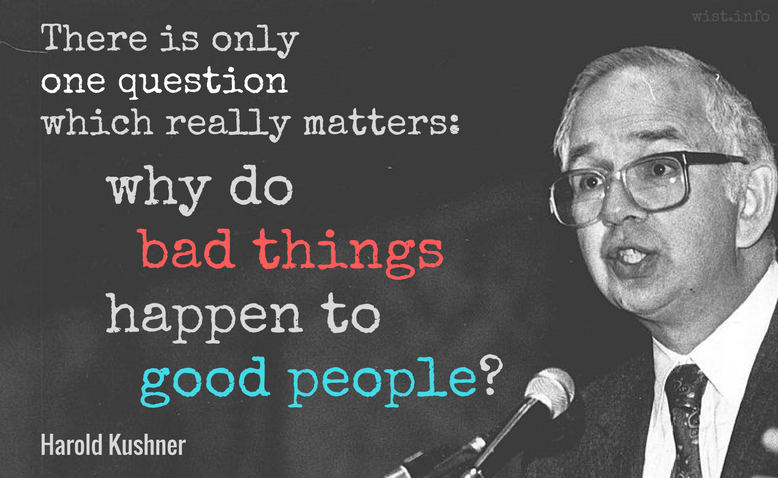
There is only one question which really matters: why do bad things happen to good people?
Harold S. Kushner (b. 1935) American author, rabbi
When Bad Things Happen to Good People, ch. 1 (1981)

The sun shines and warms and lights us and we have no curiosity to know why this is so; but we ask the reason of all evil, of pain, and hunger, and mosquitoes and silly people
Ralph Waldo Emerson (1803–1882) American essayist, lecturer, poet
Journal (1830-08-18)

O stranger, cease thy care;
Wise is the soul, but man is born to bear;
Jove weighs affairs of earth in dubious scales,
And the good suffers, while the bad prevails.
Bear, with a soul resign’d, the will of Jove;
Who breathes, must mourn: thy woes are from above.[‘ξεῖν᾽, ἐπεὶ οὔτε κακῷ οὔτ᾽ ἄφρονι φωτὶ ἔοικας:
Ζεὺς δ᾽ αὐτὸς νέμει ὄλβον Ὀλύμπιος ἀνθρώποισιν,
ἐσθλοῖς ἠδὲ κακοῖσιν, ὅπως ἐθέλῃσιν, ἑκάστῳ:
καί που σοὶ τάδ᾽ ἔδωκε, σὲ δὲ χρὴ τετλάμεν ἔμπης.]Homer (fl. 7th-8th C. BC) Greek author
The Odyssey [Ὀδύσσεια], Book 6, l. 187ff (6.187-190) [Nausicaa] (c. 700 BC) [tr. Pope (1725), l. 227ff]
(Source)
(Source (Greek)). Other translations:Stranger! I discern in thee
Nor sloth, nor folly, reigns; and yet I see
Th’ art poor and wretched. In which I conclude,
That industry nor wisdom make endued
Men with those gifts that make them best to th’ eye;
Jove only orders man’s felicity.
To good and bad his pleasure fashions still
The whole proportion of their good and ill.
And he, perhaps, hath form’d this plight in thee,
Of which thou must be patient, as he free.
[tr. Chapman (1616)]You seem to be a good man and discreet,
But Jove on good and bad such fortune lays,
Happy or otherwise, as he thinks meet;
And since distress is fallen to your share,
You must contented be to suffer it.
[tr. Hobbes (1675), l. 178ff]Since, stranger! neither base by birth thou seem’st,
Nor unintelligent, (but Jove, the King
Olympian, gives to good and bad alike
Prosperity according to his will,
And grief to thee, which thou must patient bear,)
[tr. Cowper (1792), l. 233ff]Stranger, who seemest neither vile nor vain,
Zeus both to good and evil doth divide
Wealth as he listeth. He perchance this pain
Appointed; thou thy sorrow must sustain.
[tr. Worsley (1861), st. 25]Nor vice, nor folly marks thee -- and great Jove
In high Olympus thron'd doth this world's good
To men mete out, the wicked and the just,
E'en as to Him seems best: and this thy lot
He haply hath assign'd;' and 'tis for thee
With patient soul to bear it.
[tr. Musgrave (1869), l. 289ff]Sir guest! since thou no sorry wight dost seem;
And Zeus himself from Olympus deals out weal
To the good and band: -- to each as it pleaseth him:
And somehow he hath sent these things to thee;
So it becomes thee to endure them wholly.
[tr. Bigge-Wither (1869)]Stranger, forasmuch as thou seemest no evil man nor foolish -- and it is Olympian Zeus himself that giveth weal to men, to the good and to the evil, to each one as he will, and this thy lot doubtless is of him, and so thou must in anywise endure it.
[tr. Butcher/Lang (1879)]O guest, forsooth thou seemest no fool, and no man of ill.
But Zeus the Olympian giveth to menfolk after his will,
To each, be he good, be he evil, his share of the happy day;
And these things shall be of his giving; so bear it as ye may.
[tr. Morris (1887)]Stranger, because you do not seem a common, senseless person, -- and Olympian Zeus himself distributes fortune to mankind and gives to high and low even as he wills to each; and this he gave to you, and you must bear it therefore.
[tr. Palmer (1891)]Stranger, you appear to be a sensible, well-disposed person. There is no accounting for luck; Zeus gives prosperity to rich and poor just as he chooses, so you must take what he has seen fit to send you, and make the best of it.
[tr. Butler (1898), rev. Power/Nagy]Stranger, since thou seemest to be neither an evil man nor a witless, and it is Zeus himself, the Olympian, that gives happy fortune to men, both to the good and the evil, to each man as he will; so to thee, I ween, he has given this lot, and thou must in any case endure it.
[tr. Murray (1919)]Stranger -- for to me you seem no bad or thoughtless man -- it is Zeus himself who assigns bliss to men, to the good adn to the evil as he wills, to each his lot. Wherefore surely he gave you this unhappiness, and you must bear it.
[tr. Lawrence (1932)]"Sir [...], your manners prove that you are no rascal and no fool; and as for these ordeals of yours, they must have been sent you by Olympian Zeus, who follows his own will in dispensing happiness to people whatever their merits. You have no choice but to endure.
[tr. Rieu (1946)]Stranger, there is no quirk or evil in you
that I can see. You know Zeus metes out fortune
to good and bad men as it pleases him.
Hardship he sent to you, and you must bear it.
[tr. Fitzgerald (1961)]My friend, since you seem not like a thoughtless man, nor a mean one,
it is Zeus himself, the Olympian, who gives people good fortune,
to each single man, to the good and the bad, just as he wishes;
and since he must have given you yours, you must even endure it.
[tr. Lattimore (1965)]You, stranger, since you do not seem to be
mad or malicious, know that only he --
Olympian Zeus -- allots felicity
to men, to both the noble and the base,
just as he wills. To you he gave this fate
and you must suffer it -- in any case.
[tr. Mandelbaum (1990)]"Stranger, [...]
friend, you're hardly a wicked man, and no fool, I'd say --
it's Olympian Zeus himself who hands our fortunes out,
to each of us in turn, to the good and bad,
however Zeus prefers ...
He gave you pain, it seems. You simply have to bear it.
[tr. Fagles (1996)]Stranger, you do not seem to be a bad man
Or a fool. Zeus himself, the Olympian god,
Sends happiness to good men and bad men both,
To each as he wills. To you he has given these troubles,
Which you have no choice but to bear.
[tr. Lombardo (2000), l. 191ff]Stranger -- because you seem neither base nor without understanding
Zeus himself, the Olympian, gives out fortune to mankind,
both to the base and the noble, to each one just as he wishes;
so he has given you this, yet nevertheless you must bear it.
[tr. Merrill (2002)]Since your manners show you are not a bad man or a fool -- it is Olympian Zeus himself who assigns good fortune to men, good and bad alike, as he wills, and must have sent you your personal misfortune -- and you must just endure it.
[tr. DCH Rieu (2002)]Stranger, you seem neither unknowing nor ill intentioned: it is Olympian Zeus himself who brings men good fortune, to the virtuous or not as he wills, and since he has brought you this, whatever it may be you must endure it.
[tr. Kline (2004)]Stranger, you do not strike me as either a rogue or a fool. It is Olympian Zeus himself who dispenses prosperity to men, to both good and bad, to each as he wishes; he must surely have sent you these troubles, and you must bear them as you may.
[tr. Verity (2016)]Well, stranger, you seem a brave and clever man; you know that Zeus apportions happiness to people, to good and bad, each one as he decides. your troubles come from him, and you must bear them.
[tr. Wilson (2017)]Stranger, you seem neither malicious nor witless: but it's Zeus, the Olympian in person, who bestows good fortune on men, the good and the bad, to each as he wills; I suppose he chose this lot for you, and you just have to bear it.
[tr. Green (2018)]Stranger, you don’t seem to be a wicked man,
or foolish. Olympian Zeus himself
gives happiness to bad and worthy men,
each one receiving just what Zeus desires.
So he has given you your share, I think.
Nonetheless, you must still endure your lot.
[tr. Johnston (2019), l. 241ff]

God doth not promise here to man that He
Will free him quickly from his misery;
But in His own time, and when He thinks fit,
Then He will give a happy end to it.Robert Herrick (1591–1674) English poet
“God’s Time Must End Our Trouble,” Hesperides, # 252 (1648)
For God judged it better to bring good out of evil than not to permit any evil to exist.
[Melius enim judicavit de malis bene facere quam mala nulla esse permittere.]Augustine of Hippo (354–430) Christian church father, philosopher, saint [b. Aurelius Augustinus]
Enchiridion on Faith, Hope and Love, ch. 8 / § 27 (AD 420) [tr. Outler (1955)]
(Source)
(Source (Latin)). Other translations:For He judged it better to bring good out of evil, than not to permit any evil to exist.
[tr. Shaw (1887)]God judged it better to bring good out of evil than to suffer no evil to exist.
[tr. Clifford (1903)]

It is not so much the suffering as the senselessness of it that is unendurable.
Friedrich Nietzsche (1844–1900) German philosopher and poet
(Attributed)
Paraphrased by Nicolas Berdyaev, The Destiny of Man, 2.2.5 (1931) [tr. Duddington (1955)]

Rabbi Jannai said: “It is beyond our power to explain either the prosperity of the wicked or the afflictions of the righteous.”
The Talmud (AD 200–500) Collection of Jewish rabbinical writings
The Mishnah (c. AD 200)