

All human beings have failings, all human beings have needs and temptations and stresses. Men and women who live together through long years get to know one another’s failings; but they also come to know what is worthy of respect and admiration in those they live with and in themselves. If at the end one can say; “This man used to the limit the powers that God granted him; he was worthy of love and respect and of the sacrifices of many people, made in order that he might achieve what he deemed to be his task,” then that life has been lived well and there are no regrets.
Eleanor Roosevelt (1884–1962) American politician, diplomat, activist; First Lady of the US (1933–45)
Memoir (1949), This I Remember, ch. 20 “The Last Term: 1944–1945”
(Source)
Reflecting on her life with her deceased husband, Franklin D. Roosevelt. The same passage is included in her compiled 1961 Autobiography, Part 2, ch. 27 "The Last Term: 1944–1945."
Quotations about:
weaknesses
Note not all quotations have been tagged, so Search may find additional quotes on this topic.

Thy greatest Wisdom consists in being acquainted with thy own Follies.
Thomas Fuller (1654–1734) English physician, preacher, aphorist, writer
Introductio ad Prudentiam, Vol. 2, # 1882 (1727)
(Source)
This is the tax a man must pay to his virtues, — they hold up a torch to his vices, and render those frailties notorious in him which would have passed without observation in another.
Charles Caleb "C. C." Colton (1780–1832) English cleric, writer, aphorist
Lacon: Or, Many Things in Few Words, Vol. 1, § 237 (1820)
(Source)
Every now and then, in the course of great events, the elements of tradition and innovation ally themselves and each one’s weakness supplements the other and together they achieve the perfect debacle.
Murray Kempton (1917–1997) American journalist.
“The Genius of Mussolini,” New York Review of Books (7 Oct 1982)
(Source)
Reprinted in Rebellions, Perversities, and Main Events (1994).

You have to look at yourself objectively. Analyze yourself like an instrument. You have to be absolutely frank with yourself. Face your handicaps, don’t try to hide them. Instead, develop something else.
Audrey Hepburn (1929–1993) Belgian-English actress
Quoted in Barry Paris, Audrey Hepburn, ch. 4 (2002)
(Source)

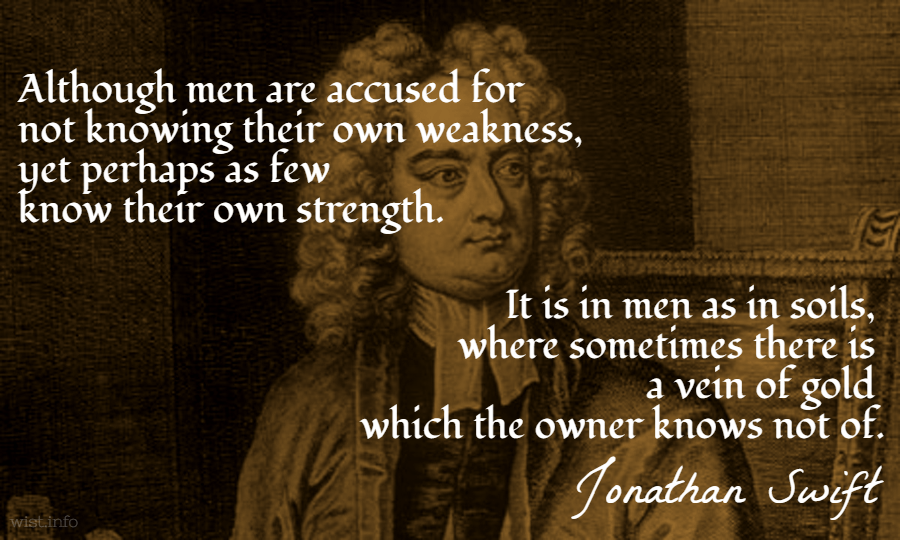
Although men are accused for not knowing their own weakness, yet perhaps as few know their own strength. It is in men as in soils, where sometimes there is a vein of gold which the owner knows not of.
Jonathan Swift (1667–1745) English writer and churchman
Thoughts on Various Subjects (1706)
(Source)

Cunning is the art of concealing our own defects, and discovering other people’s weaknesses.
William Hazlitt (1778–1830) English writer
Characteristics in the Manner of Rochefoucault’s Maxims (1823)

The awareness of their individual blemishes and shortcomings inclines the frustrated to detect ill will and meanness in their fellow men. Self-contempt, however vague, sharpens our eyes for the imperfections of others. We usually strive to reveal in others the blemishes we hide in ourselves.
Eric Hoffer (1902–1983) American writer, philosopher, longshoreman
True Believer: Thoughts on the Nature of Mass Movements, Part 3, ch. 14, § 100 (3.14.100) (1951)
(Source)
We try to make virtues of the faults we do not wish to correct.
[Nous essayons de nous faire honneur des défauts que nous ne voulons pas corriger.]
François VI, duc de La Rochefoucauld (1613–1680) French epigrammatist, memoirist, noble
Réflexions ou sentences et maximes morales [Reflections; or Sentences and Moral Maxims], ¶442 (1665-1678) [tr. Kronenberger (1959)]
(Source)
First appeared in the 5th (1678) edition.
(Source (French)). Other translations:We attempt to Vindicate, and value our selves upon those Faults we have no design to mend.
[tr. Stanhope (1694), ¶2.30; (1706 ed.), ¶442]We endeavour to get reputation by those faults we determine not to amend.
[pub. Donaldson (1783), ¶138; ed. Carvill (1835), ¶122]We endeavor to make a merit of faults that we are unwilling to correct.
[ed. Gowens (1851), ¶467]We try to make a virtue of vices we are loth to correct.
[tr. Bund/Friswell (1871), ¶442]We boast the faults we are unwilling to correct.
[tr. Heard (1917), ¶464]We endeavour to take pride in faults that we would rather not correct.
[tr. Stevens (1939), ¶442]We try to glory in those failings which we are unwilling to correct.
[tr. FitzGibbon (1957), ¶442]We try to make virtues out of the faults we have no wish to correct.
[tr. Tancock (1959), ¶442]We try to make a merit of those of our faults which we do not wish to correct.
[tr. Whichello (2016) ¶442]

We confess to small faults to create the impression that we have no great ones.
[Nous n’avouons de petits défauts que pour persuader que nous n’en avons pas de grands.]
François VI, duc de La Rochefoucauld (1613–1680) French epigrammatist, memoirist, noble
Réflexions ou sentences et maximes morales [Reflections; or Sentences and Moral Maxims], ¶327 (1665-1678) [tr. Kronenberger (1959)]
(Source)
First appeared in the 3rd (1671) edition. See also ¶126.
(Source (French)). Other translations:When we own small Faults, it is with a design to make People believe, we have no great ones.
[tr. Stanhope (1694), ¶327]We confess small faults in order to insinuate that we have no great ones.
[pub. Donaldson (1783), ¶127]We confess small faults, by way of insinuating that we have no great ones.
[ed. Carvill (1835), ¶111]We confess our little faults only to persuade others that we have no great ones.
[ed. Gowens (1851), ¶337]We own to small faults to persuade others that we have not great ones.
[tr. Bund/Friswell (1871), ¶327]We admit our petty foibles only to disclaim greater faults.
[tr. Heard (1917), ¶334]We will admit our minor defects, but only to persuade others that we have no major ones.
[tr. FitzGibbon (1957), ¶327]We own up to minor failings, but only so as to convince others that we have no major ones.
[tr. Tancock (1959), ¶327]We confess to small faults only for the purpose of persuading others that we do not possess great ones.
[tr. Whichello (2016), ¶327]We admit to lesser faults in order persuade people that we have no greater ones.
[tr. Chandler, ¶327]