It is clear that the monarch who, through bad counsel or negligence, ceases to see that the laws are executed can easily repair the damage: he has only to get a new counsellor, or correct his own negligence. But when, in a popular government, the laws have ceased to be executed, since this can result only from corruption of the republic, the state is already undone.
[Il est clair encore que le monarque qui, par mauvais conseil ou par négligence, cesse de faire exécuter les loix, peut aisément réparer le mal ; il n’a qu’à changer de conseil, ou se corriger de cette négligence même. Mais lorsque, dans un gouvernement populaire, les loix ont cessé d’être exécutées, comme cela ne peut venir que de la corruption de la république, l’état est déja perdu.]
Charles-Lewis de Secondat, Baron de Montesquieu (1689–1755) French political philosopher
Spirit of Laws [The Spirit of the Laws; De l’esprit des lois], Book 3, ch. 3 (1748) [tr. Stewart (2018)]
(Source)
(Source (French)). Other translations:Clear it is also that a monarch, who through bad advice or indolence ceases to enforce the execution of the laws, may easily repair the evil: he has only to follow other advice; or to shake off this indolence. But when in popular government, there is a suspension of the laws, as this can proceed only from the corruption of the republic, the state is certainly undone.
[tr. Nugent (1750)]It is also clear that the monarch who ceases to see to the execution of the laws, though bad counsel or negligence, may easily repair the damage; he has only to change his counsel or correct his own negligence. But in a popular government when the laws have ceased to be executed, as this can only come from the corruption of the republic, the state is already lost.
[tr. Cohler/Miller/Stone (1989)]
Quotations about:
enforcement
Note not all quotations have been tagged, so Search may find additional quotes on this topic.
Justice without strength, and strength without justice: fearful misfortunes!
[La justice sans force, et la force sans justice: malheurs aflreux!]
Joseph Joubert (1754–1824) French moralist, philosopher, essayist, poet
Pensées [Thoughts], ch. 15 “De la Liberté, de la Justice et des Lois [On Liberty, Justice, and Laws],” ¶ 18 (1850 ed.) [tr. Calvert (1866), ch. 12]
(Source)
In this and like communities, public sentiment is everything. With public sentiment, nothing can fail; without it, nothing can succeed. Consequently, he who moulds public sentiment goes deeper than he who enacts statutes or pronounces decisions. He makes statutes and decisions possible or impossible to be executed.

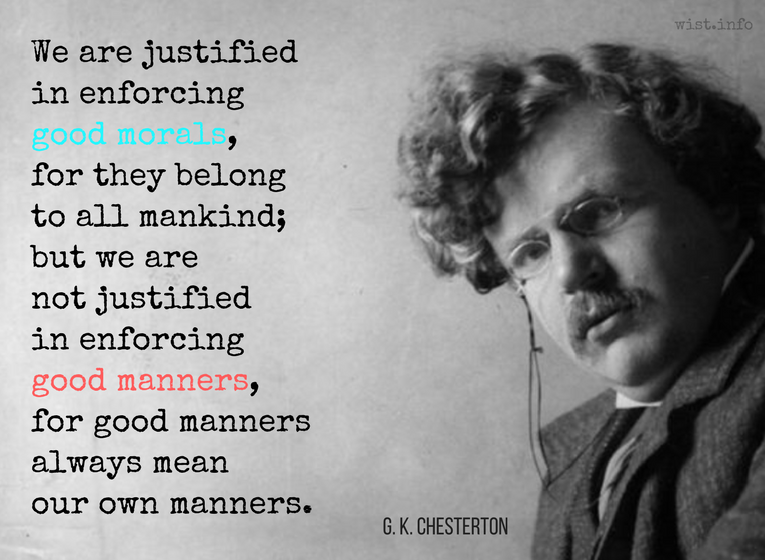
We are justified in enforcing good morals, for they belong to all mankind; but we are not justified in enforcing good manners, for good manners always mean our own manners.
Gilbert Keith Chesterton (1874–1936) English journalist and writer
All Things Considered, “Limericks and Counsels of Perfection” (1908)
(Source)
The kind of man who wants the government to adopt and enforce his ideas is always the kind of man whose ideas are idiotic.
H. L. Mencken (1880–1956) American writer and journalist [Henry Lewis Mencken]
Minority Report, #323 (1956)
(Source)
The prestige of government has undoubtedly been lowered considerably by the prohibition law. For nothing is more destructive of respect for the government and the law of the land than passing laws which cannot be enforced. It is an open secret that the dangerous increase of crime in the United States is closely connected with this.
Albert Einstein (1879–1955) German-American physicist
“My First Impression of the U.S.A.” (1921)
(Source)
Later published as "Some Notes on my American Impressions" in The World As I See It (1949)