At the hour of civilization through which we are now passing, and which is still so sombre, the miserable’s name is MAN; he is agonizing in all climes, and he is groaning in all languages.
[À l’heure, si sombre encore, de la civilisation où nous sommes, le misérable s’appelle L’HOMME; il agonise sous tous les climats, et il gémit dans toutes les langues.]
Victor Hugo (1802–1885) French writer, journalist, human rights activist, politician
Letter (1862-10-18) to M. Daelli [tr. Wraxall (1862)
(Source)
(Source (French)). Daeli was the publisher of the Italian translation of Les Misérables.
Quotations about:
torment
Note not all quotations have been tagged, so Search may find additional quotes on this topic.

Over and over in my mind preside
the dark and somber moods Love puts me through.
Self-pity broods, so I have often cried,
“Alas, do other people feel this too?”[Spesse fiate vegnonmi a la mente
le oscure qualità ch’Amor mi dona,
e venmene pietà, sì che sovente
io dico: «Lasso!, avviene elli a persona?»]Dante Alighieri (1265–1321) Italian poet
La Vita Nuova [Vita Nova; New Life], ch. 16 / Sonnet 7, ll. 1-4 (c. 1294, pub. 1576) [tr. Frisardi (2012), ch. 9]
(Source)
Dante in the painful, self-pitying throes of unrequited love for Beatrice. "Nobody has known such tormented love as mine ..."
(Source (Italian)). Alternate translations:Many the times that to my memory comes
The cheerless state imposed on me by Love;
And o’er me comes such sadness then, that oft
I say, alas, was ever fate like mine!
[tr. Lyell (1845)]At whiles (yea oftentimes) I muse over
The quality of anguish that is mine
Through Love: then pity makes my voice to pine,
Saying, “Is any else thus, anywhere?”
[tr. Rossetti (c. 1847; 1899 ed.)]Full many a time I ponder on the drear
And heavy hours which Love doth make my doom;
And then I cry, "Alas!" in piteous cheer,
"Was ever fate like mine, so wrapt in gloom?"
[tr. Martin (1862)]The dark condition Love doth on me lay
Many a time occurs unto my thought,
And then comes pity, so that oft I say,
Ah me! to such a pass was man e’er brought?
[tr. Norton (1867), ch. 16]Many a time the thought returns to me:
What sad conditions Love on me bestows!
And moved by Pity I say frequently:
"Can there be anyone who my state knows?"
[tr. Reynolds (1969)]So many tmes there comes into my mind
The dark condition Love bestows on me,
That pity comes and often makes me say:
"Could every anyone have felt the same?"
[tr. Musa (1971)]Time and again the thought comes to my mind
of the dark condition Love imparts to me;
then the pity of it strikes me, and I ask:
"Could ever anyone have felt the same?"
[tr. Hollander (1997) , sec. 7]Often it is brought home to my mind
the dark quality that Love gives me,
and pity moves me, so that frequently
I say: "Alas! is anyone so afflicted?"
[tr. Kline (2002)]Frequently there come to my mind
the puzzling characteristics Love gives me,
and I feel pity for them, so that often
I say: "Alas! Does this happen to anyone else?"
[tr. Appelbaum (2006)]

“I love and hate.” “At once?” you ask, “Now pray explain.”
“I know not how; I feel ’tis so, I’m rent in twain.”[Odi et amo. quare id faciam fortasse requiris
nescio, sed fieri sentio et excrucior.]Catullus (c. 84 BC – c. 54 BC) Latin poet [Gaius Valerius Catullus]
Carmina # 85 [tr. Symons-Jeune (1923)]
(Source)
(Source (Latin)). Other translations:Tho' I hate, yet I love! -- you'll perhaps ask me, how?
I can't tell; but I'm vext, and feel that I do.
[tr. Nott (1795), # 82 "On His Love"]I hate and love -- ask why -- I can't explain,
I feel 'tis so, and feel it racking pain.
[tr. Lamb (1821), "On His Own Love"]I hate and love -- wherefore I cannot tell,
But by my tortures know the fact too well.
[tr. T. Martin (1861), "Love's Unreason"]I have and love. "Why do I so?"
Perhaps you ask. I can't explain:
The bitter fact I only know,
And torture racks my brain.
[tr. Cranstoun (1867), "On His Love"]Half I hate, half love. How so? one haply requireth.
Nay, I know not; alas feel it, in agony groan.
[tr. Ellis (1871)]Hate I, and love I. Haps thou'lt ask me wherefore I do so.
Wot I not, yet so I do feeling a torture of pain.
[tr. Burton (1893), "How the Poet Loves"]I hate and I love. Why I do this, perhaps you ask. I know not, but I feel it happening and I am tortured.
[tr. Smithers (1894)]I hate and love. Why I do so, perhaps you ask. I know not, but I feel it, and I am in torment.
[tr. Warre Cornish (1904)]I hate and yet I love; perhaps you ask how this can be. I do not know, but that it is so I feel too well, and live in torment.
[tr. Stuttaford (1912)]I hate and love. You question "How?" I lack
An answer, but I feel it on the rack.
[tr. MacNaghten (1925)]I hate and love, nor can the reason tell;
But that I love and hate I know too well.
[tr. Wright (1926), "Odi et Amo"]I hate and love.
And if you ask me why,
I have no answer, but I discern,
can feel, my senses rooted in eternal torture.
[tr. Gregory (1931)]I hate & love. And if you should ask how I can do both,
I couldn't say; but I feel it, and it shivers me.
[tr. C. Martin (1979)]I hate and love. And why, perhaps you’ll ask.
I don’t know: but I feel, and I’m tormented.
[tr. Kline (2001), "Love-Hate"]I hate and love. You wonder, perhaps, why I'd do that?
I have no idea. I just feel it. I am crucified.
[tr. Green (2005)]I hate and I love. How do I do that, perhaps you ask?
I don't know. But I feel it is happening and I am tormented.
[tr. Wikibooks (2017)]I hate and I love. Why I do this, perhaps you ask.
I do not know, but I feel it being done and I am tormented.
[tr. Wikisource (2018)]I hate and I love: you might ask why I do this --
I don’t know, but I see it happen and it’s killing me.
[tr. @sententique (2023)]I hate, I love; I love, I hate.
But why, you ask again.
I don't know if it's fault, or fate,
This such exquisite pain.
[tr. Hill (2024)]

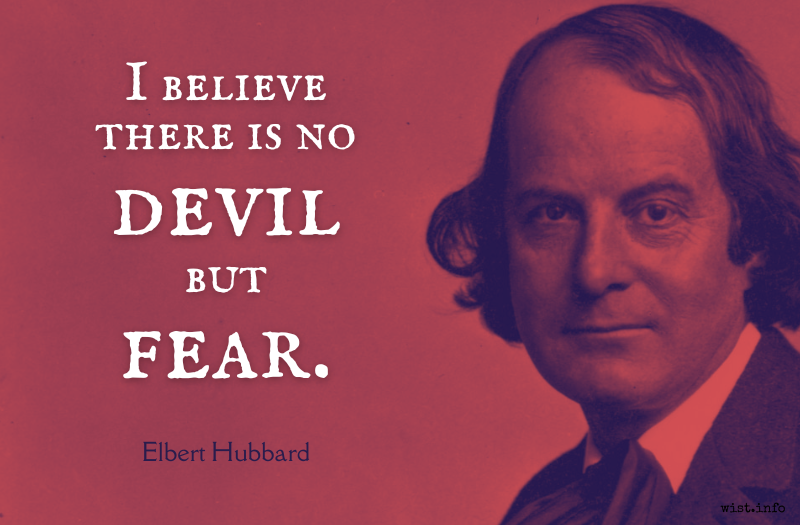
I believe there is no devil but fear.

If you make money your god, it will plague you like the devil.
Proverbs, Sayings, and Adages
English proverb
Sometimes "'twill plague you".
An anonymous proverb, recorded in Thomas Fielding, ed., Select Proverbs of All Nations (1824). Thomas Fielding was the pseudonym of John Wade (1788-1875), a British journalist and author.
Though Fielding was only a compiler of proverbs and aphorisms, the quotation then shows up in a variety of collections later in the 19th Century actually cited to "Fielding," e.g., H. Southgate, ed., Many Thoughts of Many Minds (1862); John Camden Hotten, ed. The Golden Treasury of Thought (1873); Edward Parsons Day, ed., Day's Collacon: an Encyclopaedia of Prose Quotations (1884).
In relatively short order, this "Fielding" then became conflated with the more famous English writer Henry Fielding (1707-1754), to whom this quotation is often credited.

No, not if I had a hundred tongues and a hundred mouths
and a voice of iron too — I could never capture
all the crimes or run through all the torments,
doom by doom.[Non, mihi si linguae centum sunt oraque centum
Ferrea vox, omnis scelerum comprendere formas,
Omnia poenarum percurrere nomina possim.]Virgil (70–19 BC) Roman poet [b. Publius Vergilius Maro; also Vergil]
The Aeneid [Ænē̆is], Book 6, l. 625ff (6.625-627) [The Sybil] (29-19 BC) [tr. Fagles (2006), l. 724ff]
(Source)
The punishments in Tartarus. Virgil uses a similar metaphor in Georgics 2.43.
(Source (Latin)). Other translations:Had I a hundred mouths, as many tongues,
A voice of iron, to these had brazen lungs;
Their crimes and tortures ne're could be displaid.
[tr. Ogilby (1649)]Had I a hundred mouths, a hundred tongues,
And throats of brass, inspired with iron lungs,
I could not half those horrid crimes repeat,
Nor half the punishments those crimes have met.
[tr. Dryden (1697)]Had I a hundred tongues, and a hundred mouths, and a voice of iron, I could not comprehend all the species of their crimes, nor enumerate the names of all their punishments.
[tr. Davidson/Buckley (1854)]No -- had I e'en a hundred tongues
A hundred mouths, and iron lungs,
Those types of guilt I could not show,
Nor tell the forms of penal woe.
[tr. Conington (1866)]Not if I had a hundred tongues, a voice
Of iron, could I tell thee all the forms
Of guilt, or number all their penalties.
[tr. Cranch (1872), l. 780ff]Not had I an hundred tongues, an hundred mouths, and a voice of iron, could I sum up all the shapes of crime or name over all their punishments.
[tr. Mackail (1885)]Nor, had I now an hundred mouths, an hundred tongues at need,
An iron voice, might I tell o'er all guise of evil deed,
Or run adown the names of woe those evil deeds are worth.
[tr. Morris (1900)]Ne'er had a hundred mouths, if such were mine,
Nor hundred tongues their endless sins declared,
Nor iron voice their torments could define,
Or tell what doom to each the avenging gods assign.
[tr. Taylor (1907), st. 83, l. 744ff]&I could not tell,
Not with a hundred mouths, a hundred tongues,
Or iron voice, their divers shapes of sin,
Nor call by name the myriad pangs they bear.
[tr. Williams (1910)]Nay, had I a hundred tongues, a hundred mouths, and voice of iron, I could not sum up all the forms of crime, or rehearse all the tale of torments.
[tr. Fairclough (1916)]If I had a hundred tongues,
A hundred iron throats, I could not tell
The fullness of their crime and punishment.
[tr. Humphries (1951)]No, not if I had a hundred tongues, a hundred mouths
And a voice of iron, could I describe all the shapes of wickedness,
Catalogue all the retributions inflicted here.
[tr. Day-Lewis (1952)]A hundred tongues,
a hundred mouths, an iron voice were not
enough for me to gather all the forms
of crime or tell the names of all the torments.
[tr. Mandelbaum (1971), l. 829ff]If I had
A hundred tongues, a hundred mouths, a voice
Of iron, I could not tell of all the shapes
Their crimes had taken, or their punishments.
[tr. Fitzgerald (1981)]If I had a hundred tongues, a hundred mouths and a voice of iron, I could not encompass all their different crimes or speak the names of all their different punishments.
[tr. West (1990)]Not if I had a hundred tongues, a hundred mouths,
a voice of iron, could I tell all the forms of wickedness
or spell out the names of every torment.
[tr. Kline (2002)]Not if I had a hundred mouths, a hundred tongues,
And a voice of iron, could I recount
All the crimes or tell all their punishments.
[tr. Lombardo (2005)]A hundred tongues and mouths, an iron voice, wouldn't let me cover the varieties of evil, nor all the names for punishments.
[tr. Bartsch (2021)]
But, as for thee, I think and deem it well
Thou take me for thy guide, and pass with me
Through an eternal place and terrible
Where thou shalt hear despairing cries, and see
Long-departed souls that in their torments dire
Howl for the second death perpetually.[Ond’ io per lo tuo me’ penso e discerno
che tu mi segui, e io sarò tua guida,
e trarrotti di qui per loco etterno;
ove udirai le disperate strida,
vedrai li antichi spiriti dolenti,
ch’a la seconda morte ciascun grida.]Dante Alighieri (1265–1321) Italian poet
The Divine Comedy [Divina Commedia], Book 1 “Inferno,” Canto 1, l. 112ff (1.112-117) (1309) [tr. Sayers (1949)]
(Source)
Virgil, offering Dante a tour of Hell. There is some debate, reflected in the various translations, as to whether the "second death" is the death of the soul upon damnation, the endless punishments of the damned, a prayed-for total annihilation to end their torment, or the destruction of Hell after the Last Judgment. See Rev. 2:11, 20:14, 21:8.
(Source (Italian)). Other translations:Wherefore I think, and judge it best that you
Should follow me, and I will be your Guide
From hence to places of eternal woe,
Where you shall hear the wailings of despair,
And see the Ghosts of former times lament,
Who eagerly request a second death.
[tr. Rogers (1782)]But Heav'n in love to thee hath sent me here
A kind and faithful guide -- dismiss thy fear,
Thro' other worlds to lead thy steps along.
Thine ears must meet the yell of stern despair,
Where Heav'n's avending hand forgets to spare,
And tribes forlorn a second death implore.
[tr. Boyd (1802), st. 20-21]I for thy profit pond'ring now devise,
That thou mayst follow me, and I thy guide
Will lead thee hence through an eternal space,
Where thou shalt hear despairing shrieks, and see
Spirits of old tormented, who invoke
A second death.
[tr. Cary (1814)]Now for thy weal I counsel and perpend
Thou follow hence where I shall lead thee on
Through realm eternal, whither if thou wend.
Thine ear shall hear the shrieks of hope foregone,
Thine eye shall see the souls of eld in woe,
That ever call the second death upon.
[tr. Dayman (1843)]Wherefore I think and discern this for thy best, that thou follow me; and I will be thy guide, and lead thee hence through an eternal place,
where thou shalt hear the hopeless shrieks, shalt see the ancient spirits in pain, so that each calls for a second death.
[tr. Carlyle (1849)]Thou wilt follow me and I will be thy guide --
'Tis for thy sake, I think I can discern.
From hence I'll lead thee through the place alone,
Where thou shalt hear the desperate shrieks, and see
The Antique Spirits in their misery --
Upon the second death they all will cry.
[tr. Bannerman (1850)]To thee then better counsel I commend,
Follow thou me and I will be thy guide,
And lead thee hence through the Eternal Realms'
Where thou shalt hear the wail of wild despair,
And of old times the sorrowful spirits see
Calling in anguish for the second death.
[tr. Johnston (1867)]Therefore I think and judge it for thy best
Thou follow me, and I will be thy guide,
And lead thee hence through the eternal place,
Where thou shalt hear the desperate lamentations,
Shalt see the ancient spirits disconsolate,
Who cry out each one for the second death.
[tr. Longfellow (1867)]Wherefore I for thy bettering think and decide that thou follow me; and I will be thy guide, and will draw thee from here through an eternal place, where thou shalt hear the shrieks of despair, shalt see the ancient spirits in woe, who each cry upon the second death.
[tr. Butler (1885)]Now for thy profit in my thoughts I trace
How thou mayst follow, I will guide thee fair,
From here I'll lead thee through eternal space,
Where thou shalt hear the shriekings of despair,
Shalt see the ancient spirits grief-possest,
Who each the second death invokes with prayer.
[tr. Minchin (1885)]Wherefore I think and deem it for thy best that thou follow me, and I will be thy guide, and will lead thee hence through the eternal place where thou shalt hear the despairing shrieks, shalt see the ancient spirits woeful who each proclaim the second death.
[tr. Norton (1892)]Wherefore in thy behoof I think and deem it well, that thou shouldst follow me ; and I will be thy guide, and lead thee out from this place through the eternal realms, where thou shalt hear shriekings of despair, shalt see the ancient spirits in their sorrowing, so that each crieth aloud for second death.
[tr. Sullivan (1893)]And therefore, for thy good, I thus determine.
That thou do follow me, and I will guide thee,
And hence will take thee through a place eternal,
Where thou shalt hear the desperate lamentations,
Shalt see the ancient spirits in their dolour.
Where for the second death each one makes outcry.
[tr. Griffith (1908)]Therefore, considering what is best for thee, I judge that thou shouldst follow me, and I shall be thy guide and lead thee hence through an eternal place where thou shalt hear the despairing shrieks of the ancient spirits in pain who each bewail the second death.
[tr. Sinclair (1939)]Wherefore I judge this fittest for thy case
That I should lead thee, and thou follow in faith,
To journey hence through an eternal place,
Where thou shalt hear cries of despairing breath,
Shalt look on the ancient spirits in their pain,
Such that each calls out for a second death.
[tr. Binyon (1943)]Therefore, for your own good, I think it well
you follow me and I will be your guide
and lead you forth through an eternal place.
There you shall see the ancient spirits tried
in endless pain, and hear their lamentation
as each bemoans the second death of souls.
[tr. Ciardi (1954), l. 105ff]Therefore I think and deem it best that you should follow me, and I will be your guide and lead you hence through an eternal place, where you shall hear the despairing shrieks and see the ancient tormented spirits who all bewail the second death.
[tr. Singleton (1970)]And so, I think it best you follow me
for your own good, and I shall be your guide
and lead you out through an eternal place
where you will hear desperate cries, and see
tormented shades, some old as Hell itself,
and know what second death is, from their screams.
[tr. Musa (1971)]Therefore, I think and judge it best for you
to follow me, and I shall guide you, taking
you from this place through an eternal place,
where you shall hear the howls of desperation
and see the ancient spirits in their pain,
as each of them laments his second death
[tr. Mandelbaum (1980)]The course I think would be the best for you,
Is to follow me, and I will act as your guide
And show a way out of here, by a place in eternity.
Where you will hear the shrieks of men without hope,
And will see the ancient spirits in such pain
That every one of them calls out for a second death.
[tr. Sisson (1981)]Therefore I judge it best that you should choose
To follow me, and I will be your guide
Away from here and through an eternal space:
To hear the cries of despair, and to behold
Ancient tormented spirts as they lament
In chorus the second death they must abide.
[tr. Pinsky (1994)]Thus for your good I think and judge that you shall follow me, and I shall be your guide, and I will lead you from here through an eternal place,
where you will hear the desperate shrieks, you will see the ancient suffering spirits, who all cry out at the second death.
[tr. Durling (1996)]It is best, as I think and understand, for you to follow me, and I will be your guide, and lead you from here through an eternal space where you will hear the desperate shouts, will see the ancient spirits in pain, so that each one cries out for a second death.
[tr. Kline (2002)]But as for you, I think I will advise you well
to follow me, and I will be your guide,
to lead you hence into a place eternal,
where you'll hear the shrieks, unqualified
by hope, of those who suffer so much pain,
each wishes that he died a second time.
[tr. Carson (2002)]Therefore, considering what's best for you,
I judge that you should follow, I should guide,
and hence through an eternal space lead on.
There you shall hear shrill cries of desperation,
And see those spirits, mourning ancient pain,
who all cry out for death to come once more.
[tr. Kirkpatrick (2006)]Therefore, for your sake, I think it wise
you follow me: I will be your guide,
leading you, from here, through an eternal place
where you shall hear despairing cries
and see those ancient souls in pain
as they bewail their second death.
[tr. Hollander/Hollander (2007)]And this is why I think you must allow
Yourself to follow me, and I must guide
And lead you across an eternal land, where crowds
Of desperate souls will constantly shriek and cry,
And you will see the souls of the ancient dead
In pain, wanting another chance to die.
[tr. Raffel (2010)]But by now I've pondered well
The path adapted best to serve your cause,
So let me be your guide. I'll take you through
The timeless breaker's yard where you will hear
The death cries of the damned who die anew
Every day, though dead already in the year --
No dated stones remain to give a clue --
The earliest sinners died, when time began.
[tr. James (2013), l. 146ff]As we go forward from here, stay at all times behind me,
And I'll play the part of your guide. It's my plan
To lead you through a place never-ending, i.e., eternal
Hell, where you'll hear the worst kind of wailing,
See the ageless shades writhing in pain,
Sense their vain request for a second death.
[tr. Bang (2013)]
No one has ever written, painted, sculpted, modeled, built, or invented except literally to get out of hell.
Antonin Artaud (1896–1948) French playwright, actor, director
Van Gogh, the Man Suicided by Society [Le Suicidé de la Société] (1947) [tr. Watson]
(Source)

There is no wilderness where I can hide from these things, there is no haven where I can escape them; though I travel to the ends of the earth, I find the same accursed system — I find that all the fair and noble impulses of humanity, the dreams of poets and the agonies of martyrs, are shackled and bound in the service of organized and predatory Greed! And therefore I cannot rest, I cannot be silent; therefore I cast aside comfort and happiness, health and good repute — and go out into the world and cry out the pain of my spirit!
Upton Sinclair (1878–1968) American writer, journalist, activist, politician
The Jungle, ch. 28 (1906)
(Source)
He imagined the pain of the world to be like some formless parasitic being seeking out the warmth of human souls wherein to incubate and he thought he knew what made one liable to its visitations. What he had not known was that it was mindless and so had no way to know the limits of those souls and what he feared was that there might be no limits.
Cormac McCarthy (1933–2023) American novelist, playwright, screenwriter
All the Pretty Horses (1992)
(Source)

Sometimes I wrestle with my inner demons. Sometimes we just cuddle.
Sig Lines
~

The married state, with and without the affection suitable to it, is the completest image of heaven and hell we are capable of receiving in this life.
Richard Steele (1672–1729) Anglo-Irish writer, journalist, playwright, politician
Essay (1712-09-09), The Spectator, No. 479
(Source)
What greater evil could you wish a miser than a long life?
Publilius Syrus (d. 42 BC) Assyrian slave, writer, philosopher [less correctly Publius Syrus]
Sententiae [Moral Sayings], # 69 [tr. Lyman (1862)]
I swore to never be silent whenever and wherever human beings endure suffering and humiliation. We must always take sides. Neutrality helps the oppressor, never the victim; silence encourages the tormentor, never the tormented.
Elie Wiesel (1928–2016) Romanian-American novelist, professor, political activist, Nobel Laureate.
Speech (1986-12-10), Accepting the Nobel Peace Prize
(Source)