

King George has palaces of pride,
And armed grooms must ward those halls;
With one stout bolt I safe abide
Within my own four walls.Not all his men may sever this,
It yields to friends’, not monarchs’, calls;
My whinstone house my castle is —
I have my own four walls.Thomas Carlyle (1795–1881) Scottish essayist and historian
Poem (1825?), “My Own Four Walls,” st. 4-5
(Source)
Quotations about:
refuge
Note not all quotations have been tagged, so Search may find additional quotes on this topic.
A rising mass movement attracts and holds a following not by its doctrine and promises but by the refuge it offers from the anxieties, barrenness and meaninglessness of an individual existence. It cures the poignantly frustrated not by conferring on them an absolute truth or by remedying the difficulties and abuses which made their lives miserable, but by freeing them from their ineffectual selves — and it does this by enfolding and absorbing them into a closely knit and exultant corporate whole.
Eric Hoffer (1902–1983) American writer, philosopher, longshoreman
True Believer: Thoughts on the Nature of Mass Movements, Part 2, ch. 5, § 34 (2.5.34) (1951)
(Source)
MEDEA: Now let things take their course. What use is life to me?
I have no land, no home, no refuge from despair.[ΜΉΔΕΙΑ: ἴτω: τί μοι ζῆν κέρδος; οὔτε μοι πατρὶς
οὔτ᾽ οἶκος ἔστιν οὔτ᾽ ἀποστροφὴ κακῶν.]Euripides (485?-406? BC) Greek tragic dramatist
Medea [Μήδεια], l. 798ff (431 BC) [tr. Vellacott (1963)]
(Source)
Though she has just been offered refuge in Athens by King Ægeus; perhaps because that contradiction, note that some more recent translators (Davie, Ewans) leave out these lines as interpolations.
(Source (Greek)). Other translations:Can life be any gain
To me who have no country left, no home,
No place of refuge?
[tr. Wodhull (1782)]Go to: hath life
A blessing yet for me? I have no country,
I have no house, no refuge from my ills.
[tr. Potter (1814)]Well, be it as it must be.
What good for me to live? No home for me,
Nor fatherland, nor refuge from my woes.
[tr. Webster (1868)]Enough! What gain is life to me? I have no country, home, or refuge left.
[tr. Coleridge (1891)]Let things take their course; what gain is it to me to live longer? I have neither country, nor house, nor refuge from my ills.
[tr. Buckley (1892)]Let all go: what is life to me? Nor country
Nor home have I, nor refuge from mine ills.
[tr. Way (Loeb) (1894)]Let it come!
What profits life to me? I have no home,
No country now, nor shield from any wrong.
[tr. Murray (1906)]What good is life? I have no land,
No home, no shelter for my misery.
[tr. Lucas, ed. Higham (1938)]So it must happen. What profit have I in life?
I have no land, no home, no refuge from my pain.
[tr. Warner (1944)]So -- what profit for me in living? who have
No country, no home, no shelter from misfortune.
[tr. Podlecki (1989)]Let that be as it will. What do I gain by living? I have no fatherland, no house, and no means to turn aside misfortune.
[tr. Kovacs (Loeb) (1994)]What is the point of living?
There is no land, no home, nor any means to escape my suffering. Miserable wretch!
[tr. Theodoridis (2004)]Let it pass. What good is life to me? I have no homeland,
I have no home as a refuge from evils.
[tr. Luschnig (2007)]So be it. What good does life hold for me now?
I have no father, no home, no refuge.
[tr. Johnston (2008), l. 948ff]So be it. What gain for me to stay alive? I have no fatherland, no home, no escape from disaster.
[tr. Kovacs / Kitzinger (2016)]What do I gain from living? I have no country,
no home, no relief from my misfortune.
[ed. Yeroulanos (2016)]So be it! What profit [kerdos] is life to me? I have no country, home [oikos], or refuge left from evils [kaka].
[tr. Coleridge / Ceragioli / Nagy / Hour25]
Who could deny that privacy is a jewel? I has always been the mark of privilege, the distinguishing feature of a truly urbane culture. Out of the cave, the tribal teepee, the pueblo, the community fortress, man emerged to build himself a house of his own with a shelter in it for himself and his diversions. Every age has seen it so. The poor might have to huddle together in cities for need’s sake, and the frontiersman cling to his neighbors for the sake of protection. But in each civilization, as it advanced, those who could afford it chose the luxury of a withdrawing-place.
Phyllis McGinley (1905–1978) American author, poet
“A Lost Privilege,” The Province of the Heart (1959)
(Source)

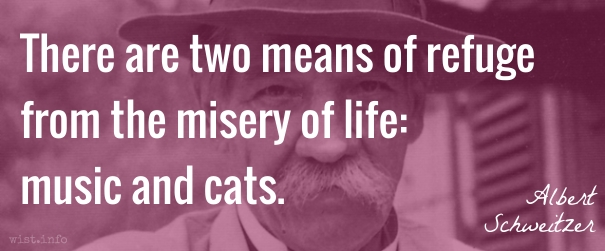
There are two means of refuge from the misery of life: music and cats.
[Zweierlei eignet sich als Zuflucht vor den Widrigkeiten des Lebens: Musik und Katzen.]
Albert Schweitzer (1875–1965) Alsatian philosopher, physician, philanthropist, polymath
(Attributed)
Widely attributed to Schweitzer, but no original source found.
That the house of every one is to him as his Castle and Fortress as well for defence against injury and violence, as for his repose; and although the life of man is precious and favoured in law; so that although a man kill another in his defence, or kill one per infortuntun [by misfortune], without any intent, yet it is felony, and in such case he shall forfeit his goods and chattels, for the great regard which the law hath of a mans life; But if theeves come to a mans house to rob him, or murder, and the owner or his servants kill any of the theeves in defence of himself and his house, it is no felony, and he shall lose nothing, and therewith agreeth 3 Edw. 3. Coron. 303, & 305. & 26 Ass. pl. 23. So it is holden in 21 Hen. 7. 39. every one may assemble his friends or neighbours to defend his house against violence: But he cannot assemble them to goe with him to the Market or elsewhere to keep him from violence: And the reason of all the same is, because domus sua cuique est tutissimum refugium [everyone’s house is his safest refuge; every man’s home is his castle].
Edward Coke (1552–1634) English jurist, politician
Semayne’s Case, 5 Rep. 91 (1604)
(Source)
Published in Coke's Reports, Part 5 (1605), describing the case as (1604) Michaelmas Term, 2 James 1 In the Court of King’s Bench. This principle was further established as common law by Coke in The Institutes of the Laws of England, Part 3, ch. 73 (1628):For a man’s house is his castle, et domus sua cuique est tutissimum refugium [and each man’s home is his safest refuge]; for where shall a man be safe, if it be not in his house?
For more on the earlier history of the phrase, see An Englishman's Home Is His Castle - Meaning & Origin Of The Phrase.
