KING RICHARD: For within the hollow crown
That rounds the mortal temples of a king
Keeps Death his court, and there the antic sits,
Scoffing his state and grinning at his pomp,
Allowing him a breath, a little scene,
To monarchize, be feared, and kill with looks,
Infusing him with self and vain conceit,
As if this flesh which walls about our life
Were brass impregnable; and humored thus,
Comes at the last and with a little pin
Bores through his castle wall, and farewell, king!William Shakespeare (1564–1616) English dramatist and poet
Richard II, Act 3, sc. 2, l. 165ff (3.2.165-175) (1595)
(Source)
Quotations about:
dust
Note not all quotations have been tagged, so Search may find additional quotes on this topic.

Last night I smote the winecup on a stone;
For such mad folly how may I atone?
The shatter’d cup, in mystic language, said,
“I was like thee, my fate shall be thine own.”
Omar Khayyám (1048–1123) Persian poet, mathematician, philosopher, astronomer [عمر خیام]
Rubáiyát [رباعیات], Bod. # 146 [tr. Talbot (1908)]
(Source)
Alternate translations:Last night I dashed my clay cup on the stone,
And at the reckless freak my heart was glad,
When with a voice for the moment out spake the cup,
"I was once as thou and thou shalt be as I!"
[tr. Cowell (1858), # 29]Last eve I broke against a stone an earthen cup, drunk in the doing of the foolish deed. Methought the cup protested unto me "I was like thee, thou wilt be like to me."
[tr. McCarthy (1879), # 395]Last night I dashed my cup against a stone.
In a mad drunken freak, as I must own,
And lo! the cup cries out in agony,
"You too, like me, shall soon be overthrown."
[tr. Whinfield (1883), # 446]I smote the glass wine cup upon a stone last night,
my head was turned that I did so base a thing;
the cup said to me in mystic language,
"I was like thee, and thou also wilt be like me."
[tr. Heron-Allen (1898), # 146]Last night the cup I dashed against a stone.
Base was the act, my head with wine was flown.
The cup cried out to me in mystic tone,
"I was like thee, my case will be thine own."
[tr. Thompson (1906), # 554]Against the stone, last night, I flung the wine-bowl of
faience. I was drunk when I did that brutal action.
The bowl said to me in the language of bowls: "I was
what thou art, thou also shall be what I am."
[tr. Christensen (1927), # 36]Yesterday I knocked my earthenware wine-jug against a stone.
I must have been inebriated to have committed such an offence.
It seemed as if the jug thus spoke to me:
"I have been as thou and thou wilt be as I".
[tr. Rosen (1928), # 299]In frolic once on stone I dashed a pot,
Alas! such wanton freaks come from a sot;
The pot then told me as if in a trance:
"Like thee I was, like me now find thy lot."
[tr. Tirtha (1941), # 5.31]When foolishly I dashed my bowl against a stone,
It answered sadly in a voice how like my own:
"I once was proudly filled with wine as full as thou:
So, broken in the dust, thou'lt lie as I do now."
[tr. Bowen (1976), # 34]Last night I dashed (my) pottery bowl against the stones; I was intoxicated, when I committed this folly. It was as if the bowl spoke to me, "I was even such a one as thou, and thou too shalt (someday) be even as I."
[tr. Bowen (1976), # 34, literal]

Yet new moons swift replace the seasons spent;
But when we forth are thrust,
Where old Aeneas, Tullus, Ancus went,
Shadow are we and dust.
[Damna tamen celeres reparant caelestia lunae:
nos ubi decidimus
quo pius Aeneas, quo dives Tullus et Ancus,
pulvis et umbra sumus.]Horace (65–8 BC) Roman poet, satirist, soldier, politician [Quintus Horatius Flaccus]
Odes [Carmina], Book 4, # 7, l. 13ff (4.7.13-16) (23 BC) [tr. Marshall (1908)]
(Source)
"To Torquatus." (Source (Latin)). Alternate translations:But the decays of time, Time doth repair:
When we once plunged are
Where good Aeneas, with rich Ancus wades,
Ashes we are, and shades.
[tr. Fanshawe; ed. Brome (1666)]When we shall view the gloomy Stygian Shore,
And walk amongst the mighty Dead
Where Tullus, where Aeneas went before:
We shall be Dust, and empty shade.
[tr. Creech (1684)]Yet the swift moons repair Heaven's detriment:
We, soon as thrust
Where good Aeneas, Tullus, Ancus went,
What are we? dust.
[tr. Conington (1872)]Nevertheless the quick-revolving moons repair their wanings in the skies; but when we descend [to those regions] where pious Æneas, where Tullus and the wealthy Ancus [have gone before us], we become dust and a mere shade.
[tr. Smart/Buckley (1853)]But moons revolve, and all again is bright:
We, when we fall, as fell the good and just
Æneas, wealthy Tullus, Ancus wight,
Are but a nameless shade, and some poor grains of dust.
[tr. Martin (1864)]But the swift moons restore change and loss in the heavens,
When we go where have gone
Sire Æneas, and Tullus, and opulent Ancus,
We are dust and a shade.
[tr. Bulwer-Lytton (1870)]The swiftly-revolving Months however restore the gifts of the Seasons but we, when we have descended where good Æneas, wealthy Tullus, and Ancus, have gone, are dust and shadow.
[tr. Elgood (1893)]The hastening moons all waste in heaven repair:
We, when we once descend
To Tullus, Ancus, sire Aeneas, there
In dust and shadow end.
[tr. Gladstone (1894)]Yet the revolving Moons repair the losses of heaven;
But we, when once we have gone
Where pious Æneas, rich Tullus, and Ancus, have vanish'd,
Lo! dust and ashes are we!
[tr. Phelps (1897)]Still, rapid moving moons repair the heavenly losses:
We, when we fall
Whither the good Æneas fell, Tullus and Ancus rich,
Are dust and shadow.
[tr. Garnsey (1907)]Yet the swiftly changing moons repair their losses in the sky. We, when we have descended whither righteous Aeneas, whither rich Tullus and Ancus have gone, are but dust and shadow.
[tr. Bennett (Loeb) (1912)]Yet, fast as moons wane in the sky, as fast
They wax; but we, poor mortals, when we fare
Whither Aeneas, Tullus, Ancus passed,
Are naught but dust here, naught but shadows there.
[tr. Mills (1924)]Moons make speed to repair their heavenly losses, but not so
We, who, when once we have gone
Downwards to join rich Tullus and Ancus and father Aeneas,
Crumble to shadow and dust.
[tr. Michie (1963)]Whatever the skies lose, quick-running
Months repair -- but men, good Aeneas
Or rich Tullus or Ancus king of Rome,
Die and turn to shadows, to dust.
[tr. Raffel (1983)]Yet after a time, and time and time again,
The moon restores itself in the nighttime sky.
But when it's time for us to go down there
Where Aeneas went, the pious, and Tullus the rich,
And old King Ancus Martius, and all the others,
Then we're nothing but dust, we're nothing but shadows.
[tr. Ferry (1997)]And yet the swiftly phasing moons repair their celestial mishaps. While we, once descended where dwells pious Aeneas and wealthy Tullus and Ancus, dust and shadow are.
[tr. Alexander (1999)]Yet swift moons are always repairing celestial losses:
while, when we have descended
to virtuous Aeneas, to rich Tullus and Ancus, our kings,
we’re only dust and shadow.
[tr. Kline (2015)]
Ah, make the most of what we yet may spend,
Before we too into the Dust Descend;
Dust into Dust, and under Dust, to lie,
Sans Wine, sans Song, sans Singer and — sans End!
Omar Khayyám (1048–1123) Persian poet, mathematician, philosopher, astronomer [عمر خیام]
Rubáiyát [رباعیات], Bod. # 129 [tr. FitzGerald (1859), # 23]
(Source)
FitzGerald used the same translation for all his editions, though the number changed -- #23 in the 1st, #26 in the 2nd, and #24 in the 3rd, 4th, and 5th. editions.
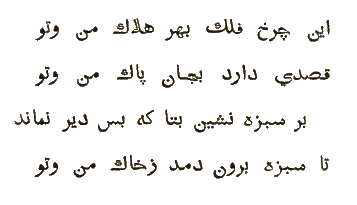
Other translations:Yon rolling heaven for our destruction, yours and mine,
Aims its stroke at our lives, yours and mine;
Come, live, sit on the grass - it will not be long
Ere grass grows out of our dust, yours and mine.
[tr. Cowell (1858), # 3]This wheel of heaven seeks my destruction and thine, it plots against my soul and thine. Come, seat thyself upon the grass, for in a little while fresh grass will spring from this dust of mine and thine.
[tr. McCarthy (1879), # 358]The wheel of heaven still holds his set design
To take away thy life, O love and mine,
Sit we on this green turf, 'twill not be long
Ere turf will hide my dust along with thine
[tr. Whinfield (1882), # 205]O Love, for ever doth heaven's wheel design
To take away thy precious life, and mine;
Sit we upon this turf, 't will not be long
Ere turf shall grow upon my dust, and thine!
[tr. Whinfield (1883), # 390]The "wheel of heaven" in its Fatal Play
Will soon our Breath of Being steal away, --
Come rest thee on this bank, for from our dust
Will spring the Vedure at no distant day.
[tr. Garner (1887), 3.3]The wheel of Heaven thy death and mine is bringing, friend!
Over our lives the cloud of doom 't is flinging, friend!
Come, sit upon this turf, for little time is left
Ere fresher turf shall from our dust be springing, friend!
[tr. M. K. (1888)]Beautiful wheel of blue above my head,
Will you be turning still when I am dead?
Were you still turning long before I came? --
O bitter thought to take with me to bed.
[tr. Le Gallienne (1897), # 54]The heavenly vault, for the sake of my destruction and thine,
wages war upon my pure sole and thine;
Sit upon the green sward, O my Idol! for it will not be long
ere that green sward shall grow from my dust and thine.
[tr. Heron-Allen (1898), # 129]Against our dear lives holding its design,
This wheel of Heaven doth plot thy death and mine;
Come sit upon this grass, 'twill not be long
Ere verdure springs up from my dust and thine.
[tr. Thompson (1906), # 442]The Heavens, that they may destroy us both,
On our pure souls to war are nothing loth;
Sit down, my Idol, on the grass, for soon
My dust and thine shall aid its vernal growth.
[tr. Talbot (1908), # 129]This wheel of Heaven, for the sake of my destruction
and thine, has designs upon my pure soul and thine.
Sit down on the grass, o idol, for it will not be long
ere grass shall spring from my dust and thine.
[tr. Christensen (1927), # 35]This Wheel of the Spheres revolves for your annihilation and for mine,
It has evil intentions on your pure soul and on mine.
Rest on the meadow, my Iove, for not much time will pass.
Until grass springs from your dust and from mine.
[tr. Rosen (1928), # 262]This Wheel of time effaces me and thee,
To slaughter us it chases me and thee;
Sit on the lawn and love, for time arrives
When lawn would hide our traces, me and thee.
[tr. Tirtha (1941), # 2.53]Allow no shadow of regret to cloud you,
No absurd grief to overcast your days.
Never renounce love-songs, or lawns, or kisses
Until your clay lies mixed with elder clay.
[tr. Graves & Ali-Shah (1967), # 24]This wheel of heaven, in order to destroy me and thee, has fell purpose against my innocent soul and thine: sit on the grass, and drink wine, and be happy, for this grass shall spring from my dust and thine.
[tr. Bowen (1976), # 14]The wheel of Fate is crooked. It destroys
Such innocent young souls as yours and mine:
So, joyously, sit down upon the grass
And while away this hour in drinking wine.
Alas! the herbage which delights our eyes,
On which you now recline your lovely head,
Is rooted in the dust of loves -- and
Will spring from ours one day when we are dead.
[alt. tr. Bowen (1976), # 14]Don’t permit sorrow to be your friend
Sadness and pain become your trend
Don’t let the book or the farm you tend
Rule your life before to earth you descend.
[tr. Shahriari (1998), literal]Before to dust you shall return
There is one thing that you must learn
Sorrow and pain your soul shall burn
Joy and bliss to light shall turn.
[tr. Shahriari (1998), figurative]
If you are looking after happiness don’t take the turnpike, take one ov the byroads, yu will avoid the tollgates, and find it less crowded and dursty.
[If you are looking after happiness, don’t take the turnpike, take one of the byroads; you will avoid the tollgates, and find it less crowded and dusty.]
Josh Billings (1818–1885) American humorist, aphorist [pseud. of Henry Wheeler Shaw]
Everybody’s Friend, Or; Josh Billing’s Encyclopedia and Proverbial Philosophy of Wit and Humor, ch. 132 “Affurisms: Chips” (1874)
(Source)

And earth who herself bestowed the body takes it back and wastes not a whit.
[Terram corpus quae dederit, ipsam capere neque dispendi facere hilum.]
Ennius (239–169 BC) Roman poet, writer [Quintus Ennius]
Fragment from the Annales Book 1, frag. 11-12 [tr. Warmingham (1935)]
(Source)
In Varro, De Lingua Latina, Book 5, sec 60, ll. 4-5 (1st C BC). In some locations, the Latin is given as "terraque corpus quae dedit ipsa capit neque dispendi facit hilum."
Other translations:The body she's given Earth does herself take back, and of loss not a whit does she suffer.
[tr. Kent (1938)]Earth herself takes back the body which she gave, and permits no loss whatsoever.
[Source (2013)]
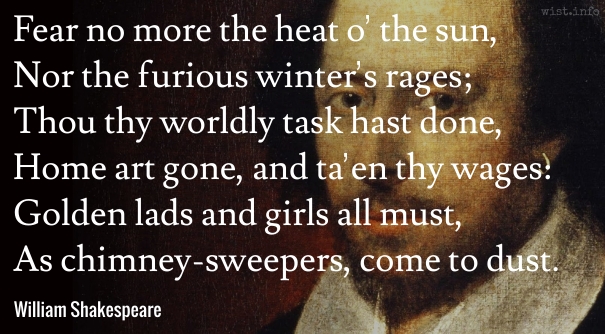
GUIDERIUS: Fear no more the heat o’ the sun,
Nor the furious winter’s rages;
Thou thy worldly task hast done,
Home art gone, and ta’en thy wages:
Golden lads and girls all must,
As chimney-sweepers, come to dust.
William Shakespeare (1564–1616) English dramatist and poet
Cymbeline, Act 3, sc. 2, l. 331ff (3.2.331-336) (1611)
(Source)