Extreme obedience assumes ignorance in the one who obeys; it assumes ignorance even in the one who commands; he does not have to deliberate, to doubt, or to reason; he has only to want.
[L’extrême obéissance suppose de l’ignorance dans celui qui obéit; elle en suppose même dans celui qui commande: il n’a point à délibérer, à douter, ni à raisonner; il n’a qu’à vouloir.]
Charles-Lewis de Secondat, Baron de Montesquieu (1689–1755) French political philosopher
Spirit of Laws [The Spirit of the Laws; De l’esprit des lois], Book 4, ch. 3 (4.3) (1748) [tr. Cohler/Miller/Stone (1989)]
(Source)
(Source (French)). Other translations:Excessive obedience supposes ignorance in the person that obeys: the same it supposes in him that commands; for he has no occasion to deliberate, to doubt, to reason; he has only to will.
[tr. Nugent (1750)]Extreme obedience assumes ignorance in him who obeys; it assumes ignorance even in him who commands: he has no need to deliberate, to doubt, or to reason, he has only to will.
[tr. Stewart (2018)
Quotations about:
autocrat
Note not all quotations have been tagged, so Search may find additional quotes on this topic.
KING RICHARD: For within the hollow crown
That rounds the mortal temples of a king
Keeps Death his court, and there the antic sits,
Scoffing his state and grinning at his pomp,
Allowing him a breath, a little scene,
To monarchize, be feared, and kill with looks,
Infusing him with self and vain conceit,
As if this flesh which walls about our life
Were brass impregnable; and humored thus,
Comes at the last and with a little pin
Bores through his castle wall, and farewell, king!William Shakespeare (1564–1616) English dramatist and poet
Richard II, Act 3, sc. 2, l. 165ff (3.2.165-175) (1595)
(Source)
KING RICHARD: For God’s sake, let us sit upon the ground
And tell sad stories of the death of kings —
How some have been deposed, some slain in war,
Some haunted by the ghosts they have deposed,
Some poisoned by their wives, some sleeping killed,
All murdered.William Shakespeare (1564–1616) English dramatist and poet
Richard II, Act 3, sc. 2, l. 160ff (3.2.160-165) (1595)
(Source)
Is it unreasonable, then, to expect that some man possessed of the loftiest genius, coupled with ambition sufficient to push it to its utmost stretch, will at some time spring up among us? And when such an one does, it will require the people to be united with each other, attached to the government and laws, and generally intelligent, to successfully frustrate his designs.
Distinction will be his paramount object, and although he would as willingly, perhaps more so, acquire it by doing good as harm, yet, that opportunity being past, and nothing left to be done in the way of building up, he would set boldly to the task of pulling down.Abraham Lincoln (1809–1865) American lawyer, politician, US President (1861–65)
Speech (1838-01-27), “The Perpetuation of Our Political Institutions,” Young Men’s Lyceum, Springfield, Illinois
(Source)
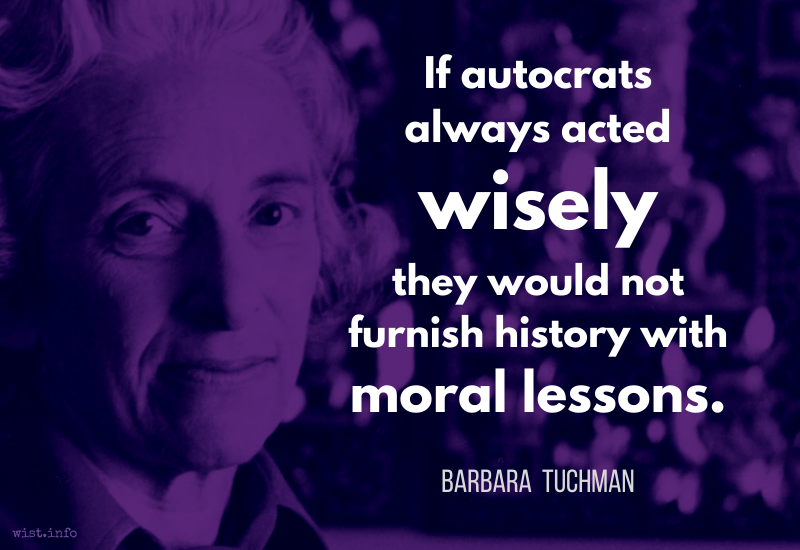
This was unwise, but if autocrats always acted wisely they would not furnish history with moral lessons.
Barbara W. Tuchman (1912–1989) American historian and author
A Distant Mirror, ch. 21 “The Fiction Cracks” (1978)
(Source)
On young King Richard II's giving substantial offices and lands to his friend and mentor, the Earl of Oxford, in so doing making an enemy of the Duke of Gloucester.
Power is always gradually stealing away from the many to the few because the few are more vigilant and consistent; it still contracts to a smaller number, till in time it centres in a single person.
Thus all the forms of governments instituted among mankind, perpetually tend towards monarchy; and power, however diffused through the whole community is, by negligence or corruption, commotion or distress, reposed at last in the chief magistrate.Samuel Johnson (1709–1784) English writer, lexicographer, critic
Essay (1753-04-10), The Adventurer, No. 45
(Source)