I don’t want to die, but I don’t worry about being dead.
[Emori nolo, sed me esse mortuum nihil æstimo.]
Epicharmus of Kos (c. 540 – c. 450 BC) Greek dramatist and philosopher
Fragment 230 K-A = B 11 DK [tr. Douglas (1985)]
(Source)
Frag. 230, also identified as frag. 247. Recorded only in Cicero, Tusculan Disputations [Tusculanae Disputationes], 1.8/1.15 (45 BC), and sometimes attributed directly to him. Cicero's Marcus explicitly chooses to quote it in Latin, and no full Greek version has been preserved, so the original Greek is unknown. It is thought to be from one of Epicharmus' comedies.
In turn, Cicero's rendition is quoted in Montaigne, Essays, 2.13 "On Judging the Death of Another" (1580). Most of the translations below are from translators of Cicero or Montaigne.
See Kollwitz.
(Source (Latin)). Alternate translations:I would not die too soone,
But care not, when tis doone.
[tr. Florio (1603)]I doe not feare death but the paine of death, which goeth before it.
[tr. Hoddesdon (1606)]I would not die, but care not to be dead.
[tr. Browne (1642)]To dye I'me loth, but weigh not to be dead.
[tr. Wase (1643)]I would not die, but yet
Am not concerned that I shall be dead.
[tr. Main (1824)]To quit the scene of life I am right loath;
Once fairly dead, I set it all at nought.
[tr. Otis (1839)]I would not die, but yet
Am not concerned that I shall be dead.
[tr. Yonge (1853)]I have no mind to die, but I have no objection to be dead.
[tr. Cotton/Hazlitt (1877)]I am unwilling to die, but I care not if I were dead.
[Source (1877)]I dread to die, but dread not being dead.
[tr. Peabody (1886)]I do not wish to die, but I care not if I were dead.
[Source (1886)]Verily I shrink from dying; little reck of being dead.
[tr. Black (1889)]I am unwilling to die, but I value myself as nothing when dead.
[tr. Taylor/Hunt (1916)]I do not wish to die; but to be dead, I make no account of.
[tr. Ives (1925)]It is not death, but dying, that I fear.
[tr. Frame (1943)]I think nothing of being dead: it is the dying that I dislike.
[tr. Screech (1987)]I have no desire to die, but I count my death as nothing.
[tr. Habinek (1996)]I don't want to die but being dead doesn't worry me at all.
[tr. Davie (2017)]I don't want to die; but being dead — I don't mind that!
[Source]
Quotations about:
rest in peace
Note not all quotations have been tagged, so Search may find additional quotes on this topic.

Life is a shadowy, strange, and winding road on which we travel for a little way — a few short steps — just from the cradle, with its lullaby of love, to the low and quiet way-side inn, where all at last must sleep, and where the only salutation is — Good-night.
Death is an equall doome
To good and bad, the common Inne of rest.Edmund Spenser (c. 1552–1599) English poet
The Faerie Queene, Book 2, Canto 1, st. 59 (1589-96)
(Source)

Death! to the happy thou art terrible;
But how the wretched love to think of thee,
Oh thou true comforter, the friend of all
Who have no friend beside!Robert Southey (1774–1843) English Romantic poet, Poet Laureate
Joan of Arc, Book 1, l. 318ff (1840 ed.)
(Source)
These lines are from the final version (1840) Southey published, the work having gone through substantial rewriting multiple times, as his reputation, talent, and politics evolved. The lines are not in the first (1796) edition as published. In the 1798 edition, we find:Bitter art thou to him that lives in rest,
O Death! and grievous in the hour of joy
The thought of thy cold dwelling; but thou comest
Most welcome to the wretched; a best friend
To him that wanteth one; a comforter.
For the grave is peace.

HORATIO: Now cracks a noble heart. Good night, sweet prince,
And flights of angels sing thee to thy rest.
William Shakespeare (1564–1616) English dramatist and poet
Hamlet, Act 5, sc. 2, l. 396ff (5.2.396-397) (c. 1600)
(Source)
After Hamlet's death words.


CALISTA: That I must die! it is my only Comfort;
Death is the Privilege of human Nature,
And Life without it were not worth our taking;
Thither the Poor, the Pris’ner, and the Mourner,
Fly for Relief, and lay their Burthens down.Nicholas Rowe (1674–1718) English poet and dramatist
The Fair Penitent, Act 5, sc. 1, l. 137ff (1703)
(Source)

OBLIVION, n. The state or condition in which the wicked cease from struggling and the dreary are at rest. Fame’s eternal dumping ground. Cold storage for high hopes. A place where ambitious authors meet their works without pride and their betters without envy. A dormitory without an alarm clock.
Ambrose Bierce (1842–1914?) American writer and journalist
“Oblivion,” The Devil’s Dictionary (1911)
(Source)
Originally published in the "Cynic's Word Book" column in the New York American (1904-09-27), and the "Cynic's Dictionary" column in the San Francisco Examiner (1903-10-28).

But if, in addition, you would like an unphilosophical rule which appeals to the heart, nothing will make you more cheerful in the face of death than to consider the things from which you are about to be parted, and the sort of characters with whom your soul will no longer be entangled.
[Εἰ δὲ καὶ ἰδιωτικὸν παράπηγμα ἁψικάρδιον θέλεις, μάλιστά σε εὔκολον πρὸς τὸν θάνατον ποιήσει ἡ ἐπίστασις ἡ ἐπὶ τὰ ὑποκείμενα, ὧν μέλλεις ἀφίστασθαι, καὶ μεθ̓ ἠθῶν οὐκέτι ἔσται ἡ … ἐμπεφυρμένη.]
Marcus Aurelius (AD 121–180) Roman emperor (161–180), Stoic philosopher
Meditations [To Himself; Τὰ εἰς ἑαυτόν], Book 9, ch. 3 (9.3) (AD 161-180) [tr. Hard (1997 ed.)]
(Source)
Hard gives the same translation in their 2011 edition.(Source (Greek)). Alternate translations:But thou desirest a more popular, and though not so direct and philosophical, yet a very powerful and penetrative recipe against the fear of death, nothing can make they more willing to part with thy life, than if thou shalt consider, both what the subjects themselves are that thou shalt part with, and what manner of disposition thou shalt no more have to do with.
[tr. Casaubon (1634)]But if you stand in need of a Vulgar Remedy, and want a Cordial to make Dying go down the better, you shall have it. Consider then what sort of World, and what sort of Humours, you will be Rid of!
[tr. Collier (1701)]If you want also a popular support, here is one which goes to the heart: you will be extremely easy with regard to death, if you consider the objects you are going to leave; and the manners of that confused croud from which you are to be disengaged.
[tr. Hutcheson/Moor (1742)]But (if you would have a popular remedy, yet what may prove a cordial, against the fear of death) it will greatly contribute to this end, if you consider what sort of world you are to leave, and with what sort of characters you will no longer be conversant.
[tr. Graves (1792)]But if thou requirest also a vulgar kind of comfort which shall reach thy heart, thou wilt be made best reconciled to death by observing the objects from which thou art going to be removed, and the morals of those with whom thy soul will no longer be mingled.
[tr. Long (1862)]But if you stand in need of a vulgar remedy to soothe the mind, consider, then, what sort of world and what sort of customs you will be rid of!
[tr. Collier/Zimmern (1887)]If your heart asks for some simple and effective reassurance, the best solace against death is correct appreciation of the material things from which you are to part, and of the moral natures with which your soul will then cease to intermingle.
[tr. Rendall (1898)]If you wish for the common sort of comfort, here is a thought which goes to the heart. You will be completely resigned to death if you consider the things you are about to leave, and the morals of that confused crowd from which your soul is to be disengaged.
[tr. Hutcheson/Chrystal (1902)]But if thou desirest a commonplace solace too that will appeal to the heart, nothing will enable thee to meet death with equanimity better than to observe the environment thou art leaving and the sort of characters with whom thy soul shall no longer be mixed up.
[tr. Haines (Loeb) (1916)]And if you would have an everyday rule to touch your heart, it will make you most contented with death to dwell upon the objects from which you are about to be parted and the kind of characters with whom your soul will be no longer contaminated.
[tr. Farquharson (1944)]But if your heart would have comfort of a simpler sort, then there is no better solace in the face of death than to think on the nature of the surroundings you are leaving, and the characters you will no longer have to mix with.
[tr. Staniforth (1964)]Or perhaps you need some tidy aphorism to tuck away in the back of your mind. Well, consider two things that should reconcile you to death: the nature of the things you’ll leave behind you, and the kind of people you’ll no longer be mixed up with.
[tr. Hays (2003)]If you want another criterion — unscientific but emotionally effective — you will find it quite easy to face death if you stop to consider the business you will be leaving and the sort of characters which will no longer contaminate your soul.
[tr. Hammond (2006)]If you want a private passage at hand to soothe your heart, the knowledge of the world around you will give you some solace at death, the world you leave and the kind of people your soul will no longer be associated with.
[tr. @sentantiq (2017)]If a person waiting for death should require some vulgar comfort, they can be more reconciled to death by remembering the evils from which they will be removed, and the morals of those they will no longer have to live with.
[tr. McNeill (2019)]

So far as we can see, both horror and pain are necessary to the continuance of life on this planet, and it is therefore open to pessimists like Swift to say: “If horror and pain must always be with us, how can life be significantly improved?” His attitude is in effect the Christian attitude, minus the bribe of a “next world” — which, however, probably has less hold upon the minds of believers than the conviction that this world is a vale of tears and the grave is a place of rest.
George Orwell (1903–1950) English journalist, essayist, writer [pseud. of Eric Arthur Blair]
Essay (1946-09), “Politics vs. Literature: An Examination of Gulliver’s Travels,” Polemic, No. 5
(Source)

Death must be so beautiful. To lie in the soft brown earth, with the grasses waving above one’s head, and listen to silence. To have no yesterday, and no to-morrow. To forget time, to forget life, to be at peace.
Oscar Wilde (1854–1900) Irish poet, wit, dramatist
The Canterville Ghost, ch. 5 [The Ghost] (1887)
(Source)

When Life is woe,
And Hope is dumb,
The World says, “Go!”
The Grave says, “Come!”
Life’s race well run,
Life’s work well done,
Life’s crown well won,
Now comes rest.Edward H. Parker (1823–1896) American physician, poet
Epitaph of President James Garfield (1881)
(Source)
The phrase was engraved on a tablet placed at the head of his coffin while he lay in state at Cleveland's Memorial Park.
The passage was selected by a committee without a clear source of the material, but it appears to be a loose transcription of the first stanza of a poem Parker wrote for his mother-in-law's funeral:Life's race well run,
Life's work all done,
Life's victory won,
Now cometh rest.
The differences may be because the Garfield epitaph was back-translated from a Latin translation of Parker's original.
Much more discussion here.
From rest and sleepe, which but thy pictures bee,
Much pleasure, then from thee, much more must flow.John Donne (1572–1631) English poet
Holy Sonnets, No. 10, “Death Be Not Proud,” ll. 5-6 (1609)
(Source)

But what is all this fear of and opposition to Oblivion? What is the matter with the soft Darkness, the Dreamless Sleep?
James Thurber (1894–1961) American humorist, cartoonist, writer
In Clifton Fadiman, I Believe: The Personal Philosophies of Twenty-Three Eminent Men and Women of Our Time (1940)
(Source)
Also published in Forum and Century (Jun 1939). Words spoken by Sylvester Blougram, the title character from Robert Browning's "Bishop Blougram's Apology" (1855).
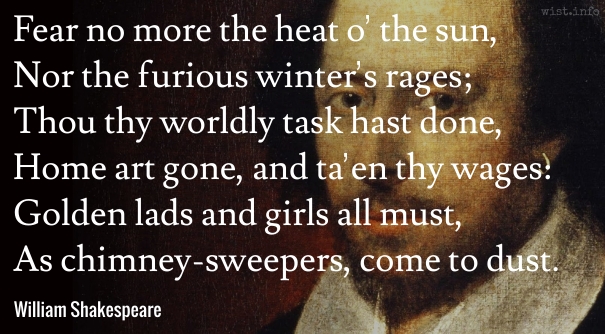
GUIDERIUS: Fear no more the heat o’ the sun,
Nor the furious winter’s rages;
Thou thy worldly task hast done,
Home art gone, and ta’en thy wages:
Golden lads and girls all must,
As chimney-sweepers, come to dust.
William Shakespeare (1564–1616) English dramatist and poet
Cymbeline, Act 3, sc. 2, l. 331ff (3.2.331-336) (1611)
(Source)
Death, the only immortal who treats us all alike, whose pity and whose peace and whose refuge are for all — the soiled and the pure, the rich and the poor, the loved and the unloved.
Mark Twain (1835–1910) American writer [pseud. of Samuel Clemens]
Last written note
(Source)Recorded by A. Paine (his literary executor), Mark Twain: A Biography, Vol III, Part 2, ch. 293 (1912).