HORATIO: Now cracks a noble heart. Good night, sweet prince,
And flights of angels sing thee to thy rest.
William Shakespeare (1564–1616) English dramatist and poet
Hamlet, Act 5, sc. 2, l. 396ff (5.2.396-397) (c. 1600)
(Source)
After Hamlet's death words.
Quotations about:
RIP
Note not all quotations have been tagged, so Search may find additional quotes on this topic.


CALISTA: That I must die! it is my only Comfort;
Death is the Privilege of human Nature,
And Life without it were not worth our taking;
Thither the Poor, the Pris’ner, and the Mourner,
Fly for Relief, and lay their Burthens down.Nicholas Rowe (1674–1718) English poet and dramatist
The Fair Penitent, Act 5, sc. 1, l. 137ff (1703)
(Source)

But if, in addition, you would like an unphilosophical rule which appeals to the heart, nothing will make you more cheerful in the face of death than to consider the things from which you are about to be parted, and the sort of characters with whom your soul will no longer be entangled.
[Εἰ δὲ καὶ ἰδιωτικὸν παράπηγμα ἁψικάρδιον θέλεις, μάλιστά σε εὔκολον πρὸς τὸν θάνατον ποιήσει ἡ ἐπίστασις ἡ ἐπὶ τὰ ὑποκείμενα, ὧν μέλλεις ἀφίστασθαι, καὶ μεθ̓ ἠθῶν οὐκέτι ἔσται ἡ … ἐμπεφυρμένη.]
Marcus Aurelius (AD 121–180) Roman emperor (161–180), Stoic philosopher
Meditations [To Himself; Τὰ εἰς ἑαυτόν], Book 9, ch. 3 (9.3) (AD 161-180) [tr. Hard (1997 ed.)]
(Source)
Hard gives the same translation in their 2011 edition.(Source (Greek)). Alternate translations:But thou desirest a more popular, and though not so direct and philosophical, yet a very powerful and penetrative recipe against the fear of death, nothing can make they more willing to part with thy life, than if thou shalt consider, both what the subjects themselves are that thou shalt part with, and what manner of disposition thou shalt no more have to do with.
[tr. Casaubon (1634)]But if you stand in need of a Vulgar Remedy, and want a Cordial to make Dying go down the better, you shall have it. Consider then what sort of World, and what sort of Humours, you will be Rid of!
[tr. Collier (1701)]If you want also a popular support, here is one which goes to the heart: you will be extremely easy with regard to death, if you consider the objects you are going to leave; and the manners of that confused croud from which you are to be disengaged.
[tr. Hutcheson/Moor (1742)]But (if you would have a popular remedy, yet what may prove a cordial, against the fear of death) it will greatly contribute to this end, if you consider what sort of world you are to leave, and with what sort of characters you will no longer be conversant.
[tr. Graves (1792)]But if thou requirest also a vulgar kind of comfort which shall reach thy heart, thou wilt be made best reconciled to death by observing the objects from which thou art going to be removed, and the morals of those with whom thy soul will no longer be mingled.
[tr. Long (1862)]But if you stand in need of a vulgar remedy to soothe the mind, consider, then, what sort of world and what sort of customs you will be rid of!
[tr. Collier/Zimmern (1887)]If your heart asks for some simple and effective reassurance, the best solace against death is correct appreciation of the material things from which you are to part, and of the moral natures with which your soul will then cease to intermingle.
[tr. Rendall (1898)]If you wish for the common sort of comfort, here is a thought which goes to the heart. You will be completely resigned to death if you consider the things you are about to leave, and the morals of that confused crowd from which your soul is to be disengaged.
[tr. Hutcheson/Chrystal (1902)]But if thou desirest a commonplace solace too that will appeal to the heart, nothing will enable thee to meet death with equanimity better than to observe the environment thou art leaving and the sort of characters with whom thy soul shall no longer be mixed up.
[tr. Haines (Loeb) (1916)]And if you would have an everyday rule to touch your heart, it will make you most contented with death to dwell upon the objects from which you are about to be parted and the kind of characters with whom your soul will be no longer contaminated.
[tr. Farquharson (1944)]But if your heart would have comfort of a simpler sort, then there is no better solace in the face of death than to think on the nature of the surroundings you are leaving, and the characters you will no longer have to mix with.
[tr. Staniforth (1964)]Or perhaps you need some tidy aphorism to tuck away in the back of your mind. Well, consider two things that should reconcile you to death: the nature of the things you’ll leave behind you, and the kind of people you’ll no longer be mixed up with.
[tr. Hays (2003)]If you want another criterion — unscientific but emotionally effective — you will find it quite easy to face death if you stop to consider the business you will be leaving and the sort of characters which will no longer contaminate your soul.
[tr. Hammond (2006)]If you want a private passage at hand to soothe your heart, the knowledge of the world around you will give you some solace at death, the world you leave and the kind of people your soul will no longer be associated with.
[tr. @sentantiq (2017)]If a person waiting for death should require some vulgar comfort, they can be more reconciled to death by remembering the evils from which they will be removed, and the morals of those they will no longer have to live with.
[tr. McNeill (2019)]

When Life is woe,
And Hope is dumb,
The World says, “Go!”
The Grave says, “Come!”

If you look for rest in this life, how will you attain to everlasting rest? Dispose yourself, then, not for much rest but for great patience.
[Si quæris in hac vita requiem: quomodo tunc pervenies ad æternam requiem? Non ponas te ad multam requiem, sed a magnam patientiam.]Thomas à Kempis (c. 1380–1471) German-Dutch priest, author
The Imitation of Christ [De Imitatione Christi], Book 3, ch. 35, v. 3 (3.35.2) (c. 1418-27) [tr. Croft/Bolton (1940)]
(Source)
(Source (Latin)). Other translations:If thou seek rest in this life, how then shalt thou come to the rest everlasting? Set not thyself to have rest here, but to have patience.
[tr. Whitford/Raynal (1530/1871)]If you seek rest in this life, how will you, then, come to everlasting rest? Do not determine to have rest here, but to have patience.
[tr. Whitford/Gardiner (1530/1955)]If thou seekest rest in this world, how wilt thou then attain to everlasting rest? Give not thy selfe to much ease, but to much patience.
[tr. Page (1639), 3.35.6]If then these are the Conditions of thy Obedience and Reward, think how absurd it, for them who indulge their Ease here, to expect Peace and Happiness hereafter. In one of the two States Enduring must be thy Lot; and therefore tough Patience, and not soft Repose, is what thou should'st labour for at present.
[tr. Stanhope (1696; 1706 ed.), 3.40]If thou seekest rest in this life, how wilt thou attain to the everlasting rest of the life to come? Thou must prepare thy heart for the exercise of many and great troubles, not for the enjoyment of continual rest.
[tr. Payne (1803), 3.27.8]If thou seek rest in this life, how wilt thou then attain to the everlasting Rest? Dispose not thyself for much rest, but for great patience.
[ed. Parker (1841)]It thou seekest rest in this life, how wilt thou attain to the everlasting rest of the life to come? Thou must not merely rest, but prepare thy heart for far greater patience and resignation.
[tr. Dibdin (1851), 3.31.2]If thou seekest rest in this life, how then wilt thou come to the rest everlasting? Dispose not thyself for much rest, but for much patience.
[ed. Bagster (1860)]If thou seek rest in this life, how then wilt thou attain unto the rest which is eternal? Set not thyself to attain much rest, but much patience.
[tr. Benham (1874)]If thou seek rest in this life, how wilt thou then attain to the everlasting rest? Dispose not thyself for much rest, but for great patience.
[tr. Anon. (1901)]If you search after rest in this life, how then will you come through to an everlasting rest? Do not set out for much in the way of rest, but for suffering that costs.
[tr. Daplyn (1952)]If you look for rest in this life, how can you attain eternal rest? Dispose yourself not to rest, but to patient endurance.
[tr. Sherley-Price (1952)]If you try to find rest in this world, how will you ever reach that rest which is life everlasting? It is not long hours of rest you must be prepared for here, but for long hours of patient endurance.
[tr. Knox-Oakley (1959)]If you are looking for rest in this life, how will you ever reach the everlasting rest at the end? It is not rest you must expect, but suffering.
[tr. Knott (1962)]You may seek rest in this life. How then will you gain rest in everlasting life? Do not expect great rest. Expect much suffering instead.
[tr. Rooney (1979)]If you seek rest in this life, how do you expect to come to eternal rest? Do not make frequent rest your goal but great patience.
[tr. Creasy (1989)]

Is not short paine well borne, that brings long ease,
And layes the soule to sleepe in quiet grave?
Sleepe after toyle, port after stormie seas,
Ease after warre, death after life, does greatly please.Edmund Spenser (c. 1552–1599) English poet
The Faerie Queene, Book 1, Canto 9, st. 40 (1589-96)
(Source)

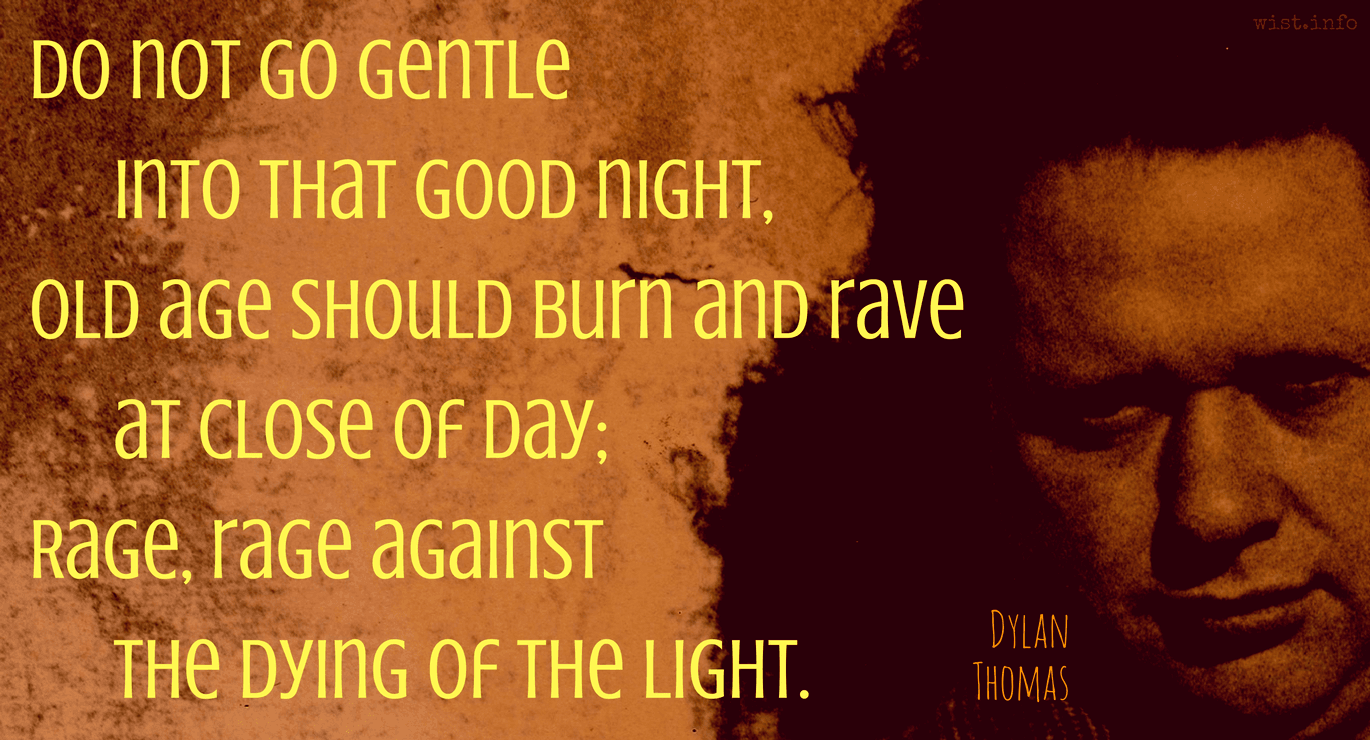
Do not go gentle into that good night,
Old age should burn and rave at close of day;
Rage, rage against the dying of the light.
Dylan Thomas (1914–1953) Welsh poet and writer
“Do Not Go Gentle into That Good Night” (1947)
(Source)
First published in Botteghe Oscure (Nov 1951).